Honey bee diseases in the US: identifying foulbrood, brood diseases, nosema, viruses and hive beetles, and what your state requires
Honey bee diseases in the US: spotting AFB and EFB, the rope test, antibiotics under the VFD rule, nosema, viruses, small hive beetle and state reporting rules.
The honey bee diseases US beekeepers meet most often fall into four groups: brood diseases (American foulbrood, European foulbrood, chalkbrood, sacbrood), adult bee diseases (nosema and paralysis viruses), varroa and the viruses it spreads, and pests such as the small hive beetle. American foulbrood is the one with legal teeth: many states require you to report it and burn or otherwise destroy infected equipment, and since 2017 the antibiotics used against foulbrood need a veterinarian’s order. There is no single national rule, so the first call when you suspect a serious disease is your state apiarist or state department of agriculture.
Behind most colony losses in the US sits one parasite, varroa, which spreads deformed wing virus and other viruses. It has its own guide: varroa mites, testing and treatment.
How do you spot disease during a hive inspection?
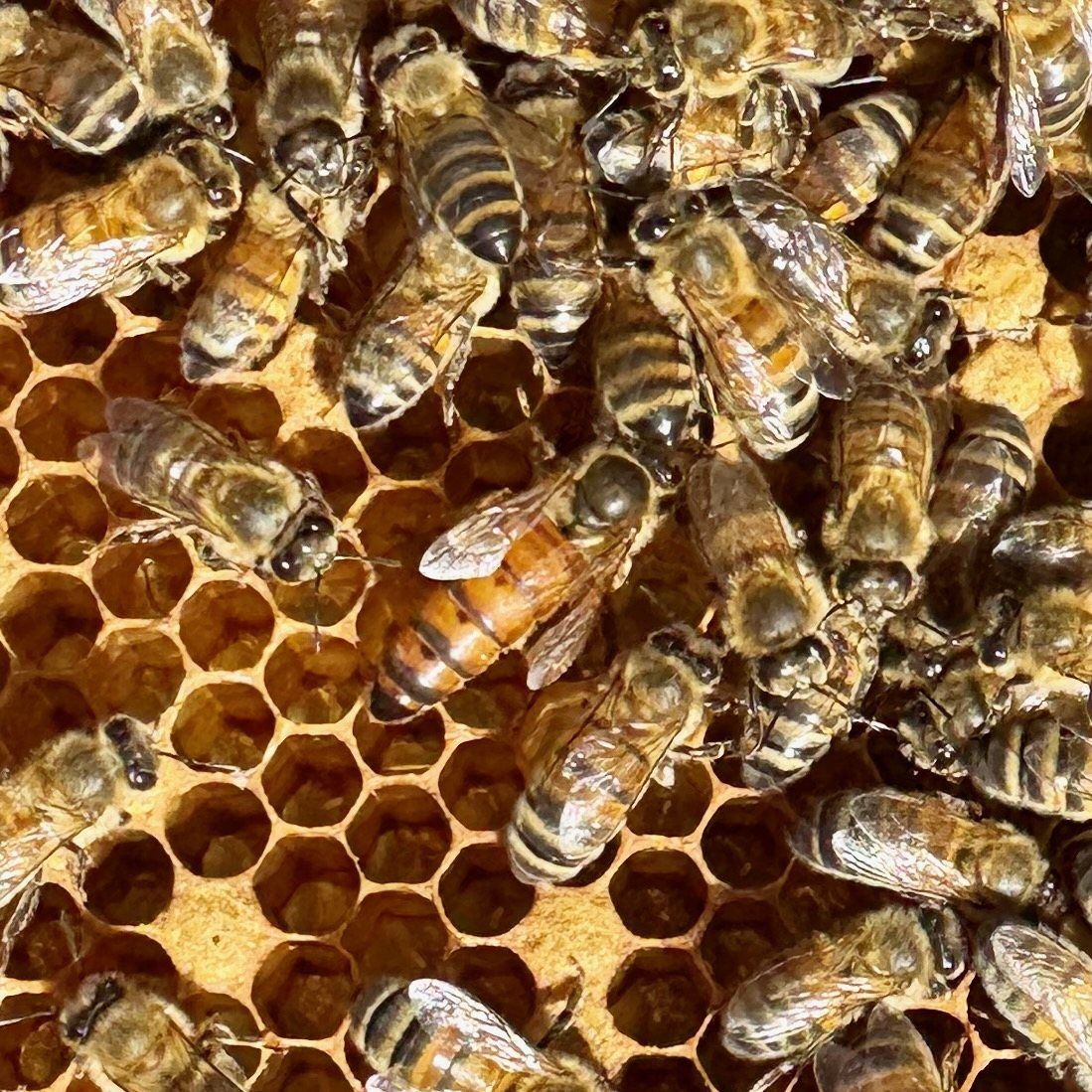
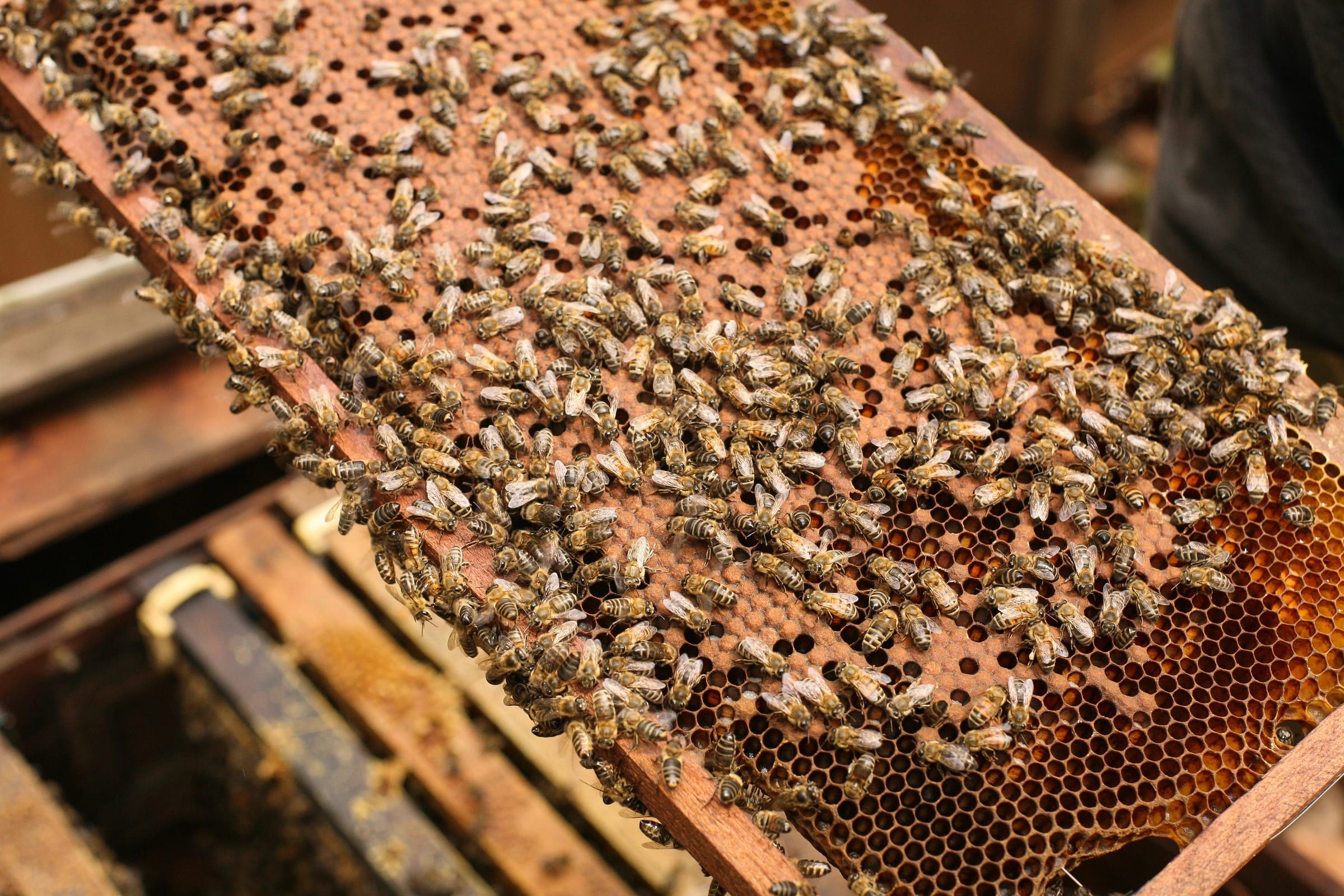
Most diseases show up in the brood first. A healthy frame of capped brood in a Langstroth deep or medium is solid from edge to edge, with slightly domed, tan cappings, and the open brood is made of pearly white larvae curled in a C on the bottom of the cell. Look harder when you see:
- a spotty or “shotgun” brood pattern, with many empty or uncapped cells among capped ones (a failing queen can do this too);
- cappings that are sunken, darker, greasy-looking or have ragged holes chewed in them;
- larvae that are yellowish, gray, brown, twisted, melted or mummified;
- an odd smell when you pull the frame.
At the entrance, warning signs include trembling or crawling bees, black, hairless and shiny bees, bees with crumpled wings, dysentery streaks, piles of dead bees and white chalky mummies on the landing board. To judge what is abnormal, you need the normal development timeline, covered in our page on the honey bee life cycle.
To read brood properly, shake the bees off the frame and hold it with the sun behind you so the light shines into the cells.
Field diagnosis chart
This chart narrows things down. For foulbrood, confirm with a lateral flow kit, your state inspector or a laboratory.
| Disease | Cause | What you see | Field test | When | Usual status |
|---|---|---|---|---|---|
| American foulbrood (AFB) | Spore-forming bacterium Paenibacillus larvae | Sunken, greasy, perforated cappings; coffee-brown remains; dark scale stuck to the lower cell wall | Rope test: about 1 inch (2 to 2.5 cm) | Any brood season | Regulated or reportable in many states |
| European foulbrood (EFB) | Bacterium Melissococcus plutonius | Corkscrew-twisted, yellow to brown, melted larvae; rubbery scale that lifts out easily | No rope | After strong spring flows, during pollination stress | Rarely regulated |
| Chalkbrood | Fungus Ascosphaera apis | Hard white to black mummies | Hard mummy | Cool, damp spring | Not regulated |
| Sacbrood | Sacbrood virus | Larva in a fluid-filled sac, head raised and dark | Lifts out whole | Spring | Not regulated |
| Parasitic mite syndrome | Varroa plus viruses | Spotty brood, chewed cappings, deformed wings | Mite wash | Late summer and fall | Not regulated |
| Nosema | Nosema apis, N. ceranae | Weak buildup, crawling bees, K-wing, dysentery sometimes | Microscope spore count | Late winter, spring, sometimes summer | Not regulated |
| Small hive beetle | Beetle Aethina tumida | Dark beetles running from light; slimy, fermenting comb; masses of larvae | Visual | Warm months, worst in the South | Established; rarely regulated |
| Tropilaelaps | Mites Tropilaelaps spp. | Tiny, fast, orange-brown mites; patchy brood | Lab ID | Brood season | Never found in the US; reportable to APHIS |
American foulbrood: symptoms, rope test and what the law requires
American foulbrood is the most serious bacterial disease of honey bee brood. It is caused by Paenibacillus larvae, which forms spores that, according to the Honey Bee Health Coalition, persist in equipment and honey for decades. Delaware’s state apiarist puts their survival on beekeeping equipment at more than 40 years and notes that each scale can contain millions of spores. Adult bees do not get sick, but they carry spores, and robbing, drifting, used equipment and the beekeeper’s hands and hive tool move them from hive to hive.
Signs of AFB
The Honey Bee Health Coalition foulbrood guide lists:
- capped cells that are perforated, sunken and greasy-looking, sometimes with a caramel-colored liquid;
- late-stage larvae or early pupae that turn coffee-brown to dark brown;
- a dark scale on the lower cell wall that is stuck so tightly it cannot be removed without damaging the comb;
- rarely, a pupal tongue stretched across the cell, which Delaware’s fact sheet describes as unique to AFB;
- a foul odor, though not always. Delaware describes it as “dirty gym socks”.
In old, stored equipment, the dark scale is often the only sign left, which is why used hive bodies and frames from an unknown source are a real risk.
The rope test, step by step
- Choose a capped cell that is sunken, discolored or perforated.
- Push a toothpick, matchstick or twig through the capping to the bottom of the cell.
- Stir the contents.
- Pull it out slowly.
- If the remains stretch into an elastic, coffee-colored thread of about an inch (2 to 2.5 cm), AFB is likely. Probe several cells if the first does not rope.
- Bag the stick, and clean your hive tool before opening another hive. Delaware advises soaking it for 20 minutes in a 10% bleach solution.
A rope test only counts when it is positive. Remains that are too fresh or already dried into scale will not rope. Other options include the Holst milk test, in which infected material clears cloudy diluted skim milk, and commercial lateral flow kits sold by bee supply companies.
What to do when you suspect AFB
- Close the hive and reduce the entrances of every colony in the yard to prevent robbing.
- Move nothing in or out of the apiary.
- Call your state apiarist or apiary inspection program. Delaware, for example, asks beekeepers to contact the State Apiarist immediately for an inspection; suspect samples are then sent to an accredited lab.
- Send a sample for confirmation if your state does not do it for you (see the lab section below).
- Follow your state’s instructions on destruction.
State rules: three examples
State law, not federal law, decides what happens next. Three examples show how much it varies:
- Florida: Rule 5B-54.017 of the Florida Administrative Code says that all colonies found infected with AFB “shall be destroyed by burning or shall be treated using irradiation” within 7 days of a positive diagnosis, and the remaining colonies in the apiary are quarantined for at least 30 days. Florida’s list of regulated honey bee pests contains just AFB and a Tropilaelaps mite, plus the African and Cape honey bee races.
- Delaware: AFB is the only regulated apiary pathogen. Confirmed hives must be burned, incinerated, buried at a certified landfill or gamma-irradiated; plastic hives should be deep-buried rather than burned because of air quality rules. Colonies stay put until the State Apiarist lifts the quarantine, and moving AFB-contaminated equipment across state lines is illegal.
- Texas: AFB, Tropilaelaps and the yellow-legged hornet are reportable, and a beekeeper who suspects one is “legally required to notify Texas Apiary Inspection Service”, which then guides the next steps.
Other states have their own lists, and some have no inspection program at all. Find yours through our guide to beekeeping laws by state.
Destroying an infected colony
Where your state leaves the method to you, the Honey Bee Health Coalition describes the standard approach: kill the adult bees with an insecticide or 70% isopropyl alcohol, then destroy all brood and honey frames. If local ordinances allow open burning, burn wooden equipment in a large pit and bury the ashes. Plastic or polystyrene goes to a landfill, double-bagged. Hive bodies, covers and bottom boards can be scorched and dipped in hot wax for 10 minutes at 320°F (160°C), or sent for gamma irradiation, instead of being burned. Do not use equipment from that yard elsewhere in your operation for a year.
Early in the season, and only where state rules allow, a shook swarm onto new foundation, with syrup and antibiotics, is an option for otherwise strong colonies. Some states do not allow it for AFB, so ask first.
Antibiotics and the veterinary feed directive
Three antibiotics are approved for honey bees in the US: oxytetracycline (Terramycin and generics), tylosin (Tylan) and lincomycin (Lincomix). According to the Honey Bee Health Coalition, all three are labeled for AFB and only oxytetracycline is labeled for EFB. The FDA counts 11 approved applications for bees.
Since January 1, 2017, none of them can be bought over the counter. The FDA’s rules on medically important antimicrobials include honey bees as a minor food-producing animal, so the drugs can only be used “by or on the order of” a licensed veterinarian who has diagnosed the condition within a valid veterinarian-client-patient relationship. Drugs mixed into feed, such as oxytetracycline in sugar or patties, need a veterinary feed directive (VFD); others need a prescription. The FDA requires the veterinarian, client and distributor to keep VFD records for 2 years. A University of Florida entomology blog noted at the time that a VFD covers at most 6 months, while a prescription may last a year.
Finding a vet who works with bees is easier than it was in 2017. In Delaware, the Office of the State Veterinarian issues VFDs to beekeepers at no cost; elsewhere, ask your state apiarist or extension office for a list. Our hive treatment records log has a field for the VFD or prescription next to each treatment.
Three rules from the Honey Bee Health Coalition:
- Antibiotics do not treat AFB. They do not kill spores or save infected larvae; they only slow the spread from adult bees to new larvae and can mask symptoms. Frame destruction is still required.
- Use them as a last resort for EFB, not as routine prevention, because overuse breeds resistance.
- Follow the label exactly: finish the full course even if colonies seem to recover, and respect the honey withdrawal times.
The Coalition adds that you can ask the USDA diagnostic lab for antibiotic sensitivity testing on a foulbrood sample.
European foulbrood: how is it different from AFB?
European foulbrood is caused by Melissococcus plutonius, a bacterium that does not form spores. Larvae usually die before they are capped. The Honey Bee Health Coalition notes that colonies with EFB can recover on their own, which is the big practical difference from AFB.
Signs of EFB
- larvae twisted in a corkscrew shape in the cell, often displaced up the cell wall;
- yellowish, gray or brown larvae, sometimes transparent with the tracheae visible;
- “melty” larvae that have lost their plumpness;
- some sunken or perforated cappings;
- a rubbery scale that lifts out easily;
- no smell, or a mildly sour one.
EFB is often confused with AFB, chalkbrood and parasitic mite syndrome. High varroa counts point to PMS; chalk-like mummies point to chalkbrood. Co-infection with chalkbrood and sacbrood is common.
AFB or EFB?
| Feature | American foulbrood | European foulbrood |
|---|---|---|
| Brood affected | Mostly capped | Mostly uncapped |
| Larva | Flat, stretched along the cell | Twisted, melted, displaced |
| Color | Coffee-brown to dark brown | Yellowish, gray, brown |
| Rope test | Ropes about 1 inch (2 to 2.5 cm) | No rope |
| Scale | Dark, stuck tight | Rubbery, lifts out |
| Spores | Yes, last decades | No |
| Antibiotic labels | Oxytetracycline, tylosin, lincomycin | Oxytetracycline only |
When and where EFB hits
The Coalition guide says EFB is common after a strong honey flow, in late spring in northern states, when brood rearing outruns the nurse bees. Larval disease in late fall is more likely linked to high varroa. Migratory pollination is a known trigger: in a North Central SARE project at Michigan State University, researchers reported that commercial beekeepers across North America see high EFB incidence in colonies used for blueberry pollination, and in their own 2019 Michigan observations, more than half of commercial colonies coming off blueberries were infected. In their small trial, about 75% of antibiotic-treated colonies had recovered at two weeks against about 5% of untreated ones, but by four weeks the difference had gone, and protein patties and probiotics did not help.
Managing EFB
The Honey Bee Health Coalition gives three options:
- Watchful waiting: inspect every brood frame in the yard, note roughly how many diseased cells each hive has, and do nothing more if the disease declines.
- Shook swarm onto new equipment, destroying the brood frames, alone or with antibiotics.
- Antibiotics under a VFD for symptomatic hives and other hives in the yard, since the bacteria are often present in adult bees where disease is visible.
Requeening with hygienic stock is a common complement to any of the three.
Chalkbrood and sacbrood
Chalkbrood
Chalkbrood is caused by the fungus Ascosphaera apis. Larvae eat the spores, the fungus grows through them, and they turn into hard mummies, first white and fluffy, then chalk-white, then gray or black when the fungus produces spores. Workers drag them out, so you find them on the bottom board and in front of the hive. It peaks in cool, damp springs, when colonies cannot keep the edges of the brood nest warm. No product is labeled for chalkbrood. Requeen if it comes back every year, replace old comb, give the hive good ventilation and a sunny, dry site (see where to put a beehive), and avoid giving small colonies more space than they can heat.
Sacbrood
The sacbrood virus kills larvae just after capping. The dead larva lies stretched out with its head raised and darkened, and its skin becomes a sac of fluid that you can lift out whole. There is no rope and no strong smell. It is common in spring and usually clears up in a strong colony; requeening helps if it persists.
Nosema: symptoms, testing and Fumagilin-B
Nosema is a gut infection of adult bees caused by microsporidia, single-celled parasites related to fungi. The Texas Apiary Inspection Service describes two species. Nosema apis was historically the main form in the US, especially in northern states where colonies overwinter. Nosema ceranae, originally from the Asian honey bee, has since become the more common form and can occur in late winter, spring and summer. Both have been reclassified into the genus Vairimorpha, though US labels and labs still say Nosema.
Signs
There is no symptom unique to either species. The Texas service lists weaker, less productive colonies, increased winter loss, more supersedure, bees foraging too young, disoriented or crawling bees in front of the hive and K-wing (wings held apart like the letter K). Dysentery is not a symptom of nosema itself, though the two often go together and fecal spotting spreads spores.
Testing
The reliable method is a spore count: crush a sample of bees, look at the fluid under a compound microscope with a hemocytometer and calculate spores per bee. According to the Texas service, a bee’s midgut can hold 30 to 50 million spores within about two weeks of infection, and up to 200 million in a winter cluster where bees cannot defecate. The most accepted economic threshold is 1 million spores per bee, though it is debated and varies by year. Telling the two species apart needs a PCR test.
Treatment and prevention
Fumagilin-B is labeled for nosema and is currently the only chemical treatment on the market, says the Texas service. Fumagillin is not covered by the 2017 antibiotics rule, so it needs no prescription or VFD. Supply was interrupted in mid-2018 when its former maker, Medivet, closed; it is now made in Canada, where Vita Bee Health supplies it. A 24 g jar is listed at $29.99 at Mann Lake in October 2026. It is mixed into warm syrup for spring or fall feeding and must not be fed just before or during a honey flow; follow the package insert for the dose.
Because spores survive in hive feces for more than a year and contaminated comb is the main source of infection, prevention matters more than the drug:
- replace old brood comb on a regular rotation;
- be careful when moving frames between colonies;
- keep apiaries away from contaminated, shared water sources where possible;
- requeen with more resistant stock;
- winter strong colonies with good stores and enough sun for cleansing flights.
Viruses and parasitic mite syndrome
Honey bees carry many viruses, most of them silently. Varroa changes that by injecting viruses straight into developing bees.
Deformed wing virus and parasitic mite syndrome
Bees infected with deformed wing virus as pupae emerge with crumpled, stunted wings and short abdomens and die quickly. When varroa and viruses build up together, the brood shows parasitic mite syndrome: a spotty pattern, chewed or sunken cappings, dying pupae and larvae that can be mistaken for EFB. A mite wash settles the question.
The scale of the problem became clear in 2025. The USDA Agricultural Research Service reported in June 2025 that commercial beekeepers had lost more than 60% of their colonies in losses reported from January 2025, about 1.7 million colonies, with an estimated impact of $600 million. Samples collected in February 2025 in California and other western states, before almond pollination, showed high levels of deformed wing virus A and B and acute bee paralysis virus in all the bees tested, and virtually all the mites showed signs of resistance to amitraz.
There is no antiviral treatment. The answer is mite control: the Honey Bee Health Coalition’s ninth-edition varroa guide (June 2026) sets the action threshold at 1 mite per 100 bees during dormancy and spring buildup and 2 per 100 at peak population and during the fall decline.
Chronic bee paralysis
Chronic bee paralysis virus causes trembling bees that cannot fly, often hairless, black and greasy-looking, crawling at the entrance or heaped in front of the hive. It spreads by contact and is worse in crowded colonies. Give the colony more room, make sure it has pollen and a laying queen, and move the dead bees away from the entrance.
Disease or pesticides?
Sudden piles of dead bees in front of many hives at once, often with bees twitching or spinning on their backs, close to a crop or mosquito spraying, point to pesticides. EPA asks beekeepers who want an incident investigated to report it to their state pesticide regulatory agency; you can also file through the National Pesticide Information Center’s portal or email [email protected]. Freeze a sample of dead and dying bees and note the date, the time and what was sprayed nearby.
Small hive beetle: the pest of the South
The small hive beetle, Aethina tumida, is native to sub-Saharan Africa. According to the University of Florida’s EDIS fact sheet by James and Amanda Ellis, it was confirmed at a commercial apiary in Florida in 1998, though unidentified specimens suggest it had been present since at least 1996, first around port cities such as Charleston, South Carolina, and Savannah, Georgia. It has since spread across much of the country, and it does most damage in the warm, humid Southeast.
Biology and damage
Adults are about 0.22 inch (5.5 to 5.7 mm) long, dark brown to black, and scurry away from light. Mature larvae are about 0.37 inch (9.5 mm) long. Larvae tunnel through comb, eat brood, pollen and honey, and make the honey ferment and run, which leaves it unfit to eat. When larvae are ready to pupate, they leave the hive and burrow into the soil: most pupate within 3 feet (90 cm) of the hive, and nearly 80% less than 4 inches (10 cm) deep. Egg to adult can take as little as 4 to 6 weeks, and heavily infested colonies, typically with more than 1,000 adult beetles, may abscond.
The UF authors stress that the beetle is increasingly seen as a secondary pest, like wax moths: it overwhelms colonies that are already weak, queenless or sick.
Control
- Keep colonies strong, requeen weak ones, and do not give them more boxes than they can cover.
- Trap adults inside the hive with oil traps, such as the Hood or West traps, baited with cider vinegar and filled with mineral oil.
- Protect the honey house: extract supers quickly, clean up comb bits and cappings, and keep humidity at 50% or less, since beetle eggs dry out below that.
- Treat the soil: GardStar 40% EC (permethrin, EPA Reg. No. 39039-8) is labeled as a soil drench against pupating beetles. The label rate is 0.17 fl oz (5 ml) in 1 gallon (3.8 L) of water, sprinkled with a watering can over an 18 to 24 inch (45 to 60 cm) strip in front of each hive, 1 gallon per 6 hives, in the late evening when bees are inactive. Permethrin is highly toxic to bees, so keep it off the hive itself.
- Use beneficial nematodes (Steinernema riobrave, Heterorhabditis indica) in the soil as a biological option.
- CheckMite+ strips under cardboard on the bottom board are another labeled option for adults; read the label for current restrictions.
Tropilaelaps: the mite that is not here yet
Tropilaelaps mites are brood parasites from Asia, smaller and faster than varroa. They have never been detected in a US hive, and USDA APHIS classes them as a foreign animal disease, immediately reportable under the National List of Reportable Animal Diseases. APHIS’s national honey bee survey, run since 2009 with samples processed at the University of Maryland, has so far verified the absence of Tropilaelaps and of the Asian honey bee, Apis cerana.
If you find a tiny, fast, orange-brown mite you cannot identify, do not let it go. APHIS asks for specimens to be killed and preserved in 70% ethanol, or stored overnight in a freezer at -4°F (-20°C), and sent for laboratory identification. Call your state apiarist the same day.
The yellow-legged hornet, a predator first found in Georgia in 2023, is not a disease, but some states, Texas among them, now list it as reportable: see our page on the yellow-legged hornet.
Where to get a diagnosis
The USDA Beltsville lab
The Bee Disease Diagnosis service at the USDA ARS Bee Research Laboratory in Beltsville, Maryland, accepts samples from beekeepers, bee businesses and regulators in the US and its territories, and there is no charge.
| Sample | What to send | How to pack |
|---|---|---|
| Adult bees | At least 100 dying or freshly dead bees, not decayed | In 70% ethyl, methyl or isopropyl alcohol in a leak-proof container; pour off the excess alcohol before mailing |
| Brood comb | A piece at least 2 x 2 inches (5 x 5 cm) with as much dead or discolored brood as possible, no honey | Wrapped in paper towel, newspaper or a paper bag, in a sturdy cardboard box; no plastic, foil, wax paper, tin or glass |
| No comb available | The toothpick or stick used on a diseased larva | Wrapped in paper, in an envelope |
Add a short description of the problem and your contact details. The lab’s address and contact person are on its web page.
Your state and extension service
Most state apiary programs will look at a suspect colony and can help with sampling. Fees vary: Texas, for example, charges $100 when a small-scale beekeeper requests a health inspection. Land-grant university extension services and bee labs also run beekeeping courses where you can learn to read brood alongside an expert.
How do you prevent honey bee diseases?
Most brood and adult diseases hit colonies that are already weak, stressed or overloaded with mites. AFB spreads through careless movement of honey, comb and equipment. Prevention comes down to biosecurity, comb rotation and regular checks.
Biosecurity, Honey Bee Health Coalition style
- Never feed honey from another operation, store-bought or otherwise.
- Buy packages, nucs and queens from inspected sources; many states require sellers to provide one; Texas asks for a health certificate or a notarized affidavit for queens, packages, colonies and nucs.
- Be wary of used equipment, which can carry AFB spores for decades.
- Keep yards separate and minimize mixing of equipment between them.
- Clean hive tools between yards and after working a sick hive, and disinfect the things you touch often.
- Reduce drifting and robbing with entrance reducers in a dearth and after harvest, and hive layouts that are not long straight rows.
- Replace old brood comb on a regular rotation, starting with the darkest frames.
A disease-check calendar by region
| Region | Key periods |
|---|---|
| Northeast and Midwest | April to June: brood check for EFB, chalkbrood and sacbrood after the spring flow; July to August: mite washes before raising winter bees; February to March: nosema check and deadout autopsies |
| South (Florida to Texas) | Year-round brood and mite checks; small hive beetle pressure from spring through fall; regular AFB checks before moving or selling colonies |
| California and the West | December to January: health checks and certificates before almond pollination; February to March: brood and mite checks after almonds; late summer: mite control |
| Pacific Northwest | Cool, wet springs favor chalkbrood and EFB; check brood closely from April to June |
Whatever your region, look at at least one frame of capped brood against the light at every spring and summer inspection. The full month-by-month workload is in our beekeeping calendar.
Frequently asked questions
Is American foulbrood reportable?
In many states, yes, but it depends on where you keep bees. Delaware lists AFB as its only regulated bee pathogen, Florida requires infected colonies to be burned or irradiated within 7 days of a positive diagnosis, and Texas legally requires beekeepers to notify the Texas Apiary Inspection Service. Call your state apiarist or department of agriculture as soon as you suspect it.
How do I do a rope test for American foulbrood?
Push a toothpick or matchstick into a sunken, discolored capping, stir the contents and pull it out slowly. If the remains stretch out like elastic about an inch (2 to 2.5 cm) before snapping back, AFB is likely, according to the Honey Bee Health Coalition and Delaware's state apiarist. A negative result does not clear the hive, so send a sample for confirmation.
Can I buy Terramycin for my bees without a vet?
No. Since January 1, 2017, oxytetracycline (Terramycin), tylosin (Tylan) and lincomycin (Lincomix) can only be used in honey bees by or on the order of a licensed veterinarian, through a veterinary feed directive or a prescription. Honey bees count as a minor food-producing animal under the FDA rules. Some states help: Delaware's Office of the State Veterinarian issues VFDs to beekeepers at no cost.
Do antibiotics cure American foulbrood?
No. The Honey Bee Health Coalition states that antibiotics do not kill AFB spores or save infected larvae; they only slow the spread from adult bees to new larvae and can mask symptoms. Infected frames still have to be destroyed. Many states require infected colonies and their equipment to be burned, buried or irradiated, so check with your state apiarist before you do anything.
How do I get rid of small hive beetles?
Keep colonies strong and avoid giving weak hives more space than they can patrol. Use in-hive oil traps, extract honey quickly and keep the honey house dry and clean. For heavy pressure, a permethrin soil drench such as GardStar, applied in a strip in front of the hive in the evening, kills larvae pupating in the soil. Follow the EPA label exactly, because permethrin is highly toxic to bees.
What is the best treatment for nosema?
Fumagilin-B is the only chemical treatment labeled for nosema in the US, and it does not need a vet's order. It is mixed into sugar syrup in spring or fall and must not be fed just before or during a honey flow. The Texas Apiary Inspection Service cites 1 million spores per bee as the most accepted threshold, so test before you treat.
Where can I get my bees tested for disease?
The USDA ARS Bee Research Laboratory in Beltsville, Maryland, diagnoses samples from beekeepers in the US and its territories free of charge. Send at least 100 adult bees in alcohol, with the excess poured off, or a piece of brood comb at least 2 by 2 inches wrapped in paper. Your state apiarist or extension office can also help with sampling.
Why are my bees' wings crumpled?
Bees that emerge with shriveled, stunted wings and short abdomens almost always carry deformed wing virus, which varroa mites inject while feeding on pupae. A few such bees mean the mite load is already high. There is no treatment for the virus itself: do a mite wash at once and use an EPA-registered varroa product if you are over the Honey Bee Health Coalition threshold.
Sources
- Identifying and mitigating foulbrood in honey bee colonies: information for beekeepers and veterinarians (revised November 2022), Honey Bee Health Coalition
- Managing foulbrood, Honey Bee Health Coalition
- Using medically important antimicrobials in bees: questions and answers, U.S. Food and Drug Administration, Center for Veterinary Medicine
- New year, new rule: a look at the FDA ruling on prescriptions for honey bees (December 2016), University of Florida IFAS, Entomology and Nematology Department
- American foulbrood (fact sheet, January 2023), Delaware Department of Agriculture, State Apiarist
- Florida Administrative Code Rule 5B-54.017: destruction or treatment of infested or infected colonies, Legal Information Institute, Cornell Law School
- Florida Administrative Code Rule 5B-54.003: regulated honey bee pests, races and regulated articles, Legal Information Institute, Cornell Law School
- Regulations, Texas Apiary Inspection Service, Texas A&M AgriLife Research
- Nosema, Texas Apiary Inspection Service
- Bee disease diagnosis, USDA Agricultural Research Service, Bee Research Laboratory, Beltsville
- Tropilaelaps case definition (December 2023), USDA Animal and Plant Health Inspection Service
- National honey bee surveys, USDA Animal and Plant Health Inspection Service
- Small hive beetle, Aethina tumida Murray (J. D. Ellis and A. Ellis, EENY-474), University of Florida IFAS Extension
- GardStar 40% EC livestock and premise insecticide label, EPA Reg. No. 39039-8 (January 2024), U.S. Environmental Protection Agency
- Nutrition management for European foulbrood recovery in honey bees (project GNC18-268), North Central SARE, Michigan State University
- USDA researchers find viruses from miticide-resistant parasitic mites are cause of recent honey bee colony collapses (June 2025), USDA Agricultural Research Service
- Tools for varroa management, ninth edition (June 2026), Honey Bee Health Coalition
- Report bee kills, U.S. Environmental Protection Agency
- Canada welcomes return of Nosema treatment (September 2019), Vita Bee Health
- Fumagilin-B, 24 g (price and directions), Mann Lake Ltd