The honey bee colony: queen, workers and drones, jobs by age, brood timing and how a hive organizes itself
How a honey bee colony works: queen, workers and drones, worker jobs by age, brood timing, winter bees and what US beekeepers should read on a Langstroth frame.
A honey bee colony is a family made of one egg-laying queen, tens of thousands of female worker bees that do every job in the hive, and a seasonal crop of male drones whose only role is mating. A typical colony peaks at around 60,000 bees in early summer and drops below 20,000 by late winter. Nobody is in charge. The colony runs on pheromones, constant contact between bees and a division of labor in which each worker changes jobs as she ages, while the brood nest at the center of the hive sets the pace for almost everything else.
Understanding this is not just bee trivia. It is what lets you pull a frame from a Langstroth box and decide in a minute whether the colony is queenright, getting ready to swarm, out of room or in trouble. It also explains why American beekeepers lose so many colonies in winter, and why the fix usually starts in August.
How many bees are in a honey bee colony?
Colony size swings hard through the year, and the swing depends on where you keep bees. The figures below come from the Mid-Atlantic Apiculture Research and Extension Consortium (MAAREC), whose Basic Bee Biology for Beekeepers describes a temperate-climate colony; they fit the Mid-Atlantic, the Northeast and much of the Midwest.
| Time of year (Mid-Atlantic and Northeast) | Adult bees | Drones | Brood |
|---|---|---|---|
| January to March | low point, fewer than 20,000 by February or March | none | little in January, then rising with day length and early pollen |
| April to June | rapid growth, average peak about 60,000 in June | reared from spring | up to about 40,000 cells in use; queen may lay about 1,500 eggs a day |
| July to August | still high but falling | present | shrinking; winter bees start to be raised |
| September to October | declining, sometimes a small early-fall bump | evicted in September or October | possible second, smaller peak on fall pollen |
| November to December | winter cluster | none | zero or nearly zero by December |
Weaker colonies peak lower and later. In the Deep South and Florida, the curve is flatter: the University of Florida’s management calendar has colonies already growing in March and the main flow over by July in all three regions of the state, with a Brazilian pepper flow possible in central and south Florida in September. In California, colonies headed for almond pollination are pushed to build up in January and February, months ahead of their natural schedule.
Drone numbers vary most of all. Juliana Rangel and Adrian Fisher’s 2019 review in Apidologie refers to a seasonal population of a few thousand males, while beekeeping guides often say a few hundred. Both hold, depending on season, colony strength and how much drone comb the bees have. MAAREC notes that about 15% of the cells in a feral nest are drone size, far more than on most foundation-built frames.
A package colony shows how much a colony depends on brood. A 3 lb (1.4 kg) package is just workers and a caged queen, with no brood. Its population falls at first, because the old bees keep dying until the first new workers emerge about 21 days after the queen starts laying, and only then begins to climb.
What does the queen bee do?
One egg layer for the whole colony
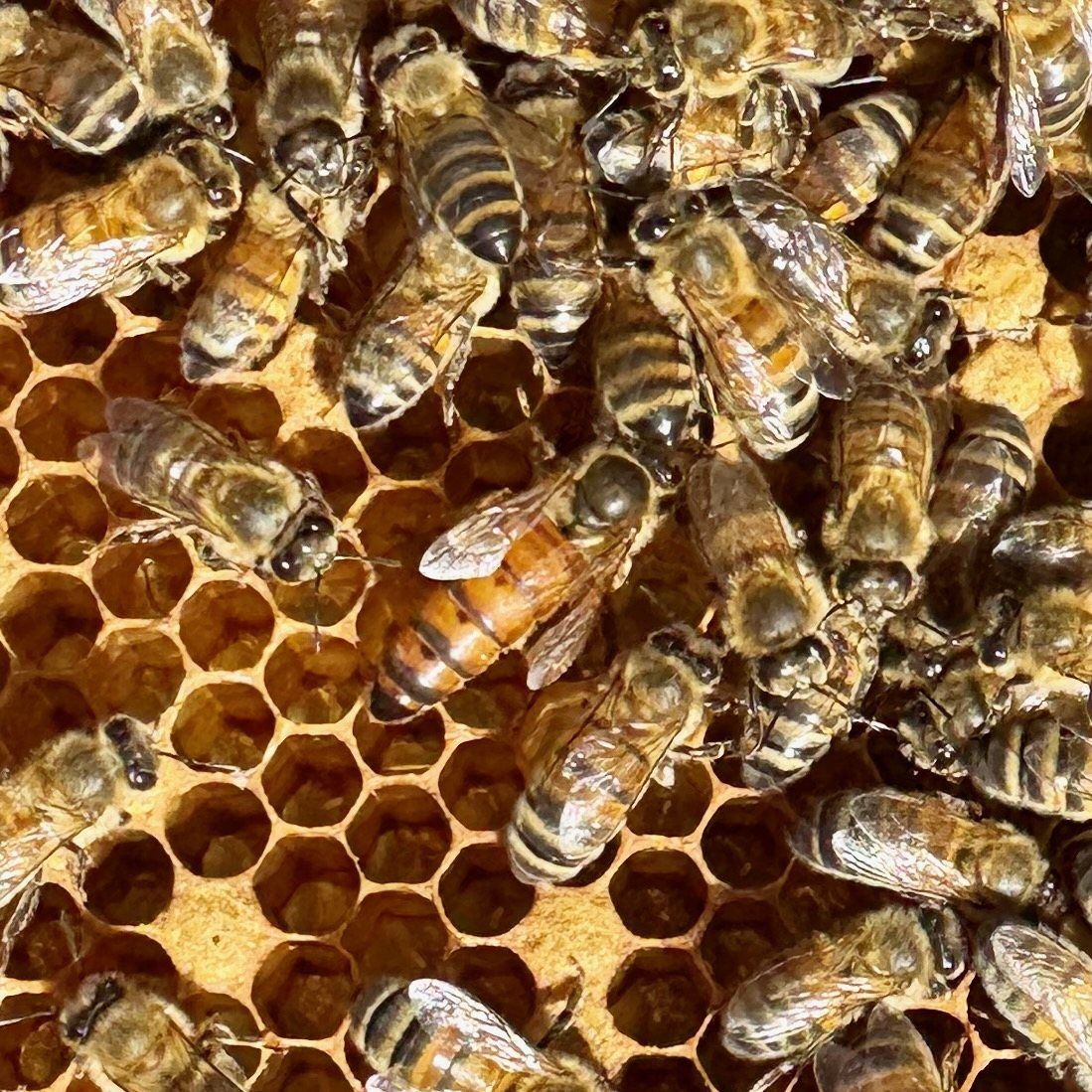
The queen is the only mated female in the colony. She is longer than a worker, with a tapering abdomen that reaches well past her folded wings, and she lives almost entirely on the brood combs. She does not forage, build comb or feed larvae. She has two jobs:
- laying eggs, up to about 1,500 a day at the peak according to MAAREC, nearly her own body weight, one per cell, spiraling out from the center of the brood nest;
- holding the colony together chemically, through pheromones her retinue picks up from her body and spreads through the hive.
Brian Johnson’s 2010 review of division of labor explains one key effect: queen mandibular pheromone (QMP) suppresses juvenile hormone in young workers, which keeps them near the brood as nurses. When the queen’s signal fades, because she is old, failing or lost in a crowded double-deep where her pheromone no longer reaches every bee, workers start building queen cells. That is the root of both supersedure and much swarming.
One mother, many fathers
A few days after emerging, a virgin queen takes one or a few mating flights. In a field study published in 2018 by Michael Simone-Finstrom and David Tarpy, then at NC State, queens made 2.4 flights on average, orientation flights included, and mated with 8 to 25 drones, 13.5 on average. A well-mated queen stores about 5 to 7 million sperm in her spermatheca and never mates again.
Two things follow. Her laying eventually fades as the sperm runs low, which is why many US beekeepers requeen every year or two. And a colony is not a family of full sisters. Every worker has the same mother, but they belong to a dozen or more patrilines. Workers with the same father are “super sisters,” sharing on average three quarters of their genes; workers from different fathers are half sisters. That mix is one reason why some workers in a colony are quicker to guard, to collect pollen or to remove diseased brood than others.
Lifespan and marking
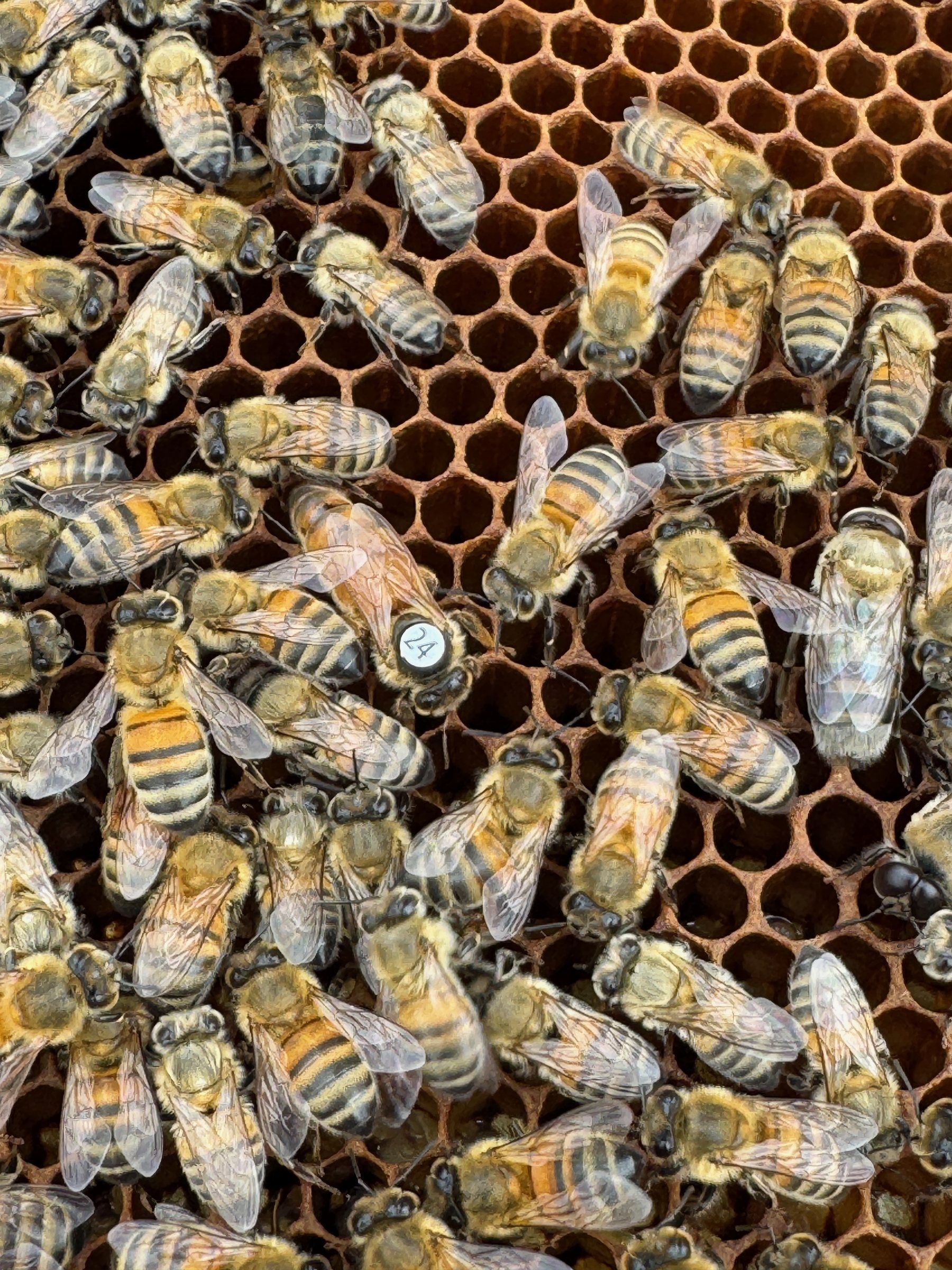
A queen can live several years; MAAREC says queens in temperate areas usually live a couple of years before the colony replaces them when forage is good. To spot her faster and know her age, mark her thorax with the international color code, based on the last digit of the year she was raised: white for 1 and 6, yellow for 2 and 7, red for 3 and 8, green for 4 and 9, blue for 5 and 0. Queens raised in 2026 are marked white, and 2027 queens will be yellow. Mating, queen cells and requeening are covered in our guide to the queen bee.
What do worker bees do?
Workers are females that develop from fertilized eggs, just like queens, but their ovaries stay undeveloped while a queen and open brood are present. They do everything else in the colony: cleaning, feeding larvae, building comb, processing nectar, guarding, fanning, heating and foraging.
Summer bees and winter bees
When a worker is born matters more than anything else for how long she lives.
- Summer bees, raised from spring to midsummer, live about five to six weeks. Johnson describes foragers that “work themselves to death over a couple weeks.”
- Winter bees, raised from late summer into fall, live for months. Johnson cites winter bees still foraging at more than 280 days old.
Mehmet Döke, Maryann Frazier and Christina Grozinger of Penn State explain that honey bees survive the winter by entering a distinct physiological and behavioral state, and link winter colony losses to varroa mites and virus infections. The health of the bees reared for winter, sometimes called fat bees, decides whether the colony sees spring.
This is where US colony losses start. The national survey led by Auburn University with Oregon State University and the Apiary Inspectors of America recorded a record 55.6% annual loss in 2024-25, then 39.9% in 2025-26, and the survey team blames parasites and poor forage. Varroa is the parasite that matters most here. Mite populations peak in late summer just as the bee population falls, so winter bees raised in a mite-heavy colony are damaged as pupae and die early. The Honey Bee Health Coalition’s 2026 guide says to control mites promptly at 2 or more per 100 bees while the colony is at peak or declining (summer and fall) and at 1 or more during dormancy and spring build-up. Cornell’s overwintering advice for the Northeast is to measure mites in late July or early August and treat promptly, calling a first treatment in September or October too late. Our guide to varroa mites lists the EPA-registered treatments.
Worker jobs by age
In summer, a worker’s job changes as she gets older, a pattern biologists call age polyethism. She starts at the center of the nest and finishes outside, in the riskiest work.
| Approximate age | Group | Main tasks |
|---|---|---|
| first few days | young bees | cleaning and polishing cells for eggs or storage |
| about 4 to 12 days | nurse bees | feeding larvae and the queen with brood food from their head glands |
| about 12 to 21 days | middle-aged bees | building comb, receiving and ripening nectar, packing pollen, fanning, guarding, undertaking |
| about 3 weeks on | foragers | collecting nectar, pollen, water and propolis |
The nurse and middle-aged bands are Johnson’s. Some details on the jobs:
- Cell cleaning comes first. The queen will not lay in a cell that has not been cleaned.
- Nursing relies on the hypopharyngeal glands in the head, which produce brood food.
- Comb building uses wax secreted as small flakes from glands on the underside of the abdomen. Bees of this age are why a colony on a strong flow draws out a box of foundation so fast.
- Receiving nectar means taking loads from foragers, evaporating water and adding enzymes, then storing it to ripen into honey.
- Guarding happens at the entrance, where guards check the colony odor of incoming bees and fight off robbers and yellowjackets.
- Foraging is the last and most hazardous job.
A schedule that bends
This sequence is a tendency, not a rule. Johnson stresses that workers switch tasks according to colony needs. When researchers removed the youngest bees from colonies, about 20% of foragers regained the ability to nurse. A colony that loses a lot of foragers, after a pesticide kill for example, sends young bees to the field early.
Pheromones drive much of this. Brood pheromone stimulates young bees’ brood food glands and encourages pollen foraging. Foragers carry ethyl oleate in their crops and pass it to younger bees during food sharing, which slows their move to the field. When foragers die in large numbers, less ethyl oleate circulates and the next group starts foraging sooner. That flexibility is why a walk-away split or a nuc made from a strong colony gets back to work within days.
What are drones for?
Males without a stinger
Drones come from unfertilized eggs that the queen lays in larger drone cells. MAAREC measures about 4 drone cells per linear inch against 5 for worker cells. Drones are stockier than workers, with huge eyes that meet on top of the head. They have no stinger, do not forage and take no part in building or brood care. Workers feed them.
Drones are seasonal. MAAREC notes that colonies start raising them in spring once food is reliable, continue through summer and stop by fall, with most colonies evicting them in September or October. Queenless colonies tend to keep drones longer.
Drone congregation areas
Rangel and Fisher’s review gathers the key figures:
- development from egg to adult: about 24 days;
- first orientation flights: about 5 to 8 days after emergence;
- sexual maturity: roughly 6 to 18 days after emergence, depending on the study;
- lifespan of a drone that does not mate: about 20 to 40 days;
- drone congregation areas: about 100 to 650 ft (30 to 200 m) across and 30 to 130 ft (10 to 40 m) above the ground, holding up to about 11,000 drones from colonies up to about 3 miles (5 km) away, although most drones gather at areas only a few hundred yards from their own hive;
- mating is fatal: the drone dies soon after, and the tip of his endophallus breaks off and stays in the queen.
Because drones mate with queens from other apiaries, the drones in your yard help shape the bees of your whole area. That matters most in the southern tier of states where Africanized honey bees are established. Open-mated queens there can mate with Africanized drones, and their daughters inherit the defensive traits. The University of Florida describes Africanized colonies as considerably more defensive than European ones, able to send out hundreds to thousands of bees and chase an intruder 400 yards (about 365 m) or more. UF advises requeening defensive colonies so that they remain European, and keeping a marked queen makes it easy to tell whether she has been replaced by a daughter of unknown mating.
Too many drones: when to worry
Drone brood in spring means a healthy colony. What deserves a closer look is drone brood in worker cells. A drone is too big for a worker cell, so the cappings are strongly domed and stand out from the comb. There are two causes:
- a drone-laying queen, unmated or out of sperm, who lays only unfertilized eggs. She usually lays one egg per cell, neatly in the base, but the brood is drone brood in worker comb, often mixed with a little worker brood.
- laying workers, in a colony that has been queenless for several weeks. With no queen pheromone and no open brood, some workers develop their ovaries. You see several eggs per cell, often on the side walls, and scattered, irregular drone brood. Such colonies rarely accept a new queen.
A newly laying queen can put two eggs in a cell for her first few days, so recheck before you act.
Brood: from egg to adult
Brood means all the immature stages: eggs, larvae and pupae. Open brood is eggs and larvae in uncapped cells. Capped brood is prepupae and pupae under wax cappings.
Development times
| Stage | Queen | Worker | Drone |
|---|---|---|---|
| Egg | 3 days | 3 days | 3 days |
| Open larva | about 5.5 days | about 6 days | about 6.5 days |
| Capped (prepupa and pupa) | about 8 days | about 12 days | about 14.5 days |
| Egg to adult | 15 to 16 days | about 21 days | about 24 days |
The stage lengths come from the University of Florida’s IFAS Extension; expect a day of variation with brood temperature. These numbers are your inspection tools. Eggs mean the queen was laying in the last three days. A capped queen cell should give a virgin in about eight days. A colony that has just lost its queen and starts an emergency cell on a young larva will have a virgin about 12 days later, who must still mate and begin laying. Add it up and a queenless colony goes three to four weeks without new eggs even when everything goes right. Each stage is explained in our guide to the honey bee life cycle.
Male or female: fertilization decides
Sex in honey bees depends on whether the egg is fertilized. Unfertilized eggs develop into males with a single set of chromosomes, and fertilized eggs into females. This is called haplodiploidy. The switch is the csd (complementary sex determiner) gene: two different versions make a female. A fertilized egg with two identical versions, more likely in inbred stock, becomes a diploid male, and workers eat these larvae soon after they hatch. Very spotty brood can therefore point to low genetic diversity, although varroa, disease and a failing queen are far more common causes.
Queen or worker: diet decides
A female larva can become a worker or a queen. The egg is the same; the food is not. Queen larvae are fed royal jelly throughout, while worker larvae get pollen and honey added to their diet after the first days. A 2015 University of Illinois study found that p-coumaric acid, present in honey and bee bread but not in royal jelly, steers larvae toward worker development by changing the activity of a large share of their genes.
That is how a queenless colony raises a new queen from an ordinary worker larva: workers enlarge the cell into a downward-hanging queen cell and flood the larva with royal jelly.
Reading a brood frame
On a deep Langstroth frame, a healthy brood nest shows a few consistent signs:
- Solid capped brood: wide sheets of capped cells with few empty cells scattered through.
- All stages present: eggs, glistening white C-shaped larvae and capped brood together show steady laying.
- A logical layout: MAAREC describes brood as a compact central area in the lower part of the comb, pollen in cells within and just outside it, and honey above and to the sides. In a two-deep hive, expect the brood nest to straddle both boxes in spring and drift up in winter.
- Healthy cappings: flat, even and tan on worker brood, domed on drone brood. Sunken, perforated or greasy cappings point to a brood disease.
Johnson notes that a brood comb holds about 6,000 cells but has room for only about 2,000 adult bees, so space in the brood nest is always contested between eggs, food and bees. A brood nest jammed with nectar in spring is a classic swarm trigger.
If cappings look wrong, call your state apiarist or apiary inspector before you move frames between hives. American foulbrood is dealt with under state apiary laws, and many states offer inspections, often free.
How does a colony control its temperature?
Brood only develops properly in a narrow range. The University of Florida’s guide to colony social organization puts the brood area at about 93°F (34°C), and MAAREC gives 90 to 95°F (32 to 36°C) as the optimum. A 2023 study in Frontiers in Ecology and Evolution adds that long exposure below about 90°F (32°C) raises the risk of deformed wings, legs and abdomens, and that pupal survival falls to zero at about 100°F (38°C).
Workers have two tools:
- Heating: they shiver their flight muscles without moving their wings. Some press a warm thorax against cappings or crawl into empty cells among the brood to warm the pupae around them.
- Cooling: they fan at the entrance and inside, and spread water that cools the air as it evaporates. On a 100°F (38°C) afternoon in Texas or Arizona, you see bees bearding on the front of the hive and a steady line of water foragers.
In winter, the colony forms a cluster. The same 2023 paper reports that at an outside temperature of about 36°F (2.5°C) the core of the cluster can stay above 95°F (35°C), warm enough for brood, while the outer mantle stays above about 63°F (17°C) and works mainly as insulation. Cornell stresses the point for northern beekeepers: bees heat only the cluster, not the hive. Drafts drain that heat, and condensation dripping onto the cluster can kill it, which is why upper ventilation and an upper entrance matter as much as wrapping.
Stores needs depend heavily on region:
- Northeast: Cornell recommends a minimum of 80 lb (36 kg) of honey for a full-size, two-deep colony and 50 lb (23 kg) for a nuc, with honey generally no longer taken after about the first week of October in Upstate New York.
- South: colonies need less honey to winter but keep raising brood, so they can still run short in a warm, flowerless winter.
- Science benchmark: Johnson gives about 20 kg (44 lb) of honey as a general figure for winter survival, a useful minimum but well below what a northern colony burns.
Does a beehive have a leader?
People talk about the “queen” and her “subjects,” but the colony has no chain of command. The queen gives no orders. Biologists call the colony a superorganism: the whole acts like one animal, while each bee responds only to local cues.
Those cues come in three main forms:
- chemical: pheromones from the queen, the brood and the workers, signaling a laying queen, hungry larvae, an alarm at the entrance or the way home (the Nasonov scent);
- contact and food sharing: workers pass food mouth to mouth all the time, and with it information and pheromones;
- dances: foragers advertise the direction and distance of good forage with the waggle dance.
Swarming shows collective decision-making most clearly, and much of what we know comes from Thomas Seeley’s work at Cornell. In a swarm, about two thirds of the workers leave with the old queen; the University of Florida gives the same “up to two thirds” figure. Several hundred of the oldest bees then scout 10 to 20 possible cavities. Each scout dances for her site for longer the better she rates it, and the swarm moves once enough scouts gather at one site. MAAREC describes the preferred cavity as about 40 liters (10.6 gallons), roughly the volume of a single deep, about 9 ft (3 m) up. No single bee chooses. Our guide to swarming turns this into swarm control.
Africanized colonies push the same system harder. The USDA’s Carl Hayden Bee Research Center in Tucson says they may swarm as often as every six weeks during swarm season, compared with about once a year for European colonies, and can throw several swarms each time.
A year in the life of a US colony
There is no single American bee year. The table compares three regions; your yard may run weeks ahead or behind depending on elevation and local bloom.
| Season | Northeast and Upper Midwest | Southeast and Florida | California |
|---|---|---|---|
| Winter | tight cluster on stores, brood restarts late winter | brood often continues; colonies growing by March | colonies built up for almond bloom in February |
| Spring | build-up on maple, willow and fruit bloom; swarm season mainly May and June | swarm control from March; orange blossom honey in south Florida by late April | citrus, sage and wildflowers after almonds |
| Summer | clover and basswood flow, then dearth; winter bees from August | main flow ends by July in Florida; summer dearth | dry-season dearth in many areas; many colonies moved |
| Fall | goldenrod and aster; drones evicted; mite treatment and feeding | small fall flows; continued mite testing | prepare and move colonies for next almond season |
In the Northeast, Cornell’s advice runs on the colony’s internal clock: populations peak around June or July, begin to fall in August, and mite numbers peak in August and September, after the bees start to decline. In Florida, the University of Florida’s calendar has colonies growing in March, swarm control from March to May, and the main flow over in July everywhere in the state. California’s year is shaped by almond pollination, which demands strong colonies in February, long before a colony would naturally reach that size.
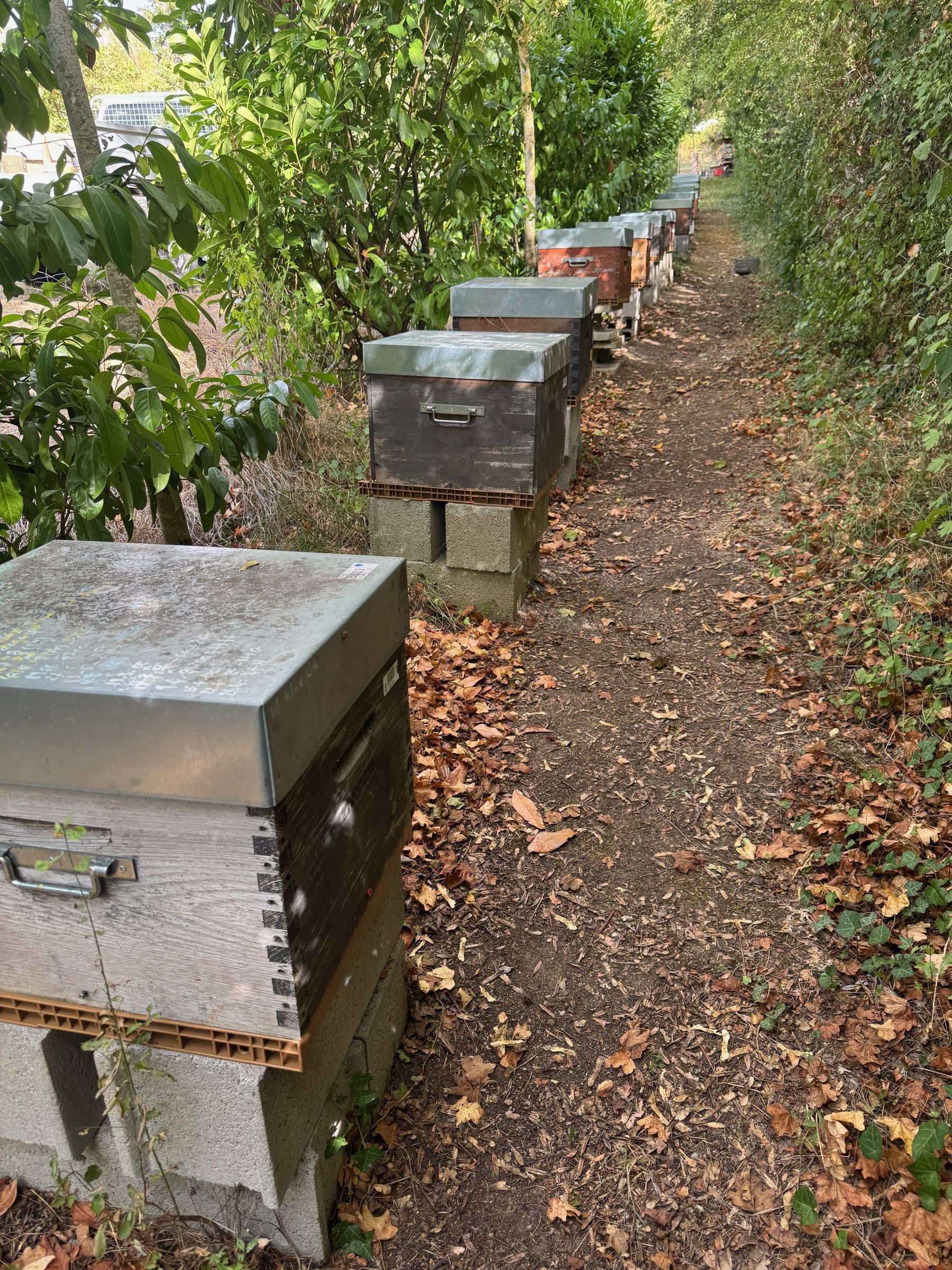
Equipment follows the colony’s shape. A 10-frame Langstroth hive with two deeps for the brood nest and mediums for honey is the most common setup; 8-frame boxes suit beekeepers who want lighter lifts. Our page on the Langstroth hive compares the configurations.
What colony organization means at an inspection
Everything above turns into a short checklist for each visit:
- Look for eggs, not the queen. One egg per cell, standing in the base, proves a laying queen was present in the last three days.
- Assess the brood pattern. Solid capped brood on several frames in spring means a good queen. Spotty brood means finding out why: varroa, disease, a failing queen or inbreeding.
- Read the queen cells. Many cells along the bottom bars in spring usually mean swarm preparations. One or two cells on the face of the comb more often mean supersedure. Emergency cells drawn from worker cells follow a sudden queen loss.
- Check the drones. Drones in spring are normal. Domed cappings in worker cells mean a drone-laying queen or, with several eggs per cell, laying workers.
- Think about winter bees in July and August. Test mites then. The colony and the mite load you have at the end of summer decide whether you have bees in April.
- Count frames of bees and brood. It is easier to compare between visits than any guess at numbers.
Finally, check your state’s rules. There is no federal permit to keep bees, but many states require you to register your apiary with the state department of agriculture. Ohio, for example, requires registration by June 1 each year or within 30 days of acquiring bees. Florida requires every beekeeper to register with any number of colonies, and Pennsylvania requires anyone who manages honey bees to register. Texas does not require registration, although bee removal, selling bees and bringing colonies into the state carry their own requirements. Registration is how state inspectors reach you in a foulbrood outbreak. Our page on beekeeping laws by state covers the details.
Frequently asked questions
How many bees are in a hive?
It depends on the season. Mid-Atlantic extension specialists put a typical colony at an average of about 60,000 bees at its June peak, falling to fewer than 20,000 by late winter. A colony also has one queen and, from spring to early fall, a few hundred to a few thousand drones. A new 3 lb (1.4 kg) package starts far smaller and takes weeks to build up.
Is the queen bee the boss of the hive?
No. The queen gives no orders. She lays eggs and produces pheromones that tell workers a fertile queen is present. Choices such as when to raise new queens, where to forage or which cavity a swarm will move into come from thousands of workers reacting to local signals. Scientists call the colony a superorganism, not a monarchy.
How long do worker bees live?
A worker born in spring or summer usually lives about five to six weeks: roughly three weeks inside the hive, then a couple of weeks of foraging until she wears out. Workers raised in late summer and fall become long-lived winter bees with big protein reserves. They can live for months, some past 280 days, and carry the colony to spring.
What is the purpose of drones?
Drones mate with virgin queens, mostly queens from other colonies. They gather in drone congregation areas 30 to 130 ft (10 to 40 m) above the ground, joined by males from colonies up to about 3 miles (5 km) away. They have no stinger, do not forage and do not build comb. A drone dies right after mating, and workers evict the rest in fall.
What happens when a hive loses its queen?
If worker larvae less than about three days old are present, workers turn some of their cells into emergency queen cells and raise a new queen, who emerges about 12 days later and still has to mate. With no young larvae, the colony cannot requeen itself. Eventually some workers lay unfertilized eggs that produce only drones, and the colony dwindles unless you give it a frame of eggs or combine it.
How do I know if I have laying workers?
Look for several eggs per cell, often stuck to the side walls rather than the base, scattered drone brood with domed cappings in worker cells, and no young worker larvae. A brand new queen can lay doubles for a few days, so check again before acting. Laying worker colonies rarely accept a new queen, so combining them with a queenright colony usually works better.
Why do bees kick drones out in the fall?
Drones eat stored food and have no job once queens are no longer being mated. In most US regions, colonies stop raising drones as fall approaches and evict the adults; Mid-Atlantic extension specialists say most colonies get rid of them in September or October. A colony that keeps lots of drones late in fall may be queenless and is worth checking on a warm day.
Do Africanized bees organize their colonies differently?
Their colony structure is the same: one queen, workers and seasonal drones. What differs is behavior. Africanized colonies are far more defensive and swarm much more often. The USDA bee lab in Tucson says they may swarm as often as every six weeks in swarm season. In southern states where they are established, the University of Florida advises requeening defensive colonies so they stay European.
Sources
- Division of labor in honeybees: form, function, and proximate mechanisms (Behavioral Ecology and Sociobiology, 2010), Brian R. Johnson, Springer, via PubMed Central
- Factors affecting the reproductive health of honey bee (Apis mellifera) drones: a review (Apidologie, 2019), Juliana Rangel and Adrian Fisher II, Springer
- Honey Bee Queens Do Not Count Mates to Assess their Mating Success (Journal of Insect Behavior, 2018), Michael Simone-Finstrom and David R. Tarpy, USDA-ARS
- Seasonality of Brood and Adult Populations (Basic Bee Biology for Beekeepers), Mid-Atlantic Apiculture Research and Extension Consortium (MAAREC), via Bee Health eXtension
- The Bee Nest (Basic Bee Biology for Beekeepers, MAAREC Publication 1.4), Mid-Atlantic Apiculture Research and Extension Consortium, via Bee Health eXtension
- The Social Organization of Honey Bees (ENY-166), Ashley N. Mortensen, Bryan Smith and James D. Ellis, University of Florida IFAS Extension
- The organizational impact of chronic heat: diffuse brood comb and decreased carbohydrate stores in honey bee colonies (Frontiers in Ecology and Evolution, 2023), Frontiers in Ecology and Evolution
- Study identifies chemical in diet that determines a honey bee's caste (2015), University of Illinois News Bureau
- European Honey Bee, Apis mellifera Linnaeus and subspecies (EENY-568/IN1005), Ashley N. Mortensen, Daniel R. Schmehl and Jamie Ellis, University of Florida IFAS Extension
- Overwintering honey bees: biology and management (Current Opinion in Insect Science, 2015), Mehmet Ali Döke, Maryann Frazier and Christina Grozinger, Penn State University
- Overwintering, Cornell University, College of Agriculture and Life Sciences, Pollinator Network
- Honeybee democracies offer useful insights, says new book, Cornell Chronicle, Cornell University
- Florida Beekeeping Management Calendar (ENY156/IN848), University of Florida, IFAS Extension
- Tools for Varroa Management: A Guide to Effective Varroa Sampling and Control (9th edition, 2026), Honey Bee Health Coalition
- U.S. honey bee colony losses ease after record year (June 2026), Auburn University, College of Agriculture
- Africanized honey bees overview, USDA-ARS Carl Hayden Bee Research Center
- Living with the African honey bee (ENY-170, revised November 2024), J. D. Ellis and M. Bammer, University of Florida IFAS Extension
- Ohio Revised Code section 909.02: registration of bees, State of Ohio
- Best practices for beekeepers (Pennsylvania Pollinator Protection Plan), Penn State University, Center for Pollinator Research
- Regulations, Texas Apiary Inspection Service, Texas A&M AgriLife