Queen bee: what she does, how she mates, how long she lives, and how to find and replace her
The honey bee queen explained for US beekeepers: her role, queen cells, mating, egg laying, lifespan, the 2026 marking color, requeening and queenless hives.
The queen bee is the only mated female in a honey bee colony. She lays every egg in the hive, up to about 2,000 a day at the peak of the season, and produces the pheromones that tell tens of thousands of workers she is present and fertile. She gives no orders, but without her the colony cannot replace itself. She can live several years, mates only during a few flights early in life, and in most US operations is replaced every one or two years because her laying declines.
Finding her, judging her and knowing when she is gone is how you read a colony: steady laying, swarm preparations, a failing queen or a queenless hive. For how she fits with the workers and drones, see our guide to the honey bee colony.
What does a queen bee do?
She has two jobs.
- Laying eggs. Every worker, drone and future queen in the hive is her offspring. As she lays she decides, egg by egg, whether to release sperm: a fertilized egg becomes a female, an unfertilized one a drone, laid in the larger drone cells.
- Holding the colony together chemically. Her pheromones, picked up by the workers around her and passed through the hive, suppress queen rearing and worker ovary development and keep a swarm cluster together.
She does not forage, build comb or care for brood, and she does not feed herself: young nurse bees feed her glandular secretions. The title is misleading. Workers decide when to raise a new queen, when to supersede her, when to swarm with her and sometimes when to kill her. Her influence is chemical, not command.
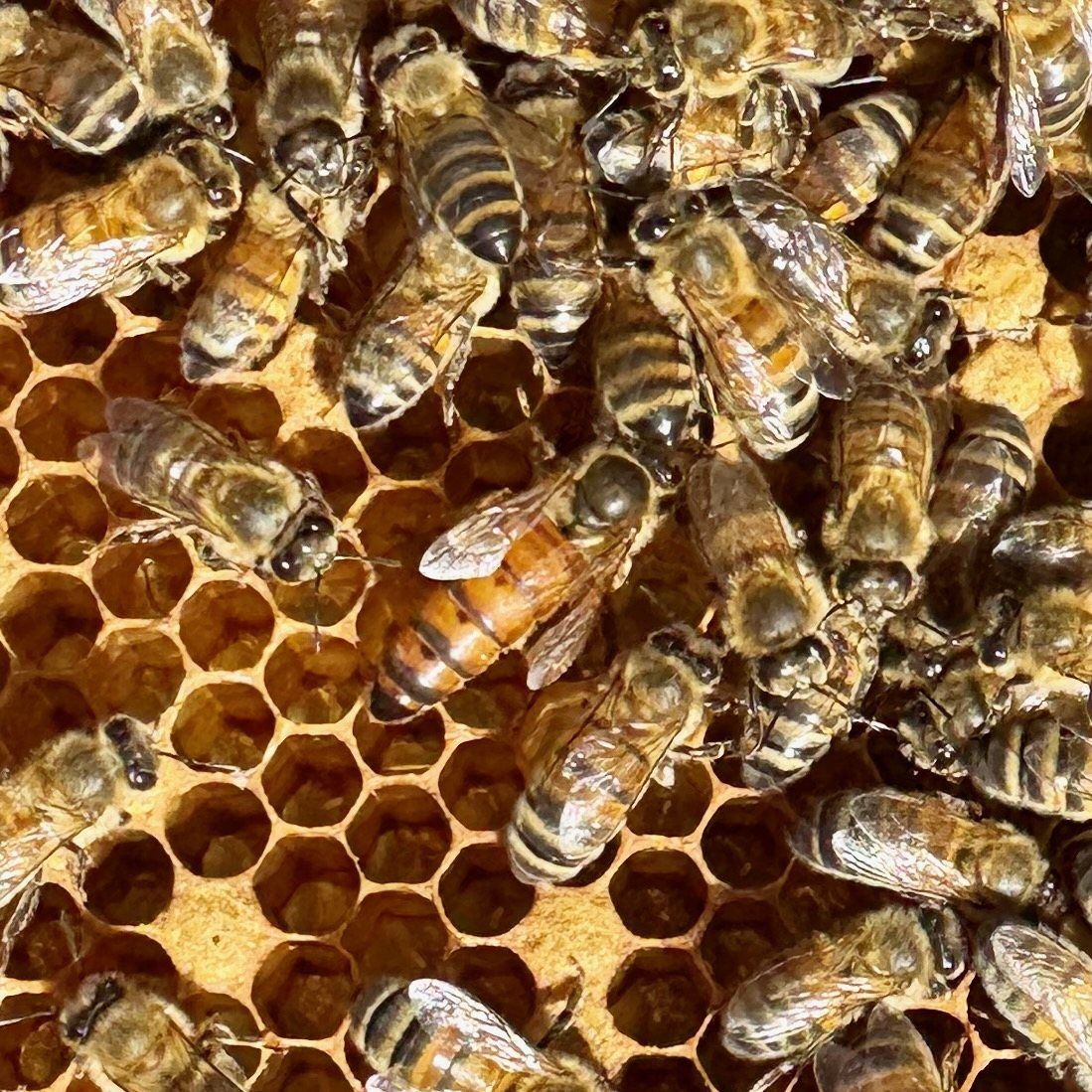
What does a queen bee look like, and how do you find her?
How to tell her apart
| Feature | Queen | Worker | Drone |
|---|---|---|---|
| Body | long, with an elongated abdomen | short and slim | broad and blocky |
| Abdomen | tapered, extends well past the folded wings | covered by the wings at rest | rounded, blunt tip |
| Eyes | separate, on the sides of the head | separate | very large, meeting at the top of the head |
| Legs | long, conspicuous | shorter, with pollen baskets | no pollen baskets |
| Stinger | curved, barely barbed, used on rival queens | strongly barbed | none |
| Behavior | moves deliberately, often ringed by attendants | busy | slow, aimless |
University of Florida extension notes that the queen is often a slightly different color from her workers, larger and shinier. Italian-type queens are usually golden or orange, Carniolan and Russian queens darker. Internally the gap is even wider. Jackson, Tarpy and Fahrbach counted the ovarioles, the egg-producing tubes, in 75 commercial queens from 10 sources (Journal of Insect Science, 2011): a median of 320 across both ovaries, compared with fewer than 10 per ovary in a worker. She also has a spermatheca, a small sac where sperm stays alive for the rest of her life.
Finding her in a Langstroth hive
In a double-deep 10-frame Langstroth with 40,000 or more bees, finding an unmarked queen takes method.
- Use light smoke and slow movements. A heavily smoked colony runs, and the queen heads for the corners and the bottom board.
- Remove the outer frame first and set it aside, then work toward the center so you never slide a frame past the queen and roll her.
- Check the side facing you first as each frame comes up. She moves away from light.
- Focus on frames with eggs. She is almost always on or near the comb where she laid most recently, inside the arc of pollen.
- Look for the retinue, a small ring of workers facing one point, rather than the queen herself.
- Hold frames over the open box, so a queen who drops falls back into the hive.
If you cannot find her, that is usually fine. Fresh eggs standing one per cell prove a laying queen was there within the last three days. In 8-frame equipment or with mediums throughout, the method is the same, with more boxes to check.
How is a queen bee raised?
The same egg, a different diet
A queen develops from a fertilized egg identical to a worker egg. The difference is housing and food: she grows in a large vertical queen cell hanging from the comb and is fed royal jelly in abundance throughout her larval life, while worker larvae switch to a diet that includes honey and pollen. Our guide to the honey bee life cycle explains caste determination.
Development times
| Stage | Queen | Worker | Drone |
|---|---|---|---|
| Egg | 3 days | 3 days | 3 days |
| Open larva | about 5 days | about 6 days | about 6.5 days |
| Capped (prepupa and pupa) | about 8 days | about 12 days | about 14.5 days |
| Egg to adult | about 16 days | about 21 days | about 24 days |
A queen cell is capped around day 8 or 9 after the egg was laid, and the virgin emerges around day 16, a day earlier or later depending on brood nest temperature. That 16-day clock is what every queen rearing schedule, and every split, is built on.
Swarm cells, supersedure cells and emergency cells
Workers raise queens in three situations, which the Mid-Atlantic Apiculture Research and Extension Consortium (MAAREC) distinguishes. The positions below are tendencies, not rules, but they are a useful diagnostic.
| Situation | Why | Where the cells are | How many |
|---|---|---|---|
| Swarming | the colony is reproducing; the old queen leaves with a swarm | along the bottom edges of the comb and in gaps | often many |
| Supersedure | the queen is failing and her pheromone output drops | on the face of the comb, often near the edge of the brood | usually few |
| Emergency | the queen died or was removed suddenly | on the face of the comb, built from worker cells | several, scattered, often smaller |
MAAREC explains that for an emergency cell the workers turn a horizontal worker cell into a vertical one, usually destroying the walls and larvae of three or four adjacent cells, and always start several queens. The University of Georgia notes that they begin within a few hours of losing the queen, using worker larvae less than four days old. Younger larvae give better queens, which is why queen producers graft larvae less than a day old.
Empty queen cups are not queen cells: most colonies build them every spring. A cup becomes a queen cell only once it holds an egg or a larva in royal jelly. Capped swarm cells mean the colony is days from leaving; our guide to swarming explains splits and other controls.
Tooting and quacking
When several virgins emerge, only one stays. The first out usually tears open rival cells, or the queens fight. They also signal by vibration. A team led by Martin Bencsik at Nottingham Trent University in England, with INRAE in France and CARI in Belgium, recorded these signals with accelerometers in hives (Scientific Reports, 2020). The free queen “toots,” signaling that she is fertile and mobile and should be protected from rivals; virgins still held in their cells answer by “quacking.” When the quacking stops, no virgins remain and the colony will not throw another swarm.
How does a queen bee mate?
Mating flights and drone congregation areas
A virgin queen makes short orientation flights to learn her hive’s location, then one or a few mating flights, typically within her first one to two weeks. She flies to a drone congregation area, a patch of sky drones return to year after year. The review by Juliana Rangel of Texas A&M and Adrian Fisher (Apidologie, 2019) gives the numbers: 100 to 650 feet (30 to 200 m) across, 33 to 130 feet (10 to 40 m) above the ground, with up to 11,000 drones from as many as 240 colonies up to 3 miles (5 km) away. Virgin queens commonly fly several miles. Mating happens in flight, and each drone dies immediately afterward.
What a North Carolina field study found
Michael Simone-Finstrom and David Tarpy followed 80 queens at North Carolina State University (Journal of Insect Behavior, 2018):
- 2.4 flights per queen on average, orientation flights included;
- mating flights of 12 to 47 minutes, 22.8 on average, versus under 5 minutes for an orientation flight;
- 8 to 25 drones per queen, 13.5 on average (Rangel and Fisher give a typical mean of 12 to 14, with extreme cases above 50);
- 65% of queens started laying after a single successful mating flight.
A fully mated queen, the authors note, stores about 5 to 7 million sperm. Mating with many drones gives the colony a mix of worker lines that makes it more resilient.
Weather, region and Africanized drones
Mating needs warm, calm afternoons and plenty of drones. That is why commercial queen production is concentrated where spring comes early or never really leaves: California, the Southeast and Hawaii, the three sources of the queens in the USDA shipping study described below. In the Northeast, Upper Midwest and Pacific Northwest, home-raised queens are usually mated from late spring through summer, once drones are flying in numbers; cells raised too early or too late in the season fail more often.
In parts of the South and Southwest, Africanized bees add a genetic problem: a virgin queen mated in an open area may bring back Africanized drone genetics, and her daughters may be more defensive. Florida addresses this through its rules: queen producers sign a Honey Bee Queen Compliance Agreement (FDACS-08419, revised 1/18) incorporated into rule 5B-54.0105, and anyone rearing queens for sale needs a state queen certificate, which requires queens from a certified European mother line. Our guide to queen rearing covers mating yards and drone saturation.
How many eggs does a queen bee lay?
The rate
University of Florida extension puts a healthy queen at up to 2,000 eggs a day. That pace lasts only a few weeks around the spring buildup and early summer. How far she slows afterward depends on where you are: in the North, laying drops sharply in fall and nearly stops in midwinter, while along the Gulf Coast and in Southern California colonies may rear some brood almost all year.
Reading the brood pattern
Laying is the best measure of a queen. A good one fills comb outward from the center, leaving solid slabs of brood of the same age.
| What you see | What it suggests |
|---|---|
| Solid brood, all stages present, few gaps | well-mated, vigorous queen |
| One egg per cell, upright, at the bottom | laying queen present within 3 days |
| Spotty brood with many empty cells | failing or poorly mated queen, but also disease, varroa or inbreeding |
| Raised drone cappings scattered in worker brood | queen running low on stored sperm |
| Only drone brood in worker cells, one egg per cell | drone-laying queen |
| Several eggs per cell, stuck to the walls | laying workers (or a brand new queen in her first days) |
| No eggs or young larvae in late spring | queenless, or a laying pause (virgin queen, dearth, just before swarming) |
UF extension suggests a problem if the open, unsealed area mixed into the capped brood exceeds 20% of a frame. The University of Georgia cautions that spotty brood is not always the queen’s fault: disease, varroa and inbreeding can produce the same look. Rule out disease first; your state apiarist can confirm a suspected foulbrood case.
Queen pheromones: how the queen holds the colony together
A blend, not one chemical
What beekeepers call queen substance is a mixture from several glands. The best known is queen mandibular pheromone (QMP), made in glands in her head. Bortolotti and Costa’s review (2014) traces it from the identification of 9-ODA in 1960 to the 1988 finding by Slessor and colleagues that four more compounds, including 9-HDA, HOB and HVA, act with it and are more active as a blend. Keeling and colleagues found further compounds in 2003 that boost retinue attraction only in combination with QMP. Dufour’s gland secretion appears to act as a fertility signal, and the tarsal glands on her feet leave “footprints” on the comb that discourage workers from building queen cups.
What the pheromones do
- Draw the retinue, which licks and touches her and spreads the pheromone.
- Suppress queen rearing. Synthetic QMP prevents queenless colonies from starting queen cups only if applied within about 24 hours of queen loss; after four days it has no effect on cells already started.
- Suppress worker ovaries, together with brood pheromone.
- Attract drones to the virgin on her mating flight; 9-ODA is the long-range sex attractant.
- Keep a swarm together. The queen is the strongest attractant in a swarm cluster; if she is lost or cannot fly, the swarm returns to the hive.
Why the signal fades
The Koschevnikov gland, near the sting chamber and another source of the queen signal, starts degenerating at about one year of age, which helps explain the weaker signal of older queens. The signal is also diluted in a crowded hive, one reason a congested colony starts swarm cells. UF extension describes the ideal queen as young, well mated and producing a large amount of pheromone.
How long does a queen bee live, and when should you requeen?
Lifespan
Simone-Finstrom and Tarpy describe queens lasting “upwards of 2-3 years” once laying begins. UF extension says a queen’s life span can exceed seven years but her productivity drops sharply after one or two. A summer worker lives about six weeks; see our life cycle guide.
Why queens fail early
Queen failure, a queen dying or no longer laying enough fertilized eggs, is a familiar complaint in US beekeeping. In a 2016 USDA-ARS news release on work led by Jeff Pettis at the Beltsville Bee Research Laboratory (PLOS ONE, 2016), the agency reported that beekeepers had recently been replacing queens about every six months, compared with one to two years previously. The study pointed to shipping:
- In the lab, exposing queens to 104°F (40°C) for one to two hours, or 41°F (5°C) for one to four hours, cut sperm viability to about 20%, from about 90%.
- Queens mailed from California, Georgia and Hawaii to Maryland in July and September carried temperature loggers; up to 20% of shipments had spikes near 105.8°F (41°C) and 46.4°F (8°C) lasting more than two hours, and exposed queens had sperm viability reduced by 50%.
- Nearly all sampled queens carried deformed wing virus, with Nosema ceranae the next most common pathogen.
Mating quality matters too. Rangel and Fisher note that supersedure can follow inadequate or poor quality sperm, and cite work by Burley showing that drones from coumaphos-treated colonies had markedly lower sperm viability. And Jackson’s team found no link between ovariole number and a queen’s weight, size or sperm count: judge her by her brood, not her looks.
When to requeen
UF extension recommends requeening annually, ideally in late spring or early summer. A UF county extension page adds that a first-year queen is less likely to swarm the next spring, and notes that in Florida queens are plentiful and cheaper in late summer, with September a good month. Some hobbyists keep a good queen for a second year. Requeen sooner when:
- the brood pattern is poor or she lays drones in worker cells;
- supersedure cells appear;
- the colony is unusually defensive. UF’s good neighbor guidelines tell Florida beekeepers to requeen such a colony with a marked European queen.
In Africanized areas, requeening is part of keeping bees responsibly. UF’s guidelines say Florida colonies should ideally be kept with marked European queens, bought from breeders following Florida’s best management practices for queen production. The UC Davis California Master Beekeeper Program advises destroying supersedure cells and buying marked queens in Africanized areas. Check your own state’s rules before relying on any of this.
How to introduce a caged queen
The UC Davis program gives a cautious protocol that works well for nervous colonies:
- Remove the old queen, then wait about 2 days, or 5 to 7 days for a highly defensive colony.
- Remove any attendants from the cage, mark the new queen if she is unmarked, and destroy every queen cell in the hive.
- Hang the cage between two brood frames in the center of the hive, screen facing up and candy end down, so you can watch the workers without opening the cage.
- Wait again and watch the workers on the cage. If they are calm, remove the cork over the candy so they can release her. If they bite at the screen or ball the cage, leave her caged and check again.
- Confirm that she is laying, and watch for supersedure cells for about a month.
Many beekeepers simply remove the old queen, put in the caged queen with the candy exposed and close the hive for a week. That works most of the time in a calm, genuinely queenless colony during a nectar flow.
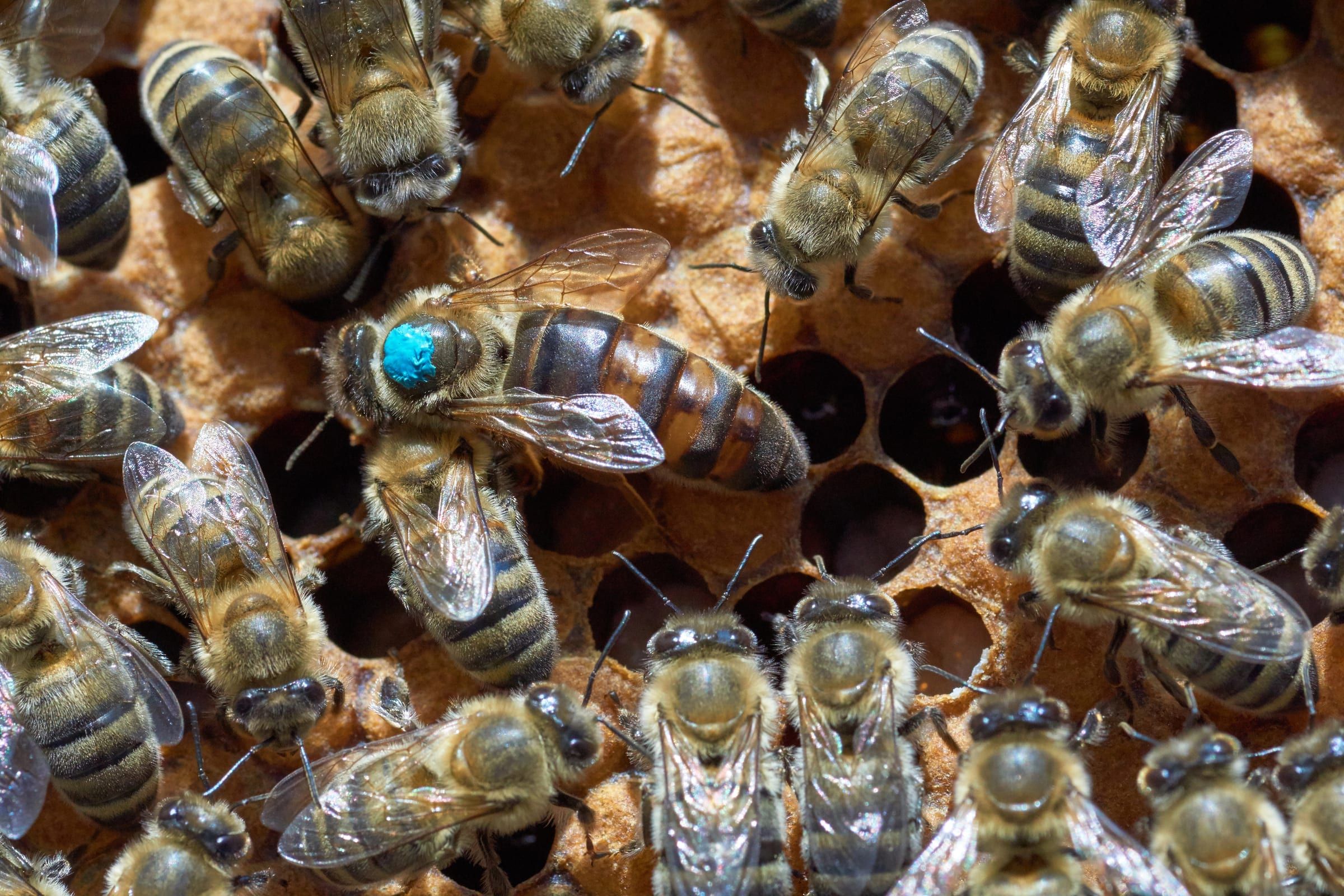
Queen bee marking color for 2026
The international color code
A dot of paint on the thorax makes the queen easy to spot and tells you her age. UF extension gives the code, based on the last digit of the year the queen was reared or installed:
| Last digit of the year | Color | Coming years |
|---|---|---|
| 1 or 6 | white | 2026, 2031 |
| 2 or 7 | yellow | 2027, 2032 |
| 3 or 8 | red | 2028, 2033 |
| 4 or 9 | green | 2029, 2034 |
| 5 or 0 | blue | 2030, 2035 |
Queens raised in 2026 are marked white. Will You Raise Good Bees? gives the order. Most queen producers will mark a queen for a few dollars more; one Iowa supplier lists marking at $4 a queen.
Marking and clipping
- Use a non-toxic paint pen. UF notes that a broad-tipped Posca PC-7M is common in the US. Test it on paper first so the paint is neither runny nor dry.
- Hold her by the wings or thorax, never the abdomen, or trap her gently against the mesh of a plunger marking tube or under a push-in cage.
- Dab the top of the thorax, keeping clear of the head, wings and abdomen, and let it dry for a few minutes.
- Release her on her frame and watch. UF suggests caging her for a few hours if the workers turn defensive toward her.
Some beekeepers also clip half of one forewing of a mated queen, as UF describes. A clipped queen cannot fly off with a swarm and falls in front of the hive, which makes the swarm easier to recover. Clipping does not remove the urge to swarm: the colony may leave with the first virgin queen to emerge.
Queenless hive: signs and what to do
A colony is queenless when it has lost its queen: natural death, a queen rolled or crushed during an inspection, a virgin lost on her mating flight, or a swarm that left before the new queen mated.
The signs
- No eggs or young larvae during the active season.
- Agitated, noisy bees. The University of Georgia describes disrupted activity, bees fanning and a loud roar when the hive is opened.
- Emergency queen cells on the face of the comb.
- Later, scattered drone brood with several eggs per cell, laid by workers.
The timeline
If young worker larvae remain, the colony raises an emergency queen:
| Time since the queen was lost | What happens |
|---|---|
| a few hours | emergency cells started on young worker larvae |
| about 12 days | emergency queen emerges |
| about 3 weeks | mating and first eggs, if all goes well |
| about 6 weeks | first workers of the new queen emerge |
No new workers emerge for those six weeks, and the population shrinks. A colony that goes queenless in spring can miss the main flow, and in Africanized areas the emergency queen’s mating is a gamble.
Without usable larvae, a colony is what the University of Georgia calls hopelessly queenless: it will die unless a new queen is added. After some weeks without queen pheromone, workers start laying unfertilized eggs that produce only drones.
What to do
- Confirm before you buy. No eggs does not always mean no queen. After a swarm or split, a virgin may still be mating, and a mated queen introduced on top of her will be killed.
- Add a test frame of eggs and young larvae from a healthy colony. Queen cells on it within a few days confirm queenlessness.
- Save weeks with a mated queen in a cage, or a capped queen cell from a good colony, where Africanization is not a concern.
- Combine a weak colony with a queenright one using the newspaper method.
- Do not expect laying workers to accept a queen. The University of Georgia says such colonies rarely do. Shaking the bees out away from the apiary, or combining them with a strong queenright colony, usually works better. The UC Davis program also suggests adding open brood from a gentle colony when a colony keeps rejecting queens.
Buying queen bees in the US
Where queens come from
Commercial queens are typically shipped from March through October, according to the ARS release on the Pettis study, and many come from breeders in California, the Southeast and Hawaii. Hawaii is a special case: under state law it is illegal to bring live or dead bees into Hawaii, while its queen producers must be inspected and certified by the State Apiary Program to ship to destinations that require it. The University of Hawaii explains that an operation needs at least 40 colonies to schedule an inspection, that certificates expire after 90 days, and that the presence of American foulbrood blocks shipment completely.
Prices vary by stock and season. As a reference point, one Iowa supplier lists a naturally mated 2027 queen from VSH Minnesota Hygienic Italian and Carniolan stock at $44.95, with marking $4 extra, shipped early April to late September.
Stock
- Italian queens are the most familiar stock in package and queen sales: gentle, prolific, golden.
- Carniolan queens build up fast in spring and are thrifty in winter, popular in the North.
- Russian bees come from about 100 queens USDA-ARS imported from the Primorsky region of Russia in 1997 and released to industry from 2000, selected mainly for varroa resistance, though the lab stresses they are “not immune.”
- VSH and hygienic lines are selected to detect and remove mite-infested brood.
Our guide to honey bee breeds compares them in detail.
State and federal rules
There is no single national rule on queen sales, but states regulate producers and movement. A few examples:
- Texas: the Texas Apiary Inspection Service charges $300 for a queen breeder inspection and lists a $200 interstate permit for moving bees across state lines.
- Florida: queens sold in Florida must come from certified producers whose stock has no African ancestry, as UF extension summarizes; rule 5B-54.014 requires a queen certificate for anyone rearing queens for sale or trade.
- Hawaii: no bees in, inspected queens out, as above.
Your state department of agriculture or state apiarist can tell you what applies where you live; our guide to beekeeping laws by state collects the contacts.
At the federal level, USDA APHIS allows adult queens and package bees into the continental US only from Canada and New Zealand, prohibits them from Australia, and restricts adult bees from everywhere else; whole colonies in hive bodies cannot be imported from any country. Honey bee germplasm can be imported from Australia, Bermuda, Canada, France, Great Britain, New Zealand and Sweden under set conditions, which is how breeders bring in new genetics for instrumental insemination.
Raising your own
Queens raised from your own best colonies are adapted to your climate and forage, cost little, and avoid the shipping risks the USDA study documented. A walk-away split with eggs, swarm cells from a gentle colony or a few grafts all work. Outside Africanized areas, the UC Davis program recommends colony-produced queens and queen cells; inside them, it recommends buying marked queens.
For the rest of the colony and how it works as a whole, browse the colony section.
Frequently asked questions
How long do queen bees live?
Researchers at North Carolina State University and USDA describe queens lasting upwards of two to three years once they start laying, and University of Florida extension says a queen can live more than seven years. Her productivity usually drops sharply after one or two seasons, so many US beekeepers requeen every year or two, and some commercial operations do so more often.
What color do you mark a queen bee in 2026?
White. The international code uses the last digit of the year the queen was reared or installed: white for 1 and 6, yellow for 2 and 7, red for 3 and 8, green for 4 and 9, and blue for 5 and 0. A queen raised in 2027 will be yellow. The phrase Will You Raise Good Bees helps you remember the order.
How do I introduce a new queen bee?
Remove the old queen and all queen cells, then hang the new queen's cage between two brood frames in the center of the brood nest, candy end down. The UC Davis California Master Beekeeper Program suggests waiting about two days, or five to seven for a defensive colony, and removing the cork over the candy only once the workers act calmly toward her. Then leave the hive closed for several days.
How do I know if my hive is queenless?
During the season a queenless colony has no eggs and no young larvae. The bees are often agitated, fan at the top bars and roar when you open the hive, and emergency queen cells may appear on the face of the comb. To check, add a frame of eggs and young larvae from another colony: if the bees build queen cells on it, they are queenless.
How many eggs does a queen bee lay per day?
University of Florida extension puts a healthy queen at up to 2,000 eggs a day at the peak of the season. She lays one egg per cell, spiraling outward from the center of the brood nest. The peak lasts only a few weeks in spring and early summer, and how much she slows in fall and winter depends on your region, from a near stop in the North to continuous light laying along the Gulf Coast.
Why did my new queen die or disappear?
The most common causes are releasing her too quickly, so the workers ball and kill her, leaving queen cells in the hive, or a colony that was not actually queenless. Queens can also arrive damaged: USDA research found that queens exposed to temperature extremes in the mail, around 104°F (40°C) or 41°F (5°C), lost most of their sperm viability.
Where can I buy queen bees in the US?
Many queens are raised by commercial breeders in California, the Southeast and Hawaii and shipped by mail or courier from early spring through fall, though many regions also have local breeders. Ask whether the queen is mated and marked, which stock she is, such as Italian, Carniolan, Russian or a VSH line, and whether your state requires shipments to come from inspected producers.
Can I import queen bees into the United States?
Only from Canada and New Zealand. USDA APHIS allows adult queens and package bees from those two countries into the continental US, prohibits them from Australia, and restricts adult honey bees from everywhere else. Whole colonies in hive bodies cannot be imported at all. Honey bee germplasm, such as semen, can come from a short list of countries under conditions, including Great Britain, France and Sweden.
Sources
- Honey Bee Queens Do Not Count Mates to Assess their Mating Success (Journal of Insect Behavior, 2018), Michael Simone-Finstrom and David R. Tarpy, USDA-ARS
- Factors affecting the reproductive health of honey bee (Apis mellifera) drones: a review (Apidologie, 2019), Juliana Rangel and Adrian Fisher II, Springer
- Histological Estimates of Ovariole Number in Honey Bee Queens, Apis mellifera, Reveal Lack of Correlation with other Queen Quality Measures (Journal of Insect Science, 2011), Joseph T. Jackson, David R. Tarpy and Susan E. Fahrbach, via PubMed Central
- Chemical Communication in the Honey Bee Society (Neurobiology of Chemical Communication, 2014), Laura Bortolotti and Cecilia Costa, CRC Press, via NCBI Bookshelf
- Queen bees 'toot' to instruct colony to keep them safe (2020), Nottingham Trent University
- Queen Replacement (Basic Bee Biology for Beekeepers, MAAREC), Mid-Atlantic Apiculture Research and Extension Consortium, Bee Health Extension
- Honey bee disorders: non-infectious diseases and pests, University of Georgia, Honey Bee Program
- The Basics of Queen Management in Beekeeping Operations (ENY2128, 2025), Francesca L. Michelini, Devan Rawn and Cameron Jack, University of Florida IFAS Extension
- Requeening a Beehive, University of Florida IFAS Extension
- Requeening, California Master Beekeeper Program, UC Davis
- Extreme temperatures during shipping cause queen failure (news release, February 2016), USDA Agricultural Research Service
- Release of USDA-ARS Russian Honey Bees, USDA-ARS Honey Bee Breeding, Genetics and Physiology Laboratory, Baton Rouge
- Honey Bees and Other Bees (import requirements), USDA APHIS
- Fla. Admin. Code R. 5B-54.0105: Location of Managed Honey Bee Colonies, Legal Information Institute, Cornell Law School
- Fla. Admin. Code R. 5B-54.014: Issuance of Certificates, Legal Information Institute, Cornell Law School
- Best Management Practices for Siting Honey Bee Colonies: Good Neighbor Guidelines (ENY115), James D. Ellis and Jerry Hayes, University of Florida IFAS Extension
- Forms and fees, Texas Apiary Inspection Service, Texas A&M AgriLife
- Compliance with Beekeeping Laws in Hawaii, University of Hawaii CTAHR
- Italian queen bee (price listing), Lappe's Bee Supply