Honey bee genetics: inheritance, heritability, mite-resistant stocks and breeding better bees in the US
Honey bee genetics for US beekeepers: the csd gene, polyandry, heritability, VSH, Pol-line, Russian and Minnesota Hygienic bees, and how to breed better stock.
Honey bee genetics rests on three facts that set bees apart from cattle or chickens: drones are haploid and hatch from unfertilized eggs, sex is decided by a single gene called csd, and a queen mates with around 15 drones on a few flights early in life. The traits beekeepers select for, honey yield, temper, overwintering and resistance to varroa mites, belong to a whole colony with one mother and many fathers. That is why breeding better bees takes controlled mating, records on many related colonies and statistical tools, and why a mite-resistant queen’s daughters often lose the trait once they mate with whatever drones fly near your yard.
This guide covers how inheritance works in the hive, how heritable the main traits are, what the American mite-resistance programs have achieved, how the closed US gene pool shapes the bees you buy, what Africanized genetics means in the South, and what a hobbyist with a few Langstroth hives can do.
How does honey bee genetics work?
Haplodiploidy: drones without fathers
The western honey bee, Apis mellifera, has 16 pairs of chromosomes in females (2n = 32) and a single set in males (n = 16). Each time the queen lays, she decides whether to release sperm from her spermatheca onto the egg. The University of Florida’s IFAS profile of the European honey bee sums up the outcome:
- Fertilized egg: diploid, it becomes a female. Larval diet then decides whether she develops as a worker or a queen, as our page on the queen bee explains.
- Unfertilized egg: haploid, it becomes a drone, which carries only its mother’s genes.
The same IFAS profile gives the development times every queen producer works from. All three castes spend 3 days as an egg. The larval stage then lasts about 5.5 days for a queen, 6 for a worker and 6.5 for a drone, and the pupal stage about 8, 12 and 14.5 days. From egg to adult, a queen takes 15 to 16 days, a worker 21 and a drone 24. Our page on the honey bee life cycle covers each stage.
The key consequence for breeders: a drone passes its entire genome, unshuffled, to every daughter. All sperm from one drone are genetically identical.
The csd gene and diploid males
In 2003, Martin Beye, then at Martin Luther University Halle-Wittenberg in Germany, and Robert Page’s team at the University of California, Davis, identified the honey bee’s sex-determining gene, csd (complementary sex determiner), in Cell. It works like this:
- A female carries two different csd alleles, one from each parent, and their proteins combine into an active form that switches on female development.
- An unfertilized egg has only one copy, so the embryo becomes male.
- A fertilized egg with two identical alleles behaves like an unfertilized one and becomes a sterile diploid male, which workers find and remove as a young larva.
A 2013 study led by Martin Hasselmann at the University of Cologne, published in Molecular Biology and Evolution with S. Lechner as first author, found at least 87 csd alleles worldwide, 53 of them in Kenya, and estimated a total of 116 to 145. That diversity puts a hard ceiling on how much inbreeding a bee population can take.
What diploid males cost a colony
Picture a queen carrying alleles A1 and A2. If one of her drones carries A1, half the fertilized eggs from that drone’s sperm will be A1/A1 and get removed. With 15 or so fathers, one matched drone costs a few percent of the worker brood. A queen inseminated with a single matched drone loses half her female brood. The colony shows a spotty, shotgun brood pattern and never builds up.
This is the classic symptom of a narrow breeding population. A spotty pattern can also come from a failing queen or from brood disease, so rule those out first. American foulbrood is regulated under state apiary laws: if you suspect it, contact your state apiarist or state department of agriculture before moving any equipment.
Why does it matter that the queen mates with many drones?
Subfamilies and relatedness
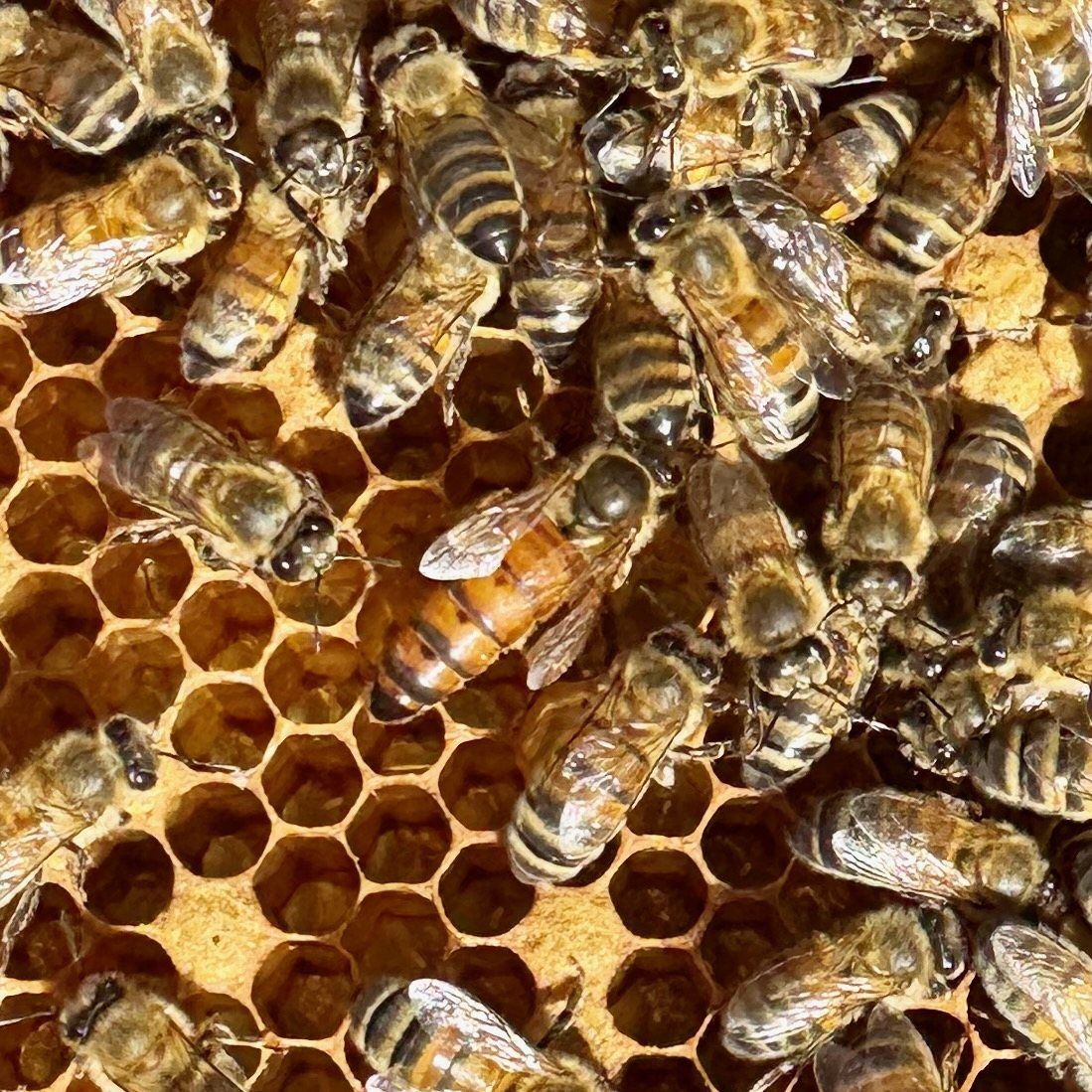
A virgin queen flies to drone congregation areas during her first two weeks and, according to IFAS, mates with about 15 drones, storing their sperm for life. Her colony is a patchwork of subfamilies, each made of workers sharing one father.
| Relationship between two workers | Coefficient of relatedness | Why |
|---|---|---|
| Same father (super-sisters) | 0.75 | they share the whole paternal genome and half the maternal one |
| Different fathers (half-sisters) | 0.25 | only the maternal half is shared |
| Worker and her mother | 0.5 | as in any diploid animal |
Polyandry pays off. Heather Mattila and Thomas Seeley at Cornell compared 12 queens each inseminated with sperm from 15 drones against 9 queens each inseminated with one drone, in a study published in Science in 2007. According to Cornell, within two weeks the genetically diverse colonies had built about 30% more comb, stored 39% more food and foraged 27% to 78% more. By late summer they had about five times as many bees and eight times as many drones. About 25% of the diverse colonies were still alive a year after founding; every uniform colony starved.
Queen effects and worker effects
Every colony trait has two components:
- The queen effect (maternal effect): her laying rate, pheromones and own genes.
- The worker effect (direct effect): the behavior of daughters who each have a different father.
Modern breeding models estimate both. In practice, you never evaluate a queen alone. You evaluate a queen plus the drones she mated with, and her colony’s performance decides whether she was a good breeder.
How heritable are honey bee traits?
Narrow-sense heritability (h²) is the share of variation between colonies explained by genes passed on additively. The higher it is, the more a colony’s own performance predicts its offspring’s. It belongs to a population measured in a given environment by a given method, and it says nothing about whether one line is better than another.
| Trait | Estimated heritability | Population and source |
|---|---|---|
| Honey yield | 0.02 (colony effect) to 0.11 | Swiss dark bee and Carnica, Guichard et al., Apidologie, 2020 |
| Calmness on the comb | 0.12 to 0.16 | Swiss dark bee, Guichard et al., 2020 |
| Defensive behavior | 0.32 to 0.34 | Swiss dark bee, Guichard et al., 2020 |
| Swarming drive | 0.06 to 0.07 | Swiss dark bee, Guichard et al., 2020 |
| Hygienic behavior (pin test) | 0.18 to 0.19 (dark bee); 0.06 to 0.09 (Carnica) | Guichard et al., 2020 |
| Varroa infestation and mite growth | close to zero | Guichard et al., 2020 |
| Suppression of mite reproduction | 0.46 | Harbo and Harris, Journal of Economic Entomology, 1999 |
What the numbers mean
- They are rough. The Swiss study followed about 1,000 colonies in each of two populations from 2009 to 2018, and standard errors were often as large as the estimates.
- Mite counts are a poor selection tool. Varroa infestation showed almost no additive genetic signal. Drifting, robbing, brood levels and sampling swamp it. In the US, where colonies are often trucked to almonds in California in February and then on to other crops, mite loads reflect neighbors even more.
- Precise traits inherit better. John Harbo and Jeffrey Harris at USDA-ARS in Baton Rouge obtained a heritability of 0.46 for suppression of mite reproduction, using 28 colonies in 7 groups of 4, each group headed by queens inseminated with semen from the same sire colony. Measuring a mechanism inside brood cells, rather than a whole-colony mite count, is what led to VSH bees.
- Temper responds to selection. Defensive behavior is among the more heritable traits, which is good news for beekeepers requeening hot colonies.
What can a breeding program achieve? Lessons from BLUP
US breeders rarely publish breeding values, but the best evidence on what systematic selection can do comes from Europe. BeeBreed, the database for Apis mellifera carnica run from the Länderinstitut für Bienenkunde in Hohen Neuendorf, Germany, ranks queens with BLUP (best linear unbiased prediction), the method Charles Henderson developed for dairy cattle. BLUP combines a colony’s performance with its relatives’ and corrects for yard and year. Andreas Hoppe and colleagues reviewed the program in Insects in 2020:
| Indicator | Value |
|---|---|
| Queens with breeding values (February 14, 2020) | 224,081, of which 195,458 were performance tested, in 12 countries |
| Index scale | mean 100, standard deviation 10 |
| Varroa index | hygienic behavior and mite infestation development weighted 57:43 |
| Honey gain, 1992 to 2018 | more than 5 kg (11 lb) per colony |
| Yearly gain, 2009 to 2018 | about 336 g (0.74 lb) of honey; 0.73 percentage points of pin test clearance |
| Average inbreeding | peaked at up to 10% around 1980, about 4% since 2000 |
Common test protocols, controlled mating at mating stations, a shared register of breeders and inbreeding monitoring all contributed. The authors are candid about limits: correlations between breeding values and later performance were only 0.15 for honey, about 0.25 for gentleness and calmness and 0.17 for swarming. Hygienic behavior was the best predicted trait and mite infestation the worst, and varroa traits were recorded in only about 15% of tests.
Mite-resistant stocks: what American programs achieved
Hygienic behavior and Minnesota Hygienic bees
Hygienic workers detect, uncap and remove dead or diseased brood. The trait protects against American foulbrood and chalkbrood, and to some extent varroa. Marla Spivak began selecting Minnesota Hygienic bees at the University of Minnesota in 1993. In SARE-funded field trials, hygienic colonies showed good resistance to American foulbrood in 1998 and 1999 and, after a year without treatment, significantly lower varroa levels than commercial stock while producing as much honey.
Penn State Extension’s liquid nitrogen test is the standard field protocol. Push two 2-inch (5 cm) metal rings into capped worker brood at the pink or purple-eyed stage, about 100 cells each, pour in about 35 ml of liquid nitrogen per ring, let it boil off, then add about 40 ml more. Return the frame and score after 24 hours. A colony qualifies as hygienic if it removes at least 95% of the frozen brood in two separate tests, with 10 or fewer cells left out of 200. Wear cryogenic gloves and eye protection.
VSH: from SMR to a defined trait
The Baton Rouge lab first selected for suppression of mite reproduction (SMR), the observation that in some colonies many mites leave no adult daughter. It then found that the main mechanism was workers removing infested pupae, and renamed the trait varroa sensitive hygiene (VSH). According to eXtension:
- workers about 15 to 18 days old detect and uncap infested cells, and other bees remove the pupa;
- in VSH colonies only about 30% of mites reproduce successfully, and about 55% are infertile or lay no eggs;
- VSH bees respond strongly to heavy infestations (15 to 25 mites per 100 capped cells) and much less to light ones (1 to 5 per 100);
- they mostly remove unpigmented or lightly pigmented pupae and are much less hygienic toward infested drone brood;
- recapping of opened cells reached 38% in VSH colonies, against 19% in hybrids and 17% in controls (Villa and colleagues, 2010);
- hybrids, VSH queens open mated to unselected drones, keep significant resistance, though less than the pure line.
In a 2004 to 2006 trial in Alabama, reported by Robert Danka and colleagues in 2008, on average 12% of VSH colonies reached the treatment threshold at any sampling time, against 24% of Russian and 40% of Italian colonies. In the authors’ words, the need for treatment of VSH colonies “was half that of Russian colonies and 30% that of Italian colonies”.
Pol-line bees
Pol-line bees are a VSH line that ARS developed in 2014, building on selection begun at Baton Rouge in the late 1990s. In a study announced by ARS in April 2022, colonies were followed in commercial operations in Mississippi, California and North and South Dakota:
| Varroa treatment | Pol-line winter survival | Standard colonies |
|---|---|---|
| No fall treatment | 62.5% | 3% |
| Treated in fall and December | 72% | 56% |
Russian bees from Primorsky
In 1997, USDA-ARS imported 100 queens from the Primorsky territory of far eastern Russia, where honey bees had coexisted with varroa far longer than in Europe or America. In February 1998 the colonies were moved to apiaries near Baton Rouge and challenged with inoculation packages averaging 1,797 workers and one mite for every 6.9 bees. Forty queens were chosen as breeders. Their brood infestation averaged 48.1%, against 65% to 75% in non-resistant colonies. The lab planned multi-state field trials of mite resistance and honey production before any general release to beekeepers, and the stock later went to queen breeders.
Purdue mite-biters
Purdue University in Indiana began breeding for mite resistance in 1997, first selecting for grooming and, from 2007, for mite biting: workers that chew the legs of varroa on adult bees. The share of fallen mites with chewed legs rose from about 3% to nearly 50%. Breeder queens go out through the Indiana Queen Breeders Association and the Heartland Honey Bee Breeders Cooperative.
The fine print
The Honey Bee Health Coalition’s 2026 varroa guide lists these stocks but warns that there is “no standardization or labelling for ‘varroa-resistant’ stock”. The 2020 review by Matthieu Guichard and colleagues at Agroscope, in Genetics Selection Evolution, notes that Russian and VSH lines in North America have recorded lower losses, but also that trait expression depends heavily on environment: in one study mite removal by VSH doubled after colonies were fed sugar syrup, and season, temperature, humidity, forage and brood amount all shift the results. Ask any producer how the line was tested, and keep monitoring. Our guide to varroa mites covers alcohol washes, thresholds and EPA-registered treatments.
How do you control mating?
Without control of the drones, half the genes in your workers come from the neighborhood. The options:
| Method | Control of paternity | Strengths | Limits |
|---|---|---|---|
| Open mating | none | free, well mated queens | local drones dilute selected traits within a generation |
| Isolated mating yard | good to very good | many drones from chosen colonies | few truly isolated sites near farmland and suburbs |
| Drone saturation | partial | works in an ordinary yard | improves the odds, guarantees nothing |
| Instrumental insemination | complete | planned crosses, single-drone matings possible | skill, equipment, inbreeding risk in a closed line |
Hoppe and colleagues trace mating stations back to 1870, at Hroby in today’s Czech Republic, with the oldest still running, Gehlberg in Germany, dating from 1911. After multiple mating was discovered in 1954, stations came to be stocked with drone colonies headed by sister queens, so the father side is at least a known line. US queen producers use the same idea when they surround mating yards with drone colonies of their chosen stock.
Instrumental insemination is how breeder queens in the VSH, Pol-line and mite-biter programs are produced. Single-drone matings help fix a trait or test a sire, as Harbo and Harris did, but in a closed population one father per queen drives up inbreeding and loses csd alleles much faster than natural polyandry. Our guide to instrumental insemination covers the technique.
Why is the US honey bee gene pool closed?
The Honeybee Act of 1922 restricted imports of honey bees from countries where the tracheal mite was known, to keep it out of the US (it was nonetheless found in Texas in 1984). Today, under federal rules at 7 CFR part 322, USDA APHIS allows adult queens and packages into the continental US only from Canada and New Zealand. Colonies in hive bodies cannot be imported from any country, and adult bees from elsewhere are limited to research permits.
The result is a population with little new genetic input, much of it produced each spring by a limited number of large queen and package producers in California and the Southeast. New genetics now arrive mostly as germplasm (semen), which APHIS allows from a short list of countries, including France, Great Britain and Sweden, under set conditions. Washington State University received a USDA permit to import honey bee semen in 2008, described it in 2016 as the only such permit in the country, and has collected semen in Italy, Slovenia, the Republic of Georgia and Kazakhstan. It stores it in liquid nitrogen at -320°F (-196°C) in what it describes as the only honey bee germplasm repository in the world, to widen the genetic base of US stock and help breeders adapt bees to regional climates.
For a hobbyist, this means that buying queens from several producers, or raising queens from your own best survivors, adds diversity both to your yard and to the drones flying in your area.
Africanized genetics in the South and Southwest
African honey bees, A. m. scutellata, escaped in Brazil in 1957 and spread north; USDA-ARS lists the first US swarm near Hidalgo, Texas, in October 1990. By 2004, ARS listed them in southern California, Arizona, New Mexico, Nevada and Texas. The genetics explain why they spread through managed apiaries:
- Mating: ARS reports that European queens mate disproportionately with African drones, which Africanized colonies produce in large numbers.
- Dominance: queen behavior and defensiveness are among the African traits that are genetically dominant, so even a partly Africanized colony can be hard to work.
- Nest usurpation: Africanized swarms move into European colonies and replace the queen, which reached 20% to 30% of colonies in Arizona studies.
In these areas, open-mated queens are a gamble. Buy marked queens from inspected, certified producers, requeen any colony with an unmarked queen or a sudden change in temper, and follow your state’s rules. Florida, Texas and other southern states have their own registration and colony placement rules, so check with your state apiarist or department of agriculture.
Why do so many selection efforts fail?
| Cause | Mechanism | Remedy |
|---|---|---|
| Open mating | local drones supply half the workers’ genes | isolated yards, insemination, drone saturation |
| Low or misjudged heritability | colony performance depends mostly on environment | many sister colonies, comparisons within one yard and year |
| Noisy mite counts | drifting, robbing, migratory moves, sampling | cell-level traits (VSH, SMR), repeated washes |
| Environmental effects | syrup, season and pesticides change trait expression | standard protocols, testing in several yards |
| Small breeding populations | loss of csd alleles, spotty brood, inbreeding | many unrelated breeder queens, semen exchange |
| Test versus reality | strong test scores may not keep colonies alive | survival records over several winters |
| Mite adaptation | one resistance mechanism could select mites that bypass it | combine traits, keep monitoring |
| Africanized introgression | African drones and dominant traits | certified queens, prompt requeening |
How can a hobby beekeeper improve the genetics of their bees?
You do not need an insemination rig. A realistic plan for a few 10-frame or 8-frame Langstroth hives:
- Record every colony the same way each season. Temper, calmness on the comb, spring buildup, swarming, honey yield in lb (kg), winter survival and an alcohol wash of about 300 bees (half a cup) on fixed dates. Compare colonies in the same yard and year.
- Test hygienic behavior on your best colonies. If liquid nitrogen is impractical, freeze a section of capped brood in a home freezer, but always use the same method and reading time.
- Raise queens from your two or three best colonies only, judged over two seasons, and requeen the worst. Our guide to queen rearing gives the schedule.
- Saturate your area with good drones. Put drone comb in your best colonies in spring and remove it from poor ones.
- Bring in good genetics regularly. A VSH, Pol-line, Russian, Minnesota Hygienic or mite-biter queen from a reputable producer adds tested traits, and her drones spread them locally.
- Join a breeding effort. Many state beekeeping associations and university programs run queen-rearing or survivor-stock projects, and pooled records beat any single yard.
- Diversify if brood turns spotty with no disease: it often points to matched csd alleles and too narrow a base.
Regional notes
- Northeast, Midwest and Northern Plains: long winters reward stock that winters in small clusters; northern-raised Carniolan, Russian and mite-resistant lines are popular.
- South and Gulf Coast: long seasons and early springs suit Italian-type stock, but Africanized drones make certified, marked queens important in Texas, Florida and neighboring states.
- California: the heart of US queen and package production and of February almond pollination, so a large share of the country’s genetics starts here every spring.
- Pacific Northwest: mild, wet winters and late springs favor stock from northern producers over early southern packages.
What it costs
At October 2026 prices, a naturally mated production queen costs roughly $45 to $50; Lappe’s Bee Supply in Iowa, for example, lists a Carniolan queen at $44.95, with $4 for marking and free shipping only on orders of three or more. Instrumentally inseminated breeder queens from mite-resistance programs cost much more, but one breeder queen can mother hundreds of daughters.
Genetics is not a substitute for management
A VSH or hygienic queen lowers the risk of mite trouble; it does not remove it. Your colonies share drones, drifting bees and robbers with every yard within a few miles. Treat breeding as a long-term investment that works alongside regular mite monitoring, good nutrition and prompt reporting of disease to your state apiarist. The articles in our breeding section go deeper into each technique.
Frequently asked questions
Why does a drone bee have no father?
A drone develops from an unfertilized egg, so it carries one set of 16 chromosomes, all from its mother. Sex in honey bees is set by the csd gene: one copy makes a male, two different copies make a female. A drone has a mother and a maternal grandfather but no father, and every sperm cell it produces carries an identical copy of its genome.
Can a spotty brood pattern be genetic?
Yes. When a queen mates with a drone carrying one of her two csd alleles, half the fertilized eggs from that drone become sterile diploid males, which workers remove as young larvae. The empty cells leave a shotgun pattern. Inbreeding makes it more likely. Rule out a failing queen and brood disease first, and contact your state apiarist if you suspect American foulbrood.
Are VSH bees treatment-free?
Not reliably. In a three-year Alabama trial, VSH colonies needed treatment about half as often as Russian colonies and 30% as often as Italians, and Pol-line colonies survived winter far better without fall treatment. But expression varies with season, feeding and reinfestation from nearby apiaries. Keep doing alcohol washes and treat with an EPA-registered product when counts pass your threshold.
What is the difference between Russian bees and VSH bees?
Russian bees descend from about 100 queens USDA-ARS imported in 1997 from Primorsky in far eastern Russia, where bees had long lived with varroa, and were selected as a closed population. VSH bees were bred at the Baton Rouge lab from US stock for one specific trait: removing pupae from cells where mites reproduce. Both reduce mite growth by different routes.
How heritable is honey production in bees?
Low to moderate. A Swiss study published in Apidologie in 2020 estimated 0.02 to 0.11 depending on population and effect. Even so, the large European Carnica program using BLUP breeding values gained about 336 g (0.74 lb) of honey per colony per year from 2009 to 2018. Low heritability means you need records on many related colonies kept the same way.
Can I import queens from Europe to improve my bees?
No. Under federal rules at 7 CFR part 322, USDA APHIS allows queens and packages into the continental US only from Canada and New Zealand, and whole colonies from nowhere. New European genetics arrive as semen, which APHIS accepts from a few listed countries under set conditions. Washington State University has held a USDA permit to import honey bee semen since 2008.
Do I need instrumental insemination to breed better bees?
No. Most hobby beekeepers improve stock by keeping records, raising queens from their two or three best colonies, requeening the worst and flooding the area with drones from good colonies. Insemination gives complete control of the father and is how breeder queens for VSH, Pol-line and mite-biter programs are produced, but it takes training, special equipment and enough colonies to avoid inbreeding.
Do Africanized bees change the genetics of my colonies?
They can, in the South and Southwest. USDA-ARS reports that European queens mate disproportionately with African drones, which Africanized colonies produce in large numbers, and defensiveness is among the African traits that are genetically dominant. An open-mated queen can come back a hybrid. Buy marked queens from certified producers and requeen any colony that turns defensive or has an unmarked queen.
Sources
- European honey bee, Apis mellifera Linnaeus and subspecies (EENY-568/IN1005), University of Florida, IFAS Extension
- Sex determiner gene of honey bee more complicated than previously assumed (Lechner et al., Molecular Biology and Evolution, 2013), Phys.org, from the University of Cologne
- An answer to the mystery of wanton queen honeybees: promiscuity produces more productive colonies (Mattila and Seeley, Science, 2007), Cornell Chronicle, Cornell University
- Estimates of genetic parameters for production, behaviour, and health traits in two Swiss honey bee populations (Apidologie, 51, 876-891, 2020), M. Guichard et al., Springer
- Substantial genetic progress in the international Apis mellifera carnica population since the implementation of genetic evaluation (Insects, 11, 768, 2020), A. Hoppe et al., MDPI
- Heritability in honey bees of characteristics associated with resistance to Varroa jacobsoni (Journal of Economic Entomology, 92(2), 261-265, 1999), J. R. Harbo and J. W. Harris, Oxford University Press
- Varroa sensitive hygiene and mite reproduction, Bee Health, eXtension (land-grant university extension network)
- Advances and perspectives in selecting resistance traits against the parasitic mite Varroa destructor in honey bees (Genetics Selection Evolution, 52, 2020), M. Guichard, V. Dietemann, M. Neuditschko and B. Dainat, Springer
- Evaluating the Russian bee, USDA-ARS, Honey Bee Breeding, Genetics and Physiology Laboratory, Baton Rouge
- Status of bees with the trait of varroa sensitive hygiene (VSH) for varroa resistance (American Bee Journal, January 2008), R. Danka et al., USDA-ARS
- ARS-developed varroa-resistant honey bees better winter survivors (April 7, 2022), USDA Agricultural Research Service
- Our breeding program (mite-biter bees), Purdue University, Department of Entomology
- A sustainable approach to controlling mite pests of honey bees (project LNC97-117), SARE, USDA
- Tools for Varroa Management, 9th edition (2026), Honey Bee Health Coalition
- Honey bees and other bees: import requirements, USDA APHIS
- Importing frozen honey bee sperm is key to conservation (2016), Washington State University
- Honey bee breeding program design: testing for hygienic behavior, Penn State Extension
- What's buzzing with Africanized honey bees? (Agricultural Research, March 2004), USDA-ARS
- Tracheal mite, USDA-ARS, Bee Research Laboratory, Beltsville
- Carniolan queen bee (price checked October 2026), Lappe's Bee Supply