Types of beehives: Langstroth 10-frame and 8-frame, top-bar, long hive and Warré compared
Types of beehives compared for US beekeepers: Langstroth 10-frame and 8-frame, deeps vs mediums, top-bar, long hive and Warré: sizes, weights, laws and prices.
The main types of beehives in the US are the Langstroth, in 10-frame and 8-frame widths, the horizontal top-bar hive, the long (horizontal) Langstroth and the Warré. The Langstroth is the national standard: nearly all packages, nucs, frames and accessories are sold to its dimensions, every bee club teaches on it, and its removable frames satisfy state inspection laws without argument. For most beginners it is the right first hive. The alternatives earn their place for specific reasons, such as lighter lifting, natural comb or a low-intervention approach, and they come with trade-offs in honey yield, inspection and equipment sharing that this guide sets out.
What are the main types of beehives?
American hives fall into two families.
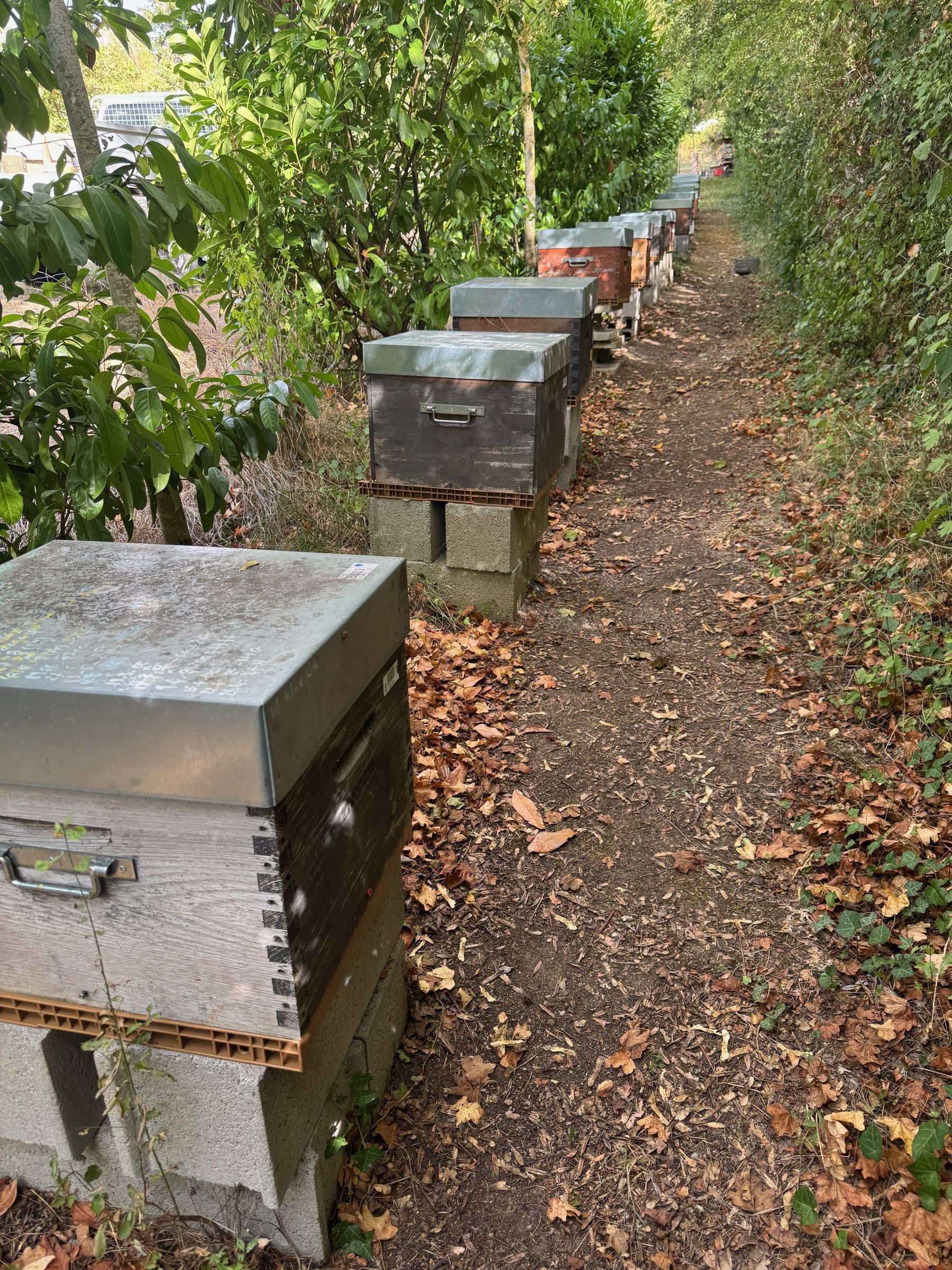
- Vertical framed hives: wooden frames hang in stackable boxes. The colony raises brood in the lower boxes (hive bodies) and stores surplus honey in supers above. The Langstroth, in its 10-frame and 8-frame versions and its deep, medium and shallow depths, dominates this group so completely that most US beekeepers never see anything else.
- Movable-comb and horizontal hives: the horizontal top-bar hive (sometimes called a Kenyan top-bar), where the bees build natural comb from wooden bars in one long box; the long Langstroth, a horizontal box that takes standard deep frames; and the Warré, a vertical stack of small square boxes with top bars and no frames.
Every design depends on bee space, the corridor of about 1/4 to 3/8 in (6 to 9.5 mm) that bees keep open. Lorenzo Langstroth’s patent of October 5, 1852 built a whole hive around it, so that each frame could be lifted out without cutting comb. Gaps smaller than bee space fill with propolis, larger ones with burr comb.
Why did the Langstroth win in America?
Lorenzo Lorraine Langstroth, a Congregational minister, worked out his hive in 1851 and patented it the following year, according to the Smithsonian. Before him, simple box hives were the usual American hive, alongside straw skeps and hollow-log gums; their combs were fixed, so honey could only be taken by cutting comb out. Langstroth’s frames could be lifted, examined and put back, and every box of the same size was interchangeable. That interchangeability is still the reason for its dominance: commercial beekeepers, queen breeders, package producers and equipment makers all built their businesses around it, and today’s state inspection systems assume it.
Hives you should not start with
- Skeps, box hives and log gums: fixed-comb hives that cannot be inspected comb by comb. In states such as Illinois, a hive that cannot be readily inspected is a nuisance under state law; elsewhere they still make disease checks and varroa treatment very difficult.
- Observation hives: glass-sided hives of one or a few frames, excellent for teaching, schools and nature centers, but too small for a colony to live in year-round without careful management and regular splitting.
- Imported European formats: Dadant-Blatt or other European frames are sold online, but nothing else in the US will fit them, from nucs to extractor baskets.
How do the hive types compare?
| 10-frame Langstroth | 8-frame Langstroth | Horizontal top-bar | Long Langstroth | Warré | |
|---|---|---|---|---|---|
| Layout | vertical stack | vertical stack | one long box | one long box | vertical stack, added from below |
| Comb support | frames, with foundation or foundationless | frames | bars only | standard deep frames | bars only (framed variants exist) |
| Box size | about 16 1/4 x 19 7/8 in (41 x 50.5 cm) outside | same length, two frames narrower | often 3 to 4 ft (90 to 120 cm) long | a long row of standard deep frames side by side | 11 13/16 x 11 13/16 x 8 1/4 in (300 x 300 x 210 mm) inside |
| Heaviest single lift | full deep, over 60 lb (27 kg) | about 20% less | one comb | one frame | the whole stack, when adding a box |
| Honey harvest | extractor, cut comb, sections | extractor, cut comb | cut comb or crush and strain | extractor (deep frames) | crush and strain, cut comb |
| Fits standard nucs? | yes | yes, with 5 deep frames | no, the nuc must be cut in or a package used | yes | no |
| Inspection | quick | quick | slower, fragile comb | quick, at waist height | slow, combs often fixed to walls |
Box depths for the Langstroth
The Mid-Atlantic Apiculture Research and Extension Consortium (MAAREC) gives these heights:
| Box | Height | Frame height | Weight full of honey (10-frame) |
|---|---|---|---|
| Deep | 9 5/8 in (24.4 cm) | 9 1/8 in (23.2 cm) | over 60 lb (27 kg) |
| Medium (Illinois or Dadant depth) | 6 5/8 in (16.8 cm) | 6 1/4 in (15.9 cm) | about 40 lb (18 kg) or more (estimate) |
| Shallow | 5 11/16 in (14.4 cm) | 5 3/8 in (13.7 cm) | about 35 lb (16 kg) |
MAAREC gives no medium weight; the figure above is scaled from its deep and shallow figures by frame depth, and a heavily capped medium can weigh more. With 3/4 in (19 mm) walls, a 10-frame deep holds roughly 2,600 cubic inches, or 42 liters. That is close to the cavity of about 40 liters that swarms chose in Thomas Seeley and Roger Morse’s classic study of nest-site selection. Two deeps give a colony about twice the space it would pick in a tree, which is what makes large honey crops possible.
10-frame or 8-frame Langstroth: which is better?
Both use the same frames and differ only in width.
| Criterion | 10-frame | 8-frame |
|---|---|---|
| Availability | the US standard; every supplier, nuc producer and pollination operation | widely sold, but fewer nucs and used boxes |
| Weight of a full deep | over 60 lb | about a fifth less |
| Cost per frame of comb | lowest | slightly higher |
| Stack height for the same colony | lower | taller, more boxes |
| Winter cluster | wide box; the cluster may move up one side and leave stores behind | narrow, closer to a tree cavity |
| Mixing | frames fit 8-frame boxes | frames fit 10-frame boxes; boxes, covers and bottom boards do not |
- Pick 10-frame if you want the cheapest, most widely supported gear, plan to buy nucs and expand, or may rent hives for pollination. Migratory beekeepers run 10-frame deeps on pallets of four with flush migratory lids so that forklifts can load them.
- Pick 8-frame if lifting is your limit, if you are building a hive for a garden where height is not a problem, or if you like a narrow stack that matches the bees’ tendency to move up through winter.
Whichever width you choose, buy every box, cover, bottom board, excluder and feeder in that width.
Deeps, mediums or both?
Cooperative extension guidance, summarized on the eXtension Bee Health site, recommends two deeps or three mediums for the brood nest, accepts one deep plus one medium, and treats one deep plus one shallow as the minimum. MAAREC adds that an all-shallow brood nest is possible but is the most expensive and time-consuming setup.
| Setup | Advantages | Drawbacks |
|---|---|---|
| Two deeps | most common, cheapest per comb, every nuc fits | heaviest lifts |
| Three mediums | one frame size for brood and honey, lighter boxes | more boxes and frames, queen harder to find, nucs must be ordered on mediums |
| Deep plus medium | a compromise for milder regions | two frame sizes in the brood nest |
| Single deep | packages, nucs, splits, comb honey hives | too small for a full colony through a northern season |
MAAREC also notes that fewer than half of beekeepers use a queen excluder. With an excluder or without, keep 10 frames (or 9 plus a follower board) tight together at about 1 3/8 in (35 mm) centers in the brood nest; spacing wider produces burr comb and drone comb. For dimensions, frame types and seasonal management, see our full guide to the Langstroth hive.
Horizontal hives: top-bar and long Langstroth
The horizontal top-bar hive
A top-bar hive is one long box, usually with sloping sides, covered by a row of wooden bars from which the bees hang natural comb. There are no frames, no foundation, no supers and usually no excluder. The brood nest sits near the entrance and honey is stored toward the far end, behind a follower board that the beekeeper moves to give space. As an example of what is on the market, Mann Lake lists an unassembled pine top-bar hive kit with 28 bars and a follower board with a feeding port at $324.50 in October 2026, shipped as a package of about 50 lb.
| Strengths | Limits |
|---|---|
| no box lifting; you work one comb at a time at waist height | new comb is soft and can break off the bar in summer heat; never turn a comb flat |
| natural comb; no foundation to buy | combs cannot be spun in an extractor, so honey is cut or crushed and strained |
| easy to see the colony’s progress bar by bar | wax is removed at each harvest and rebuilt, so surplus is lower |
| cheap to build from lumber | bars are not standardized between makers, and Langstroth frames do not fit |
| quiet inspections, little disturbance | splits, uniting and installing a nuc need improvisation |
Does the design change colony health? The evidence is thin. A Northeast SARE-funded study led by James Harding of Green Mountain College set up 16 top-bar and 16 Langstroth colonies at apiaries in Amherst, Massachusetts. The average peak weight gain was 22 lb for the top-bar colonies and 17 lb for the Langstroths, a difference the authors found not statistically significant. Only 2 of the 32 colonies survived the winter, both in top-bar hives, and the authors could not determine why the others died, suggesting late package arrival and poor queen mating. They called the results mostly inconclusive. In other words, pick a top-bar hive for the way it works, not for a health promise.
The long Langstroth
A long Langstroth is a single horizontal box that takes a long row of standard deep Langstroth frames. It keeps the top-bar hive’s main advantage, no lifting of heavy boxes, while staying compatible with deep nucs, deep frames of brood from other hives and a standard extractor. Some beekeepers add medium supers on top in a strong flow. The trade-offs are size and weight (the hive itself cannot easily be moved), and in cold winters a cluster can drift to one end of the long nest and starve beside honey it cannot reach. In the North, crowd the colony to one end with a follower board in fall.
The Warré hive: how does it work?
Abbé Émile Warré designed his “people’s hive” in France in the first half of the 20th century. The metric plans by David Heaf, based on the 12th edition of Warré’s Beekeeping for All (1948), give each box an inside size of 300 x 300 x 210 mm (about 11 13/16 x 11 13/16 x 8 1/4 in), crossed by top bars 315 mm (12 3/8 in) long with 12 mm (about 1/2 in) gaps between all bars and between the end bars and the walls. A quilt box filled with straw or wood shavings sits on a cloth over the top box, under a ventilated gabled roof.
The Warré expands downward. Bees naturally build comb down, so the beekeeper adds empty boxes underneath (nadiring) and harvests the top box when it is full of honey. Each box holds only about 1,150 cubic inches (19 liters), less than half a Langstroth deep.
| Strengths | Limits |
|---|---|
| small boxes close to a natural cavity’s shape | adding a box underneath means lifting the whole stack, or using a hive lift |
| quilt and thick walls insulate well | combs are often attached to the walls and must be cut free to be inspected |
| low cost, no foundation | small crop, harvested by crush and strain |
| suits a hands-off style | slower inspections make varroa sampling and disease checks harder |
Framed Warré variants, with removable frames or bars with side bars, make inspection easier and are worth considering in states with strict inspection language. For building plans and seasonal management, see our full guide to the Warré hive.
Wood, polystyrene or Flow frames?
- Pine is the US standard for Langstroth boxes. Paint the outside with exterior latex or dip in wax; leave the inside bare.
- Cedar is lighter and more rot-resistant, at a higher price.
- Polystyrene Langstroth-compatible boxes are popular in the coldest northern states for their insulation. Check frame fit and bee space before mixing them with wooden gear.
- Flow frames are plastic frames that let honey drain out of the comb through a tap, without removing frames or uncapping. Flow’s own guidance puts seven Flow Frames in a 10-frame deep-depth super and six in an 8-frame one. They change nothing about brood management, varroa control or swarm prevention.
Insulation matters more than once believed. The University of Leeds reported that Derek Mitchell’s work, published in the Journal of the Royal Society Interface, found typical hives with 19 mm (3/4 in) wooden walls lose about seven times more heat than a tree nest with walls about 6 in (150 mm) thick. In cold regions, a winter wrap or an insulated top cover closes part of that gap on any hive type.
Does your region change the best hive?
The US runs from Minnesota winters to south Florida, so the right hive depends on where you keep bees.
Northeast and upper Midwest
Long winters favor a tall, vertical Langstroth: two deeps, or a deep and two mediums, so the cluster can move up onto its stores. Cornell University’s guidance for upstate New York calls for at least 80 lb (36 kg) of honey for a full-size colony, a whole-hive weight of about 160 lb (73 kg), roofing-felt wraps, a small upper entrance for moisture and cleansing flights, and mouse guards before the cluster forms. Top-bar and long hives can winter here, but only with a compact nest held against one end by a follower board.
Southeast and Gulf states
Winters are short and colonies fly most days, so the danger is starvation in dry spells and dearths rather than cold. Single deeps with a super of honey left on are common; UF/IFAS Extension notes that a full super can be left on a Florida hive as winter food. In the South, Africanized bees are also part of the picture: UF/IFAS reports that African honey bees have been present in Florida since at least the early 2000s and nest at high densities in south Florida. A defensive colony is much harder to manage in a top-bar hive, where combs come out one at a time and slowly, than in a Langstroth, and beekeepers there buy queens from reputable breeders and requeen hot colonies.
California and the West
California is the center of migratory pollination. The farmdoc daily analysis by University of Illinois economists estimates that the 2024 almond bloom needed about 2.7 million colonies, and that on January 1, 2024, 37% of all US honey bee colonies were in California. Colonies on that circuit live almost entirely in 10-frame Langstroth deeps on pallets. If you hope to rent bees to growers, start with that equipment.
Pacific Northwest
West of the Cascades, damp is the enemy more than cold. Ventilation, an upper entrance and a dry roof matter more than the box shape; insulated covers help prevent condensation dripping on the cluster.
What yield to expect
USDA NASS reports that US honey-producing colonies averaged 48.0 lb (21.8 kg) in 2025, almost all from Langstroth hives. Expect less from a top-bar or Warré hive, because the comb is destroyed at each harvest, and little or none from any hive in its first year from a package or nuc.
What do state laws say about hive types?
No federal law sets hive design. Federal agencies regulate varroa products (EPA) and honey labeling (FDA), while apiary registration and inspection belong to each state, and city or county ordinances may add setbacks or colony limits. Never assume one state’s rule applies in yours. A few examples:
- Illinois: the Bees and Apiaries Act (510 ILCS 20/2-1) declares “hives that cannot be readily inspected” to be nuisances, along with diseased colonies. A Langstroth clearly qualifies as inspectable; for a frameless hive, the question is whether the inspector can examine each comb.
- Florida: Chapter 586 of the Florida Statutes requires every beekeeper with colonies in the state to register with the Department of Agriculture and Consumer Services, and UF/IFAS explains that registered beekeepers receive a number to mark on each hive body.
- Pennsylvania: the Pennsylvania Department of Agriculture states that registration is mandatory, costs $10 for about two years, and that seasonal inspectors check apiaries from May to mid-October.
Smithsonian Magazine notes that removable frames are now required by law in most states; the practical reason is that inspectors must be able to examine each comb for American foulbrood. Top-bar and Warré combs hang from movable bars, so they can usually be lifted, but state wording differs. Before you buy a frameless hive, call your state apiarist or state department of agriculture, and see our overview of beekeeping laws by state.
Varroa treatment in any hive
Varroa reaches every colony, whatever the hive. Only EPA-registered pesticides may be used against varroa mites, following the label; EPA’s list, updated September 17, 2026, includes amitraz (Apivar), oxalic acid (Api-Bioxal and others), formic acid (Formic Pro, Mite Away Quick Strips), thymol (Apiguard, Api Life Var), hop beta acids (HopGuard 3) and several others. Labels are written for Langstroth brood boxes, so in a top-bar or Warré hive you must work out placement and dose per colony while still following the label.
The Honey Bee Health Coalition’s ninth edition of Tools for Varroa Management (June 2026) recommends an alcohol or soap wash of about 300 bees (1/2 cup) from the brood nest, and treatment at 1 or more mites per 100 bees in the dormant and population-increase phases, and 2 or more in the peak and decline phases. Sampling is fastest with frames; with free comb, shake bees from a brood comb into a tub carefully. Our page on varroa mites covers monitoring and treatment in detail.
Which beehive is best for a beginner?
For most new US beekeepers, a Langstroth: 10-frame if you want the standard, 8-frame or all-medium if you want lighter boxes. Start with two hives, so that you can move a frame of eggs from one to the other if a colony goes queenless, and buy everything in one width and one brood depth.
Match the hive to your situation
| Your situation | Recommended hive | Why |
|---|---|---|
| first hive, local club uses Langstroth | 10-frame Langstroth, two deeps | standard nucs, mentors, resale |
| lifting is a concern | 8-frame, or all-medium 10-frame, or long Langstroth | lighter boxes, or no box lifting |
| northern winters | Langstroth, two deeps or deep plus two mediums, insulated top | vertical cluster movement, room for 80 lb of stores |
| Africanized bees likely (Deep South, Southwest) | Langstroth | fast inspections and requeening |
| future pollination contracts | 10-frame deeps | the industry standard on pallets |
| natural comb, small crop, close observation | top-bar or Warré, ideally after a season on a Langstroth | no foundation, low cost |
A buying checklist
- Ask your local bee club or extension service what most members use, and match it. Classes, mentors and spare frames will fit.
- Order bees on the same frames. Nucs are almost always five deep Langstroth frames. For a top-bar or Warré hive, buy a package, usually about 3 lb of bees and a queen.
- Budget for the whole hive. In October 2026, Mann Lake lists an assembled 10-frame kit with a screened bottom board, one deep, one medium, 20 frames with plastic-coated foundation, an inner cover and a telescoping cover at about $227 to $237, and an assembled deep box at about $40. Add a second brood box, supers, a feeder, a hive tool, a smoker and a veil; our list of beekeeping equipment for beginners has the details.
- Check your state’s rules on registration and inspectable hives, and your local zoning, before the bees arrive.
- Plan your site and varroa monitoring now. Our guide on where to put a beehive covers sun, wind, water and neighbors.
Once your first colonies are thriving, try a top-bar, a long hive or a Warré alongside them. Keeping one Langstroth in the yard means you always have a frame of eggs or brood to rescue a colony, whatever its hive.
Frequently asked questions
What is the best type of beehive for a beginner?
For most beginners in the US, a 10-frame or 8-frame Langstroth. Nucs and packages are sold for it, bee clubs and extension classes teach on it, and every supplier stocks parts. It also meets state inspection rules without question, because each comb sits in a removable frame. Choose 8-frame boxes, or mediums only, if you want lighter lifts. Try a top-bar or Warré hive once you have a season of experience.
Is a top-bar hive better than a Langstroth?
Not better, different. A top-bar hive spares you lifting heavy boxes and costs little to build, and you work one comb at a time at waist height. But its natural combs are fragile, cannot go in an extractor and yield less honey. A small Massachusetts study funded by SARE compared 16 hives of each type and found no statistically significant difference in peak colony weight.
Should I choose 8-frame or 10-frame boxes?
Choose 10-frame if you want the cheapest, most common equipment and plan to buy nucs, sell bees or rent hives for pollination. Choose 8-frame if weight is your limit: two fewer frames take about a fifth off every box. Frames fit both widths, but boxes, covers, bottom boards and feeders do not, so buy all your woodenware in one width.
Should I use deeps or mediums for the brood nest?
Extension guidance accepts both. Two deeps are the most common and cheapest per frame, and almost every nuc is sold on deep frames. Three mediums give one frame size throughout the hive and lighter lifts, but cost more and make the queen harder to find. A full deep can weigh over 60 lb (27 kg), so many beekeepers with back problems go all-medium.
Are top-bar and Warré hives legal in every state?
There is no federal rule on hive design, but many states require hives that inspectors can open and examine comb by comb. Illinois, for example, declares hives that cannot be readily inspected a nuisance. Top-bar and Warré combs hang from movable bars and can usually be inspected, but wording differs by state, so ask your state apiarist before buying a frameless hive.
How much does a beehive cost in 2026?
At Mann Lake in October 2026, an assembled 10-frame kit with one deep, one medium, 20 frames, inner and outer covers and a screened bottom board costs about $227 to $237, and an assembled deep box about $40. An unassembled top-bar hive kit with 28 bars is $324.50. Add a second brood box, supers, a feeder, tools, protective gear and the bees themselves; ask local suppliers or your bee club for current package and nuc prices.
What hive is best for cold northern winters?
A Langstroth with two deeps, or a deep and two mediums, is the standard choice in the Northeast and upper Midwest. Cornell advises leaving at least 80 lb (36 kg) of honey on a full-size colony, wrapping the hive and giving it an upper entrance. Some northern beekeepers use insulated polystyrene boxes. Long horizontal hives can winter well but the cluster may get stranded away from its stores.
Can I put a Flow frame in any hive?
Flow frames are made for Langstroth hives: a deep-depth Flow Super holds seven Flow Frames on a 10-frame box or six on an 8-frame box. They do not fit top-bar or Warré hives. They let you drain honey from the comb without removing frames. Everything else stays the same: you still inspect the brood nest, monitor varroa, control swarming and follow your state's registration and inspection rules.
Sources
- Beekeeping equipment, Mid-Atlantic Apiculture Research and Extension Consortium (MAAREC)
- Wooden components of a modern bee hive, Bee Health, Cooperative Extension (eXtension)
- The secret to the modern beehive is a one-centimeter air gap, Smithsonian Magazine
- Does the Flow Super fit an 8 or 10 frame Langstroth hive?, Flow (Honeyflow) support
- 10 Frame Complete Hive Kit Combo (price and contents), Mann Lake
- 10 Frame Assembled 9 5/8" Commercial Grade Deep Hive Box (price and dimensions), Mann Lake
- Top Bar Hive Kit, unassembled (price and contents), Mann Lake
- Comparative influences of hive architecture in Apis mellifera fitness (ONE12-159, final report), J. Harding and V. Hetzel, Northeast SARE
- Warré hive plans, metric (version 1.2, 2011, after the 12th edition of Beekeeping for All), D. Heaf, biobees.com
- Nest site selection by the honey bee, Apis mellifera (Insectes Sociaux 25, 323-337, 1978), T. D. Seeley and R. A. Morse, Springer
- Research challenges beliefs on honeybee insulation (work of D. Mitchell), University of Leeds
- Overwintering, Cornell University, College of Agriculture and Life Sciences, Pollinator Network
- Tools for Varroa Management, 9th edition (June 2026), Honey Bee Health Coalition
- EPA-registered pesticide products approved for use against varroa mites in bee hives (updated September 17, 2026), U.S. Environmental Protection Agency
- Bees and Apiaries Act, 510 ILCS 20/2-1 (nuisances), Illinois General Assembly
- Florida Statutes, Chapter 586: Honeybee Technical Council and apiary regulation (2025), The Florida Senate
- Keeping bees in Florida (ENY-134), UF/IFAS Extension
- Apiary and pollinator services, Pennsylvania Department of Agriculture
- Where have all the honey bees gone? To California almond orchards (farmdoc daily 15:30, 2025), B. Goodrich and A. Altschuler, University of Illinois
- Honey (March 2026 report, 2025 data), USDA National Agricultural Statistics Service