Asian hornet in the UK: how to identify it, report it and protect your hives
Asian (yellow-legged) hornet in the UK: how to identify it, how to report a sighting, what happens to nests, the 2026 figures and how to protect your hives.
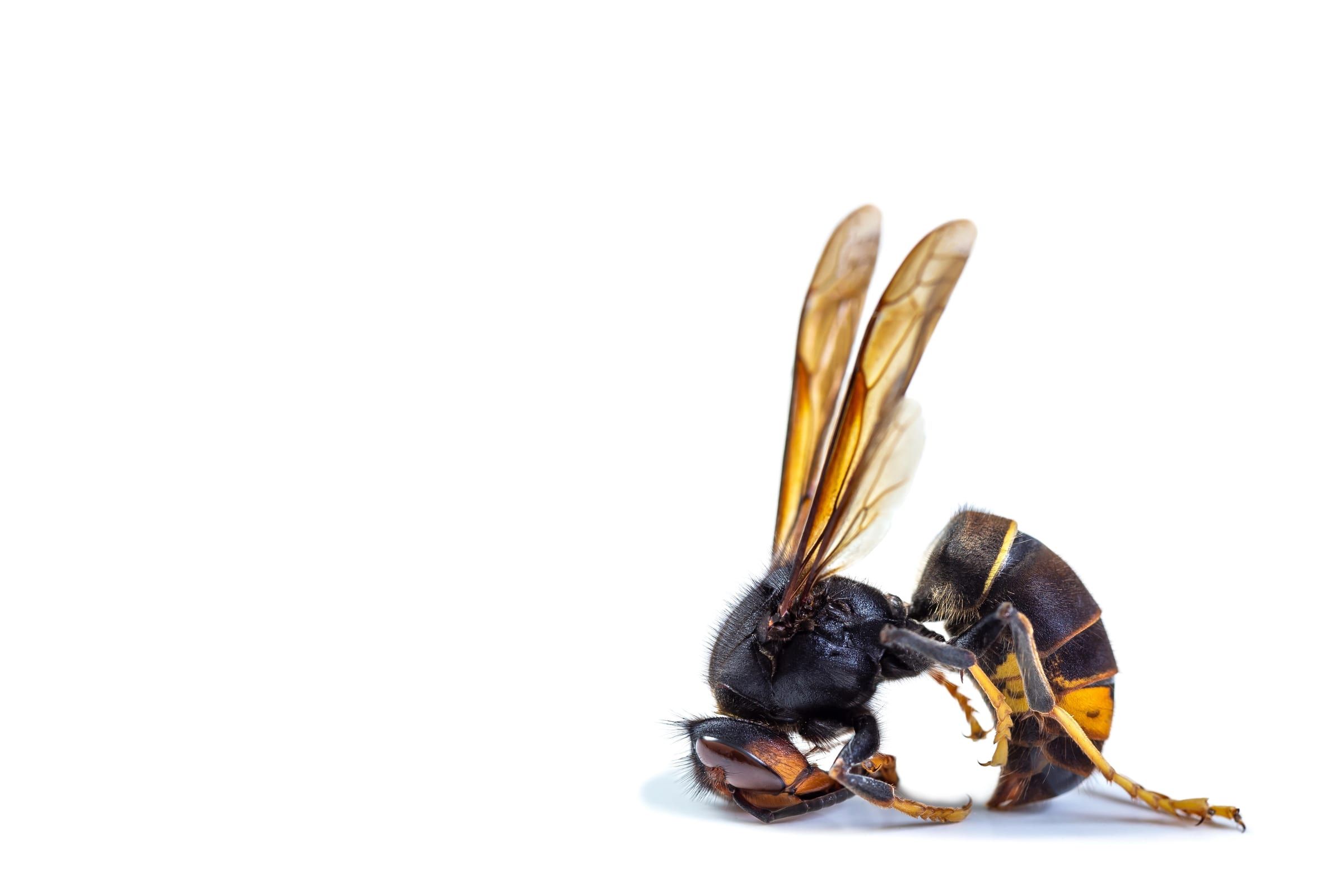
The Asian hornet, now officially called the yellow-legged hornet (Vespa velutina), is an invasive hornet first found in the UK near Tetbury, Gloucestershire, in September 2016. You can recognise it by its dark, velvety body, a single broad yellow-orange band on the fourth abdominal segment and legs that are yellow at the tips. It hunts honey bees in front of hives from midsummer to late autumn. If you think you have seen one, photograph it from a safe distance and report it through the Asian Hornet Watch app or the online form, with the location and your contact details. Do not touch a nest: in England and Wales the government response, led by the National Bee Unit, finds and destroys nests. In 2025 that response dealt with a record 163 nests, and 85 had been found by mid-October 2026.
Asian hornet or yellow-legged hornet: what changed in the name?
Defra, the Animal and Plant Health Agency (APHA) and its National Bee Unit (NBU) have moved from “Asian hornet” to “yellow-legged hornet”. The APHA science blog explains that the change is meant to reduce misidentification: there are several Asian hornet species, and the yellow legs are the feature a member of the public is most likely to notice. The Welsh Government, the Scottish Government and DAERA in Northern Ireland use both names in their notices. The reporting app is still called Asian Hornet Watch, and most people still type “Asian hornet” into a search engine, so both names appear in this article. They mean the same insect, the subspecies Vespa velutina nigrithorax that spread from France across Western Europe.
How do you identify an Asian hornet?
The four features to check
The Scottish Government’s identification guide and the GB contingency plan give the same set of features:
- Thorax: dark brown to black and velvety, with no yellow markings.
- Abdomen: dark, with fine pale edges to the segments and one broad yellow-orange band on the fourth segment. This band is the single most reliable feature.
- Head: dark from above, with an orange face and brownish-red compound eyes.
- Legs: brown near the body and yellow at the tips, hence the new name.
Size helps less than people think. The contingency plan gives workers up to 25 mm and queens up to 30 mm, smaller than the native hornet. A queen caught in spring and a worker caught in September can look very similar to an untrained eye. The plan also notes that the yellow-legged hornet hunts only in daylight, so an insect battering a lit window at night is far more likely to be a European hornet.
Asian hornet vs European hornet
| Feature | Yellow-legged hornet (Vespa velutina) | European hornet (Vespa crabro) |
|---|---|---|
| Overall look | Dark, almost black | Brighter, chestnut and yellow |
| Thorax | Black, velvety | Reddish-brown and black |
| Abdomen | Dark, one broad yellow-orange band (4th segment) | Mostly yellow with black markings |
| Legs | Yellow tips | Brown |
| Size | Workers up to 25 mm, queens up to 30 mm | Larger; queens noticeably bigger |
| Activity | Daylight only | Can fly at night, often comes to lights |
| Typical nest | Spherical paper nest, small side entrance; often high in trees in late summer | In cavities: hollow trees, roof spaces, sheds |
| Status | Invasive non-native species | Native British species |
The European hornet is a native British insect. It takes some honey bees, but it is part of our fauna and killing it does nothing to protect your colonies.
Common British look-alikes
Most reports sent to the NBU turn out to be something else: the APHA science blog notes that of nearly 30,000 app reports in 2024, about 70 were credible. The usual culprits are:
- Hornet mimic hoverfly (Volucella zonaria): large, but with one pair of wings, more stripes and no paper nest.
- Giant woodwasp (Urocerus gigas): a horn-like spike at the tail and, in females, a long ovipositor; found near conifers.
- Common wasp (Vespula vulgaris): smaller and clearly striped yellow and black.
- Median wasp (Dolichovespula media): dark for a wasp, but with yellow markings on the thorax that the yellow-legged hornet never has.
- Large ichneumon wasps (Pimpla, Megarhyssa): slender, long ovipositors, no social nest.
If you are unsure, report it anyway with a photograph.
Where is the Asian hornet in the UK now?
From a single hornet to a record year
The first UK yellow-legged hornet was confirmed near Tetbury in September 2016. Defra set up a 3-mile surveillance zone and bee inspectors searched for the nest with traps and infrared cameras. Between 2016 and 2022 there were only one or two findings a year: the Scottish Government counts 23 confirmed UK sightings over that period. Then the numbers changed.
| Year | What the official sources record |
|---|---|
| 2016 to 2022 | 23 confirmed sightings in total, a handful of nests (Scottish Government, APHA) |
| 2023 | 72 nests at 56 locations in England (Scottish Government) |
| 2024 | 24 nests found between July and October (APHA science blog) |
| 2025 | 544 credible sightings; 163 nests on the NBU list (162 in England, plus one near Wrexham found in January 2026), mainly in Kent and East Sussex, with outliers in North Yorkshire, Cheshire and the Isles of Scilly |
| 2026 (to 15 October) | 226 credible sightings and 85 nests, more than half of them in Kent, others in Hampshire, East Sussex, Surrey, Dorset, Lincolnshire, Somerset, Norfolk and single sites as far north as Derbyshire and Greater Manchester |
The Scottish Government’s Bee Health Improvement Partnership report puts the running total at 270 nests confirmed and destroyed in England since 2016. Kent and East Sussex have carried most of the pressure every year since 2023, which fits their position opposite northern France, where the species has been established since the mid-2000s.
England, Wales, Scotland and Northern Ireland differ
- England: the NBU responds to credible sightings and destroys nests. From 2026, the GOV.UK sightings page has been withdrawn in favour of the BeeBase rolling update, and hornets and nests are no longer routinely sent for laboratory analysis, because specialists can usually confirm a sighting from a clear photograph.
- Wales: the Welsh Government announced its first confirmed finding, a dead nest near Wrexham, on 20 January 2026, and asked the NBU to act under the contingency plan. It then asked the NBU to run targeted spring trapping within about 5 km of the find near Caergwrle, from mid-April to the end of June 2026.
- Scotland: the Scottish Government says there has been no confirmed sighting. Its 2025 bee health report expects an incursion “at some point in the future”, notes that SASA staff were trained in nest and genetic analysis at Fera and the NBU in October 2025, and describes an in-field exercise to test readiness.
- Northern Ireland: a member of the public caught the first confirmed hornet in Dundonald, Belfast, on 10 October 2025. The Northern Ireland Environment Agency (part of DAERA) leads the response, and its 2020 rapid response contingency plan is under review.
Is the Asian hornet established in Britain?
The official answer is cautious. Fera kinship analyses of nests destroyed in England from 2016 to 2024, presented to the Bee Health Advisory Forum, suggested a “limited established population”, according to the NBU. The Scottish Government’s 2025 report still says there is no evidence that the hornet is established in the UK, and that the NBU and APHA are working to eliminate it in England. The two statements are not as far apart as they look: a few related nests surviving locally is not the same as the self-sustaining spread seen across France, and the policy in England remains to find and destroy every nest.
What did change is the scale of the late-season problem. Fera estimated that the 32 nests destroyed in England on or after 30 September 2025 had an 18 to 50 % probability of having already released reproductive males. The NBU used these 32 nests to draw higher-risk areas for spring 2026.
What is the life cycle of the Asian hornet in the UK?
Everything turns on one mated queen per colony. The contingency plan describes a UK calendar running from queens emerging in February or March to new queens hibernating in November or December. In a mild maritime climate the dates slip by a few weeks from year to year.
| Period | What the hornet does | What you can do |
|---|---|---|
| December to February | Only mated queens survive, hibernating alone in sheltered spots. Old nests die. | Nothing useful on empty nests. Join your local Asian Hornet Team. |
| February to April | Queens emerge on warm days and feed on early flowers such as camellias. Each queen builds a primary nest alone, from golf-ball to melon size, often in a dry outbuilding, shed or porch. | Check sheds, garages and empty hives. Report any small paper nest with a photo. |
| May to June | First workers emerge and take over foraging. The colony grows quickly. | Watch flowers and water sources near apiaries. |
| July to August | Many colonies move to a larger secondary nest, often high in a tree canopy where leaves hide it until autumn. Hawking at hives begins. | Fit entrance guards; watch hive fronts in the morning and late afternoon. Report every sighting. |
| September to October | Peak colony size. The contingency plan gives nests of up to about 6,000 individuals and around 350 potential queens per nest in autumn. Predation on honey bees is at its worst. | Keep colonies strong and fed; report hawking hornets quickly so they can be tracked. |
| October to November | New queens and males leave, mate and disperse. Workers and the old queen die off. | Late nests still matter: a nest destroyed before queens leave removes hundreds of future colonies. |
The plan also notes that hornets can fly dozens of kilometres in a single flight, and that the species spread through France at about 100 km a year. Together with queens carried in freight or vehicles, this helps explain isolated nests far from any known site, such as the 2025 finds in North Yorkshire and Cheshire.
To match these stages with your own hive work, see our beekeeping calendar.
How does the Asian hornet harm honey bee colonies?
Hawking at the hive entrance
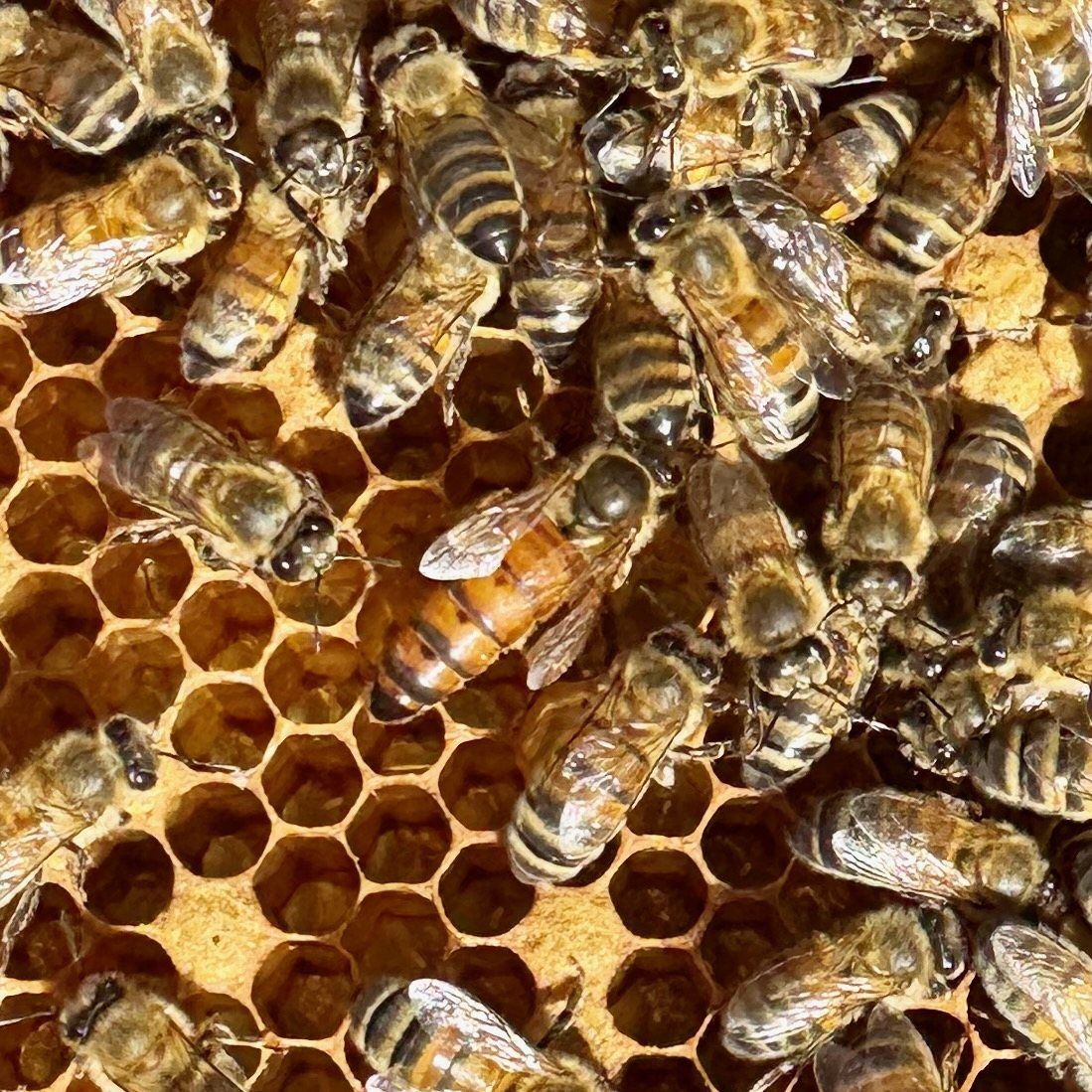
A yellow-legged hornet hunts by hovering a short distance in front of a hive, facing the entrance, and snatching returning foragers in mid-air. It carries the bee to a perch, discards the head, wings and abdomen and chews the flight muscles of the thorax into a ball of protein for its larvae. One hornet at a hive is a nuisance; a dozen hovering at once in September is a crisis for that colony. The contingency plan adds that weakened colonies can then be raided directly.
Foraging paralysis matters more than lost bees
The bees eaten are not the main problem. In a study combining field observations and modelling published in the Journal of Pest Science in 2019, Fabrice Requier and colleagues showed that hornets cause two effects: foragers that fail to return home, and a foraging paralysis in which the colony largely stops flying while hornets patrol the entrance. In their simulations the paralysis was a major driver of winter colony collapse. A colony that brings in little pollen in September raises fewer, poorer winter bees, and the damage shows up the following February or March, long after the hornets have gone.
This is why hornet pressure lands hardest on colonies already weakened by varroa mites or another honey bee disease. In the UK the late-summer varroa treatment window coincides with the start of hornet predation, so a well-timed treatment is one of the best indirect defences you have.
What the evidence does not yet show for Britain
There is no published estimate of how many British colonies have been lost to yellow-legged hornets. The numbers of nests found so far are small compared with France, and nests are destroyed as soon as they are found. Any figure you see quoted for UK losses should be treated with caution. The risk that matters for a British beekeeper is local: a single undetected nest within a kilometre or two of an apiary in September.
What should you do if you see an Asian hornet or find a nest?
Report it: the four details the NBU needs
The NBU can only follow up a report that includes a photograph, the location and your contact details. Report through:
- the Asian Hornet Watch app (free on iPhone and Android), the preferred route in all four nations;
- the online form on the UK Centre for Ecology and Hydrology RISC website (brc.ac.uk/risc), linked from the Non-Native Species Secretariat pages;
- email to [email protected], which the Scottish Government and the contingency plan both list.
In Northern Ireland, DAERA also accepts records through CEDaR’s online invasive species recording. In Scotland, the Scottish Government asks people to report to the GB Non-Native Species Secretariat and directs further questions to local area offices or [email protected].
Since 2026, hornets and nests in England are no longer routinely sent to the laboratory: a clear photo of the insect, on a flower, a trap or a hive front, is usually enough for a specialist to confirm it.
Leave the nest alone
- Keep well away and do not throw anything at it, spray it or try to knock it down.
- Photograph it from a distance, ideally with a hornet on or near it, and note the exact position and height.
- Warn neighbours and anyone cutting hedges or brambles nearby: secondary nests are often found when someone strims into one.
- Report it immediately.
How the government destroys a nest
Under the contingency plan for England and Wales, a credible report is triaged within one working day. A bee inspector visits, collects samples and searches the surroundings, within 500 m if nothing is found at first. Once a hornet is confirmed:
- the NBU runs a National Disease Control Centre and may set up a local base;
- beekeepers within a 20 km surveillance zone receive a BeeBase alert, inspections are prioritised within 2 km, and beekeepers within 5 km may be given traps; there are no movement restrictions on apiaries;
- inspectors track hornets back to the nest, using bait stations, observation of flight lines and, where licensed, tagging; the NBU holds licences from Natural England and Natural Resources Wales for activities such as releasing marked hornets;
- APHA wildlife officers, supervised by bee inspectors, destroy the nest with insecticide applied on long poles, helped by thermal imaging, and then remove it; brambles and undergrowth may be cut back to reach it.
When the first nest was found near Tetbury in 2016, Defra stated that APHA would cover the cost of eradication on private land. The response is still run by the state rather than by private pest controllers, so the right first step is always to report, not to call a contractor.
Should beekeepers trap Asian hornets?
The UK position in 2026
Trapping is where British practice differs most from what you may read on continental forums. Three points shape it this year:
- No government spring trapping in England. After the high number and wide spread of late-season nests in 2025, Defra decided in December 2025 not to ask the NBU to run spring queen trapping in England in 2026. The NBU was asked to concentrate on finding and destroying nests later in the season. Fera was also not commissioned to run genetic analyses of 2026 hornets.
- Local trapping by trained volunteers. The higher-risk areas drawn from the 32 late 2025 nests were shared with the BBKA teams coordinating spring trapping. In Wales, the Welsh Government asked the NBU to run targeted spring trapping around the Wrexham find.
- No lethal traps. The BBKA’s position statement says it actively promotes bait-station monitoring and “no kill traps” to minimise by-catch, and the NBU states that lethal traps kill beneficial insects and does not recommend them. In 2024, the NBU’s own programme of more than 600 traps checked over 14,000 times in hotspots over nine weeks caught only 13 queens, 19 in total with public and beekeeper reports. Spring trapping is labour-intensive and catches few queens.
What a selective monitoring trap looks like
The aim of a British monitoring trap is to see hornets, photograph them and report them, not to kill large numbers of insects. In practice that means:
- a trap with an exit for small insects, or a bait station you watch rather than a closed bottle where everything drowns;
- a sweet bait in spring, when queens are feeding on nectar, and a protein or sweet bait at bait stations from summer onwards;
- checking at least daily, releasing non-target insects alive and recording what you find, on BeeBase if you are part of an Asian Hornet Team;
- placing the trap at or close to your apiary, where hornets will arrive if they are around.
A monitoring station has another advantage: a hornet feeding at a bait station can be watched as it flies off. The direction and timing of these flights are how inspectors and trained volunteers find nests.
Join or contact your Asian Hornet Team
Asian Hornet Teams were set up by the BBKA, the Welsh Beekeepers’ Association and their member associations to work alongside the NBU. They raise awareness, monitor high-risk sites such as ports and distribution routes, follow up credible sightings locally and support the NBU during a response, for example by setting up and recording monitoring traps. Your local beekeeping association can put you in touch.
How can you protect your hives from Asian hornets?
No single method is enough. The goal is to reduce the number of hornets hovering in front of the hive and, above all, to keep the foragers flying.
Entrance guards and muzzles
A muzzle is a mesh cage fitted over the entrance. Bees pass through the mesh; a hornet can no longer hover right at the entrance and has to hunt further out, where it is less effective. In a French field study published in the Journal of Pest Science in 2020, Requier, Rome, Villemant and Henry compared 22 pairs of colonies, one with a muzzle and one without. The muzzle did not reduce the number of foragers that failed to return, but it drastically reduced foraging paralysis. In their simulations, it raised the survival probability of colonies under heavy hornet pressure by up to 51 %. The authors describe it as biodiversity-friendly, since it catches nothing.
On a National hive, fit the muzzle across the full width of the floor entrance, or use a reduced entrance with a mesh porch. Check that dead bees can still be cleared and that ventilation is adequate on warm days. Fit it at the first sign of hawking, usually in late July or August in southern England, and leave it until hornets stop coming, often in November.
Electric harps
An electric harp is a frame of vertical charged wires placed in front of the hives: bees fly through the gaps, while hovering hornets touch the wires and fall into a tray. A pilot study presented at the Neobiota conference in 2026 by Burbui and colleagues (University of Pisa, INBO and Ghent University) found that harps reduced hornet numbers in front of hives, possibly also at nearby hives without a harp. But the hornets that remained hunted for longer and were just as successful, which the authors read as a compensation strategy. Harps need a power source and regular maintenance and are still being evaluated. In Britain, where nests are destroyed as soon as they are found, most apiaries will never see enough hornets to justify one.
Apiary management in late summer
- Reduce entrances from August: a narrow entrance is easier for guards to defend and also limits robbing by wasps and other colonies during the late-summer dearth.
- Keep colonies strong: unite weak colonies before September rather than leaving them to face hornets and wasps alone.
- Treat varroa on time, so winter bees are reared healthy even if foraging slows.
- Check stores: a colony that stops foraging in September brings in less ivy nectar and pollen. Heft your hives and, if needed, feed your bees with syrup before winter.
- Choose an open site where you can see hive fronts easily; our guide on where to put a beehive covers the trade-offs.
- Watch and report: the single most effective thing a beekeeper can do in Britain is to spot hawking early and report it the same day, so the NBU can track the hornets to their nest.
Is the Asian hornet dangerous to people?
When the first hornet was found in 2016, Defra stated that the yellow-legged hornet is no more dangerous to people than a bee. Away from the nest it is not aggressive, and a single sting is painful but, for most people, short-lived. The real danger is disturbing a nest, for example while hedge-cutting or clearing brambles, and receiving many stings at once.
The NHS advice on stings applies:
- Call 999 if someone develops sudden swelling of the lips, mouth, throat or tongue, breathing difficulty, a tight throat, blue or grey skin or lips, sudden confusion or drowsiness, or collapses.
- Contact NHS 111 or a GP urgently if they were stung in the mouth, throat or near the eyes, were stung more than once, have had a serious reaction to a sting before, or symptoms get worse.
- For a simple sting: wash the area with soap and water, apply a cold pack for at least 20 minutes, raise the limb if possible, and use paracetamol or ibuprofen for pain and an antihistamine for itching.
Leave nest work to the response teams, who have specialist protective equipment.
What is the legal status of the Asian hornet in the UK?
Not a notifiable bee pest
Unlike American foulbrood, European foulbrood, small hive beetle or Tropilaelaps, the yellow-legged hornet is not a notifiable pest of bees. The Bees Act 1980, the Bee Diseases and Pests Control (England) Order 2006, its Welsh equivalent and the Bee Diseases and Pests Control (Scotland) Order 2007 do not apply to it, according to the GB and Scottish contingency plans. There is no statutory duty to report, although every official body asks you to.
An invasive alien species of special concern
Instead, the hornet falls under invasive species law:
- England and Wales: it is a non-native species under the Wildlife and Countryside Act 1981 and a “species of special concern” under the retained EU Regulation 1143/2014 on invasive alien species, enforced through the Invasive Alien Species (Enforcement and Permitting) Order 2019. Schedule 9A of the 1981 Act provides species control agreements and orders, which give the authorities control powers over invasive species.
- Scotland: the Scottish contingency plan points to the invasive non-native species provisions in sections 14 to 14P of the Wildlife and Countryside Act 1981 as amended, and to the same retained EU regulation, which requires Scottish Ministers to run surveillance and apply eradication measures to any detection.
- Northern Ireland: the response is led by the Northern Ireland Environment Agency within DAERA, under the Northern Ireland invasive alien species framework and contingency plan, both under review in 2025.
In practical terms, the listing means you must not keep, breed, transport or release live hornets. Do not bring a live hornet to a meeting in a jar, and do not release a hornet you have caught.
Who does what
| Body | Role |
|---|---|
| Defra (England) and Welsh Government | Policy leads; decide on strategy such as spring trapping |
| APHA National Bee Unit | Investigates reports, runs the response, oversees nest destruction, publishes updates on BeeBase |
| APHA wildlife officers | Field work, including nest destruction |
| Fera Science | Laboratory diagnosis, kinship analysis and risk mapping |
| GB Non-Native Species Secretariat and UKCEH | Receive and triage public reports |
| Scottish Government and SASA | Contingency planning, awareness and diagnostics in Scotland |
| DAERA and NIEA | Response in Northern Ireland |
| BBKA, WBKA and local associations | Asian Hornet Teams, volunteer monitoring and spring trapping in risk areas |
If you are new to the craft, this is one more reason to register your bees on BeeBase: the 20 km alerts that go out when a hornet is confirmed only reach beekeepers whose apiaries are on the system.
Frequently asked questions
Is the Asian hornet the same as the yellow-legged hornet?
Yes. Both names refer to Vespa velutina, the invasive hornet found in England since 2016. The National Bee Unit, Defra and the devolved governments now use yellow-legged hornet because the yellow tips of the legs are the easiest feature to spot and the new name reduces confusion with other Asian species. The reporting app is still called Asian Hornet Watch, so you will see both names side by side.
What should I do if I see an Asian hornet?
Take a clear photograph if you can do so safely, note the exact location and report it through the Asian Hornet Watch app or the online form on the UK Centre for Ecology and Hydrology RISC website. Include your contact details, because the National Bee Unit can only follow up reports that give a photo, a location and a way to reach you. Do not try to catch hornets near a nest.
Should I destroy an Asian hornet nest myself?
No. Keep your distance, photograph it from afar and report it. In England and Wales nest destruction is overseen by National Bee Unit bee inspectors and carried out by trained APHA staff with long poles, protective equipment and approved insecticide, after which the nest is removed. Disturbing a nest risks multiple stings and can scatter the colony, which makes it harder to find and destroy.
How many Asian hornet nests have been found in the UK?
Official figures give 72 nests in England in 2023 and 24 in 2024. In 2025 there were 544 credible sightings, and the NBU's rolling update lists 163 nests, one of them near Wrexham. The Scottish Government counts 270 nests destroyed since 2016. By 15 October 2026 the NBU had recorded 85 nests and 226 credible sightings for the year, more than half of the nests in Kent.
Is the Asian hornet dangerous to people?
Defra has said from the first UK detection that it is no more dangerous to people than a bee. A single sting is painful but usually harmless. The real risk is disturbing a nest and receiving many stings. Call 999 if someone develops swelling of the lips, mouth or throat, breathing difficulty, confusion or collapse after a sting, and call NHS 111 if they were stung several times.
Has the Asian hornet reached Scotland, Wales or Northern Ireland?
Wales announced its first confirmed finding, a dead nest near Wrexham, in January 2026. Northern Ireland recorded its first confirmed hornet, a single insect caught in Dundonald, Belfast, in October 2025. The Scottish Government says there has been no confirmed sighting in Scotland, although it considers an incursion likely and has a contingency plan, trained SASA staff and an awareness campaign in place.
Should beekeepers set Asian hornet traps?
Only selective, non-lethal ones, and preferably as part of your local Asian Hornet Team. The BBKA promotes no-kill traps and bait stations to keep by-catch down, and the NBU says volunteer teams should not use lethal traps because they kill beneficial insects. Defra did not commission NBU spring trapping in England for 2026, so local spring monitoring is organised through BBKA teams in higher-risk areas.
How can I tell an Asian hornet from a European hornet?
The yellow-legged hornet is dark: a velvety black thorax, a dark abdomen with one broad yellow-orange band on the fourth segment, an orange face and yellow-tipped legs. The native European hornet is bigger, with a reddish-brown thorax, a mostly yellow abdomen with black markings and brown legs, and it can fly at night. The European hornet is native and should be left alone.
Sources
- Yellow-legged hornet 2026 rolling update, APHA National Bee Unit (BeeBase)
- Yellow-legged hornet 2025 rolling update, APHA National Bee Unit (BeeBase)
- Yellow-legged hornet analyses (kinship analysis and 2026 arrangements), APHA National Bee Unit (BeeBase)
- Risk areas for yellow-legged hornets: spring trapping 2026, APHA National Bee Unit (BeeBase)
- The role of Asian Hornet Teams (AHTs), APHA National Bee Unit (BeeBase)
- Asian hornet contingency plan, public version (England and Wales), Defra, Welsh Government and APHA National Bee Unit
- Yellow-legged hornet monitoring and eradication in the UK, APHA Science Blog, GOV.UK
- Yellow-legged hornet (Asian hornet): UK sightings (withdrawn 26 August 2026), Defra and APHA, GOV.UK
- Asian hornet identified in Gloucestershire, Defra and APHA, GOV.UK
- First finding of yellow-legged hornet in Wales, Welsh Government
- Vigilance urged following confirmed record of Asian hornet in Belfast, DAERA, Northern Ireland
- Yellow-legged hornet: how to spot and report the pest, Scottish Government
- Asian hornet (Vespa velutina nigrithorax): pest-specific contingency plan, Scottish Government
- Bee Health Improvement Partnership (BHIP) annual report 2025: non-native invasive species, Scottish Government
- Position statements: yellow-legged Asian hornet, British Beekeepers Association
- Yellow-legged hornet and spring trapping, Hope Community Council, Flintshire
- Predation of the invasive Asian hornet affects foraging activity and survival probability of honey bees in Western Europe (F. Requier et al., 2019), Journal of Pest Science, vol. 92
- A biodiversity-friendly method to mitigate the invasive Asian hornet's impact on European honey bees (F. Requier et al., 2020), Journal of Pest Science, vol. 93, via Pestinfo
- Nearly fatal ambush: how electric harps could alter Vespa velutina predatory behaviour on Apis mellifera colonies (G. Burbui et al., 2026), ARPHA Conference Abstracts, Neobiota 2026
- Insect bites and stings, NHS