Varroa mites: monitoring, thresholds, UK-authorised treatments and husbandry control
Varroa in the UK: how the mite kills colonies, NBU monitoring methods and thresholds, VMD-authorised medicines, doses, resistance and the law in each nation.
Varroa treatment in the UK means three things done in order: count the mites, treat with a medicine authorised by the Veterinary Medicines Directorate (VMD) at the right moment, usually straight after the summer honey harvest and again in a broodless spell in winter, and use husbandry methods to slow the mite down in between. Varroa destructor is present in nearly every UK apiary. Left alone, it spreads viruses through the colony and kills it, usually in late summer or early autumn. This guide follows the National Bee Unit (NBU) methods and thresholds and the product information approved by the VMD as it stands in October 2026.
What is varroa and how does it breed?
A mite that arrived in England in 1992
Varroa destructor originally parasitised the Asian honey bee, Apis cerana, and moved onto the western honey bee, Apis mellifera, which has no natural defence against it. According to the NBU booklet Managing Varroa, the mite was first found in England in 1992 and now affects nearly all UK apiaries. The exceptions are few: the NBU names the Isles of Scilly, the Isle of Man and some remote parts of Scotland. AFBI dates its arrival in Northern Ireland to 2002.
A Defra evidence review describes varroa as “the most serious economic pest” of honey bees in England and Wales and puts its annual cost to UK beekeeping at over £27 million. The aim, then, is not eradication but keeping the mite below the level where it does damage.
Biology in brief
The figures below come from the NBU booklet.
- The adult female is flat, oval and reddish-brown, about 1.6 mm wide and 1.1 mm long: visible to the naked eye on a bee’s back or on a white tray.
- The male is smaller and pale and never leaves the brood cell.
- Lifespan: about 27 days when brood is present, and up to 100 days in broodless periods, which is how mites survive the winter on the bees.
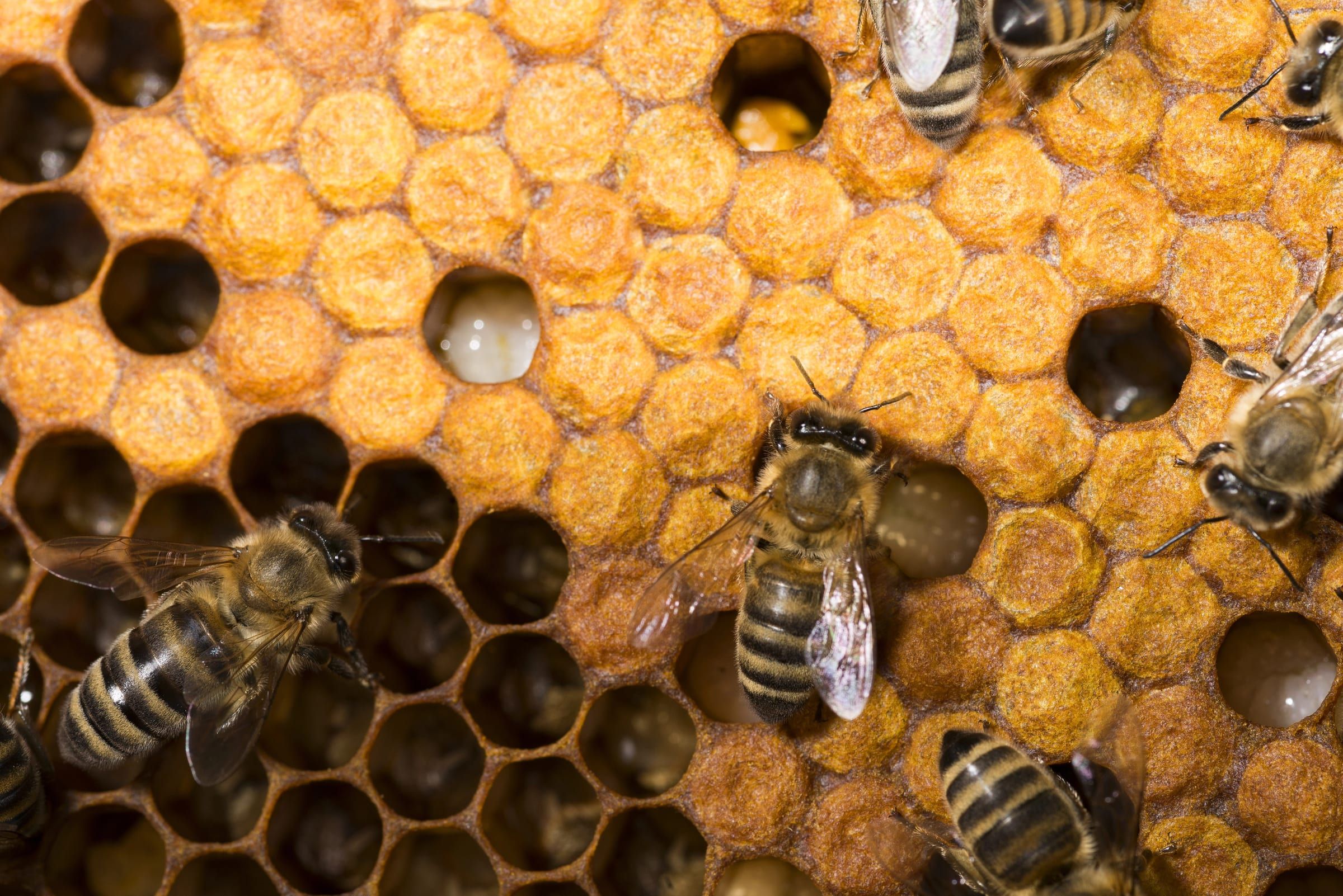
Reproduction happens only in sealed brood. The female enters a cell just before it is capped and lays her first egg 60 to 70 hours after capping, then four or five more at 30-hour intervals. The first egg gives a male; the rest give females, which mate with their brother inside the cell before the bee emerges.
Why drone brood matters
Drone cells stay sealed longer than worker cells, so more daughters reach maturity in them. The NBU gives about 1.7 to 2 new mites per mother in worker brood, against 2 to 3 in drone brood. Mites also prefer to invade drone cells. That preference explains two things: why mite numbers jump in spring when colonies rear drones, and why cutting out sealed drone brood works as a trap.
Over a season, the NBU says mite numbers can grow anywhere from 12 to 800-fold, and the population roughly doubles every four weeks when brood is plentiful.
Why does varroa kill colonies?
The mite weakens the bees it feeds on, but the real damage comes from the viruses it carries, above all deformed wing virus. The Defra review reports that deformed wing virus was found in 66% of the apiaries sampled in the first year of the 2009 to 2011 Random Apiary Survey and 75% in the second. Severe infestations cause varroosis: bees with stunted abdomens and crumpled wings, and dead bees at the entrance. The same review states that without suitable control most colonies in temperate climates would collapse within two to three years. The Hohenheim review by Rosenkranz and colleagues (2010) reaches the same practical conclusion for Europe and the USA: regular treatment is essential.
The late-summer trap
The NBU sets a UK damage threshold of 1,000 mites per colony, much lower than the 3,000 to 4,000 used in parts of Europe and the US. In late summer the bee population shrinks after the main flows, while the mite population is at its peak. That is exactly when the colony starts rearing the winter bees that must live for months. Bees parasitised and infected as pupae die early, and the cluster melts away.
The NBU notes that collapse usually takes only a few weeks, can strike colonies that looked strong, and is most common in the UK in August and September. A second wave happens in March, April and sometimes May, when mites from a dying colony invade neighbouring hives through robbing. Our page on the honey bee life cycle explains why winter bees are so different from summer foragers.
Signs of a heavy infestation
Look for bees with deformed wings, a patchy brood pattern, crawling bees, mites visible on adult bees without searching and a colony that dwindles fast in autumn despite having stores. These signs mean the threshold was passed weeks earlier. Our guide to honey bee diseases helps tell varroosis from foulbrood, which is notifiable and must be reported at once.
How do you monitor varroa?
The NBU asks beekeepers to monitor at least four times a season: in early spring, after the spring honey flow (oil seed rape in many arable areas), at the honey harvest and in late autumn. Count before and after every treatment too, or you will never know whether it worked.
Natural mite drop on an open mesh floor
Most UK hives, whether National, WBC, Commercial or 14x12, now sit on an open mesh floor with a removable tray. The NBU protocol:
- Clean the tray and slide it under the mesh. Smearing it with petroleum jelly or vegetable oil stops mites walking off and ants carrying them away.
- Leave it for at least 7 days in summer, longer in winter.
- Count the mites and divide by the number of days to get the average daily drop.
- Multiply by the seasonal factor in the table below to estimate the colony’s total mite population.
The NBU warns that the method is unreliable in broodless or collapsing colonies, and a single reading means little. The trend over several weeks tells you when to act.
Alcohol wash and sugar roll
These measure mites riding on adult bees and give a result as mites per 100 bees. The NBU fact sheet (April 2024):
- Shake or scoop about 300 to 400 worker bees, roughly half a cup, from a brood frame. Check the queen is not among them.
- Alcohol wash: cover the bees in 70% ethanol, shake, then pour through a mesh of about 2 mm that holds back the bees and lets the mites through. Count the mites.
- Sugar roll: shake the bees in icing sugar for 3 minutes, then shake the sugar and dislodged mites onto a white surface and return the bees to the hive.
- Divide the mite count by the number of bees and multiply by 100.
The alcohol wash kills the sample but is the more reliable of the two. The sugar roll keeps the bees alive but misses more mites, especially in damp weather or during a flow.
Uncapping drone brood
Lift sealed drone brood, ideally at the purple-eyed stage, with an uncapping fork and count the infested pupae. The NBU recommends examining around 300 drone pupae for an accurate figure. It is a quick check during a routine inspection in May and June, when the colony is producing drones anyway.
What varroa level should trigger treatment?
The NBU’s key number is the 1,000-mite threshold: treat before the colony reaches it. Here is what that means for each method.
Natural mite drop (NBU factors)
| Months | Multiply the daily drop by | Daily drop that signals about 1,000 mites |
|---|---|---|
| November to February | 400 | about 2.5 |
| March, April, September, October | 100 | about 10 |
| May to August | 30 | about 33 |
Example: an average of 6 mites a day in late March gives 6 × 100 = 600 mites. The colony is below the threshold but on its way, so plan a treatment or a husbandry method before the summer peak.
Adult bees and drone brood
For alcohol wash, sugar roll and drone uncapping, the NBU uses the same two marks:
| Result | Meaning |
|---|---|
| 3 mites per 100 bees or pupae, or fewer | acceptable |
| more than 5 mites per 100 | serious infestation, urgent treatment |
Between 3% and 5%, the colony is heading for trouble: re-test within a week or two and plan treatment. For drone brood, the NBU booklet adds seasonal thresholds: under 2% infested is fine in April to June, but more than 4% calls for control; in June and July the trigger is 7%, and in August, 10%.
Which varroa treatments are authorised in the UK?
Only veterinary medicines authorised by the VMD may be used on bees without a prescription. The NBU Bee medicines fact sheet (June 2025) lists the following varroa products. The VMD Product Information Database, filtered to “Honey Bees”, is the live list: check it before you buy, because products are added and withdrawn.
| Product | Active substance | Form | Notes |
|---|---|---|---|
| Apivar | amitraz | strips | synthetic |
| Apitraz | amitraz | strips | synthetic |
| Apistan | tau-fluvalinate | strips | pyrethroid, resistance documented in the UK |
| Apiguard | thymol | gel | |
| Apilife-VAR | thymol, camphor, eucalyptol, menthol | strips | |
| Thymovar | thymol | strips | |
| Formic Pro | formic acid | strips | reaches mites in sealed brood |
| Api-Bioxal | oxalic acid dihydrate | powder; solution in Great Britain only | |
| Oxybee | oxalic acid dihydrate | powder and solution | |
| Oxuvar | oxalic acid dihydrate | concentrate for solution | |
| Dany’s BienenWohl | oxalic acid dihydrate | powder and solution | |
| VarroMed | formic acid and oxalic acid | solution | |
| Varroxal | oxalic acid dihydrate | powder | Great Britain only |
“GB only” matters in Northern Ireland, where some authorisations differ under the post-Brexit arrangements: check the territory on each VMD product page.
Prescription and where to buy
Most varroa products are sold without a prescription. The Apivar and Api-Bioxal SPCs class them as not subject to prescription, and the VMD database lists VarroMed as AVM-GSL (Authorised Veterinary Medicine, General Sales List), so beekeeping suppliers sell them over the counter. As a price guide in autumn 2026, one UK supplier lists a 12-strip pack of Apivar at £31.49, enough for six colonies at two strips each, and another a 10-tray box of Apiguard at £27.50, enough for five colonies. Whatever you use, log the purchase and every treatment in a veterinary medicine record, which you must keep for 5 years.
What the law does not allow
The NBU is explicit: without a veterinary prescription, using an authorised medicine in a way that does not match its authorisation is an offence, and so is giving bees unauthorised products such as raw oxalic acid crystals or home-made thymol solutions. The BBKA relays a VMD warning that unauthorised varroa treatments are being advertised and sold, and the VMD asks beekeepers to report them. A vet can prescribe off-label or a foreign product through the cascade or a Special Import Certificate, which is the only legal route to anything outside the list.
How do you apply the main varroa treatments?
General rules: read the leaflet in the box, which overrides any guide including this one; wear nitrile gloves; never under-dose or leave strips in longer than stated; and treat every colony in the apiary at the same time so mites do not shuttle between hives.
Apivar (amitraz)
From the UK summary of product characteristics (SPC, revised March 2025):
- Use 2 strips per hive, a dose of 1 g of amitraz. The product is labelled for a single brood chamber; use on brood-and-a-half or double brood is not recommended.
- Push each strip between the top bars in the brood area or cluster, with at least 2 frames between them, so bees can reach both faces.
- Leave the strips 10 weeks if brood is present, or 6 weeks if brood is absent or minimal. Scrape and reposition strips covered in propolis or wax halfway through.
- Do not use during a honey flow or with honey supers on. The honey withdrawal period is zero days, but no honey may be taken from the brood chamber during treatment.
The SPC warns against use where amitraz resistance is known and recommends basing treatment on susceptibility tests where resistance is suspected.
Thymol: Apiguard, Thymovar, Apilife-VAR
Thymol works by evaporation, so it depends on warmth. Apiguard gel is the most familiar in the UK: one 50 g tray, opened, placed face up on the top bars over the cluster, with an eke or an inverted crownboard rim to give the bees room. After about 10 to 14 days a second tray replaces it for a further 2 to 4 weeks. The product works best above 15°C. That is the reason for applying it in August, while days are still warm, rather than in October. Thymol can make the queen stop laying for a while, and bees may beard at the entrance.
Formic Pro (formic acid)
Formic acid is the only active substance on the list that reaches mites inside sealed brood. It is also the harshest. The UK SPC (December 2025) sets:
- one sachet, that is two strips, per hive for 7 days, and at least a month between applications;
- daytime temperatures between 10 and 29.5°C on the day of application; heat in the first three days raises the risk of brood death and queen loss;
- no use on colonies of fewer than 10,000 bees;
- supers containing honey removed first, and any honey stored in supers added during treatment discarded.
Queen loss is listed as uncommon, and the SPC asks you to check the colony is queenright a month after treatment.
Oxalic acid: trickling and vaporising
Oxalic acid only kills mites on adult bees. It is very effective in a broodless colony and much less so when sealed brood is present. The Api-Bioxal powder SPC (January 2026) gives:
- Trickling: a 4.4% solution in sugar syrup (for example a 31 g bag in 500 ml of syrup made with 308 ml of water and 308 g of sugar), 5 ml per seam of bees, maximum 50 ml per hive, once. Up to two trickle treatments a year.
- Sublimation (vaporising): 2 g per hive with an electric vaporiser, hive closed for 15 minutes, once a year, not recommended in summer.
- No supers, no honey flow; honey withdrawal period zero days.
Oxybee, Oxuvar, Dany’s BienenWohl and VarroMed have their own concentrations and doses: follow each leaflet. Vapour is dangerous to the operator. The SPC requires an FFP2 mask, gloves and eye protection, and many beekeepers use a half-mask respirator with acid-gas filters for vaporising.
Varroa in winter: when to use oxalic acid
In winter the queen slows or stops laying, and for a few weeks every mite in the hive is riding on a bee within reach of oxalic acid. In much of the UK the most likely broodless window falls in December or early January, after a cold snap. Mild winters, especially in the south-west and in towns, can keep a patch of brood going: on a mild day, lift a frame from the edge of the cluster or check the debris on the tray for brood cappings.
The NBU advises using oxalic acid in winter and broodless periods when the outside temperature is above 3°C. Decide with a November drop count. At more than 2 or 3 mites a day at that time of year, the colony is already near 1,000 mites on the NBU factor of 400, and a winter treatment is justified.
Is varroa resistant to treatments in the UK?
Pyrethroids: the UK precedent
In August 2001, a national screening programme found mites resistant to the two pyrethroids then authorised, tau-fluvalinate (Apistan) and flumethrin (Bayvarol), in 25 apiaries in south-west England, with mites about ten times as tolerant as susceptible ones. Thompson and colleagues (Apidologie, 2002) linked the outbreak to product misuse. The Defra review reports that resistance became more common afterwards and that NBU trials of bringing pyrethroids back on its own colonies did not control the mites. The NBU booklet now names resistance to both tau-fluvalinate and amitraz.
Amitraz: watch your counts
With pyrethroids compromised, amitraz carries much of the synthetic load, and the Apivar SPC states that amitraz resistance has been reported in some mite populations. Where you suspect it, the SPC advises basing treatment on susceptibility tests and asking your local bee inspector or a vet.
What you can do
- Count before and after every treatment: a drop count during treatment and an alcohol wash a few weeks later show whether it worked.
- Rotate modes of action: amitraz one season, then thymol, formic acid or oxalic acid. Switching between Apistan and another pyrethroid is not a rotation.
- Never leave strips in beyond the stated time, and never reuse part-used strips.
- Report a suspected lack of efficacy to the VMD through its adverse event reporting scheme.
- Combine with husbandry methods, which select for no resistance at all.
Husbandry methods: drone brood removal, comb trapping, artificial swarm
The NBU booklet calls these husbandry or biotechnical methods. They rarely suffice on their own, but they cut mite numbers in the middle of the season, when medicines cannot go on because the supers are on.
Drone brood removal
Put a shallow frame or a frame without foundation at the edge of the brood nest in a National brood box. The bees draw it as drone comb and the queen fills it. Once sealed, cut the comb out and destroy it. The NBU says the method can be up to 50% effective at reducing mite numbers, with strict timing: check the capping after 18 to 20 days, never leave it unchecked longer than 24 days (drones emerge at 24 days and release the mites), and stop after July.
Comb trapping with a queen excluder cage
The queen is confined on one comb with a frame cage made of queen excluder. Mites then pile into the only open brood available. The NBU method uses three successive combs, nine days each, and is limited to May to July in the UK; each comb is destroyed once sealed. Combining it with an oxalic acid treatment once the colony is broodless greatly improves the result.
Artificial swarm
The classic Pagden artificial swarm, already part of most UK swarm control, doubles as varroa control. The NBU version: move the parent colony at least 4 metres away and put the queen in a new hive on the original site. After 9 days, leave one queen cell in the parent. After 21 days, the parent is broodless, its mites exposed, and bait combs or an oxalic acid treatment will catch them. Our page on swarming covers the method in detail, and queen rearing covers raising replacement queens.
Resistant stock
Interest in varroa-tolerant bees is growing in the UK, among breeders of the native dark bee (Apis mellifera mellifera) as well as Buckfast breeders selecting for hygienic behaviour. Selection is promising, but no UK stock yet lets you stop counting.
What does UK law say about varroa?
The rules differ between the four nations. That matters if you keep bees near a border or move colonies.
England, Wales and Scotland: varroa is reportable
Varroa is not a notifiable disease like American foulbrood, European foulbrood, small hive beetle or Tropilaelaps. But the Bee Diseases and Pests Control (Amendment) Orders 2021 made it a reportable pest in England, Wales and Scotland from 21 April 2021. In practice:
- if you find varroa, report it once by editing your apiary’s status on BeeBase, or use the BeeBase form if you are not registered;
- apiaries already registered before April 2021 were set to varroa-positive automatically, so you only need to contact the NBU to declare an apiary free of the mite;
- in Scotland, under the Bee Diseases and Pests Control (Scotland) Amendment Order 2021 alongside the 2007 Order, you can also report to the Scottish Bee Health team instead of using BeeBase.
The Welsh Government guidance follows the same rules for Wales. Registering on BeeBase is free and voluntary, but it is the simplest way to meet the reporting duty and to hear from your inspector about local disease: see our guide to registering your bees.
Northern Ireland: no statutory duty
AFBI states that varroa is no longer a statutory pest in Northern Ireland and that no inspections are carried out specifically for it. American and European foulbrood remain notifiable under the Bee Diseases and Pests Control Order (Northern Ireland) 2007. AFBI offers a free testing service for bee pests and diseases, and DAERA runs a free, voluntary register for beekeepers and apiaries in Northern Ireland, called DataBees.
Medicines and records apply everywhere
Across the UK, under the Veterinary Medicines Regulations:
- use only authorised products, according to their authorisation, unless a vet prescribes otherwise;
- keep a record of each medicine purchased (product, batch number, date, quantity, supplier’s name and address), administered (product, date, quantity, withdrawal period, colonies treated) and disposed of (date, quantity, how and where);
- keep those records and the proof of purchase for at least five years, even if the colony has died or left your hands. The NBU publishes a Veterinary Medicines Administration Record template.
If you sell honey under the Honey (England) Regulations 2015 or the equivalent rules in Scotland, Wales and Northern Ireland, these records also show you respected the withdrawal periods.
Varroa treatment calendar for the UK
A framework for a lowland apiary with a spring flow from oil seed rape or fruit blossom, a June gap and a main summer flow from clover, bramble and lime. Shift it for the north, for altitude and for heather. Our beekeeping calendar sets it in the full beekeeping year.
| Period | Goal | Actions |
|---|---|---|
| December to January | use the broodless window | check for brood on a mild day; single oxalic acid trickle or vaporisation if the November count justifies it |
| February to March | measure the overwintered load | tray under the mesh floor for 1 to 2 weeks; at more than 10 mites a day in March, treat before supers go on |
| April to July | slow the build-up | drone brood removal every 18 to 20 days, comb trapping or artificial swarm with swarm control, drop counts after the spring flow |
| June gap | check | alcohol wash or sugar roll on several colonies; a Formic Pro treatment in a hot spell is risky |
| Late July to end of August | protect the winter bees | take the honey off, then treat at once (Apivar, Apiguard while it is warm, or Formic Pro within its temperature range) |
| September | heather and late flows | colonies back from the heather moors are treated on return; thymol works poorly once days fall below 15°C |
| October to November | check the result | remove strips on schedule; tray count in November; plan a winter oxalic treatment if needed |
Heather beekeepers in Scotland, the North York Moors, Dartmoor and Wales face a dilemma: the heather flow runs through August, so the main treatment comes late. Some reduce the mite load in June and July with comb trapping or drone removal, so that the colonies go up to the moors with low counts.
Record every count, product and result. After two or three seasons, your notes will show when your apiary tips over the threshold and which strategy holds it back.
Frequently asked questions
When should I treat for varroa in the UK?
The main treatment goes on in late summer, as soon as the last honey is off, so that the long-lived winter bees are reared in a colony with few mites. The National Bee Unit calls this window especially important. A winter oxalic acid treatment in a broodless period is a common second step, and spring treatment is also used if counts are high before the supers go on.
How many varroa mites a day is too many?
It depends on the month. The National Bee Unit multiplies the average daily drop by 30 from May to August, by 100 in March, April, September and October, and by 400 from November to February, and advises treating before the estimate reaches 1,000 mites. That means roughly 33 a day in summer, 10 a day in spring or autumn and 2 or 3 a day in winter.
Is varroa a notifiable disease in the UK?
Varroa is not one of the notifiable diseases, but in England, Wales and Scotland it has been a reportable pest since 21 April 2021. You report it once, by marking your apiary as varroa-positive on BeeBase or, in Scotland, by contacting the Scottish Bee Health team. Apiaries registered before that date were set to positive automatically. In Northern Ireland, AFBI states that varroa is no longer a statutory pest.
Can I use oxalic acid from a hardware shop on my bees?
No. The National Bee Unit states that giving bees unauthorised products such as raw oxalic acid crystals or home-made thymol solutions is an offence unless a vet has prescribed them. Use an authorised product such as Api-Bioxal, Oxybee, Oxuvar, Dany's BienenWohl, VarroMed or, in Great Britain, Varroxal, and follow its label for the dose and method.
Can I treat for varroa with the supers on?
Generally not. The Apivar and Api-Bioxal summaries of product characteristics forbid use with honey supers or during a honey flow, and the Formic Pro summary requires honey supers to be removed before application and says honey stored in supers during treatment must not be eaten. Always read the leaflet in the box, because conditions differ from one product to another.
Do I need a prescription to buy varroa treatments?
Not for the usual products. The Apivar and Api-Bioxal summaries of product characteristics class them as not subject to prescription, and the Veterinary Medicines Directorate lists VarroMed as AVM-GSL, so beekeeping suppliers sell them over the counter. A vet is only needed to prescribe a product outside its authorisation under the cascade, or to import one authorised in another country through a Special Import Certificate.
What records must I keep of varroa treatments?
The National Bee Unit says you must record each medicine bought, used and disposed of, and keep the records for at least five years, even if the colony dies. Note the product, batch number, date, quantity and supplier when you buy, then the date, quantity, withdrawal period and colonies treated when you use it. Keep proof of purchase too.
Can a colony survive varroa without treatment?
In most of the UK, not for long. A Defra evidence review states that without suitable control most colonies in temperate climates would collapse within two to three years. Some beekeepers keep levels down with husbandry methods and careful monitoring, but that still means counting mites several times a season and acting fast. An untreated collapse also spreads mites to neighbouring apiaries through robbing.
Sources
- Managing Varroa (advisory booklet), Animal and Plant Health Agency, National Bee Unit
- Estimating Varroa mite populations (fact sheet, April 2024), National Bee Unit
- Bee medicines (fact sheet, June 2025), National Bee Unit
- Varroa: medicines, National Bee Unit, BeeBase
- Report Varroa, National Bee Unit, BeeBase
- Healthy honey bees, Welsh Government
- Honey bee health guidance: legislation, Scottish Government
- Bee health, Agri-Food and Biosciences Institute (AFBI), Northern Ireland
- Apivar 500 mg bee-hive strips for honey bees: summary of product characteristics (revised March 2025), Veterinary Medicines Directorate
- API-Bioxal 0.71 g/g bee-hive powder: summary of product characteristics (January 2026), Veterinary Medicines Directorate
- Formicpro 68.2 g beehive strips for honey bees: summary of product characteristics (December 2025), Veterinary Medicines Directorate
- VarroMed bee-hive dispersion: product details, Veterinary Medicines Directorate, Product Information Database
- Review of policies on managing and controlling pests and diseases of honey bees: evidence profile on Varroa, Defra
- First report of Varroa destructor resistance to pyrethroids in the UK (Thompson, Brown, Ball, Bew, Apidologie 33, 2002), Apidologie
- Beekeepers: voluntary registration (DataBees), Department of Agriculture, Environment and Rural Affairs (DAERA), Northern Ireland
- Reporting illegal medicines, British Beekeepers Association
- Biology and control of Varroa destructor (Rosenkranz, Aumeier, Ziegelmann, J. Invertebr. Pathol. 103, 2010), University of Hohenheim
- Apiguard, 10 trays (price and instructions), Abelo
- Apivar strips (price), Simon the Beekeeper