Queen rearing: grafting, cell builders, the day-by-day timetable, mating nucs and selection in the UK
Queen rearing in the UK: larva age for grafting, the NBU queenright cell builder, a day-by-day timetable, the Miller method, Apidea mating nucs and selection.
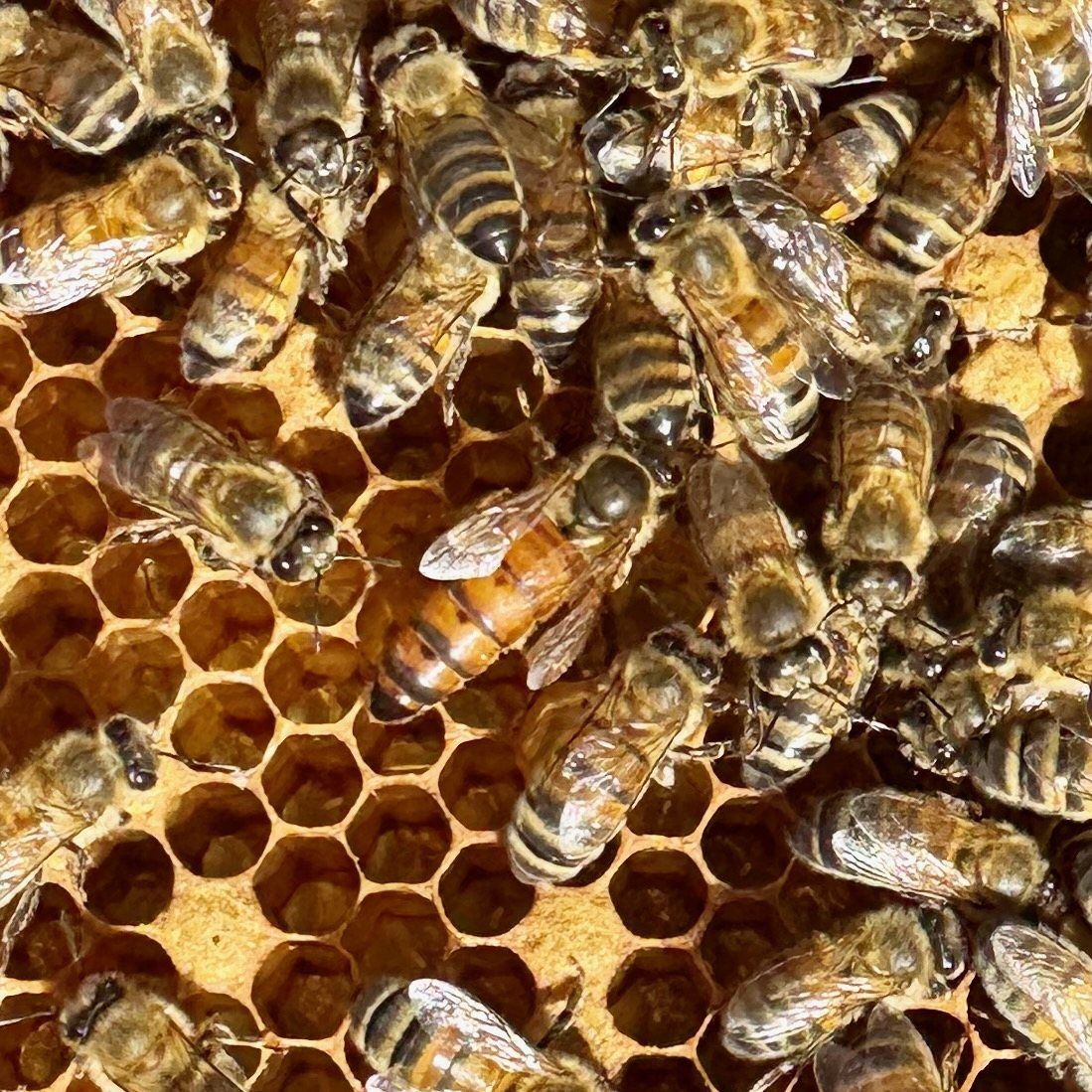
Queen rearing means getting a strong colony to raise a batch of queen cells from very young larvae of a colony you have chosen, then getting those virgin queens mated in small nucleus hives. Three numbers run the whole process: larvae 12 to 18 hours old at grafting, cells moved to mating nucs 11 days after grafting, and a wait of two to three weeks before you look for eggs. Everything else, from the cell builder to the drones and the selection records, exists to get those three steps right and to breed from the right mothers.
It is also a way to stop relying on imported stock. Great Britain imported between about 14,000 and 21,000 queens a year from the EU between 2018 and 2021, according to National Bee Unit (NBU) figures, while a Defra survey found that 41% of beekeepers felt they lacked the experience to raise their own.
Why rear your own queens in the UK?
A colony replaces its queen well on its own, by swarming, supersedure or emergency cells. What it will not do is choose: emergency cells often come from larvae that are too old, and the old queen’s faults pass on at random.
Deliberate rearing gives you:
- Choice of mother. You graft from your calmest, most productive, least swarmy and healthiest colony, using records rather than memory.
- Control of larval age, which is the main lever on queen quality.
- Numbers. A single cell builder can produce one or two batches of 24 cells a week, according to the NBU.
- A timetable. You know to the day when queens will emerge, which makes swarm control, splits and requeening predictable.
In 2017 Defra convened a Queen Rearing Working Group with the NBU, the Bee Farmers’ Association, the BBKA, BIBBA and the National Diploma in Beekeeping, after queen imports into the UK had trebled since 2009. Its 2018 survey of 4,763 beekeepers found that 44% raised no queens at all and only 5% belonged to a bee breeding or improvement group, yet 80% supported a breeding programme for the native dark bee, Apis mellifera mellifera. The group’s conclusion was simple: more good queens raised at home would reduce dependence on the continent.
BIBBA goes further, arguing that gains from imports fade as they interbreed with local bees and that “it is unsustainable to keep importing queens”. For queen biology, her spermatheca, pheromones and lifespan, see our page on the queen bee.
When can you rear queens in the UK?
You need strong colonies with plenty of young nurse bees, mature drones flying in numbers and a reliable income of nectar and pollen, all at once. In the British climate that window is narrow.
- Late April to mid May. Oil seed rape and fruit blossom build colonies quickly in much of lowland England. The NBU assesses colonies for its own rearing in early May. Drones are usually present, but cold spells can stop mating flights for a week or more.
- Late May to early July. The main season for most hobby beekeepers. Colonies are at their strongest and drones are plentiful. Watch for the June gap, the dip in forage between spring blossom and the summer flow, when cell builders must be fed or they will raise few, thin cells.
- July. Many breeders rear a last batch to requeen colonies before winter, as the NBU Miller method workbook notes. Lime, bramble and clover keep colonies feeding in many areas.
- August. Possible in good areas and on the heather moors, but drones are being evicted from many colonies by the end of the month and mating success falls. BIBBA gives the end of April to the middle of August as the season in the most favourable areas.
Scotland, upland Wales and northern England usually run two to four weeks behind southern England. The rule everywhere is the same: start when your colonies have sealed drone brood, not by the calendar. Our breeding section covers the rest of this work, from insemination to genetics.
What equipment do you need for queen rearing?
| Item | Use | Essential? |
|---|---|---|
| Graft frame (a National brood frame with 2 cell bars) | holds 12 to 24 queen cups, with about 5 cm of space below each bar | yes, for grafting |
| Queen cups (plastic or wax) | artificial queen cells | yes, for grafting |
| Grafting tool (Chinese tool, fine metal tool or wet paintbrush) | lifts the larva into the cup | yes, for grafting |
| Head magnifier and cool light | to see larvae 1 to 2 mm long | strongly advised |
| Queen excluder | keeps the queen below the cell raising box | yes |
| Cloake board | switches the top box queenless then queenright without opening the hive | method dependent |
| Cell protectors (or foil cones) | protect ripe cells in nucs | useful |
| Incubator and emergence cages | hold ripe cells if nucs are not ready | useful from a few dozen queens |
| Mating nucs (Apidea, two-way nucs, 5-frame nucs) | one per queen | yes |
| Queen marking cage and pen | identify mated queens | yes |
The NBU’s graft frame is a waxless British Standard brood frame with two removable cell bars. Most British beekeepers use the National hive, so the cell builder is usually a double brood National or a 14x12 box; Commercial and Langstroth equipment works the same way.
Prime the cups before grafting. The NBU puts the empty graft frame into the cell raising box 8 to 24 hours beforehand so the bees can polish the cups, warm them to brood nest temperature and add a small rim of wax. Cups that go in straight from the packet are accepted less readily.
How do you choose the breeder colony and the drone colonies?
A queen’s workers inherit half their genes from her and half from the drones she mated with, and they are half-sisters through a dozen or more fathers. Selection therefore has two sides: the colony you graft from and the colonies that supply the drones.
The breeder colony
The NBU picks two or three breeder colonies on lineage, past records, overwintering and temperament, and insists that they are disease free. Use records from at least one full season, ideally two, comparing colonies in the same apiary in the same year, with queens of the same age. The Miller method workbook asks you to record behaviour, health, honey yield, feeding needs, winter stores used and swarming. A typical score sheet looks like this:
| Trait | How to judge it | Example scoring |
|---|---|---|
| Temper | stings, followers, need for smoke | 4: can be handled without gloves; 1: defensive |
| Calmness on the comb | do bees run or stay put? | 4: still; 1: run and drip off |
| Swarming | queen cells in spring despite space | 4: none; 1: swarmed with room |
| Honey yield | kg per colony, against the apiary average | relative |
| Spring build up and wintering | brood frames on a fixed date, strength in March | relative |
| Hygiene | freeze-killed brood test | % removed |
| Varroa | natural mite drop or alcohol wash on a fixed date | relative |
Do not graft from a colony with any sign of notifiable disease. American and European foulbrood are notifiable under the Bee Diseases and Pests Control Orders, and suspicion must be reported to the NBU in England and Wales, the Scottish Government bee health team in Scotland or DAERA in Northern Ireland.
Which bee?
Most British stock is a mixture. Many improvement groups work with the native dark bee or near-native local strains, while bee farmers often use Buckfast lines. BIBBA groups commit not to import bees or queens, and BIBBA warns that the bad temper often seen in second-generation crosses is more likely to come from imports than from local bees. Our page on honey bee breeds compares them.
In one corner of Scotland the choice is made by law. The Bee Keeping (Colonsay and Oronsay) Order 2013, in force since 1 January 2014, prohibits keeping any honey bee other than Apis mellifera mellifera on the two islands, which makes them a native bee reserve and a natural isolated mating area.
The drone colonies
Rangel and Fisher’s 2019 review in Apidologie puts the age of drone sexual maturity anywhere from 6 to 8 days to 16 days after emergence, with sperm counts peaking around 20 days, and a drone takes about 24 days from egg to adult. In practice, drone comb must go into your chosen drone colonies roughly six weeks before you expect your virgins to fly, which is about three weeks before your first graft.
Varroa control in drone colonies matters. The same review reports that drones from varroa-infested colonies survived less well, and that coumaphos, fluvalinate and amitraz have each been linked to lower sperm counts or viability. Keep mite levels low with a varroa medicine authorised by the Veterinary Medicines Directorate (VMD), treat outside the drone rearing period where you can, and record what you use: the NBU asks for medicine records to be kept for at least five years. Our guide to varroa mites covers the authorised products.
Grafting: what larva age and how do you do it?
The rule that governs everything else: graft larvae 12 to 18 hours after hatching, as the NBU does. Larvae that young have the longest possible time on a queen diet and are still big enough to lift. Larvae much older than two days have already begun to develop as workers and give smaller queens with fewer ovarioles and a smaller spermatheca.
To have larvae of known age, the NBU either adds empty brood combs to the breeder colony four days before grafting or cages the breeder queen overnight on an empty comb in an excluder cage. Four days later the comb is full of larvae of almost the same age.
Wet or dry grafting?
The NBU reports good acceptance with dry grafting using metal tools, and a Chinese grafting tool carries a bed of brood food along with the larva. Priming cups with a little diluted royal jelly still helps when acceptance is your weak point. Delaplane and Harbo, in the American Bee Journal in 1988, found that primed cups were accepted at 92% (44 of 48) against 77% (37 of 48) for dry cups, with no difference in queen weight (267 mg against 268 mg).
Double grafting, where you replace the accepted larva after a day with a fresh young one, gave no gain in queen weight in the same study. The authors concluded that it was “not worthwhile”. Time is better spent finding younger larvae in the first place.
The technique
- Take a comb of young larvae from the breeder colony. Brush the bees off rather than shaking them, so the larvae stay put, as the NBU advises.
- Work out of the sun and wind. A car, shed or kitchen is fine. Cover the comb with a damp cloth.
- Slide the tool under the larva from the outside of its “C” curve, without turning it over, and lift it with its brood food.
- Lay it in the centre of the cup base and draw the tool back.
- Return the graft frame to the cell builder quickly.
How do you set up a cell builder?
The cell builder (or cell raiser) is the colony that takes the grafted larvae, feeds them royal jelly and builds them into queen cells. It needs a surplus of young nurse bees, plenty of pollen and nectar or syrup, and either no queen or a queen kept well away from the cells.
The NBU queenright cell builder
The NBU says it has used a queenright rearing method for over 20 years. David Wilkinson and Mike Brown described it in 2002, using British Standard frames:
- Use a large colony with at least 20 full deep combs of bees, 8 to 12 combs of brood and 2 to 3 combs of pollen, overwintered on double brood.
- Put the queen and most of the unsealed brood in the bottom box, below a queen excluder, and the sealed brood in the top box. If you cannot find the queen, shake the combs free of bees before putting them above the excluder.
- Place the graft frame in the top box between a comb of pollen and a comb of young larvae, which draws the nurse bees in.
- Without a reliable flow, feed 1 to 2 litres of 60% (w/w) sugar syrup a week in a frame or contact feeder.
- Six or seven days after grafting, shake the bees off every brood comb in the top box and destroy any emergency queen cells they have built.
- Rotate one or two brood combs each week: newly sealed brood goes up, emerged combs go down.
Across 152 batches the overall acceptance rate was 81%. Queen pupae from the queenright builder weighed 0.254 g on average against 0.249 g from queenless colonies, a difference that was not significant. Queenless cells were longer, but length did not mean heavier queens. A queenright builder matches a queenless one if it is crowded with nurse bees and fed continuously.
The Cloake board system
The Cloake board, widely used in Britain, combines a queenless start with a queenright finish in one colony. The NBU Miller method workbook uses it like this: on the morning of the transfer, slide the board in so the top box is queenless for five to six hours, introduce the cells in the afternoon, then pull the slide out two days later so the colony is queenright again for finishing. Check the top box on day four for “scrub” cells raised from older larvae, which would emerge first and destroy the rest.
Queen rearing timetable: from egg to laying queen
A queen develops in 16 days: 3 days as an egg, about 5.5 days as a larva and 7.5 days as a pupa, with the cell sealed around day 8. Our page on the honey bee life cycle explains each stage. The timetable below counts from the day of grafting (G0), with the egg-laying day alongside.
| Days from egg | Days from graft | Stage | What you do |
|---|---|---|---|
| about -17 | about -21 | drones | drone comb into drone colonies |
| 0 | -4 | egg laid | empty comb in breeder colony, or queen caged overnight |
| about 3 | G-1 | preparation | set up cell builder, cups in to polish 8 to 24 h |
| 3.5 to 4 | G0 | graft | larvae 12 to 18 h after hatching |
| 4.5 to 7 | G1 to G3 | acceptance | check gently: accepted larvae float on a deep bed of royal jelly |
| about 8 | G4 to G5 | capping | cells sealed |
| 10 to 11 | G6 to G7 | destroy emergency cells in the top box | |
| 9 to 14 | G5 to G10 | pupa | do not jolt, chill or turn the cells |
| about 15 | G11 | ripe cells | cells into mating nucs, one day before emergence |
| about 16 | G12 | emergence | virgin queens emerge |
| about 21 to 31 | G17 to G27 | mating flights | leave nucs closed in flying weather |
| about 26 to 35 | G23 to G32 | first eggs | check for eggs, then mark the queen |
The NBU removes cells 11 days after grafting, about one day before the queens emerge, and moves them to queenless mating nucs as soon as possible, keeping them warm in an incubator if there is a delay. A warm builder or a graft of slightly older larvae can bring emergence forward, which is why day 11 is the latest safe date, not a target to push. Our queen rearing calendar turns your grafting date into these dates and exports them to your phone’s calendar.
Between capping and day 10 a knock, a turn or a chill can kill or deform the pupa. Move cells before they are sealed or once ripe, warm and tip down.
An incubator set close to brood nest temperature, about 34 to 35 °C, lets sealed cells emerge into individual cages if nucs are not ready.
Queen rearing without grafting: the Miller method and other options
Grafting is not the only way. The NBU recommends the Miller method for intermediate beekeepers with three to five hives.
The Miller method
- Make a Miller frame: a brood frame cut in a zig-zag along its lower edge, or three pennants of foundation fixed to the top bar.
- Put it in the breeder colony between brood combs. Drawn comb gets eggs in about 3 days, foundation in 4 to 5.
- When there are eggs and young larvae along the lower edge, prepare the cell builder: the top box made queenless with a Cloake board for 5 to 6 hours.
- Trim the edge, removing two of every three cells so each surviving cell has room, and put the frame in the centre of the top box. Feed syrup and pollen patties.
- On day 2, confirm queen cells have started and pull the Cloake board slide.
- On day 4, look for scrub cells from older larvae.
- Make up nucs a day or a few hours before the cells are ripe, each with stores, brood, young bees and a feeder.
- Cut generously around each cell, protect it with a foil cone open at the tip, and hang it between the two central frames.
The NBU workbook expects about five cells per frame, with up to 15 recorded. It is less precise than grafting but needs no special skill.
Other methods compared
| Method | Principle | Strengths | Limits |
|---|---|---|---|
| Grafting | larvae moved by hand into cups | cheap, large batches, precise larval age | needs good eyesight and practice |
| Cell punch or cupkit systems (Jenter, Nicot type) | queen lays into removable cell bases | known age, larva never touched | costlier kit, queen caged 1 to 2 days |
| Miller method | strip of young brood | no special tools | few cells, approximate age, comb cut |
| Split or artificial swarm | colony raises its own cells | no equipment | bees choose larvae, sometimes too old |
Mating nucs and drones: getting queens mated in British weather
Mating nucs
The NBU uses Apidea mini nucs, a two-way mating nuc of Polish design and traditional 5-frame nucleus hives. Each has its trade-offs:
| Type | Strengths | Limits |
|---|---|---|
| Apidea and similar mini nucs | few bees, easy to use at mating sites | robbing, overheating, absconding, must be fed |
| Two-way nucs | two queens per box, saves bees and warmth | entrances must be well separated |
| Mini Plus style half frames | can be stacked and overwintered | special equipment |
| 5-frame National nuc | robust, queen can lay for weeks | uses a lot of bees and brood |
Fill each nuc with young bees a few hours before the ripe cell goes in, tip down. The NBU puts cells in, next to emerging brood, one to two days before emergence and leaves the nucs for about two to three weeks before checking for mating. In the NBU’s figures over 20 years, 8,112 grafted cells gave 6,550 queen cells and 5,240 mated queens, about 80% acceptance and 80% of cells producing a queen. A wet British June can cut that sharply. Queens that cannot fly within the first few weeks become drone layers.
How many flights, how many drones?
Simone-Finstrom and Tarpy (published 2018) followed 80 queens allowed a single mating flight. They made on average 2.4 flights, orientation flights included, with confirmed mating flights lasting 12 to 47 minutes, and mated with 13.5 drones on average, between 8 and 25. A fully mated queen typically stores 5 to 7 million sperm, which is why a queen that mated with too few drones may fail early.
How far do queens and drones fly?
Drones gather in drone congregation areas 30 to 200 m across and 10 to 40 m above ground, which can draw drones from up to 240 colonies within about 5 km, according to Rangel and Fisher. The most useful British data come from the Peak District. Jensen and colleagues (2005) used DNA paternity tests in Edale and Hope Valley, chosen for conserving the dark bee, and found that 50% of matings took place within 2.5 km and 90% within 7.5 km, with one queen mating about 15 km away. The Losehill ridge between the valleys did not give complete isolation, although most matings stayed within each valley.
Three strategies follow:
- Drone flooding. Put several selected drone colonies with plenty of drone comb in and around your mating apiary. BIBBA recommends requeening mite-susceptible colonies nearby from your more resistant stock, which floods the area with its drones. It improves the odds without guaranteeing the father.
- An isolated mating site. An island, a remote valley or a moor where only selected drone colonies are present. Colonsay is the best-known British example.
- Instrumental insemination, the only way to be certain of the father. The NBU has used it for research and selected breeding for over 20 years. See our guide to instrumental insemination.
How do you test and select queens?
The freeze-killed brood test
Hygienic behaviour is the workers’ ability to detect, uncap and remove dead or diseased brood. It is linked to better resistance to chalkbrood, American foulbrood and, to some extent, varroa, and it responds to selection. The NBU uses a domestic freezer:
- Cut a section of sealed worker brood from the test colony.
- Freeze it for exactly 24 hours.
- Put it back in the frame and return it to the brood nest.
- Count the cells cleared after 48 hours. The colony is hygienic if it has removed more than 95% of the dead brood.
In NBU tests, 6 of 37 colonies (16%) were hygienic in 2000 and 2 of 41 (5%) in 2001, about 10.5% over the two years, close to the 10% estimated in the USA.
The liquid nitrogen test
Penn State Extension’s version is quicker to set up in the apiary. Push two 5 cm metal rings into sealed brood at the pink or purple-eyed stage (about 100 cells each), pour in about 35 ml of liquid nitrogen per ring and let it boil off, then add about 40 ml more. Let it thaw, return the frame and score after 24 hours. The colony qualifies as hygienic if it removes at least 95% of the frozen brood in two separate tests, 10 or fewer cells left out of 200. Wear cryogenic gloves and goggles.
The pin-killed test
Piercing a hundred or so cappings with a fine pin is cheap but less reliable: the NBU warns that larvae can survive and that a damaged capping can lead bees to remove brood they would never have detected. Only compare colonies tested in the same way.
BIBBA also suggests watching for uncapping of worker brood at the pink or purple-eyed stage as a sign of varroa resistance.
Marking, introducing and buying queens
Marking
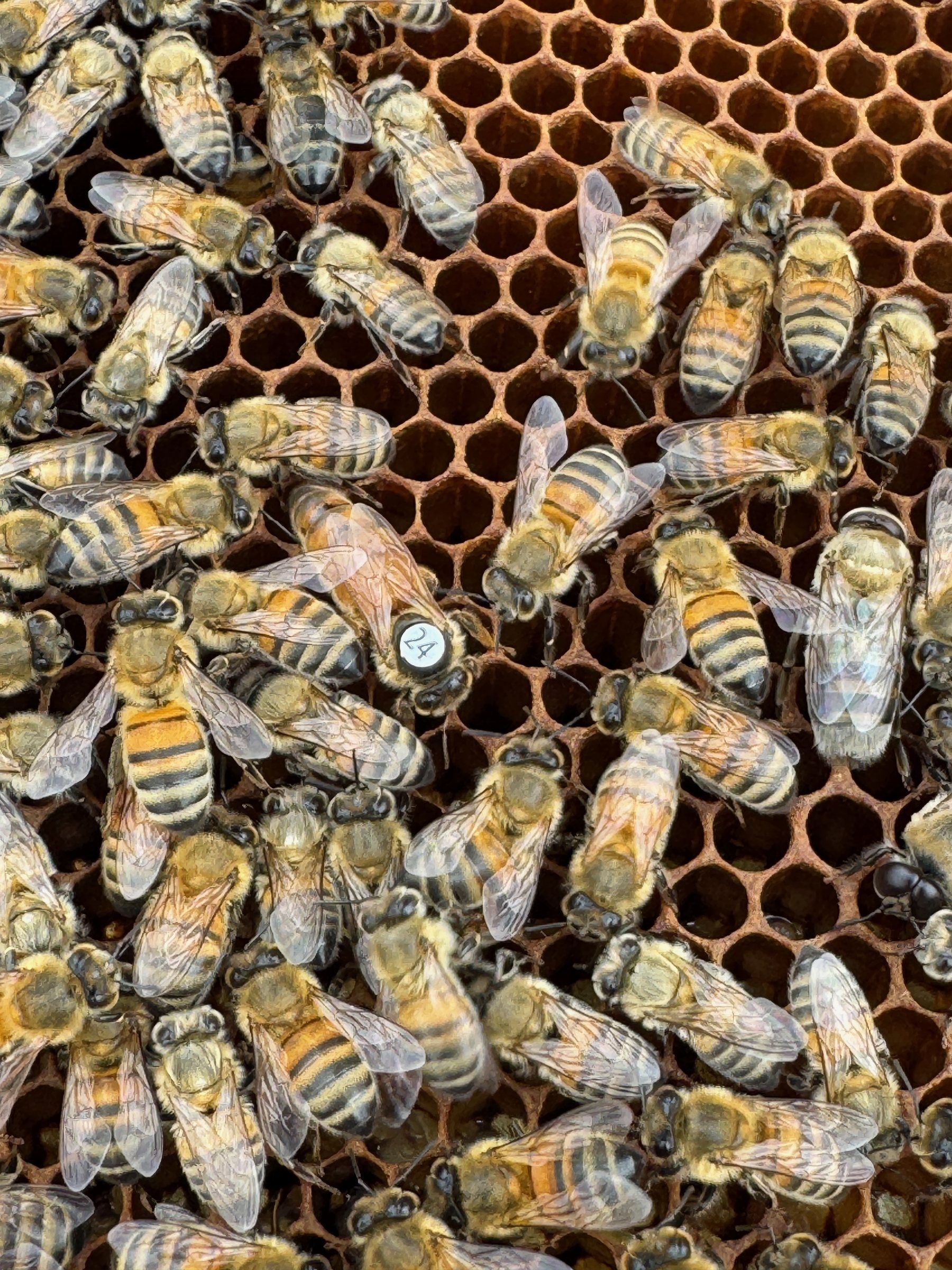
Mark the thorax of a mated queen once she is laying, with a queen marking pen or a numbered disc, never the abdomen. The international colour follows the last digit of the year:
| Last digit | Colour | Years |
|---|---|---|
| 1 or 6 | white | 2026, 2031 |
| 2 or 7 | yellow | 2027, 2032 |
| 3 or 8 | red | 2028, 2033 |
| 4 or 9 | green | 2029, 2034 |
| 5 or 0 | blue | 2030, 2035 |
Judge a new queen on several weeks of brood, not on the first eggs. If many queens in one batch lay poorly, suspect the drones or the weather during mating flights.
Introducing
Introduce a laying queen in a cage with a candy plug to a colony that has been queenless for about a day, after destroying every queen cell, and check for eggs a week later. Virgin queens are much harder to introduce: use a ripe cell or a mated queen instead.
Buying queens and the import rules
If you buy rather than rear, buy from someone who rears in the UK and can tell you how the queens were mated. As listed in October 2026, open mated UK bred queens cost around £50 to £60 plus postage: £50 for a British bred Buckfast queen from Bishops Bees, £59 plus £4.80 postage for a UK bred queen from Cornish Honey, which only posts queens when the air temperature is between 16 and 23 °C. Virgin queens cost less. Instrumentally inseminated breeder queens cost much more.
Since 1 January 2021, imports into Great Britain follow these rules, according to BeeBase and the Scottish Government:
- From the EU: queens with no more than 20 attendants only. Packages, nucs and colonies are not allowed. Calabria and Sicily cannot export because of small hive beetle.
- From outside the EU: queens only, from approved countries, through a border control post. New Zealand may also send packages.
- Paperwork: notify every import through IPAFFS, and make sure the exporter’s official health certificate carries your IPAFFS reference.
- On arrival: move the queen into a new cage, then post the original cage, attendants and packaging within five days to the NBU laboratory at Fera Science in York (England and Wales) or to SASA in Edinburgh (Scotland) for examination. Bee Inspectors may check the consignment.
- Northern Ireland: only queens can move from Great Britain to Northern Ireland, and this counts as an export needing an Official Veterinarian inspection and an Export Health Certificate. Northern Ireland applies EU animal health rules, so follow DAERA guidance.
Registering on BeeBase, or with DAERA in Northern Ireland, is voluntary but lets inspectors warn you of disease nearby.
For a hobby beekeeper, a sensible path is to buy one or two good queens from a UK breeder, run them for a season with records, then graft from the best of your own colonies, ideally with a local bee improvement group. BIBBA reckons a group needs at least 10 to 20 full colonies to start, and should aim for two to three times as many queen cells as the queens it wants.
Frequently asked questions
How old should larvae be for grafting?
As young as you can lift them. The National Bee Unit grafts worker larvae 12 to 18 hours after hatching, which is three and a half days or so after the egg was laid. At that age the larva is a tiny comma in a pool of brood food, barely longer than the egg. Larvae older than about two days have already started down the worker path and give smaller queens.
How many days after grafting do queens emerge?
A queen takes 16 days from egg to adult, so a larva grafted at under a day old emerges about 12 days after grafting. The NBU removes cells 11 days after grafting, one day before emergence, and puts them straight into mating nucs. Leave them longer and the first virgin out will tear down the others; move them earlier and you risk damaging the pupae.
When is the best time to rear queens in the UK?
When colonies are strong, drones are flying in numbers and there is a steady flow. In most of England that runs from early or mid May to July, with July batches used to requeen before winter. BIBBA gives the end of April to mid August as the season in favourable areas. Scotland and the north usually start a few weeks later.
Can I import queens from Europe after Brexit?
Yes, queens with up to 20 attendants can come into Great Britain from the EU, but not packages, nucs or colonies. You must notify the import through IPAFFS, have an official health certificate, move the queen into a new cage on arrival and post the old cage and attendants to the NBU, or to SASA in Scotland, within five days.
How much does a mated queen cost in the UK?
UK bred, open mated queens from bee farmers were listed at around £50 to £60 in October 2026, plus postage: for example £50 for a British bred Buckfast queen and £59 for a UK bred queen from a Cornish producer. Virgin queens cost less but carry the risk of failing to mate. Postage adds a few pounds, for example £4.80 by special delivery. Instrumentally inseminated breeder queens cost considerably more.
What is a Cloake board used for?
A Cloake board is a modified crown board with a removable slide that lets you turn the top box of a strong colony queenless for a day or two, so that it starts queen cells, and then queenright again without opening the hive, so that it finishes them. The NBU Miller method workbook uses it to make the cell builder queenless for the start and queenright afterwards.
What colour should I mark a 2026 queen?
White. The international code runs on the last digit of the year: white for 1 and 6, yellow for 2 and 7, red for 3 and 8, green for 4 and 9 and blue for 5 and 0. A queen reared in 2026 is white, one reared in 2027 yellow. Mark only the thorax, once she is laying, and let the paint dry before releasing her.
Why is my new queen not laying?
Give her time. A virgin needs about a week to mature, then flying weather for her mating flights, and laying starts a few days later. The NBU leaves mating nucs alone for two to three weeks before checking. A cold or wet spell in a British summer can delay mating, and a queen that cannot mate within the first few weeks will lay only drone brood and must be replaced.
Sources
- Rearing queen honeybees in a queenright colony (American Bee Journal, April 2002), David Wilkinson and Mike A. Brown, National Bee Unit, Central Science Laboratory
- Queen rearing, National Bee Unit, APHA
- Grafting and managing queen cells, National Bee Unit, APHA
- Mating nucs and artificial insemination, National Bee Unit, APHA
- Queen rearing workbook: the Miller method (2022), National Bee Unit, APHA
- Hygienic behaviour (Bee Craft, April 2002), National Bee Unit
- Imports and exports, National Bee Unit, BeeBase
- Importing bees into Scotland: guidance, Scottish Government
- Honey bee imports and exports (BeeFarmer, October 2022), Julian Parker and Adam Parker, National Bee Unit
- Queen Rearing Working Group (BeeFarmer, August 2018), Defra and National Bee Unit
- Bee medicines (fact sheet, June 2025), National Bee Unit
- The Bee Keeping (Colonsay and Oronsay) Order 2013 (SSI 2013/279), legislation.gov.uk
- BIBBA guide to forming and running bee improvement groups, Bee Improvement and Bee Breeders Association
- Quantifying honey bee mating range and isolation in semi-isolated valleys by DNA microsatellite paternity analysis (Conservation Genetics, 2005), A. B. Jensen et al., Royal Holloway, University of London
- A re-examination of double grafting (American Bee Journal, 1988), Keith S. Delaplane and John R. Harbo, University of Georgia Honey Bee Program
- Honey bee queens do not count mates to assess their mating success (Journal of Insect Behavior, 2018), Michael Simone-Finstrom and David R. Tarpy, USDA-ARS
- Factors affecting the reproductive health of honey bee drones: a review (Apidologie, 2019), Juliana Rangel and Adrian Fisher II, Springer
- Honey bee breeding program design: testing for hygienic behavior, Penn State Extension
- British bred Buckfast queen, open mated (price checked October 2026), Bishops Bees
- Queen bee, UK bred (price checked October 2026), Cornish Honey