Swarming: signs, swarm control methods, collecting a swarm and what the law says in the UK
Swarm control in the UK: why bees swarm, queen cell signs, the Pagden artificial swarm and vertical split step by step, collecting a swarm and the law.
Swarm control is everything a beekeeper does to stop a colony reproducing by swarming, when the old queen leaves with most of the flying workers to found a new nest while the colony left behind rears a new queen. In the UK most swarms leave between May and the end of July. You keep them in the hive by giving space early, keeping young queens and inspecting every seven days, and, once you find charged queen cells, by splitting the colony yourself with an artificial swarm, a vertical split or a nucleus.
A colony that swarms in May usually loses its chance of a summer honey crop and may throw casts that leave it too weak to recover. Split on your own terms, it gives you an extra colony and a new queen. Swarm control is also central to the beginner’s exams: the Scottish Beekeepers Association syllabus, like the BBKA Basic Assessment, asks candidates to describe one method of swarm control and how to take and hive a swarm.
Why do honey bees swarm?
A colony reproduces by dividing, not by laying more eggs: the superorganism described in our guide to the honey bee colony multiplies by fission, and swarming is how it does so.
What sets it off
Several pressures build up together in spring:
- A congested brood nest. In spring the queen lays at full rate and the brood box fills with brood, bees and incoming nectar. A National brood box holds 11 frames and a strong colony fills it quickly. When there is nowhere left for the queen to lay, swarm preparations follow.
- Too many young bees with nothing to do. Nurse bees accumulate as brood rearing peaks. The bees that leave with a swarm are mainly young bees, which is why removing the queen and the flying bees from the brood, as an artificial swarm does, breaks the impulse.
- The queen’s pheromone spreads less well. In a crowded colony the queen’s mandibular pheromone, which suppresses queen rearing, reaches fewer workers. Colonies headed by a queen in her first season are generally less inclined to swarm than those with older queens.
- A strong nectar flow. In arable areas the oil seed rape flow in April and May fills combs fast. Nectar is stored in brood cells as they empty, the brood nest shrinks, and congestion gets worse.
- Season and genetics. Swarming happens once drones are flying in numbers and the weather is warm. Some strains swarm more than others, and swarminess is one of the traits local association queen rearing groups select against. Our guide to queen rearing explains how.
Swarm cells, supersedure cells and emergency cells
Not every queen cell means the colony is about to swarm.
| Type of cell | Context | Usual position | Number | What to do |
|---|---|---|---|---|
| Swarm cells | strong, crowded colony in spring or early summer | edges and bottom bars of brood frames | often many | act at this inspection |
| Supersedure cells | failing or old queen being replaced quietly | on the face of the comb | one to three | usually leave them |
| Emergency cells | queen lost or killed | on the face, drawn out from worker cells | variable | check for eggs, do not destroy them |
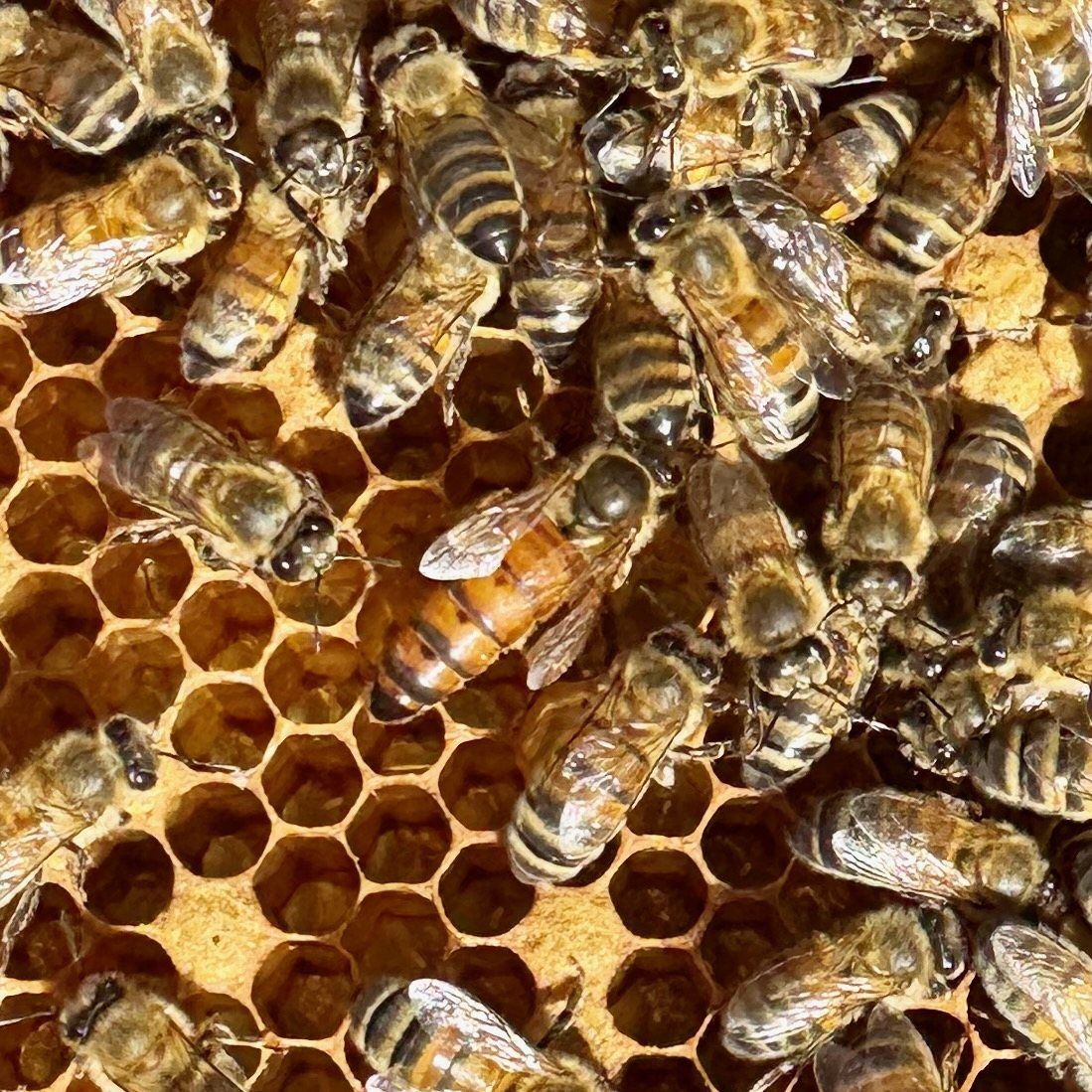
Empty play cups mean nothing: most colonies build them every spring. A cup containing an egg, or a larva floating in royal jelly, is a charged queen cell and means preparations have started. For how to recognise the queen herself and judge her age, see our page on the queen bee.
What are the signs that a colony is about to swarm?
At the inspection
- Charged queen cells, as above. Tilt each frame and look along the bottom bars and in any gaps in the comb, because swarm cells are often hidden there.
- A packed brood nest with brood from top bar to bottom bar and nectar in the cells round it.
- Fewer eggs on well-covered frames. Workers slim the queen down before a swarm so she can fly, and her laying drops.
- Little or no new comb being drawn. Outside signs, such as a beard of bees at the entrance, are late and unreliable: only the frames tell you.
The timeline, day by day
The queen develops in 16 days from egg to emergence. Her cell is sealed about 8 days after the egg is laid; The Apiarist gives 8.5 days. A colony usually swarms on or shortly after the day the first queen cell is sealed, on a warm, dry day. That gives the beekeeper a working timetable.
| What you find | Likely time before the prime swarm leaves | What you can still do |
|---|---|---|
| eggs in queen cups | about a week | anything: artificial swarm, vertical split, nucleus, Demaree |
| larvae in royal jelly | a few days | act at this visit, with an artificial swarm or a nucleus |
| sealed queen cells | the swarm may leave today, or may have gone | check how many bees are left; act on the queen cells |
The first virgin queen emerges about 8 days after her cell is sealed. If the parent colony still has many bees at that point, it may throw a cast.
This timetable is why the standard inspection interval is seven days. The Apiarist stresses that this means the same day each week, not “about once a week”: if a colony had no charged cells at the last visit, it is unlikely to have swarmed before the next. With a clipped queen you can stretch the interval to nine or ten days, because the swarm cannot leave with her; you may lose the queen, but not the bees. Noting queen cells, eggs and BIAS on a hive record card at each visit makes it easy to see when a colony is getting ready to swarm.
What happens when a colony swarms?
Who goes and who stays
The old, mated queen leaves with the prime swarm. Research reviewed by Clarence Collison in Bee Culture found that on average about 75% of the workers leave with her (Rangel and Seeley, 2012). The parent colony keeps the rest of the bees, all the brood, the stores and the queen cells.
Fell and colleagues (1977) weighed 126 swarms in New York State: 1.53 kg on average, about 11,800 bees. Before leaving, the bees gorge on honey, one reason swarms are so placid, and warm their flight muscles to at least 35 °C (Seeley and colleagues, 2003).
The cluster and the house-hunt
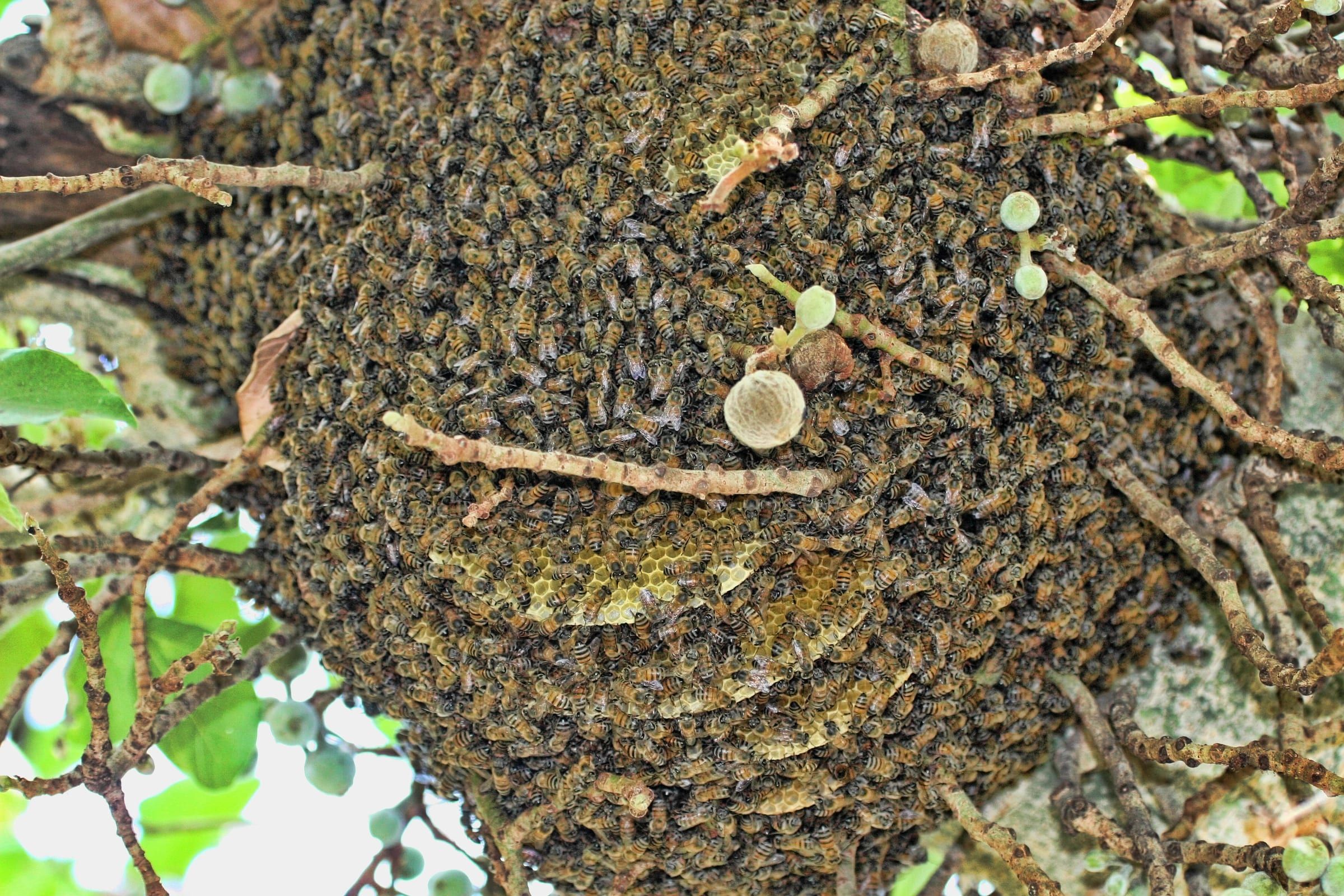
The swarm rarely flies far at first. According to the BBKA, the noisy cloud of bees usually settles into a cluster within about 15 minutes, often on a branch, a fence or a post, about the size of a football. About 5% of the bees are scouts (Beekman and colleagues, 2006) that search for cavities, sometimes several kilometres away, and advertise them with dances on the surface of the cluster. When 10 to 15 or more scouts gather at the same site, the swarm starts to prepare for take-off (Seeley and Visscher, 2003). The NBU notes that a swarm left alone usually moves on within a day or so.
Scouts favour cavities of about 40 litres with a small entrance, a few metres up: roughly a National brood box, which is why a bait hive built from one, with an old comb inside, attracts swarms.
Casts
When the first virgin queen emerges in the parent colony, she may kill her rivals in their cells, or leave with part of the remaining bees: this is a cast, a secondary swarm headed by a virgin queen. A colony can throw several casts, each smaller than the last. To prevent casts, the Scottish Government and SRUC education module advises reducing the queen cells in the original hive to one, seven days after the split.
How do you prevent swarming?
Prevention starts before the first charged cell: delay swarming and catch the preparations early enough to act.
The basic measures
| Measure | How it works | Limits |
|---|---|---|
| Seven-day inspections | find charged cells before they are sealed | essential from late April to July; tie them to the same weekday |
| Space in time | super on before the brood box is full; first super when bees cover most frames | necessary, but does not stop a colony that has already started |
| Foundation in the brood box | one or two frames of foundation at the edge of the brood occupy young wax-making bees | works only while there is a flow |
| Brood and a half or double brood | a second brood box or a shallow on top gives the queen room | more boxes to inspect, and a bigger colony to control |
| Young queens | young queens produce more pheromone | long-term measure; combine with the others |
| Equalising colonies | move a frame of sealed brood from a strong colony to a weak one | only between healthy colonies, as brood diseases travel with the frame |
| Selection | rear queens from your least swarmy colonies | slow but lasting |
| Clipping the queen | cut part of one forewing | a safety net, not prevention: it saves the bees, not the queen |
Many UK beekeepers find that a single National brood box is too small for a prolific queen in May, which is why brood and a half, double brood and the larger 14x12 and Commercial boxes are popular.
Why cutting out queen cells rarely works
Destroying queen cells does not touch the cause: the colony is still crowded and full of young bees, and starts new cells within days. You must shake the bees off every frame to see every cell, every seven days, and one missed cell is enough. If the swarm has already gone, destroying every cell leaves the parent colony hopelessly queenless. Cutting cells only makes sense as part of a real method.
The Pagden artificial swarm, step by step
The Pagden method, named after James Pagden (1814 to 1878), is the classic British method of swarm control and the one most associations teach first. It reproduces what a natural swarm does: the queen and the flying bees end up on the original site in a new box, and the brood, the nurse bees and the queen cells end up in the old box beside it. The Apiarist describes it for a strong colony found with charged cells between mid-April and late June. Use it when you find unsealed, charged queen cells; if the cells are already sealed, check first whether the colony has swarmed.
You need a complete spare hive: floor, brood box with a full set of frames, crown board and roof, and ideally a second stand.
Day 0
- Move the old hive a metre or two to one side. Take off the supers and the queen excluder and set them aside.
- Put the new floor and brood box on the original site, with the entrance facing the same way. Take out two frames from the centre.
- In the old hive, find the queen. Put her on a frame of open brood, after checking it carefully and removing any queen cells, and place it in the centre of the new box. Fill up the box with frames.
- Put the queen excluder and the supers back on the new hive, on the original site. Without supers or a flow, feed thin syrup to help them draw comb.
- In the old hive, close up the frames, add a frame to fill the gap, and replace the crown board and roof. Leave the queen cells: the old hive will rear the new queen. Many beekeepers reduce them to one or two good unsealed cells with visible larvae.
The flying bees return to the original site and join the queen, and the new hive behaves like a swarm.
Day 7
- Move the old hive to the other side of the new hive, again a metre or two away. Its flying bees return to the original site and join the new hive, which takes away the bees the old hive would need to throw a cast.
- Leave the old hive alone for at least another two weeks. It now has a virgin queen who must mate.
Day 21 onwards
- The old hive should have a mated, laying queen. Keep both colonies or, to avoid increase, unite them over newspaper after removing one queen.
When you cannot find the queen
The NBU fact sheet Swarm Control When You Can’t Find the Queen adapts the method. Move the original brood box at least a metre aside, and put a new box on the original site with one comb of eggs and young brood, without queen cells, plus the supers. After seven days, the box with the queen shows eggs and breaks down its queen cells; the queenless one has built cells: keep one healthy unsealed cell with a visible larva and destroy the rest. Later, cull the older queen if you want to reunite.
Other swarm control methods
Vertical split and Snelgrove board
If you are short of space or equipment, a vertical split does the same job on one stand. The queen stays below with the flying bees, the brood and queen cells go into a box above, separated by a split board with its own entrance facing a different way. David Evans of The Apiarist prefers it to the Pagden method, at the cost of more lifting.
The Snelgrove board, published by Leonard Snelgrove in 1934 according to the Eastern Apicultural Society, refines the idea with a double-screened board and a set of small doors. Opening and closing the doors over about ten days diverts the flying bees from the upper box to the lower one, so the queen below keeps a strong foraging force for the honey crop while the upper box rears a new queen. A newly laying queen is usually ready upstairs about four weeks after the split. The method is mainly preventive and works best before queen cells appear.
The Demaree method
Published by George Demaree in the American Bee Journal in 1884, the method separates the queen from her brood without splitting the colony, so the whole force stays together for the crop. The Eastern Apicultural Society notes that it works best in a strong flow and needs as much extra equipment as you started with.
- Find the queen, set her frame aside, and destroy every queen cell.
- On the original floor, place a new brood box of drawn comb with the queen in the centre, then a queen excluder and one or more supers.
- Put the original brood box, with all its brood, on top of the supers.
- After 7 to 8 days, open the top box and destroy any queen cells the bees have built there. After that the brood is too old to produce new queens.
- The top box empties of brood over three weeks and fills with honey.
It is heavy work, and with a National brood box above two supers, the brood at the top can be poorly covered in a cold snap.
Taking a nucleus
The simplest form of swarm control, and the best for making increase, is to take the old queen out with a small colony. Put her on a frame of brood with bees, a frame of stores and a frame of foundation in a nucleus box, shake in the bees from one or two more frames, and move it to another apiary if you can. Seven days later, reduce the queen cells in the parent colony to one good cell, as the SRUC module recommends. The parent colony rears a new queen, and the queenless gap breaks its brood cycle.
The Taranov board
Devised by G. F. Taranov in 1947, according to the Eastern Apicultural Society, the method separates swarm-ready young bees from foragers without having to find the queen. A sloping ramp runs from the ground up towards the entrance and stops about 10 cm short of it.
When queen cells are being sealed, shake the bees from every frame onto the ramp, brushing rather than shaking frames with ripe cells, and put the frames back. The foragers fly across the gap into the hive; the young bees stay behind with the old queen and cluster under the top of the ramp. Hive that cluster like a swarm, well away from the parent colony, which rears a new queen.
Which method should you choose?
| Situation at the inspection | Method | Why |
|---|---|---|
| crowded, no charged cells | add a super, foundation in the brood box, equalise | simple prevention |
| charged cells, queen found, spare hive available | Pagden artificial swarm | the standard method, reliable and easy to teach |
| charged cells, short of space or equipment | vertical split | the same principle on one stand |
| queen not found | NBU method or Taranov | no need to find the queen |
| strong flow expected, experienced beekeeper | Demaree or Snelgrove | keeps the whole force for the crop |
| you want more colonies | nucleus | an extra colony and a brood break against varroa |
Collecting a swarm safely
Equipment
A nucleus box with frames of foundation, or a skep or a sturdy cardboard box with a loose-weave sheet to cover it, a second sheet for the ground, a water spray, secateurs, a bee brush, a smoker and your full suit.
Taking the swarm
- Get the landowner’s permission before you go onto the land or cut any branches.
- Assess the access. Do not take a swarm that is dangerous to reach. Check the terms of your association’s insurance before you climb a ladder.
- Clear people and animals and spread a sheet under the cluster.
- Shake the bees into the box with one sharp knock on the branch, or cut a thin branch and lower it in. With a nucleus box, take out two or three frames first, shake the bees in, then gently put the frames back.
- Watch the entrance. If bees fan at the gap with their abdomens raised, the queen is inside. If they fly back to the branch, she is still there: repeat.
- Come back in the evening, when the last bees have gone in, wrap the box in the sheet and take it away.
Bees waggle dancing on the cluster mean it may leave soon, the NBU warns: work quickly.
Hiving the swarm
You can shake the bees straight into a brood box with a gap in the frames, or run them in: lay a sheet-covered board up to the entrance, tip the bees onto it and watch them march in, which is the best chance to spot the queen. Use new foundation rather than drawn comb if you can. The NBU explains that building fresh comb uses up the honey the bees carried, which lowers the risk of carrying disease into the new colony. A queen excluder under the brood box for a couple of days stops the swarm absconding, but remove it within 72 hours if the swarm is a cast, because a virgin queen must fly to mate.
The weeks after
- Feed if needed. After 24 to 48 hours, check that the bees are drawing foundation and the queen is laying. If not, the NBU advises 1:1 syrup, 1 kg of white granulated sugar to 1.26 litres of water, and another check 24 to 48 hours later.
- Quarantine swarms of unknown origin. The SRUC module calls swarms “one of the biggest sources of disease spread”. Keep an unknown swarm in an isolation apiary, or as far from your other colonies as possible, for at least two full brood cycles, a minimum of six weeks, as the NBU recommends. EFB can take longer to show.
- Treat for varroa while the swarm is broodless. A swarm does not leave its mites behind. Wilde and colleagues, as reported by The Apiarist, found that 25 ± 9% of a colony’s mites left with a natural swarm, and Fries and colleagues (Apidologie, 2003) found swarms no less infested than their parent colonies by late autumn. In the first days, before the first brood is sealed, all the mites are on the adult bees, and an oxalic acid treatment works at its best. Use only a medicine authorised by the VMD, such as Api-Bioxal, Oxybee, Oxuvar or Dany’s BienenWohl: the NBU states that raw oxalic acid crystals must not be given to bees unless a vet has prescribed them. Record the treatment, and keep medicine records for at least five years. See our guide to varroa mites.
- Check for eggs after a week or two. A cast has a virgin queen that still has to mate.
- Register the colony. BeeBase registration is voluntary but free; add the colony and apiary so that inspectors can warn you of disease nearby. Our guide on how to register your bees explains how, nation by nation.
What to do with a swarm in your garden
Is it really a honey bee swarm?
A honey bee swarm is a living cluster of thousands of brown bees hanging in the open, on a branch, a fence or a wall. The BBKA’s swarm collectors can only help with honey bees. Bumblebees, of which the UK has about 24 species, should be left alone, the BBKA says: their nests die out naturally by late summer or autumn. A grey paper nest is wasps, which beekeepers do not remove.
Good habits
- Keep away and leave the swarm alone, as the BBKA advises. Do not spray, hose or knock it, keep children and pets indoors, and take extra care if anyone is allergic to stings.
- Wait, if you can. The NBU says a swarm that is out of the way can simply be left, because it usually moves on within a day or so.
- Find a swarm collector if it is a nuisance or in a risky place: enter your postcode on the BBKA website. Collectors are volunteers. They are not paid for the service, though some may ask for their expenses, and they may not be able to come at once.
- Note the height and access and take a photo for the collector.
A colony that has already moved into a cavity wall, a chimney or a roof is no longer a swarm. The NBU advises considering alternatives to destruction when there is no risk to public health: professional bee removers can take colonies out without pesticides.
Who owns a swarm? What the law says in the UK
There is no British statute on the ownership of swarms. In Kearry v Pattinson (1939), the Court of Appeal described bees as wild animals, ferae naturae, before they are hived, in which a qualified property can be had; the beekeeper acquires it by hiving them. Reviewing the case law in 2025, barrister Dan Jacklin draws on Borwick Development Solutions v Clear Water Fisheries (2020), a Court of Appeal ruling on property in wild animals (fish in a lake), to conclude that a beekeeper’s rights over swarmed bees depend on whether the bees intend to return to the hive: a swarm that does not return is lost to its former owner.
In practice:
- Your bees swarm into a neighbour’s garden. You have no right to go onto their land without permission. Ask, and do not cut anything without their agreement, as the NBU guideline stresses.
- A swarm of unknown origin lands on your land. With no beekeeper following it, it is in practice treated as wild, and a collector takes it only with your permission.
What the law does impose is health rules. In Great Britain, suspected American or European foulbrood, small hive beetle or Tropilaelaps mites must be reported to the bee inspectors, under the Bee Diseases and Pests Control (England) Order 2006 and the equivalent orders in Wales and Scotland; in Wales a failure to report is an offence, as the Welsh Government reminds beekeepers. Varroa has been a reportable pest in England, Wales and Scotland since 21 April 2021. In Scotland, the Bee Diseases and Pests Control (Scotland) Order 2007 applies and reports go to the Scottish Government bee inspectors; in England and Wales, to the NBU or your local bee inspector. Northern Ireland has its own bee health rules, run by DAERA. Registration itself stays voluntary everywhere, including on DAERA’s register in Northern Ireland.
When do bees swarm in the UK?
Swarming in the UK follows the maritime climate and the forage. The BBKA says most swarms occur on warm, sunny days between May and the end of July, usually between 11 am and 4 pm, often with a peak on a fine day after a spell of poor weather when temperatures approach the high teens. Colonies on oil seed rape can start their preparations earlier, during the April and May flow, while colonies in the north of Scotland or on high ground, where April can still bring frost and snow, often start later. As the old saying goes, “a swarm in July is not worth a fly”: a late swarm has little time to build up, and may land in the June gap, when forage is short between spring and summer flows.
| Period | What happens in the colony | What you do |
|---|---|---|
| March | brood rearing restarts | check stores and queen; prepare spare hives, frames, nuc boxes and bait hives |
| April | rapid build-up, first drones, OSR in flower | first full inspection on a warm day; super early on rape; equalise |
| May | swarming season under way | inspect every seven days; artificial swarms, vertical splits, nucs |
| June | swarming continues; June gap in many areas | keep inspecting; watch stores in nucs and swarms; feed if needed |
| July | swarms less frequent; summer flow from clover and lime | last swarm checks; requeen from your best colonies |
| August | heather in the uplands; swarming rare | varroa treatment after the harvest; unite weak colonies |
| autumn and winter | no swarming | record which colonies swarmed and plan replacements |
Our beekeeping calendar sets out the whole year in more detail.
Managed well, the swarming season stops being a loss. Every artificial swarm and every nucleus gives you a young queen, a brood break against varroa and, if you want it, one more colony.
Frequently asked questions
How do I stop my bees from swarming?
Give the colony room before it fills, with a super added in good time and frames of foundation in the brood box, keep young queens and inspect every seven days from late April to July. Once you find charged queen cells, space alone will not stop it: split the colony with an artificial swarm, a vertical split or a nucleus, so that the old queen and the queen cells end up in different boxes.
What should I do if a swarm lands in my garden?
Keep calm, keep children and pets indoors and leave the cluster alone. Most swarms settle within about 15 minutes and are not aggressive. If the bees are out of the way you can wait, because they usually move on within a day or so. If they are a nuisance, enter your postcode on the BBKA website to find a volunteer swarm collector near you.
Do swarm collectors charge to remove a swarm?
BBKA swarm collectors are volunteers and are not paid for the service, although some ask for their expenses. They only collect honey bee swarms, not bumblebees, solitary bees or wasps, and may turn down a swarm that cannot be reached safely. A colony that has already moved into a wall or chimney is a different job, often handled by a professional bee remover.
Are honey bee swarms dangerous?
Usually not. The BBKA says most honey bee swarms are not aggressive and swarming bees rarely sting, because they have no brood or stores to defend and have filled up with honey before leaving. They will still sting if sprayed, knocked or crushed. Stay a few metres away, and take extra care if anyone in the household is allergic to bee stings.
What is a cast swarm?
A cast is a secondary swarm that leaves after the prime swarm, headed by a virgin queen rather than the old mated queen. Casts are smaller and leave the parent colony weaker each time. A colony can throw more than one. To prevent casts after a swarm or an artificial swarm, reduce the parent colony to a single good queen cell and check again a week later for any new ones.
Who owns a swarm of bees in my garden?
There is no single statute on swarms in England. Case law treats bees as wild animals in which a beekeeper has only a qualified property while they are hived; once a swarm leaves and does not return, it is generally treated as lost to its former owner. A beekeeper following a swarm has no right to enter your land without permission, so they should ask you first.
Do I need to register a swarm I have collected?
Registration on BeeBase is voluntary in England, Wales and Scotland, and DAERA runs a voluntary register in Northern Ireland, but all four strongly encourage it. If you register, add the new colony and its apiary so inspectors can warn you of disease nearby. What is compulsory is reporting suspected foulbrood, small hive beetle or Tropilaelaps, and varroa in Great Britain.
Does clipping the queen stop swarming?
No. A clipped queen cannot fly, so when the colony swarms she falls to the ground and the swarm returns to the hive, but the colony will usually swarm again with the first virgin queen to emerge. Clipping buys time rather than preventing swarming. The Apiarist notes that with a clipped queen you can stretch inspections to nine or ten days, at the risk of losing the queen.
Sources
- Swarm Control When You Can't Find the Queen (fact sheet, January 2019), National Bee Unit, APHA
- Using Artificial Swarms for Varroa Control (fact sheet, September 2026), National Bee Unit, APHA
- Good Practice Guideline: Taking and Hiving a Swarm (BBKA News, May 2012), National Bee Unit
- What to do if you find a swarm?, National Bee Unit, BeeBase
- Legal responsibility of beekeepers, National Bee Unit, BeeBase
- Bee medicines (fact sheet), National Bee Unit
- Honey bee swarms, British Beekeepers Association
- Swarms: identify the bees and find a swarm collector, British Beekeepers Association
- Honey bee health guidance: legislation, Scottish Government
- Responsible beekeeping (Beekeeping Education Module 1, with notes), Scottish Government and SRUC
- Healthy honey bees, Welsh Government
- Bee registered: help DAERA protect your honey bees (7 February 2017), Department of Agriculture, Environment and Rural Affairs
- Basic Beekeeping Certificate syllabus (April 2023), Scottish Beekeepers Association
- Local Authority Enforcement Powers and Domestic Bee Keeping (3 June 2025), Dr Dan Jacklin, St Philips Chambers
- Pagden's artificial swarm, David Evans, The Apiarist
- Irregular inspections and swarm prevention, David Evans, The Apiarist
- Swarm and mite partitioning, David Evans, The Apiarist
- Swarming in honey bees (Apis mellifera) and Varroa destructor population development in Sweden (Apidologie 34, 2003), Ingemar Fries, Henrik Hansen, Anton Imdorf and Peter Rosenkranz
- Weird Techniques for Swarm Control, Landi Simone, Eastern Apicultural Society
- A Closer Look: swarming, Clarence Collison, Bee Culture