The honey bee colony: queen, workers and drones, jobs by age, brood timings and how a hive organises itself
How a honey bee colony works, for UK beekeepers: queen, workers and drones, jobs by age, brood timings, winter bees and what to read on a National frame.
A honey bee colony is a family of one egg-laying queen, tens of thousands of female workers that do every job in the hive, and a seasonal population of male drones whose only role is mating. At the summer peak a strong British colony holds roughly 30,000 to 60,000 workers; in winter it shrinks to a cluster of several thousand. There is no leader. The colony runs itself through pheromones, constant contact between bees and a division of labour in which each worker changes job as she ages, while the brood nest at the centre of the hive sets the pace for almost everything else.
Knowing how this works is the most practical skill in beekeeping. It is what lets you read a frame at an inspection and decide, in a minute or two, whether a colony is queenright, preparing to swarm, short of space or failing. It is also the ground floor of the BBKA Basic Assessment, whose syllabus, as the British Beekeepers Association puts it, lists the basic things all beekeepers should know.
How many bees are in a honey bee colony?
Numbers move with the seasons more than most new beekeepers expect. A colony that fills a brood box and two supers in June may sit on four or five seams of bees in January, and both can be perfectly healthy.
| Time of year (UK) | Workers | Drones | Queen | Brood |
|---|---|---|---|---|
| January to February | several thousand, in a cluster | none | 1 | small patch restarting in the centre |
| March to April | rising fast | first drones appear | 1 | expanding, often on oil seed rape pollen |
| May to July | roughly 30,000 to 60,000 at peak | a few hundred to a few thousand | 1 | at its largest, then levelling off |
| August to September | falling; winter bees start to be reared | being evicted | 1 | shrinking |
| October to December | several thousand, clustering in cold spells | none | 1 | little or none, depending on the weather |
Published figures for drones vary because drones vary. Juliana Rangel and Adrian Fisher’s 2019 review in Apidologie refers to a seasonal population of a few thousand males, while many beekeeping texts say a few hundred. Both are right at different times, in different colonies, and depending on how much drone comb the bees have been allowed to build.
Treat all of these numbers as orders of magnitude. Colony size depends on the strain of bee, the queen, the forage and above all the weather of the year. Native and near-native dark bees (Apis mellifera mellifera) are often kept in smaller, more frugal colonies than Buckfast or Italian-type bees. A National Bee Unit article in BBKA News notes that the old British black bee needed about 10 kg of stores to winter, while an average colony today needs about 18 to 22 kg, and larger colonies headed by prolific queens may need more. If a colony in your apiary covers only three or four frames in July while its neighbours fill two boxes, the queen, disease or varroa are the first suspects. Our guide to honey bee breeds compares the strains kept in Britain.
What does the queen bee do?
One egg layer for the whole colony
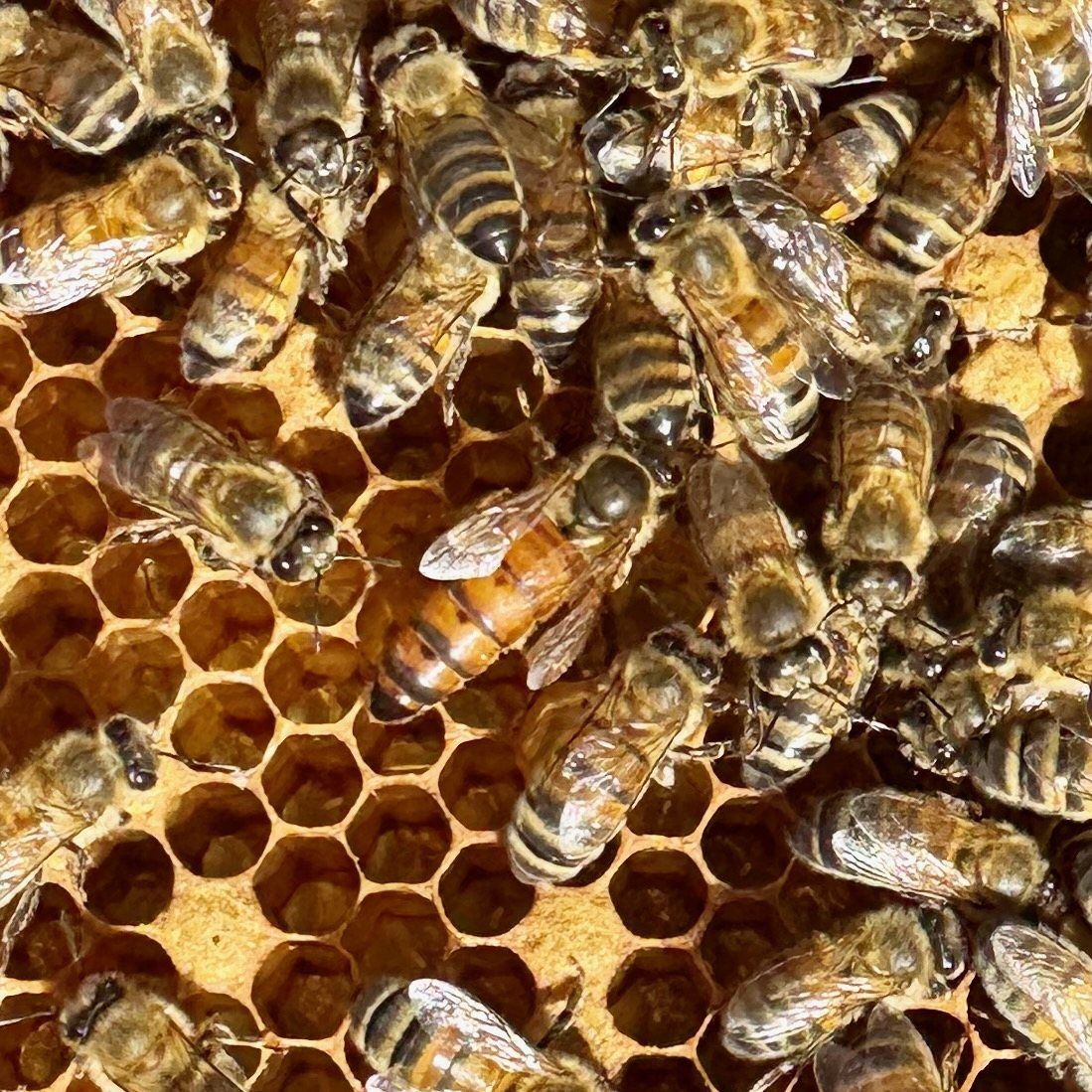
The queen is the only fully mated female in the colony. She is longer than a worker, with a tapering abdomen that extends well beyond her folded wings, and she spends almost her whole life on the brood combs. She does not forage, build comb or feed larvae. Her work is twofold:
- laying eggs, well over a thousand a day at the spring peak in a good colony, one per cell, working outwards in a rough spiral from the centre of the brood nest;
- holding the colony together chemically, through the blend of pheromones her retinue picks up by licking and antennating her and then spreads through the hive.
Laura Bortolotti and Cecilia Costa’s 2014 review describes “queen substance” as a mixture from several glands, the best known part being queen mandibular pheromone (QMP). Brian Johnson’s 2010 review of division of labour explains one of its effects: QMP suppresses production of juvenile hormone in young workers, which keeps them on the comb as nurses near the brood. When the queen’s signal weakens, because she is ageing, failing or simply lost in a colony so crowded that her pheromones no longer reach every bee, workers start building queen cells. That is the root of both supersedure and much of swarming.
One mother, many fathers
A few days after she emerges, a virgin queen makes one or a few mating flights. In a study by Michael Simone-Finstrom and David Tarpy of North Carolina State University, published in 2018, queens made 2.4 flights on average, orientation flights included, and mated with between 8 and 25 drones, 13.5 on average. A well-mated queen stores around 5 to 7 million sperm in her spermatheca and never mates again.
Two consequences follow. First, her laying eventually declines as the store runs down, which is why some British beekeepers requeen every two years while others let the colony supersede. Second, a colony is not a family of full sisters. All the workers share a mother but belong to a dozen or more patrilines. Workers from the same father are “super sisters”, sharing on average three quarters of their genes; workers from different fathers are half sisters. That genetic mix is one reason why some workers in a colony are more inclined to guard, to forage for pollen or to remove diseased brood than others.
In a British summer the mating window can be the colony’s weakest point. A virgin queen needs warm, calm, dry days, and a week of wind and rain in June can leave her unmated or poorly mated. A drone-laying queen in July often traces back to a wet fortnight in her mating window.
Lifespan and marking
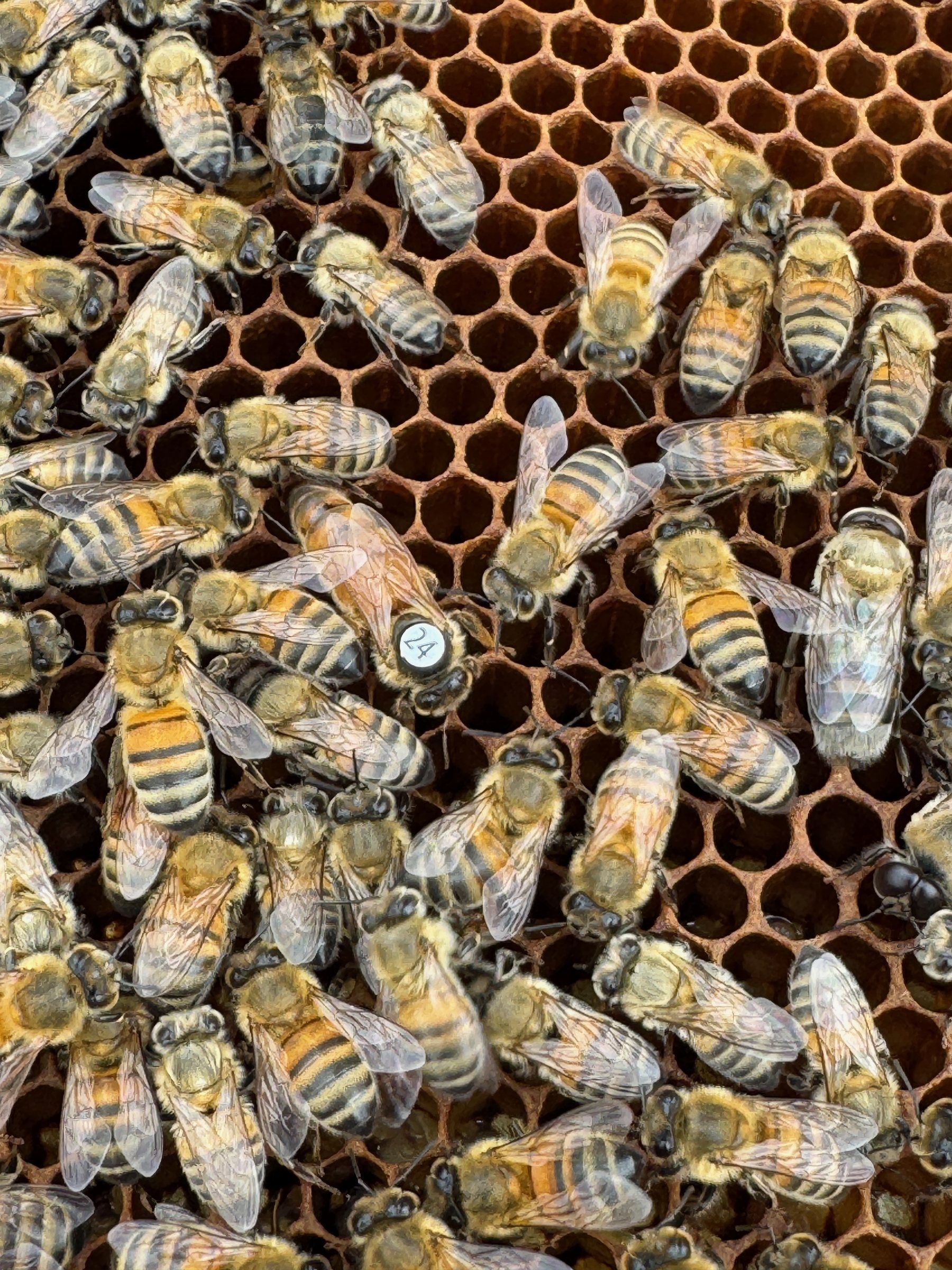
A queen can live several years, though two to three years of good laying is typical. To find her quickly and know her age, mark her thorax with the international colour code, which follows the last digit of the year she was reared: white for 1 and 6, yellow for 2 and 7, red for 3 and 8, green for 4 and 9, blue for 5 and 0. Queens reared in 2026 are marked white, and 2027 queens will be yellow. British associations teach the order with “Will You Rear Good Bees”. Everything else about her, from mating to queen cells, is in our page on the queen bee.
What do worker bees do?
Workers are females reared from fertilised eggs, like the queen, but their ovaries stay undeveloped while a queen and open brood are present. They do everything else: cleaning, feeding larvae, building comb, processing nectar, guarding, fanning, heating and foraging.
Summer bees and winter bees
A worker’s lifespan depends on when she is born, not just on her genes.
- Summer bees, reared from spring to midsummer, live about five to six weeks. Johnson describes foragers that “work themselves to death over a couple weeks” once they start flying.
- Winter bees, reared from late summer into autumn, live for months. Johnson cites winter bees still foraging at more than 280 days old.
Mehmet Döke, Maryann Frazier and Christina Grozinger’s 2015 review at Penn State explains that honey bees survive the winter by entering a distinct physiological and behavioural state, and links winter colony losses to varroa mites and virus infections. The quality of the bees reared for winter decides whether the colony survives to March. Bees reared in August and September in a colony with high varroa levels are damaged as pupae, die early, and the cluster melts away over winter even with full frames of stores. That is why UK varroa treatment is timed for late summer, as soon as the supers come off. Our page on varroa mites gives the National Bee Unit thresholds.
Worker jobs by age
In summer, a worker’s job changes as she ages, a pattern biologists call age polyethism. She starts in the centre of the nest and ends her life outside, in the most dangerous job.
| Approximate age | Group | Main tasks |
|---|---|---|
| first few days | young bees | cleaning and polishing cells ready for eggs or stores |
| about 4 to 12 days | nurse bees | feeding larvae and the queen with brood food from their head glands |
| about 12 to 21 days | middle-aged bees | building comb, receiving and ripening nectar, packing pollen, fanning, guarding the entrance, removing dead bees |
| about 3 weeks onwards | foragers | collecting nectar, pollen, water and propolis |
The age bands for nurses and middle-aged bees are those given by Johnson. A few points about the jobs themselves:
- Cell cleaning is the first task. The queen will not lay in a cell that has not been cleaned.
- Nursing depends on the hypopharyngeal glands in the head, which produce brood food.
- Comb building uses wax secreted as small scales from four pairs of glands on the underside of the abdomen. Bees of this age are why a colony on a nectar flow draws foundation so quickly.
- Receiving nectar means taking loads from returning foragers, evaporating water and adding enzymes, then storing it to ripen into honey.
- Guarding happens on the landing board, where guards check the colony odour of incoming bees and challenge robbers and wasps.
- Foraging is the last and most hazardous job.
A timetable that bends
This sequence is a tendency, not a rule. Johnson stresses that workers change job according to what the colony needs. When researchers removed the youngest bees from colonies, about 20% of foragers regained the ability to nurse. A colony that loses many foragers sends young bees to the field early.
Pheromones do much of this adjusting. Brood pheromone stimulates young bees’ brood food glands and encourages pollen foraging. Foragers carry ethyl oleate in their crops and pass it to younger bees during food sharing, which slows their move to foraging. When foragers die in large numbers, less ethyl oleate circulates and the next cohort leaves the hive sooner. This flexibility is why a split or an artificial swarm settles down within days: the colony reallocates its workforce on its own.
What are drones for?
Males without a sting
Drones hatch from unfertilised eggs that the queen lays in the larger drone cells, typically on the lower edges of brood frames or on any patch of comb the bees have built freely. They are stockier than workers, with huge eyes that meet on top of the head. They have no sting, do not forage and take no part in building or brood care. Workers feed them.
Drones are seasonal. In Britain they appear from April, once the colony is strong and forage is reliable, and they are expelled when the mating season ends, from late summer into autumn.
Drone congregation areas
Rangel and Fisher’s review brings together the key figures:
- development from egg to adult: about 24 days;
- first orientation flights: about 5 to 8 days after emergence;
- sexual maturity: between about 6 and 18 days after emergence, depending on the study;
- lifespan of a drone that does not mate: about 20 to 40 days;
- drone congregation areas: 30 to 200 m across, 10 to 40 m above the ground, holding up to about 11,000 drones from colonies up to 5 km away, although most drones gather at areas only a few hundred metres from their own hive;
- mating is fatal: the drone dies soon after, and the tip of his endophallus breaks off and stays in the queen.
Drones also drift between hives far more than workers do, and are usually accepted wherever they land. Since drones also mate with queens from other apiaries, your drones help shape the bees of your whole district, and your queens are mated by your neighbours’ drones.
Too many drones: when to worry
Drone brood in spring is a sign of a healthy colony. What deserves attention is drone brood in worker cells. Worker cells are too narrow for a drone, so the cappings are strongly domed and stand proud of the comb, giving a bumpy, bullet-like look. There are two causes:
- a drone-laying queen, unmated or out of sperm, who lays unfertilised eggs. She usually lays one egg per cell, neatly in the base, but the brood that results is drone brood in worker comb, often mixed with a little worker brood.
- laying workers, in a colony queenless for several weeks. With no queen pheromone and no open brood, some workers develop their ovaries and lay. You see several eggs per cell, often stuck to the side walls, and scattered, irregular drone brood. Such colonies rarely accept a new queen.
One caution: a newly laying queen can put two eggs in a cell for her first few days, so confirm at the next inspection before you act.
Brood: from egg to adult
Brood means all the immature stages: eggs, larvae and pupae. Open brood is eggs and larvae in uncapped cells. Sealed brood is prepupae and pupae under wax cappings.
Development times
| Stage | Queen | Worker | Drone |
|---|---|---|---|
| Egg | 3 days | 3 days | 3 days |
| Open larva | about 5.5 days | about 6 days | about 6.5 days |
| Sealed (prepupa and pupa) | about 8 days | about 12 days | about 14.5 days |
| Egg to emergence | 15 to 16 days | about 21 days | about 24 days |
The stage lengths are those given by the University of Florida’s IFAS Extension; individual colonies can vary by a day or so with brood temperature. These numbers are the working tools of every inspection. Eggs mean the queen was laying in the last three days. A queen cell sealed today should produce a virgin in about eight days, and a colony that has just lost its queen and starts an emergency cell on a young larva will have a virgin about 12 days later, who must still mate and start laying. Add it up and a queenless colony goes three to four weeks without new eggs even when everything goes well. The full sequence for each caste is in our guide to the honey bee life cycle.
Male or female: fertilisation decides
Sex in honey bees depends on whether an egg is fertilised. The Institute of Evolutionary Genetics at Heinrich Heine University Düsseldorf, where Martin Beye’s group identified the gene responsible, explains that unfertilised eggs develop into males with a single set of chromosomes, and fertilised eggs into females. This system is called haplodiploidy. The switch is the csd gene: two different versions produce a female. A fertilised egg that carries two identical versions, which happens more often in inbred stock, becomes a diploid male, and the workers find and eat these larvae soon after hatching. Very patchy brood can therefore reflect a lack of genetic diversity, although disease, varroa and a failing queen are far more common causes.
Queen or worker: diet decides
A female larva can become a worker or a queen. The egg is the same; the food is not. Queen larvae are fed only royal jelly, while worker larvae also get honey and bee bread, processed pollen. A 2015 study from the University of Illinois found that p-coumaric acid, present in honey and bee bread but not in royal jelly, pushes larvae towards worker development by changing the activity of a large share of their genes.
That is how a queenless colony rears a new queen from an ordinary worker larva: the bees enlarge the cell into a downward-hanging queen cell and flood the larva with royal jelly.
Reading a brood frame
On a British Standard National brood frame, a healthy brood nest shows a few consistent features:
- Compact sealed brood: solid sheets of capped cells with only a few empty cells scattered through.
- All stages present: eggs, pearly white curled larvae and sealed brood together show continuous laying.
- A logical layout: brood in the centre and lower part of the frames, a band of pollen around it, and honey in the top corners and outer frames.
- Healthy cappings: flat, even and biscuit coloured on worker brood, domed on drone brood. Sunken, perforated or greasy cappings point to a brood disease.
Johnson notes that a brood comb has about 6,000 cells but room for only about 2,000 adult bees, so the space in the brood nest is constantly contested between eggs, stores and the bees themselves. A brood box clogged with nectar on oil seed rape in April is a classic UK trigger for swarm preparations.
If the cappings look wrong, do not guess. American foulbrood and European foulbrood are notifiable in the UK: in England the National Bee Unit asks you to report a suspicion to it directly, Scottish beekeepers contact the Scottish Government’s Bee Health Team, and in Northern Ireland DAERA’s bee health inspectors must be informed.
How does a colony control its temperature?
Brood develops properly only within a narrow temperature range. A 2023 study in Frontiers in Ecology and Evolution reports that worker brood develops best between 32 and 36°C, with an optimum around 35°C. Long exposure below 32°C increases the risk of deformed wings, legs and abdomens, and pupal survival falls to zero at 38°C.
Workers have two ways to hold that line:
- Heating: they shiver their flight muscles without moving their wings. Some press their warm thorax against brood cappings, or crawl into empty cells among the brood to warm the pupae around them.
- Cooling: they fan at the entrance and inside the hive, and spread droplets of water that cool the air as they evaporate. On a hot July afternoon you see lines of fanners on the landing board.
In winter the colony forms a cluster. The same 2023 paper reports that at an outside temperature of 2.5°C the core of the cluster can stay above 35°C, warm enough to rear brood, while the outer mantle stays above 17°C and acts mainly as insulation. The cluster heats itself, not the hive.
The British winter is rarely cold enough to threaten a healthy cluster. What kills colonies here is more often damp, starvation in a long cold spell when the cluster cannot reach its stores, or the late-summer varroa damage described above. Two UK reference points help:
- Stores: the National Bee Unit’s winter fact sheet says each colony should have approximately 20 kg of honey in autumn, and that any less reduces the likelihood that it will survive the winter. Johnson gives the same order of magnitude, 20 kg, for colonies in general.
- Insulation: the University of Leeds reports that Derek Mitchell’s work found that typical hives with 19 mm wooden walls lose about seven times more heat than a natural nest in a tree hollow with 150 mm walls. Mitchell’s results have led some British beekeepers to put a block of insulation over the crown board in winter, while keeping some ventilation to avoid condensation.
Where you put the hive matters as well. A dry, sheltered site out of frost pockets saves the bees a great deal of work, which is why apiary siting appears early in every association course.
Is there a leader in a beehive?
People talk about the “queen” and her “subjects”, but the colony has no hierarchy in the human sense. The queen issues no commands. Biologists describe the colony as a superorganism: the whole behaves like an individual, while each bee reacts only to local cues.
Those cues come in three main forms:
- chemical: pheromones from the queen, the brood and the workers themselves, signalling a laying queen, hungry larvae, an alarm at the entrance or the way home (the Nasonov scent);
- contact and food sharing: workers pass food mouth to mouth constantly, and with it information and pheromones;
- dances: foragers advertise the direction and distance of good forage with the waggle dance.
The waggle dance has given British researchers a window on the bees’ landscape. Margaret Couvillon, Roger Schürch and Francis Ratnieks at the University of Sussex decoded more than 5,000 dances and found mean foraging distances of about 500 m in spring, more than 2 km in summer and about 1.3 km in autumn. Long dances in summer mean forage is scarce close to home: they are, in effect, the colony’s own record of the June gap and the late summer dearth.
Swarming shows collective decision making at its clearest. Thomas Seeley’s work, described by Cornell University, shows that about two thirds of the workers leave with the old queen. Several hundred of the oldest bees then act as scouts, inspecting 10 to 20 possible cavities. Each scout dances for her site for longer the better she judges it, and the swarm moves when enough scouts gather at the same site. No single bee chooses.
Queens add their own signals at swarming time. A team led by Martin Bencsik at Nottingham Trent University recorded the vibrations queens make: the queen that is free to move about the hive “toots”, and rival virgin queens held captive in their cells by the workers answer by “quacking”. When the quacking stops, the colony has run out of captive virgins and the workers keep the bees at home rather than swarm again. British beekeepers who hear piping through the hive wall in June are listening to this exchange. Our guide to swarming explains how to use this timetable for swarm control.
A year in the life of a British colony
The UK’s maritime climate gives a long, uneven season with mild winters, cool wet spells at almost any time and big regional differences between Cornwall, the Midlands and the north of Scotland. The pattern below fits much of lowland England and Wales; in Scotland and on high ground, shift spring a few weeks later.
| Season | Inside the colony | What the beekeeper watches |
|---|---|---|
| January to February | cluster; brood rearing restarts on a small patch, fed on stores and the first willow, hazel and snowdrop pollen | hive weight (hefting), fondant if light, entrance clear |
| March to April | rapid build-up, first drones, wax building | first inspection on a warm day, space, early oil seed rape |
| May to June | peak brood and population, queen cells, swarming | weekly inspections, supers, swarm control |
| June gap | forage drops between spring blossom and summer flowers; brood may shrink | stores, especially in colonies that swarmed |
| July to August | summer flow (bramble, clover, lime, borage), then heather on the moors in August; drones thrown out | harvest, varroa monitoring, wasps, yellow-legged (Asian) hornet |
| September to October | winter bees reared; ivy gives late pollen and nectar | varroa treatment, feeding to about 20 kg, mouse guards |
| November to December | small cluster, little or no brood in cold spells | leave them alone, check roofs and woodpecker damage |
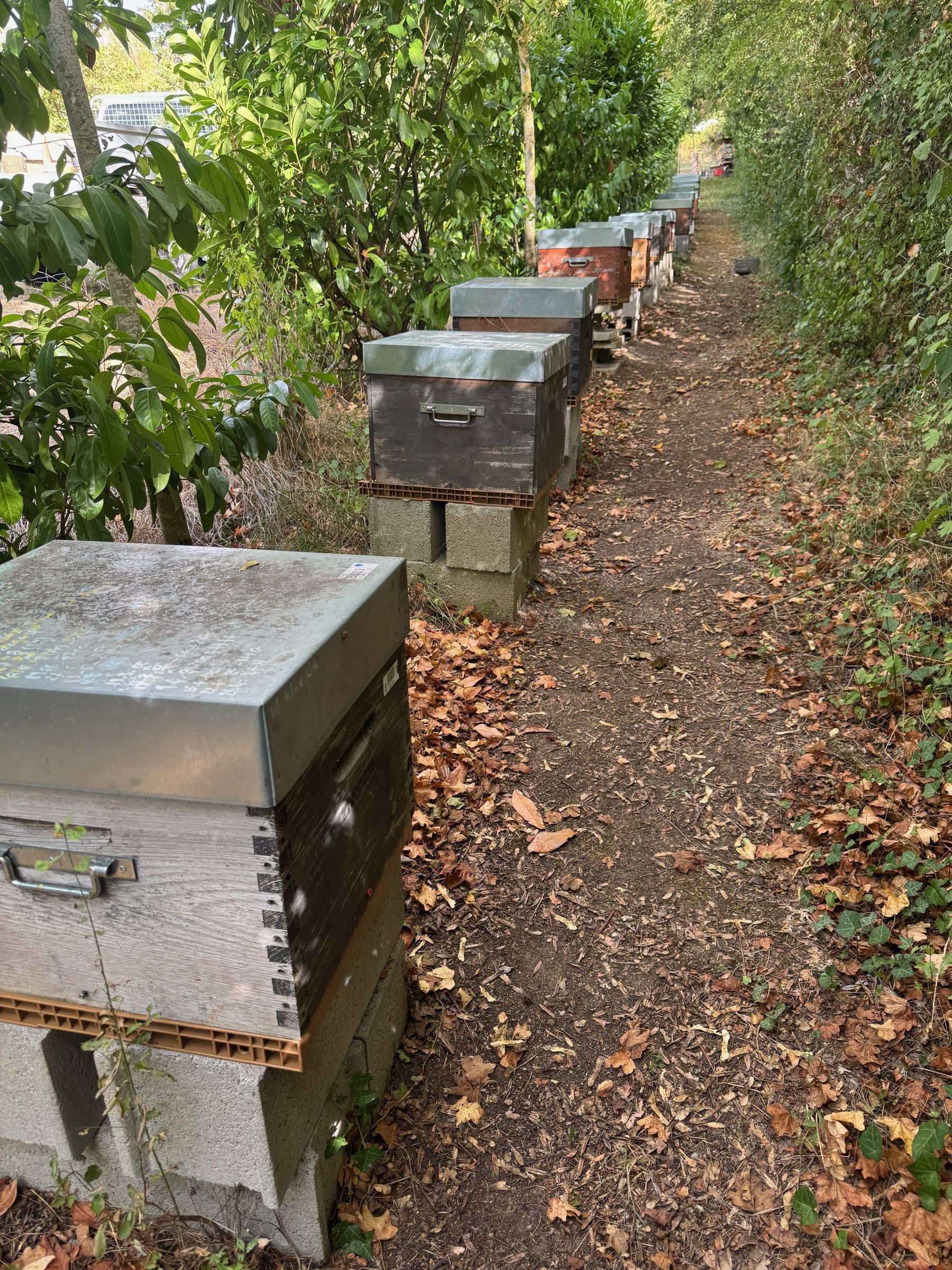
A National hive with a single brood box and a queen excluder suits this cycle for many colonies, while prolific strains often need a brood and a half or a 14x12 box at the spring peak. Our page on the National hive covers those options.
Mild British winters have a cost. In a mild winter, especially in the south, many colonies keep a patch of brood through December, which keeps varroa breeding and makes a broodless winter oxalic acid treatment harder to time. A cold snap in December is often the beekeeper’s best chance of a broodless window.
What colony organisation means at a UK inspection
Everything above turns into a short checklist for each visit:
- Look for eggs, not the queen. One egg per cell, standing in the base, proves a laying queen was present in the last three days. Searching for her wastes time and rolls bees.
- Assess the brood pattern. Solid sheets of sealed brood on several frames in May mean a good queen. Pepper-pot brood means finding out why: disease, varroa, a failing queen or inbreeding.
- Read the queen cells. Many cells along the bottom bars in May and June usually mean swarm preparations. One or two cells in the middle of the comb face, especially later in the season, more often mean supersedure. Emergency cells drawn out from worker cells follow a sudden loss of the queen.
- Check the drones. Drones in spring are normal. Domed drone cappings in worker cells mean a drone-laying queen or, with several eggs per cell, laying workers.
- Think about winter bees in August. The colony you have at the end of August, and its mite load, decides whether you have bees next April.
- Count frames, not bees. UK beekeepers usually describe colony strength in seams of bees and frames of brood, which is easier to compare between visits than any guess at numbers.
The law adds a few duties that follow directly from what you see on the comb. Suspected American or European foulbrood must be reported, and since April 2021 so must the presence of varroa in England, Wales and Scotland, which you can do through BeeBase. Registering your apiary on BeeBase is voluntary, and the free registration is how the inspectors find you. SRUC’s beginners’ leaflet points out that registered beekeepers are notified if they are within 3 km of a foulbrood outbreak. Northern Ireland has its own voluntary register through DAERA. If you are thinking of taking the BBKA Basic Assessment, it is open once you have managed at least one colony for 12 months, and much of it rests on the biology on this page.
Frequently asked questions
How many bees are in a hive in the UK?
A strong colony at its summer peak holds roughly 30,000 to 60,000 workers, one queen and a few hundred to a few thousand drones. By midwinter it shrinks to a cluster of several thousand workers with no drones at all. Native dark bee colonies tend to stay smaller than Buckfast or Italian-type colonies, and a poor queen or a wet spring can keep any colony well below these figures.
Is the queen bee in charge of the hive?
No. The queen gives no orders. She lays eggs and releases pheromones that tell the workers a fertile queen is present. Decisions such as when to rear new queens, where to forage or which new home a swarm should take come from thousands of workers responding to local signals. Biologists describe the colony as a superorganism rather than a monarchy.
How long do worker bees live?
It depends on when they are born. A worker reared in spring or summer usually lives about five to six weeks, working inside the hive for three weeks and then foraging until she wears out. Workers reared in autumn become winter bees, with large protein reserves, and live for several months, some for more than 280 days, carrying the colony through to spring.
What do drones do?
Drones exist to mate with virgin queens, usually queens from other colonies. They fly to drone congregation areas 10 to 40 m above the ground, where thousands of males from colonies up to about 5 km away gather. They have no sting, do not forage and do not build comb. A drone dies as soon as he mates, and the rest are thrown out by the workers in late summer and autumn.
What happens if a colony loses its queen?
If there are worker larvae less than about three days old, the bees build emergency queen cells and rear a new queen, who emerges about 12 days later and still has to mate. With no young larvae, the colony cannot requeen itself. After a few weeks, some workers start laying unfertilised eggs that only produce drones, and the colony dies out unless the beekeeper adds a frame of eggs or unites it.
How can I tell if I have laying workers?
Look for several eggs in one cell, often stuck to the side walls instead of the base, scattered drone brood with domed cappings in worker cells, and no young worker larvae. A newly mated queen can briefly lay two eggs in a cell too, so confirm at the next inspection. Laying worker colonies rarely accept a new queen; uniting with a queenright colony usually works better.
Why are there no drones in my hive in winter?
Drones are expensive to keep and useless once no queens are being mated. As forage dries up in late summer and autumn, workers stop feeding them, drag them out of the hive and leave them to die. A colony that still keeps plenty of drones in November may be queenless or have a failing queen, so it deserves a careful look on a mild day.
What is on the BBKA Basic Assessment about colony organisation?
The BBKA Basic Assessment is open to beekeepers who have managed at least one colony for 12 months, and its syllabus lists the basic things every beekeeper should know, including the life cycle of the bee. Your local association's exam secretary arranges the assessment and can give you the current syllabus. Knowing the 16, 21 and 24 day timetable and the jobs of workers by age is a sound start.
Sources
- Division of labor in honeybees: form, function, and proximate mechanisms (Behavioral Ecology and Sociobiology, 2010), Brian R. Johnson, Springer, via PubMed Central
- Factors affecting the reproductive health of honey bee (Apis mellifera) drones: a review (Apidologie, 2019), Juliana Rangel and Adrian Fisher II, Springer
- Honey Bee Queens Do Not Count Mates to Assess their Mating Success (Journal of Insect Behavior, 2018), Michael Simone-Finstrom and David R. Tarpy, USDA-ARS
- Chemical Communication in the Honey Bee Society (Neurobiology of Chemical Communication, 2014), Laura Bortolotti and Cecilia Costa, CRC Press, via NCBI Bookshelf
- The organizational impact of chronic heat: diffuse brood comb and decreased carbohydrate stores in honey bee colonies (Frontiers in Ecology and Evolution, 2023), Frontiers in Ecology and Evolution
- Study identifies chemical in diet that determines a honey bee's caste (2015), University of Illinois News Bureau
- Haplodiploidy and complementary sex determination, Heinrich Heine University Düsseldorf, Institute of Evolutionary Genetics (Martin Beye)
- European Honey Bee, Apis mellifera Linnaeus and subspecies (EENY-568/IN1005), Ashley N. Mortensen, Daniel R. Schmehl and Jamie Ellis, University of Florida IFAS Extension
- Overwintering honey bees: biology and management (Current Opinion in Insect Science, 2015), Mehmet Ali Döke, Maryann Frazier and Christina Grozinger, Penn State University
- Honeybee democracies offer useful insights, says new book, Cornell Chronicle, Cornell University
- Queen bees 'toot' to instruct colony to keep them safe (2020), Nottingham Trent University
- Waggle dance distances as integrative indicators of seasonal foraging challenges (Couvillon, Schürch and Ratnieks, PLoS ONE, 2014), University of Sussex
- Research challenges beliefs on honeybee insulation (work of Derek Mitchell), University of Leeds
- Preparing your hives for winter (Fact sheet 19), Animal and Plant Health Agency, National Bee Unit
- Good practice guideline: feeding bees (BBKA News, August 2012), National Bee Unit
- Legal responsibility of beekeepers, Animal and Plant Health Agency, National Bee Unit (BeeBase)
- Report Varroa, Animal and Plant Health Agency, National Bee Unit (BeeBase)
- Apiarists warned to 'bee' on their guard to protect their hives from disease (8 September 2016), Department of Agriculture, Environment and Rural Affairs (DAERA), Northern Ireland
- Beekeeping for beginners (leaflet), SRUC, Scotland's Rural College
- Basic Assessment, British Beekeepers Association