History of beekeeping in Britain: from wicker skeps to the National hive
History of beekeeping in Britain: Anglo-Saxon honey rents, Domesday hives, straw skeps and bee boles, the BBKA in 1874, the National hive and varroa in 1992.
The history of beekeeping in Britain runs from honey hunting and wicker hives to the movable-frame hive. Neolithic farmers in Europe, the Near East and North Africa were exploiting beeswax by the seventh millennium BC; hive beekeeping in England is recorded from about AD 705, and by Domesday in 1086 hives were counted village by village. For a thousand years the British hive was the straw skep, often sheltered in a wall recess called a bee bole. Langstroth’s movable frame, patented in 1852, reached British beekeepers through the BBKA, founded in 1874, and led to the WBC and National hives. The twentieth century brought Isle of Wight disease, the Buckfast bee and, in 1992, varroa.
This guide follows that story in order, with the figures recorded by historians and the bee health authorities, and explains why so much of what you do at the hive today goes back to it.
Where did beekeeping begin?
Two practices need separating. Honey hunting means robbing a wild colony in a hollow tree or a cliff. Beekeeping means housing a colony in a container people have made, the hive, so it can be kept and harvested year after year. Hunting came first by a long way.
Chemical traces in Neolithic pottery
The strongest early evidence is chemical. In 2015 an international team led by Mélanie Roffet-Salque and Richard Evershed of the University of Bristol published in Nature an analysis of lipid residues in the pottery of early farmers. They made secure identifications of beeswax and concluded that bee products were exploited “at least from the seventh millennium cal BC”, continuously and probably extensively in some regions, across Neolithic Europe, the Near East and North Africa. One wax-bearing sherd, from Çayönü Tepesi in south-east Turkey, dates to 6500 to 6000 BC.
The wax could come from honeycomb, from wax used on its own, or from a coating to waterproof a pot. The study shows that the honey bee lived alongside the first farmers from the start of agriculture; it does not prove that those farmers built hives.
The first hives: Egypt and the Jordan valley
The oldest pictures of hives are Egyptian. In The Tears of Re (Oxford University Press, 2015), the entomologist Gene Kritsky describes the beekeeping relief from the sun temple of the pharaoh Nyuserre (Newoserre Any, about 2474 to 2444 BC) at Abu Ghurab, showing beekeepers at stacked horizontal hives, taking comb and storing honey in jars. The Royal Society of Biology’s review of the book notes that the hives look strikingly like the mud hives of traditional beekeepers today, and that honey served for eating and also in painting, dentistry, boat making and contraception.
The oldest apiary found by archaeologists is at Tel Rehov in the Jordan valley, in northern Israel. Amihai Mazar’s excavations uncovered about thirty hives of unfired clay mixed with straw, crushed under a burnt destruction layer, each about 80 cm long and 40 cm across (roughly 56 litres), from the late tenth or early ninth century BC. The excavators reconstruct about 180 hives in three tiers and, from ethnographic comparison, estimate 3 to 5 kg of honey and 0.5 to 0.7 kg of wax per hive a year.
Beekeeping in Anglo-Saxon and Norman England
British beekeeping has an unusually good paper trail, and the best guide to it is a 1999 study by Eva Crane and Penelope Walker in The Local Historian, now published by the Eva Crane Trust. Their evidence comes from laws, charters, estate rules and the Domesday survey.
The earliest written records
| Date | Record | What it shows |
|---|---|---|
| 688 to 694 | Laws of King Ine of Wessex | food rents including 10 vats of honey from 10 hides |
| c. 705 | Aldhelm mentions wicker hives | earliest written evidence of hive beekeeping in England |
| 871 to 899 | Asser’s Life of King Alfred | beeswax candles used to measure time |
| c. 885 to 899 | Laws of Alfred | the fine for stealing bees higher than for many other thefts |
| c. 1000 to 1050 | Rectitudines singularum personarum | the bee churl, an estate beekeeper, owes a rent of 5 sesters of honey |
| 1042 to 1066 | Reign of Edward the Confessor | tithes on bees payable at one hive in ten |
| c. 1042 to 1045 | Statutes of the Abbotsbury Guild | dues of a penny or its worth in wax to the minster |
Wax mattered as much as honey. Churches and monasteries needed it for candles, and dues paid in wax turn up repeatedly in the records. Honey went into mead: Bishop Æthelwold (active 963 to 975) allowed his monks a sester of mead, about 15 pints, between six at dinner, and Ely Abbey had its own mead-keeper.
Wales: the king’s mead-brewer
The medieval Welsh laws were written down in the thirteenth century but draw on older material. Crane and Walker note that they treat mead as part of the dues owed for the king’s entertainment, and that the king’s mead-brewer was paid one third of the wax left in the vat, a neat illustration of how valuable wax was compared with the labour of brewing.
What the Domesday Book counted
The Domesday survey of 1086 is patchy on bees, but where it counts them the detail is remarkable. Little Domesday, which covers Essex, Norfolk and Suffolk, records 1,369 hives at 292 of 1,822 places (16%), an average of 4.6 hives at each place that had them. Across England, honey renders appear in 88 entries from 20 counties, and about a quarter of them (21 of 88) had already been converted into money payments by 1086. Honey, in other words, was taxable property, counted alongside ploughs and pigs.
How did people keep bees in skeps?
From wicker to coiled straw
The first English hives were wicker skeps, woven like baskets and usually daubed with mud or dung to keep out the weather. Skeps of coiled straw, made by binding ropes of straw into a spiral, came into use later and became the standard British hive until the late nineteenth century. Crane and Walker reproduce an 1880s photograph of the last known wicker skeps in use in England, in north Herefordshire, each protected by a straw hackle.
Skeps were small. Authors writing between 1587 and 1890 recommended skeps of 16 to 32 litres, while a modern hive is likely to hold 60 litres or more in summer. A small skep fills quickly, so skep colonies swarmed readily, which suited the beekeeper: swarms were how stocks were increased.
| Straw skep | Modern National hive | |
|---|---|---|
| Volume | 16 to 32 litres (authors 1587 to 1890) | 60 litres or more in summer with supers |
| Combs | fixed to the walls by the bees | on removable frames |
| Inspection | impossible without cutting comb | every frame can be lifted out |
| Increase | natural swarms | splits, nucs and queen rearing |
| Harvest | cutting comb, often killing the colony | supers removed, brood nest left intact |
Bee boles and bee shelters
Straw rots in British rain, so skeps needed shelter. The commonest answer was the bee bole, a recess built into a wall, usually a south-facing garden wall, each one sized for a single skep. According to the Eva Crane Trust, skeps were up to about 12 in (30 cm) across and about as tall, and the boles were built to match. The Bee Boles Register, started by Dr Eva Crane in 1952 and put online in 2005, now holds records for over 1,600 sites across the UK and Ireland. Examples range from an alcove at Daresbury Hall in Cheshire, built about 1760 to 1775, to a nineteenth-century bee house at Tayfield House in Fife, still with brightly coloured landing boards, and a Norfolk winter storage building probably of the early 1900s. If you have an old walled garden near you, look for a row of small arched niches at chest height.
Harvesting before frames
With fixed combs, every harvest meant cutting comb out. Two methods ran side by side for centuries:
- Taking the whole colony. In autumn the beekeeper hefted the skeps, kept the middle weights to overwinter and killed the bees in the heaviest, and often the lightest, usually with the fumes of burning sulphur. All the comb was then cut out, the honey drained or pressed, and the wax melted down. Crane and Walker note that wild nests were probably taken the same way, after killing the bees “with sulphur or fire”.
- Partial harvesting. After smoking the bees, the beekeeper cut out only part of the comb and left the brood and enough stores for winter. Reformers urged this kinder method for a long time, but killing the bees remained common until frame hives spread.
Some beekeepers also set a straw cap on top of the skep, or an eke, a shallow straw ring, under it, giving the bees room for honey that could be taken without touching the brood. The cap is a distant ancestor of the super.
Who discovered that the queen bee is female?
For nearly two thousand years, Europeans followed Aristotle, who wrote of “kings” leading the colony. According to an American Bee Journal history of these discoveries, the Spaniard Luis Méndez de Torres described the ruler as an egg-laying female in 1586, and the English clergyman Charles Butler called it a queen, mother of workers and drones, in The Feminine Monarchie of 1609, a practical book written for English skep beekeepers. The Dutch naturalist Jan Swammerdam settled the matter by dissection in 1669, drawing the reproductive organs of a queen and a drone (published in 1682).
The great observer of the eighteenth century was François Huber of Geneva, blind from his teens, who worked through his assistant François Burnens. His Nouvelles observations sur les abeilles (1792) showed that the queen mates outside the hive on mating flights; a second volume, in 1814, traced wax to glands under the workers’ abdomen. Huber watched his bees in a leaf hive whose frames opened like the pages of a book, the first hive designed to be inspected comb by comb.
What Huber did not explain was where drones come from. In 1845 the Silesian parish priest Johann Dzierzon reported that unmated queens produce only drones, which hatch from unfertilised eggs. Our guide to the honey bee colony and the role of each bee covers what we now know about the queen, workers and drones.
How did the movable-frame hive reach Britain?
Langstroth and bee space
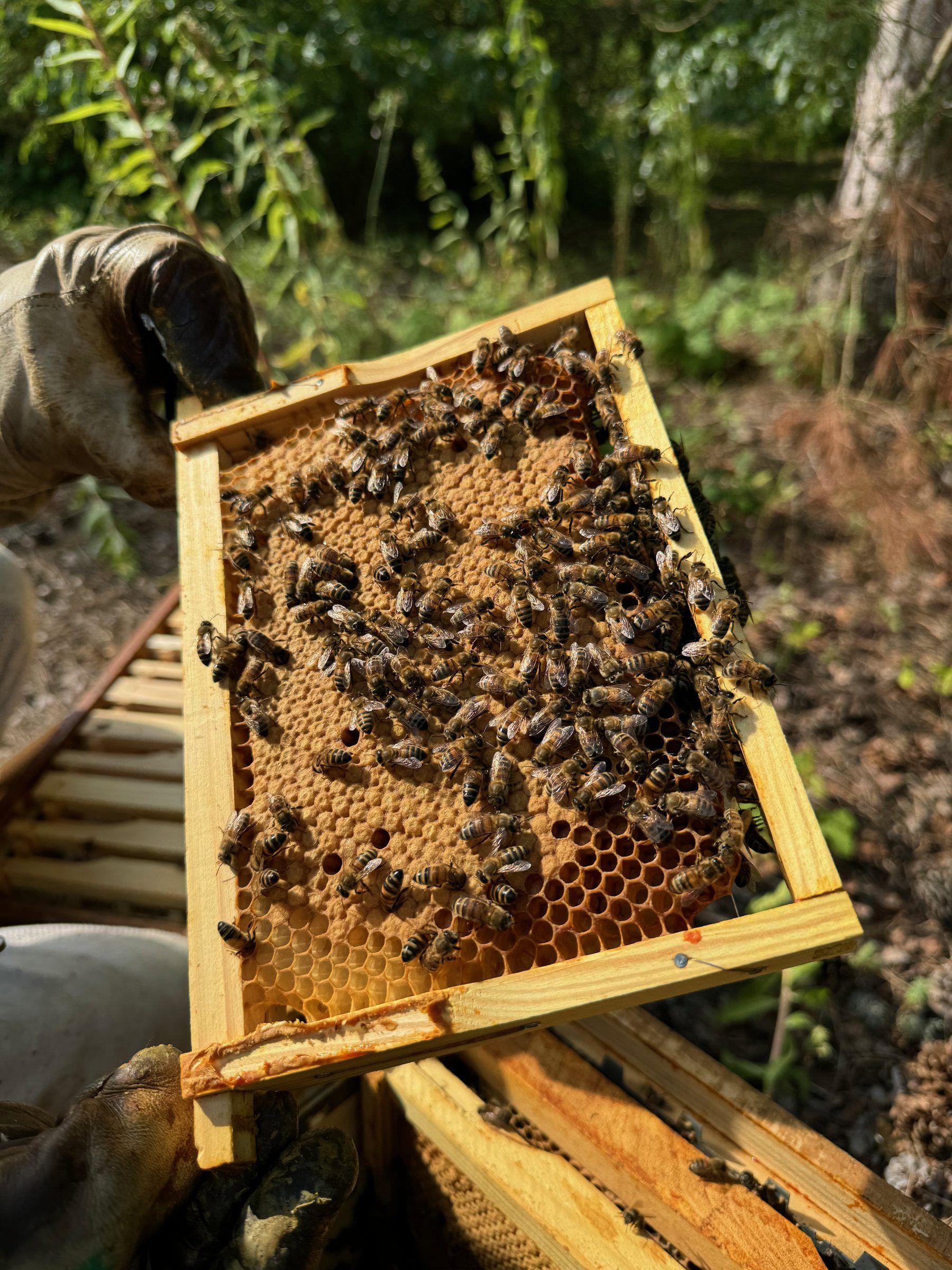
The decisive invention was American. In 1851 Lorenzo Lorraine Langstroth, a Congregational minister in Philadelphia, built a hive around the gap bees leave open as a passage. According to the University of Illinois, that gap is about 3/8 in (about 9.5 mm): a narrower space is glued shut with propolis, a wider one filled with comb. Hanging each frame with that space all round meant combs were no longer fixed to the hive and could be lifted out one at a time, examined and harvested without killing the bees. Langstroth’s US patent, No. 9,300, was granted on 5 October 1852 and his manual, Langstroth on the Hive and the Honey-Bee, followed in 1853. The University of Illinois credits the design with raising a typical hive’s yield from about 20 lb (9 kg) to more than 100 lb (45 kg) a year.
Foundation and the extractor
Two continental inventions completed the system. According to the Deutsche Biographie, Johannes Mehring (1815 to 1878), a beekeeper from Kleinniedesheim in the Palatinate, pressed wax between two wooden plates carved with the pattern of cell bases and showed his sheets and press at a travelling beekeepers’ congress in Stuttgart in 1858, winning a prize of 30 gulden; bees draw foundation into straight, mostly worker-cell comb. In the mid-1860s the Austrian officer Franz von Hruschka, based near Venice, introduced the centrifugal extractor, which spins honey out of the comb so that the empty comb can go back to the bees.
The BBKA and the end of the sulphur pit
In Britain, the new methods spread through an organisation. According to its own history, the British Beekeepers Association was instituted in 1874, beginning as a London-based club with the aim “For the Encouragement, Improvement and Advancement of Bee Culture in the United Kingdom”, and with an aim of improving the lives of rural workers as well as of bees. Teaching movable-comb methods meant teaching beekeepers to harvest without killing their colonies.
The association grew quickly:
- within about a decade it had become a national body, with early county members such as Lincolnshire, Surrey, Devon and Exeter, Dorset and Shropshire;
- in 1879 it linked up with the Royal Agricultural Society of England, whose shows gave it a public platform;
- in 1882 it began examinations, built around movable-comb methods and open to men and women alike;
- by 1890 its governing body included the presidents of 26 affiliated county associations;
- the Technical Education Act of 1889 let the BBKA and county associations apply for grants to teach beekeeping.
Those examinations are the ancestors of today’s BBKA Basic Assessment. As Crane and Walker put it, skeps were “gradually superseded by wooden movable-frame hives” in the late nineteenth century.
The British hive: from the WBC to the National
British beekeepers never adopted the Langstroth as their standard. In the late nineteenth century William Broughton Carr designed the WBC hive, a double-walled hive in which inner boxes holding ten British Standard frames with long lugs sit inside tapered outer “lifts”, according to the Scottish Beekeepers’ Association data sheet. It is warm and handsome, and still the classic image of an English garden hive, but slow to work because the lifts come off before every inspection.
The National kept the same British Standard frame and put it in a single-walled, square, stackable box, much quicker to handle. The BBKA’s history records that by 1955 it had negotiated nine standards relevant to beekeeping with the British Standards Institution; the hive and frame specifications appear in BS 1300:1960, a standard now withdrawn, although British Standard frames remain the norm. The National’s frame has a 17 in (432 mm) top bar with long lugs, and the boxes use bottom bee space, unlike the top bee space of the Langstroth.
| Hive | Origin | Frame | Where you see it now |
|---|---|---|---|
| WBC | William Broughton Carr, late 19th century | British Standard | gardens, shows, heritage apiaries |
| National | early twentieth century, standardised in BS 1300:1960 | British Standard (brood 14 in x 8 1/2 in) | the most common UK hive |
| 14x12 | National box with deeper frames | 14 in x 12 in | beekeepers wanting one larger brood box |
| Commercial | British, larger frame | 16 in x 10 in (406 x 254 mm) | some commercial and bee farmer operations |
| Langstroth | United States, 1852 patent | Langstroth | some larger UK operations and imported equipment |
The Dorchester and Weymouth Beekeepers’ Association’s comparison of hive sizes shows how small the National brood box is, at about 60,000 cells against 61,400 for the Langstroth and 85,000 for the Dadant, which is why many British beekeepers run “brood and a half” or a 14x12 box. Our National hive guide gives the full dimensions, frame options and current prices.
Isle of Wight disease and the native dark bee
The epidemic of 1906
The great disaster of early twentieth-century British beekeeping was Isle of Wight disease. According to the BBKA’s history, heavy losses from 1906 caused panic among beekeepers. The tracheal mite, Acarapis woodi, was described in 1921 by John Rennie from Isle of Wight bees, as Texas A&M AgriLife’s fact sheet records, and it was blamed for the losses. Restocking followed, much of it with imported bees.
Isle of Wight disease also had lasting institutional effects. The BBKA records that its lobbying led to a bee research unit being set up at Rothamsted Experimental Station in 1922, the start of a long line of British bee research. The tracheal mite story also crossed the Atlantic: the United States banned imports of adult honey bees in 1922 to keep the mite out.
A myth reassessed
The explanation did not hold. In 1964 Leslie Bailey of Rothamsted published “The ‘Isle of Wight Disease’: the origin and significance of the myth” in Bee World, reviewing the evidence and arguing that the mite had not caused the losses. Bee scientists have largely accepted that view, though many beekeeping books repeated the older story for decades.
Brother Adam and the Buckfast bee
The epidemic also produced Britain’s best-known bee. At Buckfast Abbey in Devon, according to the abbey, the disease killed 29 of its 45 colonies; the survivors were of Italian and Carniolan origin. Brother Adam (Karl Kehrle), who took charge of the abbey’s bees in 1919, travelled over 100,000 miles collecting stock and spent decades crossing it at an isolated mating apiary on Dartmoor, creating the Buckfast line, still kept by beekeepers worldwide.
Is the native bee still here?
The native dark bee, Apis mellifera mellifera, was long said to have been wiped out. Genetics says otherwise. A whole genome study published in 2024 by Victoria Buswell and colleagues in the Journal of Apicultural Research analysed 70 colonies from Britain and Ireland and found 17 with no significant introgression from other subspecies. It describes Ireland as a large reservoir of the dark bee and points to Jersey, mainland Scotland and the Isle of Man as new areas of interest for conservation. Our guide to honey bee breeds in the UK covers the dark bee, the Buckfast and imported stocks in detail.
Beekeeping in the twentieth century: war, foulbrood and the law
Sugar for bees in two world wars
During both world wars, according to the BBKA, the association secured extra sugar rations for beekeepers, because honey was treated as a valuable food. Beekeeping boomed: the BBKA records about 80,000 beekeepers and 396,000 colonies in England and Wales in 1953.
The journals and the split of 1943
The British Bee Journal was the BBKA’s official organ until 1943, when the Herrod-Hempsall brothers resigned from the BBKA’s leadership and withdrew it. Bee Craft filled the gap in 1947. By then separate national associations had formed in Ireland, Scotland and Wales, which is why Scottish and Welsh beekeepers today have their own national associations alongside local branches.
Foulbrood becomes notifiable
Disease control took decades to settle. The BBKA’s history records years of disagreement with government over American and European foulbrood from 1895, until the Foul Brood Order of 1942 made them notifiable and subject to inspection. Today’s framework rests on the Bees Act 1980, under which each part of Great Britain has its own Bee Diseases and Pests Control Order, such as the England Order of 2006 (SI 2006/342), with equivalent rules in Northern Ireland run by DAERA. Defra and APHA’s guidance lists the notifiable diseases and pests, American and European foulbrood, small hive beetle and Tropilaelaps mites, and makes varroa a reportable pest; failing to report a suspected notifiable disease or pest is an offence. Bee inspections in England and Wales are carried out by the National Bee Unit, part of APHA; in Scotland by the Scottish Government’s bee inspectors with SASA; in Northern Ireland by DAERA.
Varroa, hornets and beekeeping today
Varroa from the early 1990s
The most disruptive event of recent British beekeeping was Varroa destructor, a mite of the Asian honey bee, Apis cerana. The NBU booklet Managing Varroa states that it was first found in the UK in 1992; the find was made in Devon that spring, and the mite then spread across the UK. The 2020 booklet names the Isles of Scilly, the Isle of Man and some remote parts of Scotland as places where it has not been found. (The BBKA’s own history gives 1990, but the official first detection is 1992.) The BBKA links the mite to a fall in its membership from 15,000 in 1990 to just under 9,000 in 2001, as many older beekeepers gave up rather than learn to treat.
Varroa ended the era of the untreated colony. It is why the modern British calendar is built around mite counts and treatment windows; our guide to varroa mites gives the NBU thresholds and the VMD-authorised treatments.
The yellow-legged hornet since 2016
The newest threat is the yellow-legged hornet, Vespa velutina, still widely called the Asian hornet. Defra confirmed the first UK finding near Tetbury, Gloucestershire, in September 2016, set up a three-mile surveillance zone and sent bee inspectors with infrared cameras and traps to find the nest so it could be destroyed. Our page on the Asian hornet explains how to identify and report it.
How big is British beekeeping now?
Comparisons over time are rough, because the old figures and the new ones are not collected the same way. The NBU says over 9,500 beekeepers completed the 2024 Hive Count, giving an estimated UK total of about 252,647 hives. Set against the BBKA’s 396,000 colonies in England and Wales alone in 1953, that is a large fall, although many beekeepers do not register on BeeBase or take part.
Timeline of beekeeping history in Britain
| Date | Event |
|---|---|
| From the 7th millennium BC | beeswax in the pottery of Neolithic farmers in Europe, the Near East and North Africa |
| c. 2450 BC | Abu Ghurab relief, Egypt: oldest known picture of hives |
| 10th to 9th century BC | Tel Rehov apiary, about 180 clay hives |
| 688 to 694 | Laws of Ine: honey rents in Wessex |
| c. 705 | Aldhelm mentions wicker hives |
| 1042 to 1066 | bee tithes at one hive in ten |
| 1086 | Little Domesday records 1,369 hives in Essex, Norfolk and Suffolk |
| 13th century | Welsh laws written down: the mead-brewer’s third of the wax |
| 1609 | Charles Butler, The Feminine Monarchie |
| 1669 | Swammerdam shows the “king” is female |
| 1792 | Huber, Nouvelles observations sur les abeilles |
| 1845 | Dzierzon: drones come from unfertilised eggs |
| 1851 to 1852 | Langstroth’s movable-frame hive and patent |
| 1858 | Mehring presents wax foundation |
| 1874 | BBKA founded |
| 1882 | first BBKA examinations |
| 1906 | Isle of Wight disease losses begin |
| 1919 | Brother Adam takes charge of the Buckfast bees |
| 1921 | tracheal mite described from Isle of Wight bees |
| 1922 | bee research unit at Rothamsted |
| 1942 | Foul Brood Order makes foulbrood notifiable |
| 1952 | Eva Crane starts the Bee Boles Register |
| 1960 | BS 1300 hive and frame standard |
| 1964 | Bailey reassesses Isle of Wight disease |
| 1980 | Bees Act |
| 1992 | varroa first found in the UK, in Devon (NBU) |
| 2016 | first yellow-legged hornet near Tetbury |
What does this history mean for beekeepers today?
History is not only background; it explains several things you will do in your own apiary.
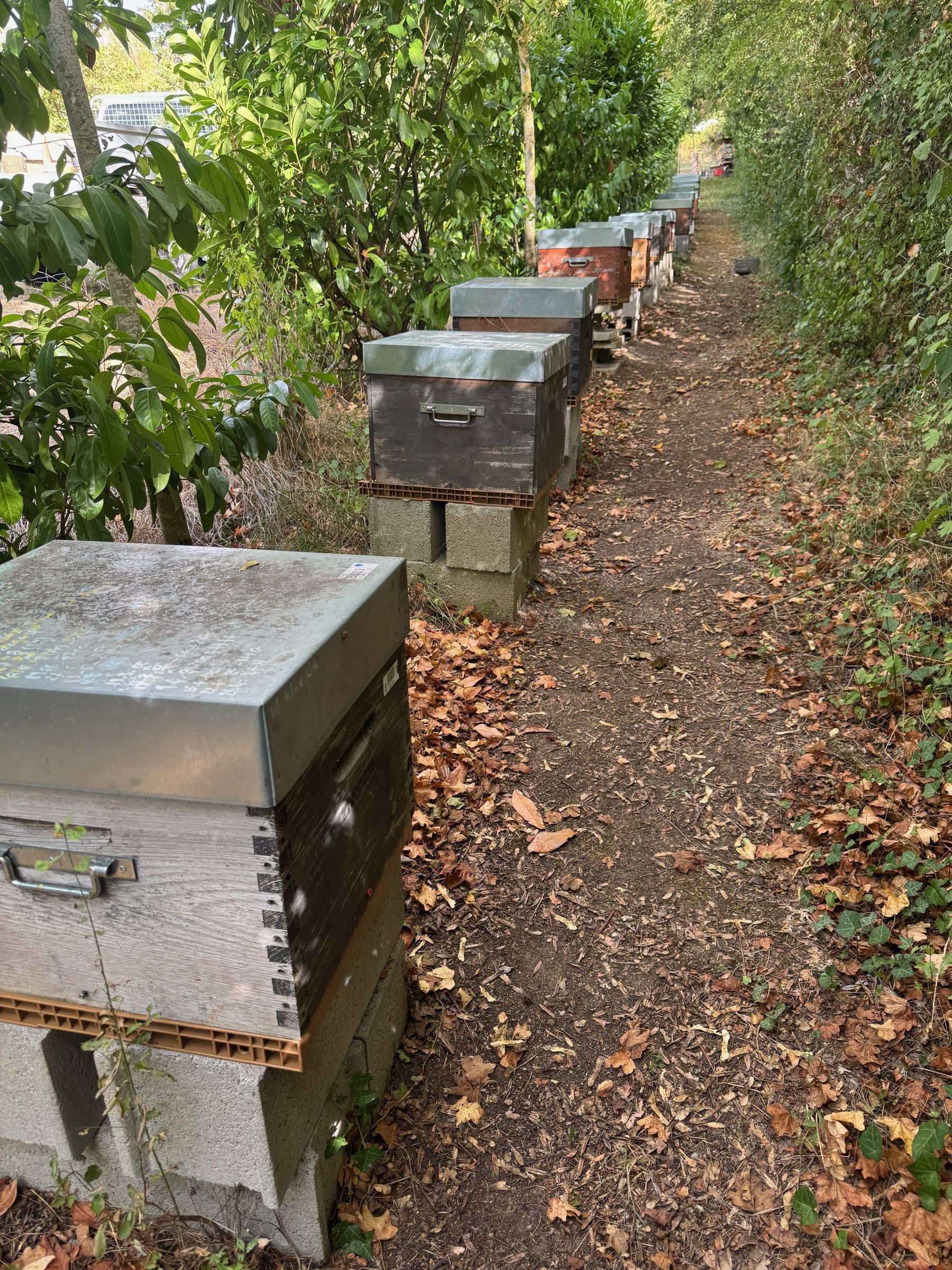
- Bee space still rules. Mixing bottom bee space and top bee space equipment, or leaving a gap too wide under a crownboard, invites brace comb and propolis. Sticking to one system is applying Langstroth’s observation of 1851.
- The skep beekeeper’s partial harvest is still the rule. Take honey from the supers and leave the brood box with enough stores to see the colony through winter.
- Swarming is no longer an asset. The skep beekeeper relied on swarms for increase; with frames, you make splits and nucs instead and practise swarm control from April.
- Disease law is a century old. The notifiable diseases and inspector powers you work under come from a line that runs from the BBKA’s arguments with government in 1895 to the Bees Act 1980.
- Old stories deserve checking. Isle of Wight disease shows how a plausible explanation can sit in books for decades. Read the current NBU and VMD guidance rather than relying on older manuals.
If you are thinking of joining that long line of British beekeepers, our guide on how to start beekeeping in the UK explains associations, training and the Basic Assessment, and our bee history section gathers the other articles on the past of beekeeping. From the bee churl of the Anglo-Saxon estate to today’s BeeBase user, the aim has stayed the same: take a surplus while keeping the colony alive.
Frequently asked questions
How long have people kept bees in Britain?
Hive beekeeping in England is documented from about AD 705, when Aldhelm mentioned wicker hives, and honey rents already appear in the laws of King Ine of Wessex (688 to 694). By 1086 the Domesday survey recorded 1,369 hives in Essex, Norfolk and Suffolk alone. Honey and wax were collected in Europe much earlier, from at least the seventh millennium BC.
What is a skep and how was honey taken from it?
A skep is a dome-shaped hive of coiled straw, or earlier of wicker, with fixed combs attached to the walls. English authors writing between 1587 and 1890 recommended skeps of 16 to 32 litres. To harvest, beekeepers either cut out part of the comb after smoking the bees, or in autumn killed the bees of the heaviest and lightest skeps with burning sulphur and took everything, keeping the middle weights to overwinter.
What are bee boles?
Bee boles are recesses built into walls, usually south-facing garden walls, each sized to shelter one straw skep from wind and rain. The Bee Boles Register, started by Dr Eva Crane in 1952 and now held by the Eva Crane Trust, records over 1,600 sites in the UK and Ireland. Many survive in old walled gardens in England and Scotland.
When was the BBKA founded?
The British Beekeepers Association was instituted in 1874, beginning as a London-based club with the aim of encouraging, improving and advancing bee culture in the United Kingdom. It became a national body within about a decade, started examinations in 1882 based on movable-comb methods, and still runs the Basic Assessment taken by most new beekeepers today.
Did Isle of Wight disease wipe out the British black bee?
Not in the way older books claim. Heavy colony losses from about 1906 were blamed on the tracheal mite, described by Rennie in 1921 from Isle of Wight bees, and restocking with imported bees followed. Leslie Bailey of Rothamsted challenged that explanation in 1964, and a 2024 genome study still found 17 of 70 dark bee colonies without significant introgression.
When did varroa arrive in the UK?
Varroa destructor was first found in the UK in 1992, in Devon; the National Bee Unit gives 1992 as the official first detection, although the BBKA's history says 1990. It then spread to nearly all apiaries; the NBU's 2020 booklet lists the Isles of Scilly, the Isle of Man and some remote parts of Scotland as still free. It ended the era of untreated colonies.
Who invented the National hive?
No single inventor is credited. The National developed in the early twentieth century by putting the British Standard frame, also used in William Broughton Carr's double-walled WBC hive, into a simpler single-walled square box. Its hive and frame dimensions were set out in BS 1300:1960, a British Standard since withdrawn.
How many beekeepers were there in the past compared with now?
The BBKA records about 80,000 beekeepers and 396,000 colonies in England and Wales in 1953. The National Bee Unit's 2024 Hive Count was completed by over 9,500 beekeepers and gives an estimated UK total of about 252,647 hives. The two figures are not measured the same way, but they show how much colony numbers fell after the mid-century peak.
Sources
- Widespread exploitation of the honeybee by early Neolithic farmers (Roffet-Salque et al., Nature 527, 2015), Nature
- The Tears of Re: Beekeeping in Ancient Egypt (G. Kritsky, Oxford University Press, 2015), book review, Royal Society of Biology
- The Apiary at Tel Rehov: An Update (Mazar, Panitz-Cohen and Bloch, Near Eastern Archaeology 85.2, 2022), Hebrew University of Jerusalem, Guy Bloch group
- Early English beekeeping: the evidence from local records up to the end of the Norman period (E. Crane and P. Walker, The Local Historian 29(3), 1999), Eva Crane Trust
- What are bee boles? About the Bee Boles Register, Eva Crane Trust
- A History of the Discoveries About the Sexuality of the Honey Bee, part 1 (F. Eggers de Villepin, November 2024), American Bee Journal
- Symposium marks milestones in honey bee management, research (December 2010), University of Illinois
- Mehring, Johannes (1815-1878), biographical entry, Deutsche Biographie (NDB/ADB)
- The history of the British Beekeepers Association, British Beekeepers Association
- Hive sizes (National, 14x12, Commercial, WBC, Langstroth, Smith and Dadant compared), Dorchester and Weymouth Beekeepers' Association
- Beehives, frames and wax foundation (BS 1300:1960, withdrawn), BSI Knowledge
- Honey bee tracheal mite, Texas A&M AgriLife Extension, Department of Entomology
- The 'Isle of Wight Disease': the origin and significance of the myth (L. Bailey, Bee World 45, 1964), Rothamsted Research repository
- Our bees: history of the Buckfast Abbey bee department, Buckfast Abbey
- Whole genome analyses of introgression in British and Irish Apis mellifera mellifera (Buswell et al., Journal of Apicultural Research, 2024), James Hutton Institute
- The Bee Diseases and Pests Control (England) Order 2006 (SI 2006/342), made under the Bees Act 1980, legislation.gov.uk
- Honey bees: protecting them from pests and diseases, Defra and APHA, GOV.UK
- Managing Varroa (advisory booklet), Animal and Plant Health Agency, National Bee Unit
- Asian hornet identified in Gloucestershire (September 2016), Defra and APHA, GOV.UK
- Hive Count, APHA National Bee Unit (BeeBase)