National hive: dimensions, frames, brood box options, supers and cost
The British National hive explained: box and frame dimensions, bottom bee space, brood and a half or 14x12, supers, winter stores, the law and 2026 prices.
The National hive, or British Standard National, is the standard beehive of the UK: a single-walled, square box about 460 mm (18 1/8 in) across, with a brood box 225 mm (8 7/8 in) deep, supers 149 mm (5 7/8 in) deep and bee space at the bottom of each box. It takes British Standard frames with long lugs: a 17 in (432 mm) top bar, a 14 in (356 mm) bottom bar and 8 1/2 in (216 mm) side bars in the brood box. Almost every UK supplier, association apiary and nucleus seller works in National, which is why most beginners start with it.
What is a National hive made of?
From the ground up, a National hive has seven parts, plus a stand.
- Hive stand: keeps the floor 30 to 45 cm off damp ground and puts the brood box at a comfortable working height. Many suppliers sell one with legs and a landing board.
- Floor: today almost always an open mesh varroa floor with a slide-out tray underneath for counting mite drop. It carries the entrance.
- Entrance block: a wooden strip with a large summer gap and a small winter gap, used to reduce the entrance against robbing and wasps. In autumn a metal mouse guard replaces or supplements it.
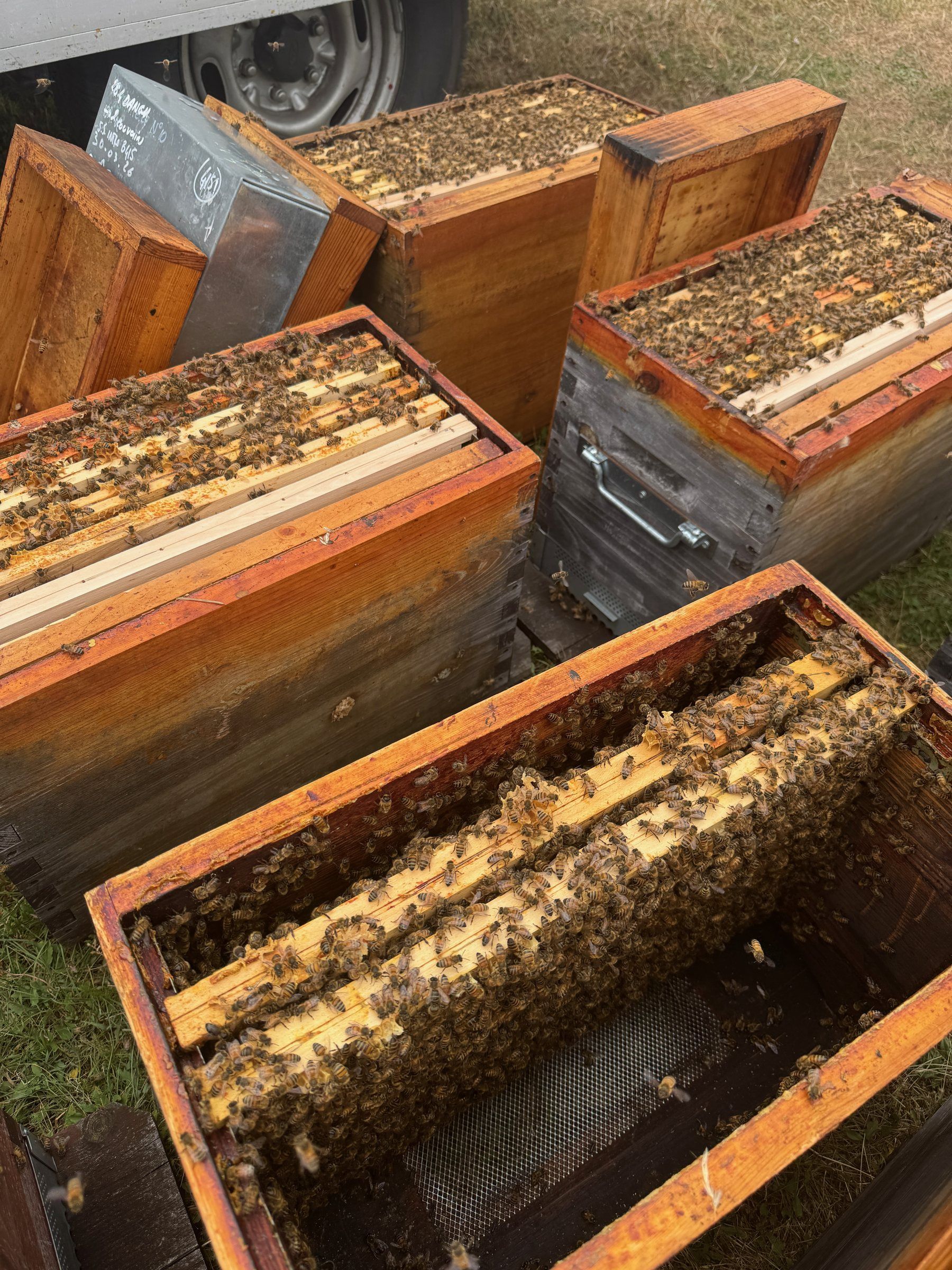
- Brood box: the deep box, 225 mm high, holding 11 brood frames and a dummy board. This is the brood nest and the winter larder.
- Queen excluder: a slotted zinc or wire grid placed between the brood box and the first super, so that the queen cannot lay in the honey frames.
- Supers: shallow boxes, 149 mm high, where the bees store surplus honey. Two or three per hive is normal.
- Crown board and roof: the crown board closes the top of the hive and usually has one or two holes that take a feeder or a Porter bee escape. The roof is a telescopic wooden lid covered in metal, often with a ventilated rim; flat 4 in (about 100 mm) roofs are the usual pattern.
An eke, a shallow rim the same footprint as the boxes, is the extra piece most beekeepers end up owning: it creates room under the roof for a block of fondant, an oxalic acid trickling session or a rapid feeder. For how the colony uses the space inside these boxes, see our guide to the honey bee colony.
What are the dimensions of a National hive?
The National brood frame and shallow frame
The National uses British Standard (BS) frames. The table gives the figures quoted by the Dorchester and Weymouth Beekeepers’ Association and by UK frame makers.
| Frame | Top bar | Bottom bar | Side bars | Lug length (each end) | Where it goes |
|---|---|---|---|---|---|
| Deep (brood) | 17 in (431 to 432 mm) | 14 in (356 mm) | 8 1/2 in (216 mm) | 1 1/2 in (about 38 mm) | National and WBC brood box |
| Shallow (super) | 17 in (431 mm) | 14 in (356 mm) | 5 1/2 in (140 mm) | 1 1/2 in (about 38 mm) | National and WBC super |
| 14x12 deep | 17 in (431 mm) | 14 in (356 mm) | 12 in (305 mm) | 1 1/2 in (about 38 mm) | 14x12 brood box |
The long lugs are the National’s signature. They let you lift a frame with your fingers clear of the bees, but the lugs need a rebate to rest on, which is why two sides of a National box are built up from thin inner and outer walls with a handhold gap, rather than being plain boards.
Two families of frames sit on those lugs:
- Straight-sided frames (DN1 deep, SN1 shallow): side bars about 7/8 in (22 mm) wide, which need plastic or metal spacers, castellated runners, or careful manual spacing. They are cheap and let you space super frames wide.
- Hoffman self-spacing frames (for example DN4 deep, SN4 shallow): the side bars widen to 35 mm in their upper part, so frames pushed together sit at 35 mm centres without spacers. Most beginners use them in the brood box because spacing errors disappear.
Frames ship flat-packed and take wired wax foundation; the foundation is pinned into a grooved or wedge top bar and held by a split or grooved bottom bar.
Bee space and frame spacing: the measurements that matter
Bee space is the gap the bees leave free for walking: below about 6 mm (1/4 in) they fill it with propolis, above about 9 mm (3/8 in) they build comb in it. The National is a bottom bee space hive: the top bars sit flush with the top of the box, and the bee space is left under the bottom bars. Its competitors the Smith (Scotland) and the Langstroth use top bee space. Never mix the two in one stack, or you will end up with either a double gap, which the bees fill with brace comb, or no gap at all, which crushes bees.
Frame spacing is the other figure to get right:
- In the brood box: 35 mm centres (about 1 3/8 in), which is what Hoffman side bars give. Eleven frames plus a dummy board fill the box.
- In the supers: wider spacing makes fatter combs that are quicker to uncap. The usual options are 9 or 10 frames on castellated spacers, or 8 frames with wide-end spacers.
Do not space brood frames wide. Above roughly 38 mm the bees fill the gap with drone comb or wild bridges between combs.
Box dimensions and capacity
| Box | External size | Height | Frames | Approx. cells (association estimate) |
|---|---|---|---|---|
| National brood box | 460 x 460 mm | 225 mm (8 7/8 in) | 11 plus dummy board | 60,000 |
| National super | 460 x 460 mm | 149 mm (5 7/8 in) | 9 or 10 on castellations | not given (a super is about two thirds of the brood box depth) |
| 14x12 brood box | 460 x 460 mm | 315 mm | 11 plus dummy board | 93,500 |
The capacity figures are the Dorchester and Weymouth association’s estimates of worker cells per brood box. The same page estimates that a colony at its spring peak, with a queen laying about 2,000 eggs a day, needs about 72,000 cells. That is the root of the main debate about the National: a single standard brood box is smaller than a strong colony needs in May.
National, 14x12, Commercial, WBC, Smith, Langstroth and Dadant compared
| Hive | External size | Brood box height | Super height | Bee space | Approx. brood cells | Notes |
|---|---|---|---|---|---|---|
| National | 460 x 460 mm | 225 mm | 149 mm | bottom | 60,000 | UK standard, long lugs |
| 14x12 | 460 x 460 mm | 315 mm | 149 mm | bottom | 93,500 | deep National, same supers |
| Commercial | 465 x 465 mm | 267 mm | 162 mm | bottom | 70,500 | 16 x 10 in frames, short lugs, heavy supers |
| WBC | 505 x 505 mm | 225 mm | 149 mm | bottom | 45,000 | double-walled, outer lifts, same frames as National |
| Smith | 416 x 463 mm | 225 mm | 149 mm | top | 50,000 | Scottish design, National frames with short lugs |
| Langstroth | 508 x 413 mm | 240 mm | 146 mm | top | 61,400 | world standard, not common in UK |
| Dadant | 508 x 470 mm | 299 mm | 168 mm | not stated | 85,000 | large, heavy, rarely used in the UK |
The Commercial and 14x12 share the National footprint closely enough that boxes can be mixed, which gives a National owner a way to enlarge the brood nest without changing roofs, floors or supers. For a fuller comparison of all these designs, top-bar hives and long hives included, see our guide to the types of beehives.
In Scotland, a 2024 Scottish Beekeepers Association survey shows how dominant the design is: of 294 hive-type entries, 222 were National, 33 Smith, 14 Langstroth and 13 WBC.
Is a single National brood box big enough?
This is the question every National beekeeper ends up asking. A single brood box suits gentle, less prolific bees, small colonies, nucs that are building up and native or near-native dark bees in the north and west. With a prolific queen, often Buckfast or other imported lines, a single National brood box is full by late April or May. A congested brood nest is the classic trigger for swarming.
There are four standard answers.
| Option | How it works | Advantages | Drawbacks |
|---|---|---|---|
| Single brood | one brood box under the excluder | lightest, quickest inspections, cheapest | cramped for prolific strains, more swarming pressure |
| Brood and a half | brood box plus one super below the excluder | 11 more shallow frames of laying space, same equipment | two frame sizes in the brood nest, queen hunting in two boxes |
| Double brood | two brood boxes below the excluder | very large nest, all frames interchangeable | heavy, 22 frames to inspect, often more space than needed in winter |
| 14x12 brood box | one deep brood box, same footprint | about 93,500 cells in one box, one frame size in the nest | each frame heavier, different frames from the supers |
Practical points:
- Brood and a half is the classic National compromise, because it uses only standard National boxes. The colony usually winters in both boxes with stores in the half.
- Converting to 14x12 can be done gradually: put a 14x12 box under the existing brood box, or stand a National brood box on a 90 mm (about 3 1/2 in) eke so that it takes 14x12 frames, which hang down into the eke; the old National frames are then removed as the queen moves onto the new combs.
- Double brood is mostly a temporary state in May and June for strong colonies or for queen rearing; reduce the colony to one box for winter if it cannot fill two.
Choose before you buy a second hive. Mixing systems within one apiary means some frames and boxes will not swap between colonies, which is exactly when you need them to: uniting, making up nucs or taking a frame of eggs from one hive to another.
When should you put a super on a National hive?
Adding the first super
Add the first super when three conditions are met:
- The bees cover about 7 or 8 of the 11 frames in the brood box, and there is brood on 5 or 6.
- There is fresh white wax along the top bars, a sign that the colony is drawing comb and wants space.
- A flow is starting or about to start. In much of lowland England, oilseed rape, fruit blossom, hawthorn and sycamore in April and May give the first flow.
Too early, the colony has to warm a big empty volume in a cold April night. Too late, nectar fills the brood nest, the queen runs out of laying room and swarming becomes likely. Put the queen excluder on, and place two or three frames of drawn comb in the middle of the first super if you have them: bees go up far faster onto drawn comb than onto foundation.
How many supers, and top or bottom supering?
Plan on two supers per hive as a minimum and three in a good area or year. Add the next super when the current one is about two thirds full.
- Top supering: the new super goes on top of the stack. It is the simplest method and avoids lifting full boxes.
- Bottom supering: the new super goes directly above the excluder, under the partly filled one. The bees fill space close to the brood nest faster, but you have to lift the full supers off first.
Oilseed rape honey sets hard and fast in the comb. Extract it within days of the field finishing, while it is still liquid, and do not leave rape supers on into the summer.
How heavy is a full National super?
A full National super holds about 11 to 12 kg (25 to 27 lb) of honey: 11.4 kg in the Dorchester and Weymouth figures, at least 12 kg according to the National Bee Unit. A National brood frame full of honey holds about 2.3 kg. Add the wood and wax and a full super is a 14 to 15 kg lift. A full Commercial super is noticeably heavier, which is one reason Commercial hives are less popular with hobbyists.
Taking the crop off
Take only frames that are capped, or nearly so, and check ripe honey with a refractometer if in doubt. The Honey (England) Regulations 2015, and the equivalent Scottish, Welsh and Northern Ireland regulations, set a maximum of 20% moisture for most honey and 23% for heather (Calluna) honey. Aim well below the limit, at 18% or less, to avoid fermentation. Put a clearer board with Porter bee escapes under the supers 24 to 48 hours before removal, keep every exposed super covered, and never spill honey in the apiary, or robbing starts. Extraction itself is covered in our guide to harvesting honey.
How much does a National hive cost in the UK in 2026?
These are prices observed in October 2026 at UK suppliers, including VAT and excluding delivery.
| Equipment | Indicative price (2026) |
|---|---|
| Cedar National hive, assembled: varroa floor and tray, brood box, 2 supers, crown board with 2 Porter bee escapes, 4 in roof, entrance block, no frames (Abelo) | about £225 |
| The same hive, assembled and painted, with a hive stand and landing board (Abelo) | about £295 |
| Cedar 14x12 National hive, flat pack, same components (Abelo) | about £194 |
| DN4 Hoffman brood frame or SN1 shallow frame, per frame (Abelo) | from about £1.30 |
| 14x12 Hoffman brood frames, pack of 11 (Simon the Beekeeper) | about £16 |
On top of the hive, budget for wax foundation, a queen excluder, a dummy board, a feeder, a mouse guard, a stand and the bees themselves. A National nucleus of five frames is the usual starting colony; buy it on National frames, otherwise it will not fit your box. For a full starter budget, see our list of beekeeping equipment for beginners.
Cedar, pine or polystyrene?
- Western red cedar is the traditional British choice: light, naturally rot-resistant and long-lived without paint. Second-quality cedar, with knots and small blemishes, is often sold cheaper and works just as well.
- Pine or other softwoods are cheaper but need an exterior, bee-safe treatment or paint on the outside only.
- Polystyrene National-compatible hives insulate far better, but are easily damaged by hive tools, woodpeckers and rodents, and some brands have slightly different internal dimensions, so check frame compatibility.
Insulation matters more than once thought. The University of Leeds reports that Derek Mitchell’s work, published in the Journal of the Royal Society Interface, found that typical hives with 19 mm wooden walls lose about seven times more heat than a natural nest in a tree hollow with 150 mm walls. A National’s single cedar walls are about that thickness, so a block of insulation over the crown board in winter is a cheap improvement.
What does the law say about keeping a National hive?
The rules apply to the bees, not the hive model, but they shape how you run any hive. They differ slightly between the four nations.
Registration and inspections
- England, Wales and Scotland: registration on BeeBase, run by the National Bee Unit (part of the Animal and Plant Health Agency), is voluntary and free. Registering lets bee inspectors contact you when there is foulbrood nearby and gives you access to your inspection records.
- Northern Ireland: voluntary registration is with DataBees; bee health is handled by DAERA ([email protected]).
- Scotland: the Scottish Government’s Bee Health Team runs inspections ([email protected]), with BeeBase as the register.
See our guide on how to register your bees for the step-by-step.
Notifiable and reportable pests and diseases
Under the Bee Diseases and Pests Control Orders (in England, the 2006 Order as amended, with separate Orders in Wales, Scotland and Northern Ireland), you must report any suspicion of the notifiable diseases American foulbrood (AFB) and European foulbrood (EFB) and the notifiable pests small hive beetle and Tropilaelaps mites. Failing to report is an offence. Since 21 April 2021, varroa has also been a reportable pest in England, Wales and Scotland: you report it once, by marking your apiary as varroa-positive on BeeBase or using the BeeBase form; in Scotland you may email the Bee Health Team instead. Apiaries registered before that date were set to positive automatically.
This is one reason movable frames matter: an inspector, or you, must be able to lift every brood frame and examine the cells for foulbrood, and a National with straight combs makes that quick.
Medicines
The National Bee Unit’s bee medicines fact sheet (June 2025) states that only products authorised by the Veterinary Medicines Directorate (VMD) can legally be used on honey bees without a veterinary prescription. It lists, among others:
- Amitraz: Apivar and Apitraz strips;
- Thymol: Apiguard gel, Thymovar and Apilife-VAR strips;
- Oxalic acid dihydrate: Api-Bioxal, Oxybee, Oxuvar, Dany’s BienenWohl and, in Great Britain only, Varroxal;
- Formic acid: Formic Pro strips; formic plus oxalic acid: VarroMed;
- Tau-fluvalinate: Apistan strips, now of limited use where mites are resistant.
Raw oxalic acid crystals and home-made thymol mixtures are not authorised. You must record medicines bought, used and disposed of, and keep the records for at least five years, even if the colony has died. Check the VMD Product Information Database (“Honey Bees”) for the current list.
Honey for sale
If you sell honey, the Honey (England) Regulations 2015 and their Scottish, Welsh and Northern Ireland equivalents set the composition (including the 20% moisture limit) and labelling rules. Most British beekeepers sell in 1 lb (454 g) jars.
Running a National hive through the British year
The calendar below fits lowland England and Wales; move it two to four weeks later in northern England and Scotland and on high ground. For the full month-by-month version, see our beekeeping calendar.
| Period | Main jobs on a National |
|---|---|
| February to March | Heft the hive for stores, give fondant if light, clean or swap the floor, first quick look on a calm day above about 14 °C |
| April to May | Weekly inspections for queen cells, decide single brood, brood and a half or 14x12, replace 2 or 3 old brood combs, super for oilseed rape and spring blossom, extract rape honey promptly |
| June | The June gap: forage can drop sharply after spring blossom, so watch stores even with supers on; swarm control continues |
| July | Main summer flow from bramble, clover, lime and field beans; add supers; monitor varroa in late July |
| August | Take the summer crop, treat for varroa early to mid-August, or move colonies to heather moorland and treat after it |
| September | Feed to about 20 kg of stores, reduce the entrance, fit mouse guards |
| October to January | Leave the bees alone, check roofs after storms, fit woodpecker netting if needed, consider a winter oxalic acid treatment in a broodless period |
Winter stores and feeding
The National Bee Unit advises that each colony should have approximately 20 kg of honey in autumn. On a National, that is roughly one full super plus three or four full brood frames, since a full super holds at least 12 kg and a brood frame about 2.3 kg. A colony on brood and a half often winters with its stores in the half.
- Autumn feeding: thick syrup at 1 kg of white granulated sugar per 630 ml of water (about 2 lb per pint), given straight after the last crop comes off and the varroa treatment allows, in a contact or rapid feeder over the crown board hole.
- Spring or emergency feeding: fondant placed over the crown board hole, in an eke if needed. Do not give liquid syrup in winter.
- Hefting: lift the back of the hive every other week through winter to judge stores. It takes practice; compare with a hive of known weight.
Ventilation from the open mesh floor and the roof is usually enough: damp kills more colonies than cold. Fit mouse guards before the mice move in, and in areas with green woodpeckers wrap the hive in chicken wire at least 300 mm from the walls. Our page on feeding bees covers syrup, fondant and pollen substitutes in detail.
Varroa monitoring on a National
The open mesh floor and its tray are your first monitoring tool: slide the tray in for a week, count the mites, and divide by the number of days. The National Bee Unit’s Best Practice Guideline on varroa (November 2025) asks beekeepers to:
- monitor at least four times a year, by daily mite drop, drone brood uncapping or an alcohol wash or sugar roll of adult bees;
- keep the population below about 1,000 mites, since around 2,500 mites causes irreversible damage;
- check in February to March, before supers go on, in late spring, in late July before the winter bees are reared in August, and again in October to decide whether a winter oxalic acid treatment is needed.
The NBU’s winter fact sheet places the main varroa treatment normally in early to mid-August, after the supers come off, or after late forage such as heather and Himalayan balsam. For the detailed thresholds, multipliers and treatments, see our page on varroa mites.
Replacing brood combs
Old, dark brood combs carry pathogen spores and pesticide residues. Replace 2 or 3 brood frames a year in spring, moving the oldest to the edge of the box and taking them out once empty of brood, so that the whole nest is renewed every three to four years. A shook swarm or Bailey comb change replaces all the brood combs at once and is recommended where disease has been a problem.
What yield to expect
Yields vary hugely with weather and forage. In the Scottish Beekeepers Association’s 2024 survey, respondents averaged just under 22 lb (about 10 kg) of liquid honey per hive; the 36 beekeepers who took heather honey averaged 8.4 lb (about 3.8 kg) of it. Lowland England with oilseed rape and lime usually does better, wet summers much worse.
Where did the National hive come from?
Before the National, the standard British hive was the WBC, designed by William Broughton Carr in 1890: a double-walled hive with outer lifts and inner boxes that take the same British Standard frame. The WBC is handsome and warm but slow to work, because the lifts must come off before every inspection. The National took the same frame and put it in a single-walled, square, stackable box, which made it cheaper and quicker to handle. The design dates from the interwar period and was written into British Standard BS 1300, “Beehives, frames and wax foundation”, whose 1960 edition is now withdrawn. The name stuck, and so did the dimensions.
The National’s frame is short and shallow compared with continental and American designs. The Langstroth, patented in the United States in 1852, has a longer, deeper frame and a box of slightly larger capacity. The Dadant, popularised by Charles Dadant in Illinois in the late 19th century and now the standard hive in France, goes much further: a brood box of about 85,000 cells, roughly 40% more than a National. British beekeepers who want that much space generally move to 14x12 or Commercial boxes instead, keeping the National footprint and their existing supers. For the broader story, read our history of beekeeping.
Is the National hive right for you?
For most beekeepers in the UK, yes. Its strengths are the ones that matter in your first years: equipment and nucs are sold everywhere, your association’s apiary and mentors use it, boxes are light enough to handle alone, and second-hand kit is easy to find and resell. Its weaknesses are a small brood box for prolific bees, the awkward rebated box construction, and frames that do not fit any foreign system.
Before you buy:
- choose your brood configuration now: single brood with spare supers for brood and a half, or 14x12 from the start;
- stick to bottom bee space and British Standard frames, and do not mix with Smith or Langstroth equipment;
- use Hoffman frames at 35 mm centres in the brood box, castellations or wide spacing in the supers;
- buy at least two supers, a queen excluder, a dummy board, a feeder and a mouse guard per hive;
- register on BeeBase (or DataBees in Northern Ireland) as soon as your bees arrive, and plan your varroa monitoring before the first spring.
Frequently asked questions
What are the dimensions of a National hive?
A National box is about 460 mm (18 1/8 in) square on the outside. The standard brood box is 225 mm (8 7/8 in) deep and the super 149 mm (5 7/8 in) deep. The brood frame has a 17 in (432 mm) top bar, a 14 in (356 mm) bottom bar and 8 1/2 in (216 mm) side bars; the shallow frame has 5 1/2 in (140 mm) side bars. Bee space is at the bottom of each box.
Is a National brood box big enough?
Often not, with a prolific queen. A single National brood box gives about 60,000 cells, and many associations consider it too small for modern strains at the peak of the season. The usual fixes are brood and a half (a brood box plus a super below the excluder), double brood, or a 14x12 brood box, which holds roughly 93,500 cells on the same footprint.
How many frames go in a National brood box?
Eleven brood frames plus a dummy board is the standard. With Hoffman self-spacing frames, whose side bars are 35 mm wide, the frames sit at 35 mm centres. The dummy board takes up the slack, so you can slide it out first and work the frames without crushing bees. Supers usually take 9 or 10 frames on castellated spacers, or 8 with wide-end spacers.
How heavy is a full National super?
A National super full of capped honey weighs roughly 11 to 12 kg (25 to 27 lb) of honey alone, plus the box and frames. The National Bee Unit counts at least 12 kg in a full super. A full National brood frame holds about 2.3 kg of honey. Lifting a stack of full supers is the hardest physical job of the season, so use a hive tool and lift with your legs.
Can I put Langstroth frames in a National hive?
No. A Langstroth frame is longer (about 19 in over the lugs) and deeper, and the Langstroth uses top bee space where the National uses bottom bee space. The boxes do not stack together either: a National is about 460 mm square, a Langstroth about 508 by 413 mm. Pick one system and buy frames, foundation, boxes, feeders and queen excluders to match it.
Do I have to register my National hive in the UK?
Registration on BeeBase is voluntary in England, Wales and Scotland, and free; in Northern Ireland the voluntary register is DataBees. It is strongly recommended because inspectors can then warn you of foulbrood nearby. Reporting is compulsory in other cases: suspected foulbrood, small hive beetle or Tropilaelaps must be notified, and in England, Wales and Scotland varroa must be reported once.
How much honey does a National hive need for winter?
The National Bee Unit advises about 20 kg of honey per colony in autumn. A full National super holds at least 12 kg and a full brood frame about 2.3 kg, so one full super plus three or four brood frames of stores is roughly enough. If the hive is light, feed thick syrup at 1 kg of sugar per 630 ml of water as soon as the last crop is off.
How much does a National hive cost?
In October 2026 a complete cedar National, with floor, brood box, two supers, crown board, roof and entrance block but no frames, costs about £225 assembled from a UK maker, and about £295 painted. A 14x12 version sells flat-packed for about £194. Frames start around £1.30 each, and you still need foundation, a queen excluder, a feeder and the bees.
Sources
- Hive sizes (National, 14x12, Commercial, WBC, Langstroth, Smith and Dadant compared), Dorchester and Weymouth Beekeepers' Association
- Beehives, frames and wax foundation (BS 1300:1960, withdrawn), BSI Knowledge
- DN4 National frames, first quality (specification and price), Abelo
- SN1 National frames, first quality (specification and price), Abelo
- National hive with flat roof, cedar, assembled (price and contents), Abelo
- National hive with flat roof, cedar, painted (price and contents), Abelo
- National 14x12 hive with flat roof, cedar, flat pack (price and contents), Abelo
- BS 14 x 12 deep brood Hoffman frames and pins (price), Simon the Beekeeper
- Preparing your hives for winter (Fact sheet 19), National Bee Unit, APHA
- Varroa (Best Practice Guideline No. 11, November 2025), National Bee Unit, APHA
- Bee medicines (fact sheet, June 2025), National Bee Unit, APHA
- Report Varroa, National Bee Unit, BeeBase
- Honey bees: protecting them from pests and diseases, Defra and APHA, GOV.UK
- The Bee Diseases and Pests Control (England) Order 2006 (as amended), legislation.gov.uk
- The Bee Diseases and Pests Control (Wales) (Amendment) Order 2021, legislation.gov.uk
- Healthy honey bees, Welsh Government
- The Honey (England) Regulations 2015, Schedule 1: compositional criteria, legislation.gov.uk
- The Honey (Scotland) Regulations 2015, Schedule, legislation.gov.uk
- 2024 Scottish Honey Survey results, Scottish Beekeepers Association
- Research challenges beliefs on honeybee insulation (work of D. Mitchell), University of Leeds