Where to put a beehive in the UK: neighbours, the law, siting, water, drifting and moving hives
Where to put a beehive in the UK: nuisance law and allotment rules, shelter and sun, entrance direction, water, hive layout against drifting and moving hives.
There is no legal minimum distance between a beehive and a neighbour anywhere in the UK, so where to put a beehive is a question of nuisance law, private rules and good sense. Choose a dry, level spot sheltered from the prevailing wind, out of frost pockets and away from dripping trees, with morning sun, a screen about 2 metres high in front of the entrance, a water supply of your own and forage within a couple of miles. Check your deeds, tenancy or allotment rules first, and talk to the neighbours before the bees arrive.
This guide covers garden, allotment and farm sites in England, Scotland, Wales and Northern Ireland. The legal points below are based on English law as it stood in October 2026; Scotland and Northern Ireland have their own legal systems and the details of nuisance law differ there, but the practical advice on siting is the same everywhere.
Is there a legal distance between a beehive and a neighbour in the UK?
No. No UK statute or regulation fixes how far hives must be from a boundary, a house or a road. No licence is needed to keep bees, and BeeBase registration (DataBees in Northern Ireland) is voluntary. Defra and APHA’s guidance concerns pests and diseases, not siting. The rules that do apply come from three directions: nuisance law, planning law and private agreements.
Statutory nuisance: what a council can do
Councils deal with complaints about bees under Part III of the Environmental Protection Act 1990. In an analysis published in Local Government Lawyer in June 2025, barrister Dan Jacklin of St Philips Chambers sets out how the provisions fit:
- Section 79(1)(fa), insects. It looks like the obvious route, but it only covers insects coming from “relevant industrial, trade or business premises”, so it does not suit domestic gardens. That could change if hive products are sold from an otherwise domestic property.
- Section 79(1)(a), premises. A poor fit: hives are chattels, not part of the land, so a nuisance does not come from the “state of the premises”.
- Section 79(1)(f), animals. This is the route councils have traditionally used. “Animal” is not defined but would include bees, and Jacklin concludes that bees remain “kept” while they visit other land, as long as they intend to return to the hive.
He adds that a council does not have to prove which bees visited a property, and that a large number of bees could amount to a statutory nuisance in the right circumstances. Whether it does is very fact-specific: an apiary that is reasonable on a smallholding may not be reasonable in a terrace of narrow gardens.
Private nuisance and the courts
A neighbour can also bring a claim in private nuisance. The case law is thin and old. In Johnson v Martin (1950), beekeeping was held to be an ordinary use of land and 750,000 bees were not unreasonable, but the decision is not binding and Jacklin suggests it may be outdated. More recent nuisance cases point the other way: the Supreme Court held in Fearn v Tate Gallery (2023) that nuisance does not need a physical invasion and that the public benefit of an activity is no defence, and Jacklin reads Birmingham Development Co v Tyler (Court of Appeal, 2008) as authority that fear of using your own land because of a neighbour’s activity can be actionable. “We were here first” is not a defence either, following Lawrence v Fen Tigers (2014). The practical lesson is that being popular, or helping pollinators, will not protect a badly sited apiary.
Planning permission
You do not need planning permission to keep a few hives in a garden. In the planning appeal Tandridge District Council v Homewood (1986), the Secretary of State treated keeping and selling bees as uses of land rather than operational development, and found that selling bees bred on site did not need planning permission. A material change of use could arise if you start selling hive products from a domestic property on a commercial scale, and Jacklin notes that councils have up to 10 years to act on a breach of planning control (section 171B of the Town and Country Planning Act 1990).
Deeds, leases, allotments and insurance
Private rules are often stricter than the law:
- Title deeds and leases can forbid livestock or “anything causing a nuisance”. Housing association and private tenancy agreements frequently need the landlord’s written consent.
- Allotments need the landlord’s permission and come with conditions. Croydon Council’s 2019-2020 rules are typical of a cautious council: only on designated beekeeping plots, a maximum of 2 hives and 1 nucleus per plot, screening at least 2.0 metres high (fine mesh netting, willow, hazel or a hedge), membership of a BBKA-affiliated association, all hives on BeeBase, public liability insurance of at least £5,000,000, gentle bees with aggressive colonies requeened or removed, a sign saying honey bees are kept there and weekly inspections from April to July. New keepers must hold the BBKA Basic Assessment or be mentored and pass it within 24 months.
- Insurance: BBKA registered, partner, honorary and junior members, who usually join through their local association, are covered by a public and product liability policy with a £10,000,000 limit for beekeeping activities in the UK. That limit is well above the £5 million that Croydon asks for, for example; the BBKA can supply a confirmation letter as proof of cover.
Our guide to how to register your bees explains BeeBase, DataBees and the Hive Count.
How do you choose a good apiary site?
Judge a site by what flowers within flying range, not by your own garden. Most foraging happens within a couple of kilometres of the hive, although bees will fly further when they must. Then look at the microclimate, the access and the neighbours.
Forage through the British season
Walk or map the area within about 3 miles and note the main sources:
- March and April: willow (sallow), blackthorn, dandelion, fruit blossom, and oil seed rape from April in arable areas. Rape gives a big early crop that sets fast in the comb.
- May: hawthorn, sycamore, horse chestnut, the tail of the rape.
- June: often a gap. Timberlake, Vaughan and Memmott (University of Bristol, Journal of Applied Ecology, 2019) found on farms in south-west England that nectar supply peaked in May and July, with a dip in June between them, and was low in March and in much of August and September.
- July: bramble, lime, white clover, field beans, borage where it is grown, and rosebay willowherb.
- August: heather on the moors of Scotland, northern England, Wales and the South West, and Himalayan balsam along rivers.
- September and October: ivy, which matters for late pollen and stores in a mild autumn.
A site with a strong spring and a dead June and August needs watching: colonies can starve in early summer even after a good rape crop. Our page on plants for bees has more detail on forage.
How many colonies can an area support?
No official figure exists for the UK, but density matters, especially in towns. The London Beekeepers’ Association (LBKA) says the number of honey bee colonies in London “continues to rise year on year”, with uneven “hot spots” and “cold spots”. Its 2023 paper on sustainable beekeeping describes “an imbalance between honeybee numbers and availability of forage” in parts of the capital. Its advice: check local honey bee density against forage before setting up an apiary; in high-density, low-forage areas, consider collective apiaries, fewer hives and smaller colonies; and plant forage. A 2020 review led by Kew scientists in Plants, People, Planet warned that the “save the bees” message had fuelled urban beekeeping that may harm wild bee conservation through competition for limited forage and disease spread.
Outside cities, ask your local association whether there is a large apiary or a bee farmer’s site nearby. Putting two hives next to a bee farmer’s forty on the heather does neither of you any good.
Microclimate: wind, frost and damp
The British problem is rarely heat; it is wind, cold and damp.
- Shelter from the prevailing wind, which across most of the UK comes from the south-west. A hedge, a wall or a fence on the windward side makes a large difference to foragers coming home loaded. Avoid exposed hilltops and wind tunnels between buildings.
- Avoid frost pockets. Cold air drains downhill at night and pools in valley bottoms and hollows, where fog lingers and hives stay damp. A gentle slope or a raised, well-drained shelf is better.
- Not under trees. The LBKA advises against siting hives under trees, where water drips on the roofs. Dense shade keeps hives cold and wet; dappled light at the edge of a wood is fine.
- Dry ground. Avoid boggy corners and places that flood in winter.
Access and your back
You will carry full supers, each often more than 12 kg, and a full hive cannot be lifted by one person. Choose a site you can reach with a car or a wheelbarrow in all seasons, on firm ground, with space to put boxes down behind each hive. The LBKA lists secure access, room to move safely around the hives and enough storage among the basics of a good site. If you are still choosing equipment, our guide to the National hive compares box sizes and weights.
Which way should a beehive face?
No rule fixes the direction of the entrance. These are the points British beekeepers weigh:
- Morning sun. The LBKA notes that early morning sun extends the foraging period. Most beekeepers face entrances somewhere between east and south, so the sun reaches the landing board early.
- Out of the wind. With a south-westerly prevailing wind, a hive facing south-west takes the weather straight into the entrance. A south-east or east aspect, with shelter behind, usually works best.
- Away from people. The flight line should not cross a path, a gate, a washing line, a patio or the neighbours’ garden. The LBKA advises making sure the flight path does not cross busy public areas, and notes that a fence can raise it.
- Raise the flight path. A fence, hedge or fine netting about 2 metres high, one or two metres in front of the entrance, makes the bees climb steeply and fly over people’s heads. This is the single most useful thing you can do in a small garden.
In a very sheltered garden in southern England, direction matters less than these last two points. On an exposed upland site in Wales or Scotland, wind protection matters more than anything else.
How should you arrange and space hives to reduce drifting?
Drifting is when bees return to the wrong hive. It weakens some colonies, strengthens others and carries Varroa and disease between them.
What the research shows
Nelson and Jay (Apidologie, 1989) measured drift in colonies set in a straight line with offset entrances near Beaverlodge, Alberta. After 7 days, drift reached 13% of marked bees in colonies that had not been moved, 21% in colonies moved at least 14 km and brought back, and 38% in colonies moved at least 14 km to a new apiary. It was highest on the first day of flying.
At Cornell, Seeley and Smith (Apidologie, 2015) compared 12 colonies set in a row about 1 metre apart with 12 colonies spread 21 to 73 metres apart. In the crowded row, around 35% of drones entering each hive came from another colony; in the dispersed group drifting was essentially absent. By late August, colonies in the crowded group that had swarmed carried far higher mite loads than dispersed colonies (11.5 against 1.6 mites per 300 bees), and none of the six crowded colonies survived the winter, against five of nine dispersed ones. The colonies were untreated, so the numbers say more about how mites spread than about what happens in a managed apiary, but the direction is clear. Our guide to Varroa mites covers monitoring and treatment.
Good layout in practice
The NBU’s fact sheet on apiary hygiene says hives “should be positioned in a way that reduces drifting”. Its methods, with one practical addition:
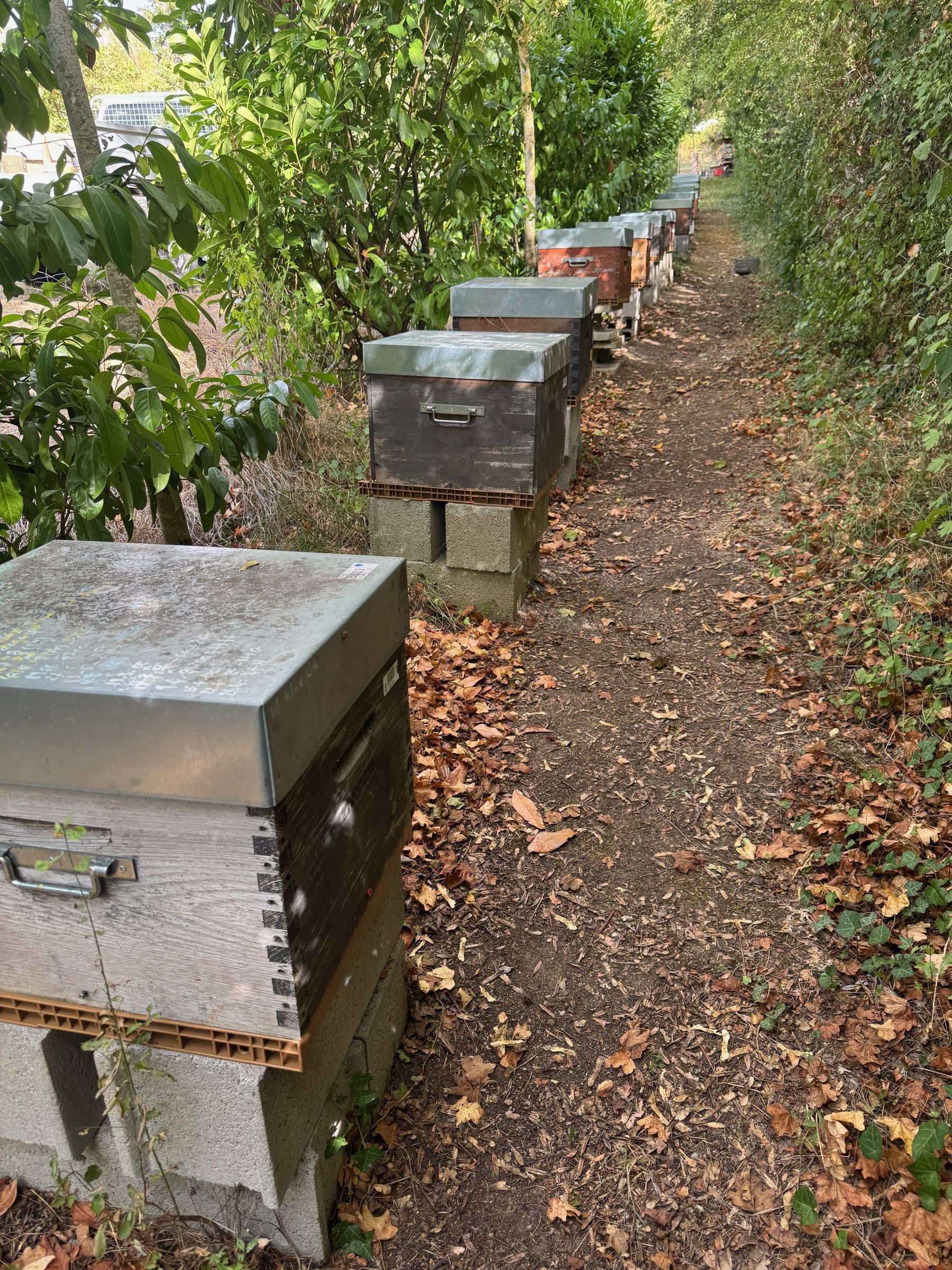
- Avoid straight lines. Use a semicircle, a horseshoe or small groups.
- Point entrances in different directions.
- Use different colours or heights. Landmarks such as a shrub or a post between hives also help.
| Situation | Practical spacing |
|---|---|
| Two hives on one stand | 30 to 50 cm between them |
| Hives on individual stands | at least 1 metre |
| Comfortable apiary | 1.5 to 3 metres between hives |
| Working space behind each hive | about 1 metre |
These are working figures, not rules. You inspect from behind or beside the hive, never standing in the flight line, so leave room there.
Plan a quarantine apiary
The NBU advises putting swarms of unknown origin into a quarantine apiary, separate from the main apiary, and leaving them through two brood cycles, around six weeks, before they join your other colonies. If you plan to collect swarms, find that second site when you set up the first.
Do bees need water near the hive?
Yes. The NBU’s Best Practice Guideline on water states that “apiary sites should be sited near to a suitable water source”. Colonies use water to dilute stored honey for brood food and to control temperature and humidity, and in hot weather they spread droplets over the combs to cool the nest by evaporation. Bees do not store much water: “reservoir bees” hold it in their honey sacs.
Research shows how quickly demand can rise. Ostwald, Smith and Seeley (Journal of Experimental Biology, 2016) heated the brood nest of two colonies and then took their water away. Brood nest temperature rose to 43.3 °C and 43.7 °C. When water was returned, collection jumped from 6.0 and 3.2 g to 21.5 and 22.8 g per 30 minutes, and the brood nest cooled by about 4 to 6 °C over three hours even though heating continued. British summers rarely push a colony that far, but a run of hot days in July or August can.
Setting up a water source
The NBU’s advice, with practical additions:
- Do it before the bees arrive. Foragers keep using the first reliable source they find, and the NBU warns that in dry spells bees can become a nuisance by drinking from swimming pools and garden ponds.
- Make it attractive. Bees prefer wet, dark surfaces such as damp soil, sand or brick, which warm quickly in spring, and water above about 18 °C. The NBU suggests a little salt when you first set it up.
- Stop drowning. Add floats to a water butt, or fill a bowl or old livestock drinker with pebbles so bees have somewhere to stand.
- Site it sensibly. Bees can fly up to 2 km for water, but a source close by saves energy. The NBU notes that a communal site a little away from the hives can work better than one right beside them.
- Keep it topped up and clean, especially from June to September.
A clean stream or a pond that never dries out can be enough on a farm site.
How do you prepare the ground: stands, levelling and protection?
Raise the hives
Never stand a hive directly on the ground. A stand keeps the floor dry, lets air circulate under an open mesh floor and brings the boxes to a comfortable working height. Common options are concrete blocks with timber rails across them, a purpose-made metal or timber stand, or old pallets on blocks. A floor about 40 to 50 cm off the ground suits most people: high enough to keep away damp and to save your back, low enough that a tall stack of supers stays manageable in July.
Level the stand from side to side so frames hang true and the bees do not build comb across them. A very slight tilt forward helps rain run out of the entrance.
Clear and maintain
- Keep vegetation down in front of the entrances without weedkiller; a paving slab or weed membrane under the stand helps.
- Cut back overhanging branches that drip on roofs or rub against them in wind.
- Fence out livestock. Cattle and horses rub against hives and knock them over. On farm sites, a stock fence around the apiary is essential.
- Never put honey supers directly on the ground: the NBU’s hygiene fact sheet warns of contamination by soil-borne spores.
Woodpeckers, mice and hornets
- Green woodpeckers can drill through the sides of wooden hives during prolonged spells below freezing. The author of The Apiarist, a beekeeping blog written by a Scottish bee researcher, finds the damage on the sides of the brood box where the frame lugs sit, and protects hives with either a chicken-wire cage on canes or a single layer of damp proof membrane pinned around the brood box.
- Mice move into hives in autumn: fit mouse guards in October.
- Yellow-legged hornets (Vespa velutina, often called the Asian hornet) are now found and destroyed each year in England. The NBU reports that Fera Science analysed data on the 162 nests found and destroyed in England in 2025 to identify areas at higher risk of overwintering hornets for 2026 spring trapping coordinated with BBKA teams. If you are in or near such an area, make sure you can watch your hive entrances easily in late summer and report sightings through the Asian Hornet Watch app. Our guide to the Asian hornet explains what to look for.
- Theft and vandalism: out-apiaries out of public view, with discreet access, suffer less. Put your name and a phone number inside the roof.
Gardens, allotments and rooftops: what extra precautions do you need?
In a garden
A garden is where most British beekeepers start, and where siting mistakes cost the most goodwill.
- Talk to the neighbours first. The LBKA advises consulting them and asking whether anyone is allergic to stings. Showing someone a frame of bees, and a jar of honey later, does more than any legal argument.
- Screen the hives with a 2 metre fence, hedge or netting so the bees fly up over the boundary.
- Keep away from the house. Place hives at the far end of the garden, away from the back door, the barbecue and children’s play areas.
- Provide water from day one.
- Manage swarming seriously. A swarm settling in a neighbour’s hedge is the most common source of complaints. Inspect every 7 to 9 days from April to July, and read our guide to swarming.
- Keep gentle bees. Requeen a defensive colony rather than hoping it calms down.
On an allotment
Follow the landlord’s rules to the letter: designated plot, hive limit, screening, signage, insurance and a back-up keeper are common requirements. Plot neighbours are close and often in shorts, so the screen and the flight line matter even more than in a private garden. Do your inspections when the site is quiet and avoid weekend afternoons.
On a roof or balcony
The LBKA strongly discourages high rooftops: bees waste energy reaching them, strong winds make them unsuitable and air-conditioning units can cause vibration. If you consider a lower flat roof or a terrace, check:
- the building owner’s or freeholder’s written consent;
- safe access by stairs, not a ladder, for full supers and for winter checks;
- shelter from wind, and a way to strap or weigh down the hives;
- afternoon shade and water, because roofs get hot;
- local forage and honey bee density, as above.
Out-apiaries on farms and taking bees to the heather
Many beekeepers keep some colonies away from home: on a farm, an estate or a friend’s field.
Agree terms with the landowner
Put the basics in writing: where the hives go, how you get in, when you will visit, gates and livestock, and what happens if the land changes hands. The usual “rent” is a few jars of honey a year. Check your insurance covers you on someone else’s land.
Pesticides and BeeConnected
Arable sites mean crop protection products. BeeConnected, a free online scheme run by the Voluntary Initiative and developed with the NFU, the BBKA and CropLife UK, lets farmers set up a “spray event” before applying insecticide. The system alerts registered beekeepers with hives within 5 km of the field, and both sides can message each other anonymously. The NFU says it connects more than 3,000 beekeepers with nearly 2,000 farmers. Register your apiaries, and talk to the farmer directly as well: knowing when the rape will be sprayed is worth a lot.
Moving to the heather
Taking colonies to the heather moors in August is a British tradition, particularly in Scotland, northern England and Wales. Ask the estate or landowner for permission, find a sheltered spot out of sight of walkers, strap the hives securely and move only strong, healthy colonies with a laying queen. Never move colonies, equipment or honey from a site where you suspect a notifiable disease: Defra and APHA’s guidance is to leave them in place until the disease has been controlled or the NBU agrees. Heather honey is a thixotropic gel, so plan how you will extract it before you go.
How do you move a beehive to a new spot?
Under 3 feet or over 3 miles
Foragers return to the exact position they have learnt. Move a hive 10 metres across the garden and they will go back to the old spot, cluster there and many will die. Hence the old rule of thumb:
- Short moves: about 1 metre (3 feet) per flying day, in steps, until the hive reaches its new place.
- Long moves: more than 3 miles, so the bees are outside their known area and reorient. To move a hive a few hundred metres, take it more than 3 miles away for about three weeks, then bring it back to the final site.
Nelson and Jay’s figures above show why care matters: colonies moved to a new apiary lost the most bees to drifting. On arrival, give the new site landmarks and avoid placing the moved hive in a neat row with others.
On the day
- Close the entrance in the evening once the foragers are home, with a screen or foam that still lets air in.
- Strap the hive together with a ratchet strap; never trust the weight of the roof.
- Ventilate in warm weather. The NBU suggests a frame feeder half-filled with water and floats beside the brood for long, hot journeys, or a light mist of water through a mesh screen.
- Open the entrance as soon as the hive is on its stand and settled, and put a branch or some grass across it to make the bees notice the change.
- Update BeeBase with the new apiary location.
When should you set up an apiary?
A realistic timetable for a first apiary in most of the UK:
- Autumn and winter before: join a local association and take its beginners’ course. Ask about local hive density, forage and good sites.
- January and February: check deeds, lease or allotment rules, ask the landowner, talk to the neighbours, and arrange insurance through association membership.
- February and March: prepare the site: stands, screening, water, fencing if there is livestock, access. If you plan to collect swarms, find a quarantine site too.
- March and April: order nucleus colonies from a local beekeeper. Register on BeeBase or DataBees.
- May and June: bring the bees home, in the evening, and open the entrance the next morning. Leave them alone for a few days before the first inspection.
- July and August: watch water, space and swarming; in late summer, keep an eye out for hornets hovering at the entrances.
- September: check stores and feed any shortfall, fit mouse guards in October, and plan winter woodpecker protection if you have had trouble before.
For more on hives and equipment, see the hives and apiary section.
Frequently asked questions
How far does a beehive have to be from my neighbour's house in the UK?
There is no legal minimum distance anywhere in the UK. What protects your neighbours is nuisance law: a council can treat a problem from kept animals as a statutory nuisance, and a neighbour can sue in private nuisance. In practice, a 2 metre screen in front of the hives, entrances facing away from their garden and your own water supply prevent almost every complaint.
Do I need permission to keep bees in my garden?
No licence or planning permission is needed for a few hives in a domestic garden; in the 1986 Tandridge planning appeal, keeping bees and selling bees bred on site were found not to need permission. Check your title deeds, lease or tenancy agreement, which can restrict or forbid livestock. Registering on BeeBase is voluntary but free and recommended, and BBKA membership through your local association gives £10 million of public liability cover.
Which way should a beehive entrance face in the UK?
No rule fixes it. Most British beekeepers face entrances somewhere between east and south so the morning sun warms the hive and the bees start foraging earlier. More important is to keep the entrance out of the prevailing wind, usually from the south-west, and to point the flight line away from paths, washing lines, patios and the neighbours.
Can I keep bees on an allotment?
Often, but only with the landlord's consent and under its rules. Croydon Council, for example, limits plots to 2 hives and 1 nucleus, asks for screening at least 2 metres high, membership of a BBKA-affiliated association, BeeBase registration, £5 million public liability insurance and the BBKA Basic Assessment or a mentor. Ask your allotment officer or society before you buy bees.
Can I put a beehive on a roof or balcony?
It is legal with the owner's consent, but the London Beekeepers' Association strongly discourages high rooftops: bees waste energy climbing to them, high winds make them unsuitable and air-conditioning plant can vibrate the hives. A low, sheltered flat roof with safe stair access can work. Never carry full supers up a ladder; plan how you will bring honey down.
How far can I move a beehive without losing bees?
The beekeepers' rule is under 3 feet or over 3 miles. Foragers return to the exact spot they remember, so a move of a few metres or a few hundred metres leaves them clustering where the hive used to be. Move a hive about 1 metre per flying day, or take it more than 3 miles away for three weeks and then bring it back to its new spot.
Do I need to give my bees water?
Yes, unless there is a reliable source close by. The National Bee Unit says apiaries should be sited near a suitable water source, because colonies use water to dilute honey and to cool the hive. Set up a dark tray, a bowl with pebbles or a water butt with floats before the bees arrive, otherwise they may adopt the neighbours' pond or pool.
How many hives can I keep in a garden?
No national limit exists, but forage, space and neighbours set one. Two colonies is the usual advice for a beginner, with spare equipment for swarm control. In dense urban areas such as central London, the London Beekeepers' Association asks beekeepers to check local honey bee density against forage first and to consider fewer hives, smaller colonies or planting instead.
Sources
- Local authority enforcement powers and domestic beekeeping (D. Jacklin, St Philips Chambers, 27 June 2025), Local Government Lawyer
- Honey bees: protecting them from pests and diseases, Defra and Animal and Plant Health Agency, GOV.UK
- Rules for beekeeping on allotments 2019 to 2020, Croydon Council
- Insurance, British Beekeepers Association
- Siting hives, London Beekeepers' Association
- Honeybees in London, London Beekeepers' Association
- Towards more sustainable beekeeping in London (version 1.0, 17 October 2023), London Beekeepers' Association
- The state of the world's urban ecosystems: what can we learn from trees, fungi, and bees? (Stevenson et al., Plants, People, Planet, 2020), University of Greenwich Research Repository
- Best Practice Guideline No. 7b: Feeding bees, water, National Bee Unit, APHA
- Fact sheet 3: Apiary hygiene and quarantine, National Bee Unit, APHA
- Risk areas for yellow-legged hornets: spring trapping 2026, National Bee Unit, APHA
- BeeConnected: connecting beekeepers to farmers, National Farmers' Union
- Phenology of farmland floral resources reveals seasonal gaps in nectar availability for bumblebees (Timberlake, Vaughan and Memmott, Journal of Applied Ecology 56, 2019), Cardiff University ORCA
- Woodpeckers (6 December 2014), The Apiarist
- Crowding honeybee colonies in apiaries can increase their vulnerability to the deadly ectoparasite Varroa destructor (Seeley and Smith, Apidologie 46, 2015), Apidologie, Springer
- The effect of colony relocation on loss and disorientation of honeybees (Nelson and Jay, Apidologie 20, 1989), Apidologie
- The behavioral regulation of thirst, water collection and water storage in honey bee colonies (Ostwald, Smith and Seeley, Journal of Experimental Biology 219, 2016), The Company of Biologists