Plants for bees: the best UK flowers, trees, shrubs and hedges for every season
Plants for bees in the UK: a season-by-season list of flowers, trees and hedging, what Sussex and RHS research found, plants to avoid and help for the June gap.
The best plants for bees in the UK are the ones that give nectar and pollen in quantity, with flowers bees can open, and that between them keep something in bloom from February to October. In practice that means willows, fruit trees and hawthorn in spring; marjoram, borage, lavender, catmint, knapweed, bramble, clover and lime in summer; and ivy in autumn, with single rather than double flowers. University of Sussex trials found that popular garden plants differ about a hundred-fold in how many bees and other insects they attract, so the choice matters more than the size of the garden. This guide lists the plants that work season by season, from window boxes to farm margins, the species you must not plant, and what all this means if you keep bees.
What makes a plant good for bees?
Bees live on two things they collect from flowers. Nectar is a sugary liquid that fuels flight and, in the honey bee, is turned into honey. Pollen is the colony’s only source of protein, fats, vitamins and minerals, and every larva is reared on it. A plant can be rich in one and poor in the other. Hazel catkins give plenty of pollen and no nectar; lime trees pour out nectar in July. A garden that works for bees covers both.
Four things decide whether a plant is genuinely useful:
- Reward: how much nectar and pollen each flower produces, and how many flowers the plant carries. A single mature willow or lime tree holds more food than a whole border of bedding plants.
- Access: whether the bee can reach it. Long, narrow flower tubes keep nectar for long-tongued bumblebees, moths and butterflies. Honey bees have short tongues and rarely work catmint for that reason, even though bumblebees love it.
- Flowering time: food in March or September is worth more than food in late May, when almost everything is in bloom.
- Quantity: bees forage efficiently on patches. Three or five plants of one kind together are visited far more than the same plants scattered.
Single flowers, not doubles
Many garden varieties have been bred for double flowers, where extra petals have replaced the stamens. That removes pollen and often walls off the nectar. The University of Sussex information sheets list pelargonium and pompom, semi-cactus and cactus dahlias as poor for bees and insects because they offer little or no accessible pollen or nectar, while the single, open dahlia ‘Bishop of Llandaff’ draws plenty of bumblebees. The RHS gives the same advice: choose simple, open flowers with a single layer of petals.
What the RHS Plants for Pollinators logo means
The Royal Horticultural Society’s Plants for Pollinators lists, relaunched in July 2025 after a review that began in 2022, now cover more than 10,000 plants in three lists: garden plants, wildflowers and plants of the world. The RHS says it chooses them on scientific evidence, its own experience and the records of gardeners and beekeepers, and the logo appears on labels in many garden centres. It is a good starting filter. Sussex researchers who surveyed garden centres found that plants sold as bee-friendly did attract about three times as many visitors as the rest, but labelling was inconsistent and some excellent unlabelled plants did as well. Use the logo as a guide and watch what the bees actually visit.
Native or non-native?
The RHS Plants for Bugs experiment, published by Salisbury and colleagues in the Journal of Applied Ecology in 2015, planted plots with UK natives, other northern hemisphere plants and southern hemisphere exotics. Its conclusion was practical: base a pollinator garden on UK natives and northern hemisphere plants, and use southern hemisphere plants to extend flowering later into the year. Above all, the gardens with more flowers across the season supported more bees and hoverflies, whatever their origin. The Sussex trials agree that bred varieties and hybrids are not necessarily worse than wild types, and are sometimes better.
Which plants for bees flower in each season?
The table below is built for lowland England. In Scotland, northern England, upland Wales and Northern Ireland, flowering runs two to four weeks later in spring and finishes earlier in autumn. For what the colonies are doing at each point, see our beekeeping calendar.
| Season | Trees and shrubs | Garden plants | Wild and farm plants | Main reward |
|---|---|---|---|---|
| Late winter (January to February) | Hazel, mahonia, winter honeysuckle, winter-flowering heathers | Snowdrop, winter aconite, hellebore, crocus | Gorse in mild spells | Mostly pollen |
| Early spring (March to April) | Goat and grey willow, blackthorn, cherry plum, flowering currant, pear, plum, cherry | Lungwort, grape hyacinth, rosemary, aubrieta, wallflower ‘Bowles’s Mauve’ | Dandelion, coltsfoot, white dead-nettle | Pollen and nectar |
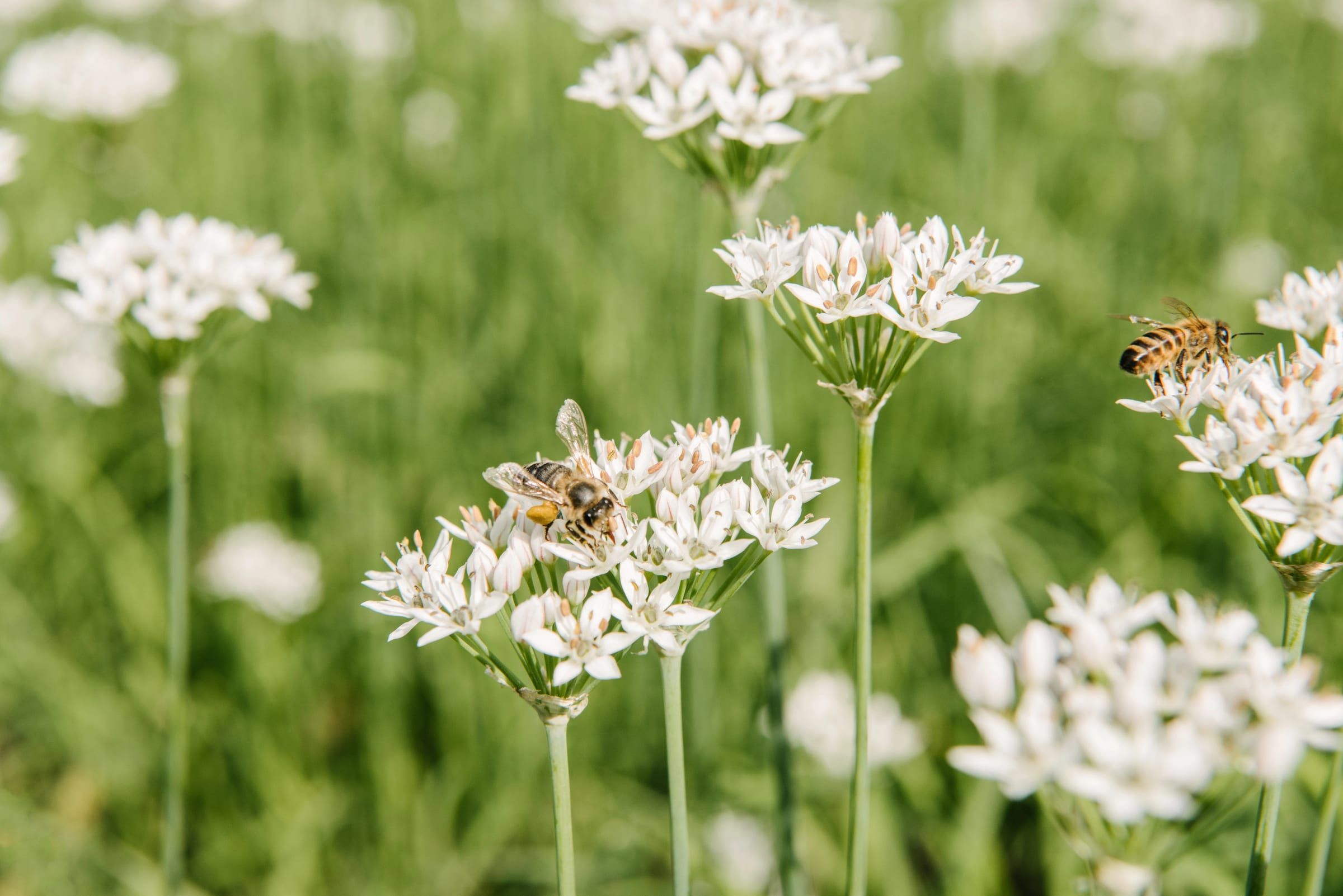
| Late spring (late April to May) | Apple and crab apple, hawthorn, sycamore, horse chestnut, field maple, cotoneaster | Alliums, chives, comfrey, honesty | Oil seed rape, bluebell, buttercup, cow parsley | Nectar flow |
| June gap (June) | Raspberry, privet, pyracantha in some years | Catmint, sage, foxglove, single roses, phacelia, geranium ‘Rozanne’ | Clover starting, bird’s-foot trefoil, field beans | Patchy |
| Summer (July to August) | Lime, sweet chestnut, bramble, buddleia (butterflies more than bees) | Marjoram, borage, lavender, agastache, thyme, echinops, helenium, eryngium, cosmos | White clover, knapweed, thistles, rosebay willowherb, ling heather from August | Main flow |
| Autumn (September to October) | Ivy, strawberry tree | Michaelmas daisies (some varieties), sedum, salvias, helianthus ‘Lemon Queen’, Japanese anemone | Ivy, late knapweed, devil’s-bit scabious | Ivy nectar and pollen |
Late winter: small meals on sunny days
Honey bees only leave the hive on mild, bright days in winter, so early flowers are less a lifeline than a top-up that helps the colony start rearing brood. Pollen is what they want most. Hazel catkins, crocuses and snowdrops are worked heavily on a warm February afternoon, and winter heathers such as Erica carnea and Erica x darleyensis flower for months in a sunny border. Mahonia and winter honeysuckle offer nectar for bumblebee queens that wake early in the south.
Spring: the willows matter most
Goat willow and grey willow (pussy willow) are the most valuable early trees in the country. Male trees are covered in pollen-laden catkins in March, female trees produce nectar, and both are worked by honey bees, bumblebee queens and the early mining bees. Blackthorn, cherry plum and the stone fruits follow. By late April and May the countryside is full: apple and pear blossom, hawthorn, sycamore and horse chestnut, dandelions in every verge, and in arable areas oil seed rape. Dandelion is one of the best plants you can simply allow to flower: leave it in the lawn until it has set seed.
The June gap
The June gap is not folklore. A University of Bristol study by Timberlake, Vaughan and Memmott, published in the Journal of Applied Ecology in 2019, measured nectar across farmland in south-west England through the year and found peaks in May and July with a dip in June between them, and lean periods in early March and in late summer as well. The hawthorn and spring blossom are over, the bramble, clover and lime have not started, and verges are often cut just then. The study measured nectar for bumblebees, but honey bees forage on the same flowers.
Gardens can fill the gap better than farmland. Plants that peak in June include chives, catmint, sage, comfrey, foxgloves (for bumblebees), single roses, hardy geraniums, cotoneasters already in your garden, alliums and phacelia sown in early spring. Mowing the lawn less often in late May and June lets white clover and bird’s-foot trefoil flower when they are most needed.
Summer: the main flow
July is the high point. Bramble, white clover and lime trees are the great nectar sources of lowland Britain, and borage, field beans and garden flowers add to them. In gardens, members of the mint family are reliable: marjoram, thyme, lavender, catmint, Russian sage (perovskia) and hyssop. The daisy family adds helenium, echinops, cosmos and sunflowers. From August, ling heather flowers on the moors of Scotland, the Pennines, the North York Moors, Wales and the south-west.
Autumn: the ivy season
Ivy (Hedera helix and Hedera hibernica) is the most underrated bee plant in Britain. In Garbuzov and Ratnieks’s study in Sussex, about 89% of the pollen loads that honey bees brought home in autumn came from ivy, and its nectar ran at about 49% sugar. Hoverflies, wasps, butterflies, bumblebees and the ivy bee (Colletes hederae), a solitary bee that arrived in England in 2001, all depend on it. The authors call ivy a likely keystone species for autumn insects. If you have mature ivy on a wall, a tree or a fence, let some of it flower: only the adult, shrubby growth at the top produces flowers. Late asters, salvias, sedums and helianthus ‘Lemon Queen’ carry the garden into October.
Which trees and shrubs are best for bees?
Trees give more flowers per square metre of ground than any border, and they keep giving for decades. If you have room for one tree, it will probably feed more bees than everything else you plant.
| Tree or shrub | Flowering (lowland England) | Size | Value for bees |
|---|---|---|---|
| Goat willow (Salix caprea) | March to April | 8 to 10 m | Pollen (male trees) and nectar; the key early tree |
| Hazel (Corylus avellana) | January to March | 4 to 6 m, coppiced | Pollen only; wind-pollinated |
| Blackthorn (Prunus spinosa) | March to April | Hedge shrub | Nectar and pollen before the leaves |
| Apple, crab apple, pear, plum, cherry | April to May | 3 to 8 m | Nectar and pollen; easy in small gardens on dwarfing rootstocks |
| Hawthorn (Crataegus monogyna) | May | Hedge or small tree | Heavy nectar in warm, humid weather |
| Sycamore and field maple | April to May | Large | Nectar and pollen; sycamore honey is a common spring crop |
| Horse chestnut | May | Large | Nectar and dark red pollen |
| Lime (Tilia x europaea, T. cordata, T. platyphyllos) | Late June to July | Large | Major nectar flow, especially in towns |
| Sweet chestnut | July | Large | Nectar and pollen; dark, strong honey |
| Bramble (Rubus fruticosus agg.) | June to August | Scrambling shrub | One of the most important summer flowers |
| Ivy | September to November | Climber | Autumn pollen and nectar |
Lime deserves its reputation. In a good July, avenues of common lime in towns and parks give a flow that urban beekeepers rely on, and lime honey is one of the few floral honeys a town beekeeper can sometimes label as such. Lime yields best on warm, humid days and can fail completely in cold or dry weather. Choose small-leaved lime (Tilia cordata) for a large garden: it suits the British climate and is a native tree.
In a small garden, fruit trees on dwarfing rootstocks are hard to beat: they give blossom for bees, fruit for you, and need bees to set a crop. Crab apples such as ‘Evereste’ or ‘John Downie’ flower heavily and stay under 5 m.
How do you plant a bee-friendly hedge?
A mixed native hedge is one of the best things you can plant for bees because it flowers in sequence for months. A typical mix for lowland England:
- February to April: hazel, blackthorn, cherry plum, goat willow.
- May: hawthorn, crab apple, field maple, holly.
- June to July: dog rose, bramble, privet, elder in the hedge bottom, honeysuckle threaded through.
- September to October: ivy climbing through the older stems.
Planting step by step
- Plant bare-root whips between November and March, when the ground is not frozen or waterlogged. They cost a fraction of pot-grown plants and establish faster.
- Plant a double staggered row, about five plants per metre, with the rows 30 to 40 cm apart. Make hawthorn 50 to 70% of the mix, because it knits the hedge together, and add the others in groups of two or three.
- Mulch and protect. A sheet or bark mulch keeps grass away for the first two or three years, and spiral guards protect against rabbits.
- Cut lightly and late. A hedge flowers on the previous year’s wood, so cutting every year in late summer removes next spring’s blossom. Cut in January or February, and ideally only every second or third year, alternating sides. On farmland in England, the Management of Hedgerows (England) Regulations 2024, in force since 23 May 2024, ban hedge cutting from 1 March to 31 August inclusive and require a 2 m buffer strip from the centre of the hedge with no cultivation, pesticides or fertiliser.
Local provenance
Use whips grown from UK seed where possible. Native shrubs from local seed flower at the right time for your climate and support the insects that evolved with them. Most hedging nurseries now label plants as UK provenance.
What are the best garden flowers for bees?
What the Sussex trials found
The most useful evidence for British gardeners comes from the Laboratory of Apiculture and Social Insects at the University of Sussex. In 2011 and 2012, Mihail Garbuzov and Francis Ratnieks counted insects on 32 popular summer-flowering garden varieties and published the results in Functional Ecology in 2014. Attractiveness varied about a hundred-fold between plants that all look good to people. Marjoram and agastache came top; pelargonium came bottom with about one-hundredth as many visitors.
The laboratory’s information sheets summarise what each plant attracted:
- Marjoram (Origanum vulgare): among the best for both numbers and variety, including honey bees, bumblebees and butterflies.
- Borage: especially attractive to honey bees.
- Lavender ‘Grosso’: mainly bumblebees, with honey bees and others. Hybrid lavenders (Lavandula x intermedia) attracted more insects than the species lavenders.
- Catmint: mainly bumblebees. Honey bees rarely visit because the flower tube is too long for their tongues.
- Wallflower ‘Bowles’s Mauve’: honey bees, bumblebees and butterflies, flowering from April to November.
- Fleabane, helenium ‘Sahin’s Early Flowerer’, lamb’s ear and helianthus ‘Lemon Queen’: wide ranges of bees and hoverflies.
- Buddleia, verbena bonariensis and hemp agrimony: excellent for butterflies, much less so for bees.
A separate Sussex survey of more than 200 aster varieties found that most attracted few insects, while the best were as easy to grow and as attractive to people as the rest. That is the real lesson: within one plant group, variety choice can matter as much as the plant itself.
Herbs and the vegetable plot
Many kitchen herbs are first-class bee plants if you let them flower: thyme, marjoram, sage, rosemary, chives, mint, hyssop and fennel. Borage self-seeds and flowers from June to the frosts. On the vegetable plot, broad and runner beans, courgettes and squashes, raspberries, strawberries and currants all feed bees and need them for a good crop. Phacelia (Phacelia tanacetifolia) is sown as a green manure and is one of the most heavily worked flowers there is; sow in spring for flowers in the June gap.
Pots, balconies and window boxes
Even a balcony can feed bees if it gets sun. Choose a few plants that flower in different months:
| Container plant | Pot depth | Flowering | Notes |
|---|---|---|---|
| Crocus, grape hyacinth, dwarf iris | 15 cm | February to April | Plant bulbs in autumn |
| Wallflower ‘Bowles’s Mauve’ | 30 cm | April to November | Long season; replace every 2 to 3 years |
| Thyme and chives | 15 to 20 cm | May to July | Let them flower |
| Lavender ‘Grosso’ or ‘Hidcote’ | 30 cm | June to August | Free-draining compost |
| Marjoram | 20 cm | July to September | One of the best plants in the Sussex trials |
| Catmint ‘Walker’s Low’ | 30 cm | June to September | Bumblebees; cut back after first flush |
| Sedum (Hylotelephium) ‘Autumn Joy’ | 20 cm | August to October | Late food |
Group three or four pots of the same plant together so they form a visible patch, avoid peat-based compost where you can, and water well in hot spells, because stressed plants produce less nectar.
Lawns
A lawn can be a meadow in miniature. In a Brighton park, the Saltdean Oval, Sussex researchers found that the half where the council had reduced grass cutting had about 50 times as many insects as the short grass, with black knapweed, which is extremely attractive to honey bees, among the commonest flowers to benefit. You do not need to stop mowing altogether: cutting less often lets white clover, self-heal, bird’s-foot trefoil and dandelion flower between cuts.
Which plants should you avoid?
Plants you must not plant or sell
Several plants loved by bees are invasive in Britain and are controlled by law. In England and Wales, the invasive alien species rules list 36 plants as species of special concern. You must not import, keep, breed, transport, sell, grow, cultivate or let them reproduce, including as seeds or cuttings. Himalayan balsam (Impatiens glandulifera) is on that list. Beekeepers near rivers often get a useful late-summer flow from wild balsam, but sowing or spreading it is an offence, and landowners are expected to control it where they can.
Separately, Schedule 9 of the Wildlife and Countryside Act 1981 lists plants that it is an offence to plant or otherwise cause to grow in the wild in England and Wales. Its Part II includes Himalayan balsam, Japanese knotweed, Rhododendron ponticum, montbretia, three-cornered garlic and five cotoneasters: Cotoneaster horizontalis, C. integrifolius, C. simonsii, C. bullatus and C. microphyllus. Cotoneasters are excellent bee plants in June, and having one in a garden is not an offence, but do not plant them near woodland, cliffs or heath where birds will carry the berries into the wild, and never dump cuttings over the fence.
Scotland works differently. Under the Wildlife and Natural Environment (Scotland) Act 2011, it is an offence to plant, or otherwise cause to grow, any plant in the wild outside its native range. NatureScot’s code of practice treats gardens, farmland and settlements as outside “the wild”, so garden planting is not caught, but planting non-native species along woodland edges or on rough ground can be. Northern Ireland has its own list under the Wildlife (Northern Ireland) Order 1985.
Rhododendron: a special case
Rhododendron ponticum is not only invasive. Its nectar contains grayanotoxins, the compounds behind “mad honey”. Research summarised by Kew in 2016 found that honey bees fed the nectar died within hours, that a native mining bee (Andrena scotica) showed disrupted behaviour, while the buff-tailed bumblebee was unaffected. It is no plant for a beekeeper’s garden.
Buddleia
Buddleia (Buddleja davidii) is not on Schedule 9 and is legal to sell and grow in Great Britain. It is a magnificent butterfly plant, but the Sussex trials found it was not very attractive to bees. It also seeds freely on railways, walls and derelict sites. If you grow it, deadhead it before it sets seed, and give bees something better alongside it.
Treated plants and false friends
Some nursery plants are grown with systemic insecticides, which can end up in pollen and nectar, and much ornamental stock sold in Britain is raised abroad. Ask your supplier how plants were grown, buy from nurseries that grow without systemic insecticides, or raise bee plants from seed. Other false friends are plants sold in bloom that bees cannot use: double begonias, petunias, busy lizzies and most bedding pelargoniums.
How do you make a wildflower meadow or nectar patch?
A sown wildflower patch can feed bees heavily, but it is not a quick fix. Most native meadow flowers need poor soil. On rich garden soil, grasses and docks swamp them within two years.
Annual or perennial?
- Annual cornfield mixes (cornflower, corn marigold, corncockle, field poppy, with phacelia or borage often added) give a spectacular first summer, but they need bare, disturbed soil every year.
- Perennial meadow mixes build up over three to five years. For bees, look for common knapweed, field scabious, bird’s-foot trefoil, red and white clover, oxeye daisy, wild marjoram, viper’s bugloss, self-heal, yarrow, meadow cranesbill and wild carrot. Include yellow rattle in grassy sites: it is semi-parasitic on grasses and weakens them so the flowers can establish.
Step by step
- Strip or reduce fertility. Remove turf and the top few centimetres of soil, or sow into a lawn scarified until 50% is bare soil.
- Sow in September or March to April, at about 2 to 5 g per square metre for a pure wildflower mix, mixed with sand for even spreading, then roll or tread in. Do not bury the seed.
- Cut the first year every six to eight weeks to 5 cm, to keep annual weeds down.
- From the second year, take one hay cut in late August or September after most flowers have seeded, and remove the cuttings so the soil stays poor.
On farms: SFI pollen and nectar mixes
In England, farmers can be paid for flower-rich strips. Under the Sustainable Farming Incentive 2026, action CAHL1 (pollen and nectar flower mix) pays £739 per hectare per year over three years. The mix must be grass-free with at least six flowering species, none above 50% by weight, and include at least two of common knapweed, musk mallow, oxeye daisy, wild carrot and yarrow. It is sown between early spring and early autumn and re-established after the second summer. Defra’s SFI 2026 leaflet set a first application window in June 2026 for small farms (3 to 50 ha) and farms without an existing agreement, and a second window from September 2026 open to all; you need at least 3 ha of agricultural land to apply. Scotland, Wales and Northern Ireland run separate agri-environment schemes.
What do bee plants mean for a beekeeper?
Forage range
Honey bees fly much further than most garden insects. Couvillon, Schürch and Ratnieks decoded 5,097 waggle dances from hives in Sussex over two years and found mean foraging distances of 493 m in spring, 2,156 m in summer and 1,275 m in autumn. Summer is the hard season: bees fly furthest when flowers are scarcest. A colony works an area of several square kilometres, so the forage around your apiary matters more than what is in your own garden. That is why choosing a site is the first decision in where to put a beehive.
Britain’s nectar landscape
Britain’s nectar supply fell sharply in the twentieth century. Baude and colleagues, writing in Nature in 2016, found substantial nectar losses in England and Wales between the 1930s and the 1970s, a stabilisation by 1978 and some increase between 1998 and 2007. But diversity fell: by 2007 just four species provided more than half of the national nectar supply. Calcareous grassland, broadleaved woodland and neutral grassland gave the most nectar per hectare, arable land the least. Gardens, parks and road verges are part of the answer because they hold plants that farmland no longer does.
Plants and the honey in the jar
The plants within reach of your hives decide what honey you take off:
| Source | When | Honey |
|---|---|---|
| Oil seed rape | April to May | Pale, mild, sets hard within days: extract quickly |
| Hawthorn, fruit blossom, sycamore | May | Mixed spring honey, often blended with rape |
| Bramble, white clover | June to August | Pale and mild; the classic English summer honey |
| Lime | July | Greenish tint, minty or fresh flavour |
| Borage (field crops) | June to August | Very pale, slow to granulate |
| Ling heather (Calluna vulgaris) | August to September | Dark, strong, thixotropic: it sets like a jelly in the comb |
| Ivy | September to November | Sets hard in the comb; usually left for the bees |
Ling heather honey is the most valued British crop. Under the Honey (England) Regulations 2015, and their equivalents in Scotland, Wales and Northern Ireland, heather honey may contain up to 23% water, against 20% for most honey. It is also unpredictable: in the Scottish Beekeepers Association’s survey of the 2024 season, heather yielded an average of 8.43 lb per hive, against 21.96 lb for runny honey, but heather sold for an average of £12.10 a 1 lb jar.
If you want to put a plant’s name on your label, Trading Standards guidance for England and Wales says a floral name such as “lime honey” or “heather honey” is allowed only if the honey comes wholly or mainly from that plant. Our guides to harvesting honey and how to choose honey cover the rest.
When planting is not enough
Even a well-planted area has gaps. A cold April, a dry June or a wet August can stop the flow, and colonies taken off the heather or the rape can be short. Check stores by hefting the hive and, if needed, see our guide to feeding bees. Wild bees share the same flowers, and many of them forage only a few hundred metres from their nest, so planting for bees helps far more than the honey bee: see our guide to wild bees.
Frequently asked questions
What are the best plants for bees in a UK garden?
In a University of Sussex trial of 32 popular summer garden plants, marjoram and agastache drew the most insects, about 100 times more than pelargonium. Borage was especially good for honey bees, and the hybrid lavender 'Grosso' for bumblebees. Add spring blossom such as willow, crab apple and hawthorn and autumn ivy, and choose single flowers, so there is food from February to October.
What flowers can I grow for bees in winter?
Bees only fly on mild, bright days in winter, so these plants are a bonus rather than a lifeline. Winter heathers (Erica carnea and Erica x darleyensis), mahonia, winter honeysuckle, hellebores, snowdrops, crocuses and hazel catkins are all visited in January and February. Goat willow and pussy willow follow in March and are the first big pollen source of the year for many colonies.
Is buddleia good for bees?
It is far better for butterflies than for bees. In the University of Sussex garden trials, buddleia attracted six butterfly species but was not very attractive to bees. It is not banned in England or Wales, but it seeds freely along railways and in brownfield sites. If you want summer food for bees, marjoram, borage, lavender, catmint and knapweed do the job better.
What can I plant to help bees in the June gap?
The gap falls between the end of hawthorn and spring blossom and the start of bramble, clover and lime. Garden plants that flower in early to mid June help: chives, catmint, alliums, cotoneaster you already have, comfrey, sage, foxgloves for bumblebees, early roses with single flowers and phacelia sown in spring. Leaving clover and bird's-foot trefoil to flower in the lawn also fills it.
Should I plant native or non-native plants for bees?
Both. The RHS Plants for Bugs experiment found that UK native and other northern hemisphere plants should form the backbone of a pollinator garden, while southern hemisphere plants add flowers later in the year. What mattered most was the amount of flower: the gardens with more flowers across the season supported more bees and hoverflies.
Are double flowers bad for bees?
Usually. In double varieties extra petals replace some or all of the stamens, so there is less pollen and the nectar is often hard to reach. The Sussex trials found pompom and cactus dahlias, and pelargoniums, offered little or no accessible pollen or nectar and drew few insects, while the single dahlia 'Bishop of Llandaff' was well visited. The RHS advises choosing simple, open flowers.
Can I grow Himalayan balsam for my bees?
No. Himalayan balsam is listed as a species of special concern under the invasive alien species rules, so you must not plant, grow, sell or let it spread in England and Wales, and it is on Schedule 9 of the Wildlife and Countryside Act. Many beekeepers get a late flow from wild stands along rivers, but deliberately sowing it is an offence.
How far do honey bees fly to find flowers?
It depends on what is in flower nearby. Decoding more than 5,000 waggle dances in Sussex, researchers found a mean foraging distance of about 500 m in spring, more than 2 km in summer and about 1.3 km in autumn. Bees can fly 10 km or more when they must. Your garden mostly feeds bees from colonies in your own neighbourhood.
Sources
- RHS Plants for Pollinators, Royal Horticultural Society
- Quantifying variation among garden plants in attractiveness to bees and other flower-visiting insects (Garbuzov and Ratnieks, Functional Ecology 28, 2014), University of Sussex
- Garden flower information sheets (February 2017), University of Sussex, Laboratory of Apiculture and Social Insects
- Helping bees in urban gardens and parks (F. Ratnieks, British Bee Journal, December 2014), University of Sussex, Laboratory of Apiculture and Social Insects
- The common herb that could bring bees buzzing to your garden, The Conversation (University of Sussex researchers)
- Plants for Bugs: first paper is published (Salisbury et al., Journal of Applied Ecology, 2015), Royal Horticultural Society
- Ivy: an underappreciated key resource to flower-visiting insects in autumn (Garbuzov and Ratnieks, Insect Conservation and Diversity 7, 2014), University of Sussex
- Waggle dance distances as integrative indicators of seasonal foraging challenges (Couvillon, Schürch and Ratnieks, PLoS ONE, 2014), University of Sussex
- Historical nectar assessment reveals the fall and rise of floral resources in Britain (Baude et al., Nature 530, 2016), University of Leeds, via White Rose Research Online
- Phenology of farmland floral resources reveals seasonal gaps in nectar availability for bumblebees (Timberlake, Vaughan, Memmott, Journal of Applied Ecology 56, 2019), University of Bristol, via Cardiff University ORCA
- Invasive non-native (alien) plant species: rules in England and Wales, Department for Environment, Food and Rural Affairs and Environment Agency (GOV.UK)
- Wildlife and Countryside Act 1981, Schedule 9, legislation.gov.uk
- Law on non-native species in Scotland, NatureScot
- Hidden poisons in rhododendron nectar (15 March 2016), Royal Botanic Gardens, Kew
- CAHL1: Pollen and nectar flower mix, Department for Environment, Food and Rural Affairs and Rural Payments Agency (GOV.UK)
- Sustainable Farming Incentive 2026 leaflet (May 2026), Department for Environment, Food and Rural Affairs
- The Honey (England) Regulations 2015: schedules, legislation.gov.uk
- The Management of Hedgerows (England) Regulations 2024 now law, Hedgelink
- Labelling of honey (quick guide for England and Wales, reviewed March 2026), Business Companion, Chartered Trading Standards Institute
- 2024 Scottish Honey Survey results, Scottish Beekeepers Association