Harvesting honey in the UK: when to take supers off, extraction, water content and labelling
Harvesting honey in the UK: when supers are ready, clearer boards, extracting, refractometer readings, rape and heather honey, jarring and the labelling rules.
Harvesting honey in the UK comes down to five steps: take off supers whose frames are at least three quarters capped, clear the bees with a clearer board fitted the night before, uncap and spin the combs within a day or two, check that the honey holds no more than 20% water (23% for heather) and ideally 18% or less, then strain, settle and jar it under a label that meets the Honey Regulations of your nation. The main crop comes off in July or early August in most of England so that varroa treatment can start, and the colony keeps about 20 kg of stores for winter. This guide covers the method frame by frame, the awkward honeys (oil seed rape and heather), and the rules for selling in England, Scotland, Wales and Northern Ireland.
When should you harvest honey in the UK?
Signs that a super is ready
Bees cap a cell with wax once the nectar inside has been ripened down to a stable water content. A frame that is fully capped is almost certainly ripe. The working rule among British beekeepers is to take frames that are at least three quarters capped, and to check partly capped frames with the shake test: hold the frame flat over the open hive and give it one sharp downward jerk. If nectar sprays out of the open cells, it is not ready, and those frames stay on.
The shake test is a rough guide. On a humid summer, even capped honey can sit close to the legal limit, and in a dry spell the bees sometimes leave ripe honey uncapped. A refractometer settles the question in a minute (see below), and it is the only way to be sure before you sell.
The UK harvest calendar
The UK has a maritime climate and a short, stop-start season, so most beekeepers take two or three crops a year rather than one.
| Crop | Usual timing | Notes |
|---|---|---|
| Spring: oil seed rape, fruit blossom, hawthorn, sycamore | Late May to mid June | Rape honey sets fast: extract within days |
| June gap | Mid June to early July | Little nectar; watch stores, especially after a spring harvest |
| Summer: clover, bramble, lime, borage, field beans | July to early August | The main crop in most of lowland England |
| Late: ling heather, Himalayan balsam, ivy | August to September | Heather in the uplands and moors; ivy is left for the bees |
The British Beekeepers Association (BBKA) advises checking rape supers for ripeness as soon as the yellow fields start turning green, because the flow ends abruptly. On the moors, bell heather (Erica cinerea) flowers from July, depending on altitude, and ling (Calluna vulgaris) flows from early August to early September, often ending when the weather breaks.
Take the main crop off early enough
The National Bee Unit (NBU) states that varroa treatments cannot be given while honey supers are on, and that treatment usually starts once the summer crop is removed, in early to mid August. Late flows such as heather or Himalayan balsam push this later, which is one reason heather beekeepers have to plan their varroa control carefully. A harvest that drags on into September means winter bees are reared in a mite-loaded colony. Our guide to varroa mites explains the timing and the authorised medicines.
How much to take, how much to leave
A full National super holds at least 12 kg (about 26 lb) of honey, according to the NBU feeding guideline. The same guideline says a colony needs 18 to 22 kg of stores to winter, and the NBU winter fact sheet sets about 20 kg (44 lb) in autumn as the target. In practice:
- Leave the brood box stores alone. In a single National brood box they rarely reach 20 kg on their own.
- After the last harvest, heft the hive from the back. If it feels light, feed thick syrup (the NBU recipe is 1 kg of white granulated sugar dissolved in 630 ml of water) in September rather than waiting.
- Never feed honey from another apiary or from a shop. The NBU warns that bought honey can carry American foulbrood spores and the bacterium that causes European foulbrood. Our page on feeding bees has the full method.
Yields vary widely from year to year and region to region. The most recent national figure is the Scottish Beekeepers Association’s 2024 survey, which found an average of just under 22 lb (about 10 kg) of runny honey per hive in a poor summer, roughly one super per colony, and 8.4 lb of heather honey per hive. For England and Wales, the last published BBKA honey survey dates from 2018, a good year: just over 30 lb (about 14 kg) per hive on average, 41 lb in the East and 31.4 lb in Wales, a third more than in 2017. Treat both as a rough guide rather than a forecast. To see how many jars your own hives might fill and what they would earn, try our honey yield and price calculator.
What equipment do you need to extract honey?
For a hobby beekeeper with a few National hives, the essentials are:
- Clearer boards, one per hive being harvested: a crown board fitted with a Porter escape, or a purpose-built board with rhombus or other multi-exit escapes.
- A spare brood box or empty super with a cover for each stack, plus a bee brush or a handful of long grass.
- An uncapping knife or uncapping fork, and a tray or bucket with a mesh to catch cappings.
- An extractor. A manual four-frame tangential model takes four shallow National frames or two deeps. A typical stainless steel one cost £369.50 including VAT at a UK specialist supplier in October 2026. Radial models, which spin both faces at once, cost more and suit beekeepers with more hives.
- Double strainer (coarse and fine stainless mesh) that sits on top of a food-grade bucket.
- A settling tank or honey bucket with a gate, in food-grade plastic or stainless steel.
- A honey refractometer, ideally with automatic temperature compensation.
- Jars and lids: the 454 g (1 lb) round or hexagonal jar is the British standard; 227 g (8 oz) jars suit small sales and gifts.
Many local associations lend or hire extractors to members, which is the obvious first step before spending several hundred pounds. Ask your association before you buy.
How do you clear bees from the supers?
Clearer boards and Porter escapes
A clearer board is a one-way valve between the supers and the brood box. Bees can go down into the brood nest but cannot find their way back up. The method:
- In the evening, open the hive, lift off the supers you want and set them on an upturned roof.
- Put the clearer board on the brood box, or on top of any super you are leaving for the bees, with the escape side facing down.
- Replace the supers above it, close the hive and make sure the roof and every joint are bee-tight.
- Next day, lift off the supers. A few dozen bees left on the frames can be brushed off at the hive entrance.
Porter escapes have small sprung parts that a bit of propolis or a drone can block, and they are usually left overnight. Boards with rhombus or other multi-exit escapes have no moving parts and often clear supers in a few hours. Whichever type you use, check the board works before harvest day: a jammed escape means a super still full of bees.
Two things go wrong regularly. If the queen excluder has a gap or a brood frame has been moved up, you may find brood in the super, and the nurse bees will not leave it. And if the stack has a crack or the crown board hole is uncovered, robbers and wasps get into supers that are now undefended. Do not leave a clearer board on for more than a day or two: the supers cool, the honey thickens and becomes harder to spin, and the risk of robbing and wax moth rises.
Shaking and brushing
For one or two supers, or for a crop that must come off fast, shake each frame sharply in front of the hive entrance and brush off the last bees, then put the frame straight into a covered empty box. This is the method the BBKA recommends for oil seed rape, which may set in the comb if you wait a day for a Porter escape to work. Work quickly, keep the receiving box covered with a cloth, and stop if robbing starts.
Robbing and wasps
August is wasp season in much of the UK and the end of the main flow, which is when robbing starts. The NBU apiary hygiene fact sheet warns that robbing is a route for several bee diseases and advises reducing entrances after the main flow and giving extra attention to small colonies. Carry supers away from the apiary at once, never leave combs, honey or spilt syrup in the open, and do the extraction in a room bees cannot reach.
How do you check the water content of honey?
The legal limits in each UK nation
Composition is set by four almost identical sets of rules: the Honey (England) Regulations 2015, the Honey (Scotland) Regulations 2015, the Honey (Wales) Regulations 2015 and the Honey Regulations (Northern Ireland) 2015. All four set these moisture limits:
| Product | Maximum water content |
|---|---|
| Honey in general | 20% |
| Heather (Calluna) honey | 23% |
| Baker’s honey (not heather) | 23% |
| Heather baker’s honey | 25% |
The same schedule caps hydroxymethylfurfural (HMF), a breakdown product that rises with heat and age, at 40 mg/kg for most honey, and requires a diastase activity of at least 8 on the Schade scale. Both are why you should never overheat honey.
Why aim for 18% rather than 20%
Honey always contains some wild yeasts. Whether they ferment it depends mostly on the water content. An article on refractometers by Hanna Bäckmo, reprinted in the US magazine Bee Culture from The Irish Beekeeper, sums up the usual thresholds: below 17% honey does not ferment; at 18% it does not ferment unless yeasts are very numerous; above 19% there is a definite risk; and from 20% upwards yeasts multiply freely. An 18% target gives you a margin, particularly for honey that will sit in jars through winter or that will be soft set, because crystallisation concentrates water in the liquid between the crystals.
Using a refractometer
A honey refractometer reads the sugar content (Brix) and converts it to percentage water on a scale that usually runs from about 10% to 30%.
- Calibrate at the start of each season. Bäckmo’s method uses extra virgin olive oil, which reads 71 to 72 Brix: set the instrument to 71.5 Brix, or 27% water.
- Let honey and instrument reach room temperature. Most honey refractometers have automatic temperature compensation, but readings are still most reliable when both sit at the same temperature.
- Sample sensibly. Before extraction, take honey from several frames, including the least capped ones. After extraction, stir the bucket first: honey at the top can be wetter than at the bottom. Take several readings and note the highest.
- Clean the prism with warm water and dry it between readings.
What to do with damp honey
If a super reads above 18% before extraction, leave it on the hive for another week if the flow is still on. If it is already off, stack the supers criss-cross in a small warm room with a dehumidifier running for a day or two before extracting; this lowers the water content of uncapped honey. Once honey is in a bucket, drying it is slow and difficult. Honey above 20% (other than heather) cannot be sold as honey; it is best fed back to the colony it came from, never to another colony. You can check a reading against the legal limits, or work out a blend of two batches, with our honey moisture calculator.
How do you uncap and extract honey?
Preparing the room
Extract in a clean kitchen or a dedicated honey room with washable surfaces, closed windows and nothing else going on. Wash the extractor, strainer and buckets with hot water before you start and let them dry: water on the equipment ends up in the honey. The NBU recommends keeping supers off the ground at all times because soil can carry botulinum spores, so stand them on a tray or a spare roof, never on the floor or the lawn. Supers taken off the same day are warm and spin far more easily than cold ones; if they have cooled, leave them in a warm room for a few hours first.
Uncapping
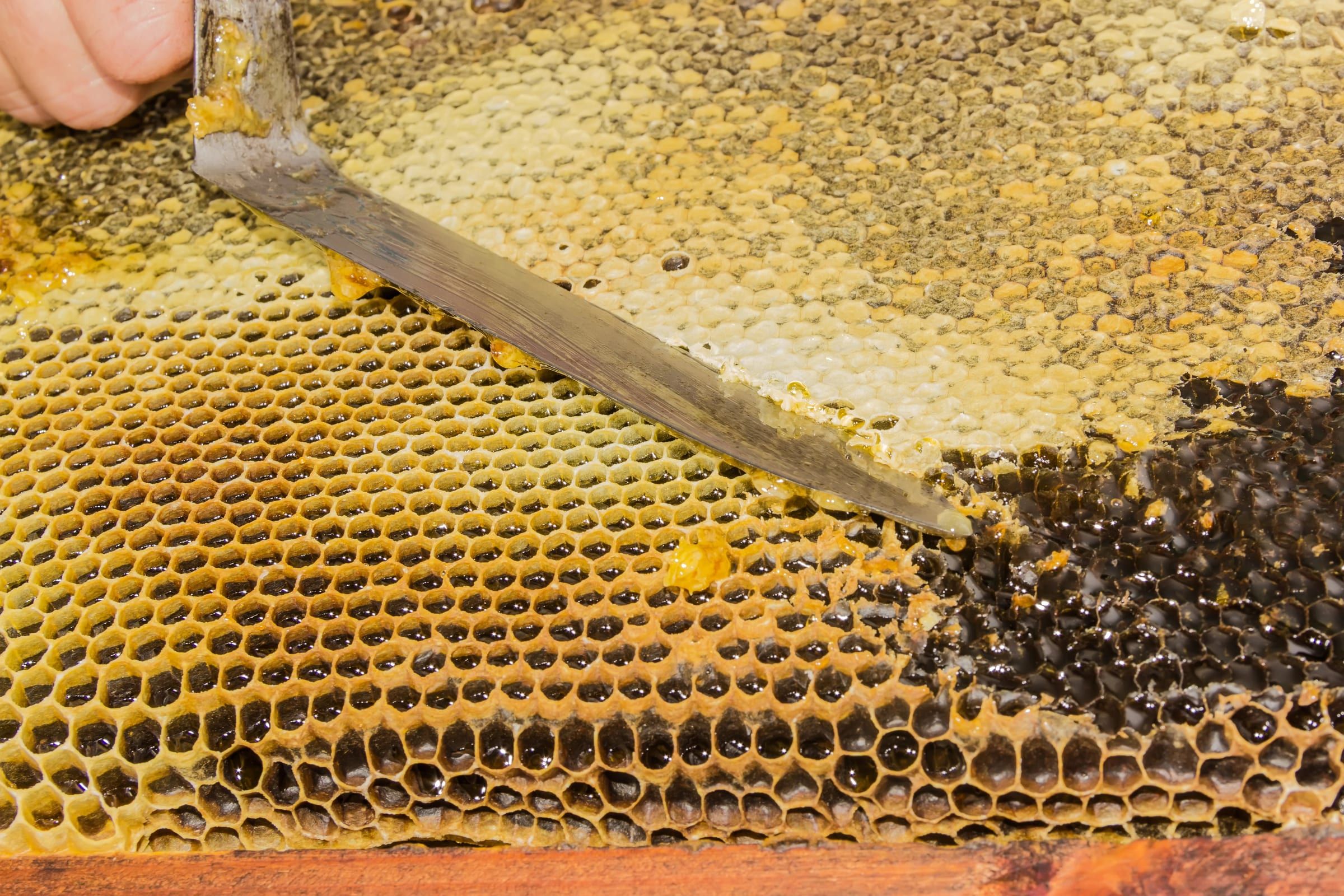
Hold the frame upright over the uncapping tray, slightly tilted so the cappings fall away from you, and slice the cappings off from bottom to top with a sharp or heated knife, using the frame’s side bars as a guide. An uncapping fork lifts cappings in hollows the knife misses. Super frames on wide (Manley or castellated) spacing are easier to uncap because the comb is drawn proud of the wood.
Cappings hold a surprising amount of honey. Let them drain through a mesh for a day or two in a warm room, then melt the wax separately: cappings wax is the cleanest and palest wax you will produce, ideal for candles or show entries.
Spinning
In a tangential extractor:
- Load frames of similar weight opposite each other to balance the drum.
- Spin slowly for a minute or two to empty the outer face partly; spinning hard straight away can break a heavy, full comb.
- Reverse the frames, spin the second face fully, then reverse again to finish the first.
- Open the tap when the honey reaches the cage, so it does not slow the drum.
A radial extractor spins both faces at once with the frames like spokes of a wheel. It is slower per batch but saves handling. The BBKA notes that a load of partly set rape honey can throw the extractor out of balance so it dances as it turns, which is another reason to start slowly.
How do you deal with oil seed rape and heather honey?
Oil seed rape: speed is everything
Rape honey is high in glucose and crystallises quickly, sometimes in the comb before the frame leaves the hive. The BBKA’s advice is to watch the crop closely, take supers off as soon as they are ripe, use the shake-and-brush method rather than a slow Porter escape, and extract without delay. If honey has already set in the comb, extract what you can, then the BBKA suggests dipping the combs in water and giving them back to the bees to clear out. Try not to leave rape honey in the comb, because the seed crystals can make later crops set too.
The fine, fast set of rape honey is also its strength: it makes excellent soft set honey, and it is the classic seed for creaming other honeys (see below and our page on crystallised honey).
Heather: pressing, loosening or cut comb
Ling heather honey is thixotropic: it forms a gel in the cell and only becomes fluid when agitated. It does not leave the comb in a normal extractor, so heather beekeepers use one of four methods, as described by The Apiarist:
- Crushing and straining: the traditional method for small batches. It is tedious and some honey stays in the crushed comb.
- Pressing: a fruit press with a mesh bag, or a water-powered press such as the Speidel Hydropress. The Apiarist reports one run producing 40 kg of honey at 16% water.
- Loosening: a heather loosener pushes blunt needles into the cells to stir the honey, after which the frame can go in the extractor. A manual one works on 196 cells at a time; a National super frame has about 2,000 cells per side.
- Cut comb, sold as it is, which needs no extraction at all.
Pressed honey is a legal description in its own right, and the regulations allow it a higher water-insoluble content (0.5 g/100 g rather than 0.1 g/100 g) because it contains more wax particles. Bell heather honey is not thixotropic and extracts normally. Heather honey has a 23% water limit, but a sample well under 20% keeps much better.
How do you strain, settle and jar honey?
Straining without stripping the pollen
Pour the honey from the extractor through a double strainer, coarse above fine, into the settling bucket. This removes wax, bee parts and debris. Do not use very fine filters or pressure filtration: Business Companion explains that honey filtered so that a significant amount of pollen is removed must be called “filtered honey”, must not carry a floral or regional name and needs a nutrition declaration. Coarse straining through domestic mesh does not count as filtering.
Settling
Let the strained honey stand in a closed bucket in a warm room for a day or two. Air bubbles and fine wax rise to the top as a froth, which you skim off before jarring. Keep the lid on: honey absorbs moisture from the air.
Warming and soft set honey
Liquid honey that has started to crystallise can be warmed gently in a water bath or warming cabinet. Keep the temperature low and the time short. SRUC’s honey module advises not heating honey above 35°C, while allowing up to 45°C for pressed honey, and warns that overheating raises HMF and destroys enzymes. Honey heated beyond those limits risks failing the 40 mg/kg HMF limit, and honey that has been overheated can only be sold as baker’s honey.
To make soft set (creamed) honey, the Scottish Beekeepers Association’s seeding method is a good reference:
- Melt all coarse crystals in the bulk honey at 50 to 52°C, strain through a 200 micron cloth and cool to 30°C.
- Warm a fine-grained set honey, such as oil seed rape or clover, to 30°C without melting it, and stir it in at 10% of the bulk.
- Hold at 25°C for 24 hours so the bubbles rise, then let it set at 14°C. Jarred honey should set within a week; store at about 10°C.
Jarring
Use clean, dry jars and new lids. Fill from the bucket gate to the shoulder of the jar so the net weight is met; check the first few on kitchen scales and allow for the jar. A 454 g jar is filled with 454 g of honey, not 454 g gross. Write down the batch, the date and the supers it came from: that record becomes your lot mark. Our free honey batch record keeps it in your browser, from the supers to the best before date.
What happens to the wet supers and the combs?
Return wet supers to the same colony
After extraction, the combs are sticky and the bees will clean them in a day or two. The NBU hygiene fact sheet is explicit: always return each super to the colony it came from, and never leave wet supers outside for any length of time, because they attract robbing and can spread disease. Put them back in the evening, above the crown board or above the clearer board with the escape removed. Honey and frames from a colony with foulbrood must never be moved to other colonies: American foulbrood spores survive in honey and comb for decades. Our guide to honey bee diseases covers the notifiable foulbroods.
Small hive beetle, which wrecks extracted supers and stored honey in the US, is a notifiable pest in the UK and is not currently present here. If you suspect a beetle or larva, you must by law notify the NBU (in Scotland, the Scottish Government’s bee health team); kill the suspect insect by freezing.
Storing drawn comb over winter
Drawn super comb is valuable. The main threat in storage is wax moth. The NBU wax moth fact sheet says super frames should be stored somewhere cold or wax moth proof, and that 24 hours in a domestic freezer kills all life stages; seal frames in bags before freezing. Comb that has never held brood is far less attractive to wax moth than old brood comb, which should not be stored with supers.
Varroa treatment once supers are off
As soon as the last super is off, the main varroa treatment can begin. Always follow the label. The Formic Pro summary of product characteristics, for example, requires supers containing honey to be removed before application and says honey stored in supers added during treatment must not be used for human consumption, even though the product has a zero-day withdrawal period for honey. That rule is stricter than the US label for the same product, which allows supers to stay on.
What are the rules for selling honey in the UK?
Registering as a food business
The NBU states that anyone producing honey for sale must comply with food safety legislation and must register their food business with the local authority. GOV.UK adds that registration is free, cannot be refused and should be made at least 28 days before trading. That covers selling from home, at the gate, at markets, to shops and online. How strictly a council treats a beekeeper selling a few dozen jars varies, so speak to its environmental health food team before your first sale.
- England and Wales: register with your district or unitary council.
- Scotland: register with your local council; Food Standards Scotland is the regulator for composition and labelling, according to SRUC.
- Northern Ireland: district councils enforce the Honey Regulations (Northern Ireland) 2015.
Retailers and markets usually ask for public liability insurance and often a basic food hygiene certificate. SRUC notes that the Scottish Beekeepers Association and the Bee Farmers’ Association offer cover, and many local associations include insurance in membership; check what it covers for product sales.
Composition, residues and medicine records
Nothing may be added to honey: the NBU reminds beekeepers that you must not include any other ingredient or additive. Selling honey that contains an unauthorised substance, or an authorised one above its maximum residue limit, is an offence, and the NBU notes that you may face enforcement action if unauthorised veterinary medicines are found in honey sampled from your hives. Keep records of every medicine given to your colonies for at least five years; inspectors can ask for them. Our guide to registering your bees explains BeeBase and the inspection system.
How must honey be labelled in the UK?
Mandatory information
Business Companion, the Trading Standards guidance for England and Wales, lists what a prepacked jar must carry:
- The name: “honey”, or a reserved description such as blossom honey, heather honey, comb honey, chunk honey, pressed honey. A floral name (lime honey, borage honey, oil seed rape honey) is allowed only if the honey comes wholly or mainly from that plant; a regional name only if it comes wholly from that place.
- Net quantity in metric units, generally in figures at least 4 mm high, in the same field of vision as the name. An imperial figure (1 lb) may be added but must not be more prominent than the metric one.
- A best before date. No minimum shelf life is set; two years is a common choice. Honey that is not prepacked, or prepacked for direct sale, does not need one.
- Name and address of the producer or packer.
- Country of origin, for example “Produce of England” or “Produce of Scotland”.
- A lot mark, which the best before date can replace if it gives at least the day and month; otherwise a code, ideally starting with “L”.
Business Companion also notes that members of the British Honey Importers and Packers Association voluntarily print “Unsuitable for children under 12 months”. It is not a legal requirement, but given the NHS advice it is a sensible addition.
Origin of blends: Great Britain and Northern Ireland now differ
In England, Wales and Scotland, honey from more than one country may still be labelled “blend of honeys from more than one country” (as of October 2026). Northern Ireland is different. Under the Windsor Framework it follows EU Directive 2024/1438, implemented by the Breakfast Foods (Amendment) Regulations (Northern Ireland) 2026, in force since 14 June 2026: a blend must list every country of origin in the principal field of vision, in descending order of weight, with the percentage of each (a 5% tolerance applies to each share). Stock labelled before that date may be sold until it runs out. For a beekeeper selling honey from their own hives, nothing changes: the label simply names the one country.
Words to avoid
SRUC’s honey module advises against “raw” and “organic” on beekeepers’ labels; organic honey has to be certified. Avoid health claims too: general food law only allows claims that have been authorised.
Example label
Lime Honey Produce of England 454 g (1 lb) Best before end: 10.2028 | L2607 A. Beekeeper, 12 Orchard Lane, Witney OX28 1AB Unsuitable for children under 12 months
Plan the year’s harvests alongside the rest of your colony management with our beekeeping calendar.
Frequently asked questions
When is honey ready to harvest in the UK?
A super is ready when most of its frames are capped, usually three quarters or more, and uncapped honey does not shake out when you hold a frame flat and give it a sharp jerk. A refractometer reading of 18% water or less confirms it. Most English beekeepers take a spring crop in May or June and the summer crop in July or early August, with heather honey following in late August or September.
How long should a clearer board be left on?
Fit it the evening before you want the supers and take them off the next day. A board with rhombus or other multi-exit escapes often clears supers in a few hours, while Porter escapes are usually left overnight. Do not leave the board on for days: cold supers are harder to extract, and a gap anywhere in the stack invites robbing and wax moth.
What is the maximum water content for honey in the UK?
The Honey (England) Regulations 2015, and the matching regulations in Scotland, Wales and Northern Ireland, set a maximum of 20% water for most honey and 23% for heather (Calluna) honey. Baker's honey may hold 23%, or 25% if it is heather. In practice aim for 18% or less, because yeasts that are always present in honey can ferment it above about 19%.
Can I extract heather honey in a normal extractor?
Not straight from the comb. Ling heather honey is thixotropic: it sets like a jelly in the cells and only turns liquid when agitated. Beekeepers either press the comb, crush and strain it, sell it as cut comb, or use a heather loosener, a block of blunt needles that stirs each cell before the frame goes into the extractor. Bell heather honey is not thixotropic and spins out normally.
Do I need to register to sell honey from home?
Yes, in most cases. The National Bee Unit says beekeepers producing honey for sale must comply with food safety law and register their food business with the local authority. GOV.UK says registration is free, cannot be refused and should be done at least 28 days before you start trading. Ask your council's food team how it treats very small sales, as approaches vary.
What must a jar of honey show on the label?
In England and Wales a prepacked jar needs the name of the food, such as honey or heather honey, the net weight in grams, a best before date, the name and address of the producer or packer, the country of origin and a lot mark, which the best before date can replace if it shows the day and month. The name and weight must be in the same field of vision.
How much honey should I leave on the hive for winter?
The National Bee Unit advises about 20 kg (44 lb) of stores per colony in autumn, and says winter colonies need between 18 and 22 kg. A full super holds at least 12 kg, so take only what the brood box and any super left on cannot replace. Weigh or heft the hive after the last harvest and feed thick syrup straight away if it falls short.
Can babies have local honey?
No. The NHS advises that honey should be completely avoided until a baby is 12 months old, because it can contain bacteria that cause infant botulism. This applies to local, raw and supermarket honey alike. Many UK packers add a voluntary warning that honey is unsuitable for children under 12 months, which is a sensible line for a beekeeper's label too.
Sources
- The Honey (England) Regulations 2015, Schedule 1: compositional criteria, legislation.gov.uk
- 2018 honey harvest is a third bigger than last year's, British Beekeepers Association
- The Honey Regulations (Northern Ireland) 2015: explanatory note, legislation.gov.uk
- Labelling of honey (quick guide for England and Wales, reviewed March 2026), Business Companion, Chartered Trading Standards Institute
- The Breakfast Foods (Amendment) Regulations (Northern Ireland) 2026 (SR 2026 No. 5), legislation.gov.uk
- Refractometer: all you need to know (Hanna Bäckmo, reprinted from The Irish Beekeeper), Bee Culture
- Manual 4 frame tangential extractor, Optima line (price checked October 2026), Abelo (retailer)
- Starting a food business, GOV.UK
- Legal responsibility of beekeepers, APHA National Bee Unit, BeeBase
- Apiary hygiene and quarantine (fact sheet, September 2026), APHA National Bee Unit
- Preparing your hives for winter (fact sheet, September 2026), APHA National Bee Unit
- Best Practice Guideline No. 7a: Feeding bees, sugar (November 2025), APHA National Bee Unit
- 2024 Scottish Honey Survey results, Scottish Beekeepers Association
- Wax moth (fact sheet, September 2026), APHA National Bee Unit
- Formicpro 68.2 g beehive strips: summary of product characteristics, Veterinary Medicines Directorate
- Honey: beekeeping education module 10 (with notes), SRUC, Scotland's Rural College
- Technical Data Sheet 25: seeding honey, Scottish Beekeepers Association
- May in the apiary, British Beekeepers Association
- Under pressure: the Speidel Hydropress (heather honey), The Apiarist (David Evans)
- Safe weaning: foods and drinks to avoid, NHS