Honey bee diseases in the UK: recognising foulbrood, brood diseases, nosema and viruses, and what you must report
Bee diseases in the UK: how to spot AFB and EFB, the rope test, chalkbrood, sacbrood, nosema and CBPV, what is notifiable and how the NBU, SASA and DAERA act.
The honey bee diseases that matter most in the UK fall into three groups: brood diseases (American foulbrood, European foulbrood, chalkbrood, sacbrood), diseases of adult bees (nosema, chronic bee paralysis, deformed wing virus) and parasites or pests (varroa, and two exotic threats, the small hive beetle and Tropilaelaps mites). American and European foulbrood are notifiable diseases and the beetle and Tropilaelaps are notifiable pests: if you suspect any of them, the law requires you to tell the National Bee Unit (NBU) or your local bee inspector straight away, or SASA in Scotland and DAERA in Northern Ireland. Everything else is managed by the beekeeper, with help from your association and inspector.
The colony’s worst enemy is still varroa, because it spreads most of the serious viruses. It has its own page: varroa mites, monitoring and treatment.
How do you recognise a bee disease during an inspection?
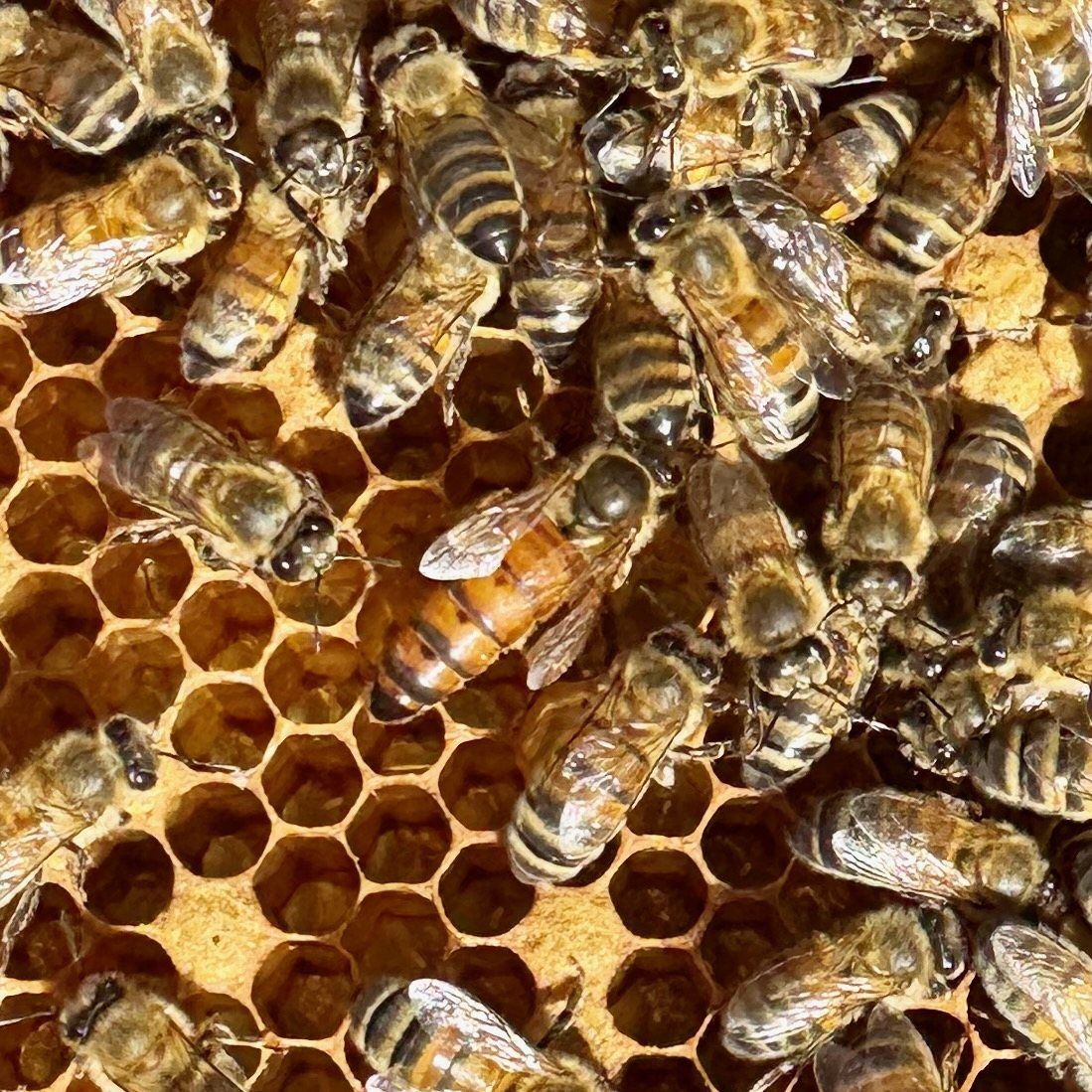
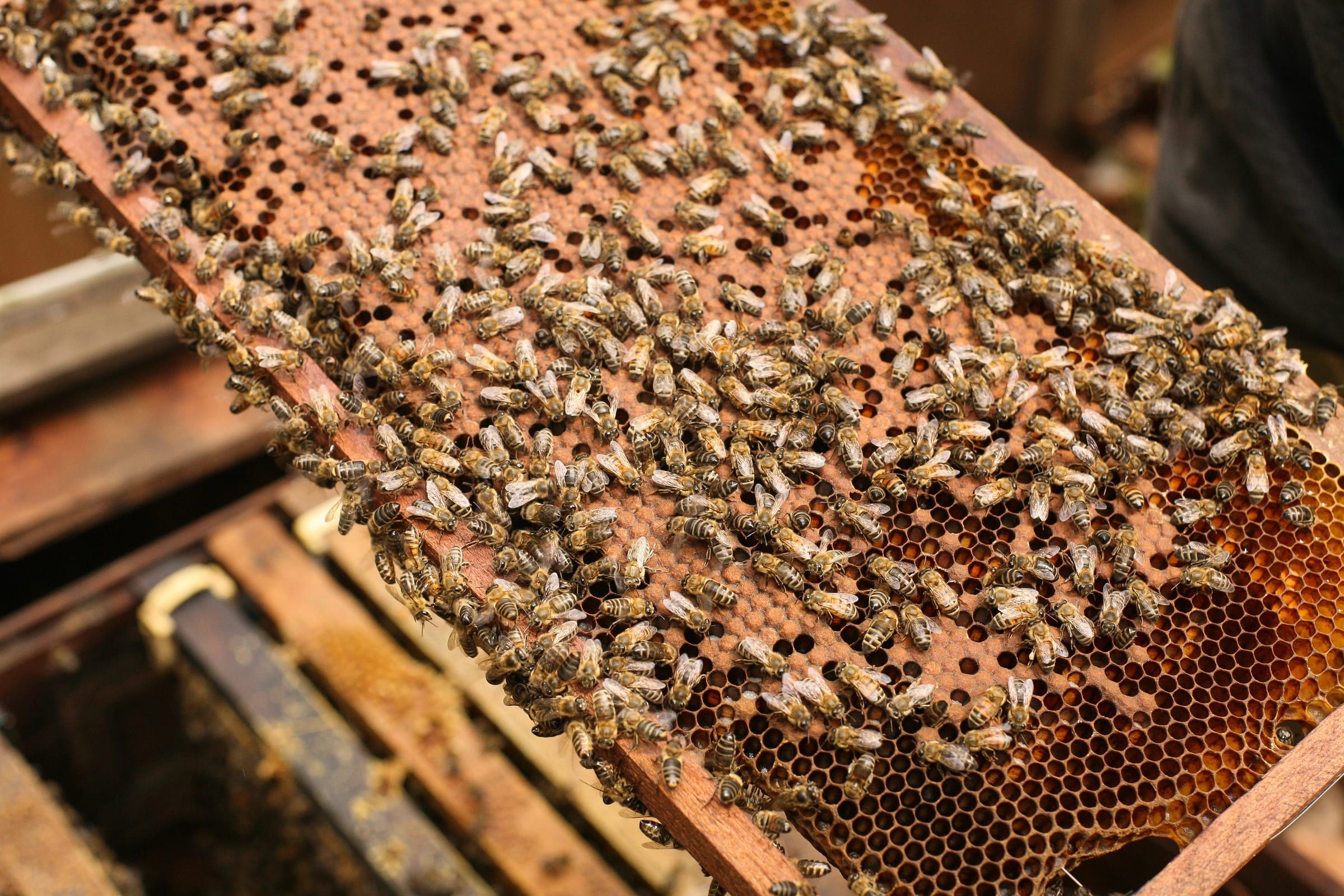
Disease shows first in the brood. A healthy frame of sealed brood is compact, with domed cappings the colour of a digestive biscuit, and open brood made of pearly white larvae curled in a C at the base of the cell. Be wary of:
- a patchy or “pepper pot” brood pattern, with empty cells scattered among sealed ones (non-specific, since a failing queen can do it too);
- cappings that are sunken, darker than their neighbours, moist, greasy or perforated;
- larvae that are yellowed, brown, twisted, melted down or mummified;
- an unusual smell when you lift the frame.
At the entrance, watch for trembling or crawling bees, black and hairless bees, crumpled wings, dysentery streaks, heaps of dead bees and chalky mummies. The normal timetable of egg, larva and pupa is in our page on the honey bee life cycle.
Shake the bees off the frame and hold it with the light behind you, shining into the cells. The NBU recommends a specific brood disease check at least twice a year, on top of routine inspections.
Field diagnosis table
Confirmation for the foulbroods comes from the inspector’s lateral flow test and, where needed, the laboratory.
| Disease | Cause | What you see | Field test | Peak season | Status and action |
|---|---|---|---|---|---|
| American foulbrood (AFB) | Spore-forming bacterium Paenibacillus larvae | Sunken, dark, greasy, perforated cappings; brown, slimy remains; dark scale stuck to the lower cell wall | Matchstick: brown thread 10 to 30 mm | Any brood-rearing month | Notifiable. Report at once; infected colonies are destroyed |
| European foulbrood (EFB) | Bacterium Melissococcus plutonius | Twisted, yellowish, “melted” open larvae, creamy gut visible; rubbery brown scale that lifts out easily | No rope | Spring and early summer especially | Notifiable. Report at once; destruction or shook swarm |
| Chalkbrood | Fungus Ascosphaera apis | Hard white, grey or black mummies in cells and on the floor | Mummy is hard, does not rope | Cold, damp spring | Not notifiable. Husbandry and requeening |
| Sacbrood | Sacbrood virus (SBV) | Larva stretched out, head raised and dark, body a fluid-filled sac | Larva lifts out whole as a sac | Spring | Not notifiable. Often transient |
| Nosema | Microsporidia Nosema apis and N. ceranae | Dysentery (N. apis), slow dwindling, poor spring build-up | Microscope only | Late winter and spring | Not notifiable. No authorised medicine |
| Chronic bee paralysis | Virus CBPV | Trembling, black, shiny, hairless bees; heaps of dead at the entrance | None in the field | Early summer | Not notifiable. More space, pollen, wider entrance |
| Deformed wing virus | DWV, spread by varroa | Newly emerged bees with crumpled wings and short abdomens | Varroa count | Late summer and autumn | Treat the varroa |
| Small hive beetle | Beetle Aethina tumida | Fast, dark beetles hiding from light; masses of larvae in comb; fermenting honey | Visual | Warm months | Notifiable. Not present in the UK |
| Tropilaelaps | Mites Tropilaelaps spp. | Tiny, fast, orange-brown mites; patchy brood; deformed bees | Visual, laboratory | Brood season | Notifiable. Not present in the UK |
American foulbrood: symptoms, the matchstick test and what happens next
American foulbrood is the most destructive brood disease in the UK. It is caused by Paenibacillus larvae, a bacterium that forms extremely tough spores. According to the NBU’s foulbrood leaflet, larvae are most susceptible when they are 12 to 36 hours old and become infected by eating spores in their food. AFB kills 100% of the larvae it infects, and the remains of a single larva can hold up to 2,500 million infectious spores, which survive for decades. UK strains usually take about twelve days to kill a larva, so the signs appear after the cell is sealed.
Adult bees do not fall ill, but they carry spores. Spread happens through robbing of weak or dying colonies, drifting, swapping frames, feeding honey from another source, buying old comb or used equipment, and the beekeeper’s own gloves and hive tool.
What you see
The NBU’s page on how to spot AFB lists the classic signs:
- cappings that sink, darken and become perforated as the bees nibble holes in them;
- some cappings that look moist or greasy and slightly darker than healthy ones;
- in a heavy case, a pepper-pot brood pattern and a smell of decay;
- a very dark brown, rough scale lying along the lower side of the cell, easiest to see when the comb is tilted towards the light.
In an early infection, only a handful of cells may be affected while the colony looks strong.
The matchstick (rope) test, step by step
- Pick a suspect cell: sunken, dark, greasy or perforated capping.
- Push a matchstick through the capping to the bottom of the cell.
- Stir the contents gently.
- Withdraw the matchstick slowly and watch what comes with it.
- If the remains draw out as a brown, mucus-like thread about 10 to 30 mm long, the NBU calls this “a reliable test for the presence of AFB”.
- Put the matchstick in a sealed bag, and wash your gloves and hive tool before you open another colony.
The test only counts when it is positive. Remains at an earlier or a later stage, including dried scale, will not rope, even in an infected colony.
What to do if you suspect AFB
- Close the hive and reduce the entrance to limit robbing.
- Do not move any bees, frames, supers, honey or equipment off the site. The GOV.UK guidance asks you to keep everything in place until the disease, if confirmed, has been controlled.
- Disinfect your hive tool and change or wash your gloves.
- Contact your bee inspector or the NBU (Scotland: SASA; Northern Ireland: DAERA). Failure to report a suspected notifiable disease is an offence.
- The inspector examines the colony and tests a symptomatic larva on the spot with a lateral flow device (LFD), a rapid field kit. Samples go to Fera Science Ltd for official confirmation, according to the NBU leaflet.
- If AFB is confirmed, a standstill notice prohibits moving bees and equipment out of the apiary, and the infected colonies are destroyed under the inspector’s supervision. The NBU leaflet is explicit: AFB is controlled by compulsory destruction of infected colonies.
AFB is not common, but it is far from extinct. The NBU leaflet records 82 colonies that tested positive in the UK in 2023, 47 of them in England and Wales, and fewer than 100 cases a year over the past decade.
European foulbrood: how do you tell it from AFB?
European foulbrood is caused by Melissococcus plutonius, a gut bacterium that does not form spores. The larvae usually die of starvation shortly before the cell is capped, because the bacteria in their gut compete with them for food. The NBU leaflet describes EFB as more widespread than AFB, with cases more numerous in southern and central England than in the north. Some strains are very virulent, but many UK strains are milder, which leads to low-level or recurring infections that a beekeeper can miss for years.
Signs of EFB
The NBU lists:
- larvae that no longer lie in a plump C shape, some twisted in the cell, some looking melted down;
- a creamy-white gut visible through the translucent body wall;
- dead larvae turning yellowish then brown, drying into a rubbery brown scale that is easily removed;
- some perforated or sunken cappings where larvae died after capping, but contents that do not rope;
- in a heavy infection, a patchy brood pattern as nurse bees clear the dead larvae.
AFB or EFB? The key differences
| Feature | American foulbrood | European foulbrood |
|---|---|---|
| Brood mainly affected | Sealed | Unsealed (open) |
| Larva at death | Lying flat, stretched along the cell | Twisted, displaced, melted |
| Colour | Coffee brown, then very dark brown | Yellowish, then brown; creamy gut visible |
| Matchstick test | Brown thread 10 to 30 mm | No rope |
| Scale | Very dark, rough, stuck to the lower cell wall | Rubbery, brown, easily removed |
| Control in the UK | Destruction | Destruction or shook swarm |
No single feature settles it. Both are notifiable: stop, report and let the inspector test.
How EFB is controlled in the UK
The NBU’s fact sheet on the control of EFB, revised in September 2026, sets out the current rules. Report the suspicion to your Appointed Bee Inspector, to [email protected] in England and Wales, or to [email protected] in Scotland. Place the apiary under a voluntary standstill until the inspector visits: nothing comes in, nothing goes out. Reduce the entrances and photograph what worried you.
Once M. plutonius is confirmed, the inspector decides on one of two options.
Destruction applies if the colony meets any one of these conditions:
- fewer than six full British Standard frames of bees;
- visible disease in more than 25% of the open brood;
- treatment in the previous 12 months, followed by a recurrence.
A shook swarm is possible for a colony with at least six frames of bees, less than 25% visible infection and otherwise good condition. It is normally done between mid-March and the end of July, depending on locality and season. The bees are shaken onto clean frames of foundation in a clean hive, and all the old combs are destroyed. The beekeeper supplies the equipment and must have the time and skill to look after the colony afterwards, because EFB can recur. The NBU urges beekeepers to consider destruction for any infected colony.
Giving antibiotics to bees yourself is illegal in the UK, the NBU leaflet stresses. No medicine for foulbrood appears in the NBU’s list of products authorised for bees, which covers varroa products only.
Living in an EFB area
The fact sheet grades the apiary’s risk into four control levels:
| Level | Situation | Main measures |
|---|---|---|
| 1 | No EFB known locally | Check brood for disease twice a year; change 3 to 4 brood combs a year; basic hygiene; supers and excluders stay with their apiary |
| 2 | EFB in the local area | Check three times a year; change all brood combs every two years; strict hygiene; equipment stays with its colony |
| 3 | EFB in the apiary in the past 12 months | Check four times a year; change all brood comb, preferably by shook swarm; supers, brood boxes, feeders and excluders stay with their colony |
| 4 | EFB persisting for two years or more | Check at every visit; shook swarm every colony each year; destroy colonies showing signs; keep a separate hospital apiary |
Registered BeeBase users receive an alert when EFB or AFB is confirmed within 3 km of their apiary, and BeeBase can show incidence by 10 km square, which is worth checking before you buy bees from another area. If you have not yet registered, see our guide to registering your bees.
Chalkbrood, sacbrood and other common brood disorders
Sacbrood, chalkbrood and parasitic mite syndrome were the disorders NBU inspectors found most often between 2006 and 2016. None is notifiable, and none has an authorised medicine.
Chalkbrood
Chalkbrood is caused by the fungus Ascosphaera apis. Larvae eat the spores with their food, the fungus grows through the body, and the larva turns into a hard mummy shaped like the cell, first fluffy and white, then chalk-white, then grey or black when the fungus fruits. Workers drag the mummies out, so you find them on the floor, the varroa insert and the landing board.
According to the NBU leaflet, the spores germinate when the colony’s temperature falls below 32°C for more than two hours, which explains why chalkbrood flares in cold, wet British springs, at the edge of the brood nest and in small colonies. The spores stay viable for fifteen years. The NBU suggests:
- requeening from a different stock if chalkbrood comes back year after year, since susceptibility is partly genetic;
- improving ventilation and keeping hives off damp ground (see where to put a beehive);
- replacing brood combs at least every three years;
- avoiding pollen traps on affected colonies.
Sacbrood
The sacbrood virus kills the larva at its final moult, just after capping. The larva lies stretched out, its head raised and darkened, often described as gondola-shaped, and its body turns into a sac of fluid that you can lift out of the cell in one piece. There is no rope and no strong smell. Larvae are susceptible up to eight days old. The NBU leaflet lists comb replacement, requeening with a younger queen or caging the queen for 10 to 14 days to create a brood break. Heating honey to 70°C for ten minutes inactivates the virus. In a strong colony it usually fades on its own.
Nosema: symptoms, diagnosis and prevention
Nosema is an infection of the adult bee’s gut caused by microsporidia, single-celled parasites related to fungi. Two species occur in the UK:
- Nosema apis, native to Europe, linked to dysentery, higher winter losses, slow spring build-up and lower honey yields, though infection can also be silent;
- Nosema ceranae, originally from East Asia and first found in the UK in 2008, which does not usually cause dysentery but is considered more virulent in laboratory work and can lead to collapse without obvious warning.
Taxonomists have moved both into the genus Vairimorpha, but UK guidance still calls them Nosema.
The NBU’s random apiary survey of 2010 and 2011 found N. apis in 46% of colonies and N. ceranae in 40%, and found no strong link between infection and poor colony health, as Kirsty Stainton of the NBU reported in BBKA News in 2018. Nosema is common; it becomes a problem when colonies are already stressed.
Diagnosis
No field sign confirms nosema. The NBU states that you need microscopy or molecular testing. The classic method is to crush the abdomens of a sample of older bees, such as foragers taken at the entrance, and examine the fluid under a compound microscope at 400x magnification. N. apis spores are barrel-shaped and N. ceranae spores look like grains of rice, though telling them apart reliably needs a molecular (PCR) test.
Treatment and prevention
Fumagillin, once sold to beekeepers as Fumidil B, is no longer authorised in the UK, as the NBU’s Kirsty Stainton notes. Ben Jones of Fera Science adds that its production was discontinued in 2018 and that most alternatives under study are not registered veterinary medicines. Management is therefore about the comb and the colony:
- change comb regularly, because spores survive outside the bee for a year or more;
- sterilise stored comb: the NBU gives heat at 49°C for 24 hours, or fumigation with 80% acetic acid;
- sterilise tools at 60°C for 15 minutes, or scorch the hive tool;
- keep colonies strong, unite weak ones in autumn, and site hives where bees can make cleansing flights on mild winter days;
- prefer disposable or washable gloves to leather.
Chronic bee paralysis and deformed wing virus
Many viruses infect honey bees, usually without visible signs. Two matter most in British apiaries.
Chronic bee paralysis (CBPV)
The NBU’s information note, written with Newcastle University and published in 2024, describes the signs:
- bees that tremble or shake and do not react to smoke, then become partly and then fully paralysed, and die within about a week;
- bees that have lost their hair because healthy bees nibble at them, and look shiny and darker;
- piles of dead and dying bees at the entrance.
The note gives a useful rule: pesticide poisoning typically leaves a carpet of dead bees across the whole apiary, while CBPV leaves piles at the entrances of particular colonies. Bees on their backs, spinning and beating their wings, point to pesticides.
Varroa is not thought to transmit CBPV. Bees catch it from infected food and contact with diseased or dead bees, so crowding makes it worse. It is most common in early summer, and colony loss occurs in 40 to 50% of cases. Reported cases in England and Wales have risen over recent decades, and every race in common use is affected, from the British dark bee (Apis mellifera mellifera) to Buckfast and locally reared stock.
The NBU’s recommendations:
- Add a brood box or a super to relieve crowding.
- Make sure the bees have plenty of pollen; young bees reared in a pollen dearth, such as the June gap, are more susceptible.
- Check that there is a laying queen. Requeening has not been shown to help.
- Widen the entrance so the bees can remove the dead, but do not take the floor off, which invites robbing and wasps late in the season.
- Move piles of dead bees away from the hive, because they stay infectious for months.
- Reduce drifting by facing entrances in different directions.
Deformed wing virus (DWV)
The NBU’s varroa booklet calls DWV the most significant virus spread by varroa. It is common in UK colonies at low levels, and rises as mite numbers rise. Bees infected as pupae emerge with crumpled, stunted wings and short abdomens and die quickly. When high varroa and high DWV combine, the NBU describes parasitic mite syndrome: dying pupae, a pepper-pot brood pattern, neglected brood and few eggs, the sign of a colony in terminal decline. Collapse is most common in August and September, with a second wave in March and April as mites from collapsed colonies spread through robbing.
There is no antiviral treatment. A handful of bees with deformed wings means the varroa threshold was passed weeks ago: count the mites and treat with an authorised product.
Virus or poisoning?
If many colonies are hit at once, with a carpet of dead bees near a crop that has just been sprayed, suspect poisoning. Freeze a sample of dead and dying bees, note the date and nearby crops, and report it. In Wales, the Welsh Government asks for suspected wildlife poisoning to go to the Wildlife Incident Investigation Scheme ([email protected], freephone 0800 321600).
Small hive beetle and Tropilaelaps: the exotic threats
Neither pest is present in the UK, and both are notifiable. Surveillance for both is part of the routine risk-based inspection programme in England and Wales, and the NBU runs a network of sentinel apiaries near the main risk points.
Small hive beetle (Aethina tumida)
The small hive beetle comes from sub-Saharan Africa. Adults are light brown to black, about half the size of a worker bee, and run from the light when you open the hive. Their larvae tunnel through comb, eat brood and pollen and make the honey ferment and run. In a BeeFarmer article in June 2023, Nigel Semmence of the NBU described the situation in Italy, where the beetle was found in Calabria in 2014. In the first two years, 6,000 hives were destroyed and €2 million was paid in compensation, but the beetle has been found every year since and eradication is no longer thought achievable.
In England and Wales, around 125 voluntary sentinel apiaries send debris samples, and around 50 enhanced sentinel apiaries near freight ports and bee importers get three inspections a year. The likeliest route into the UK is the movement of bees.
Tropilaelaps
Tropilaelaps mites are brood parasites from Asia. The NBU describes them as about 1 mm long and 0.5 mm wide, roughly a third of the size of varroa, light orange-brown, and much faster-moving. They spend less time on adult bees than varroa does, so a sugar roll or floor insert can miss them. Of the four species, T. mercedesae poses the greatest risk to Europe and the UK.
The threat is getting closer. The NBU reports infested colonies in European Russia and confirmed presence in Georgia, with unconfirmed reports from Belarus, Crimea and Azerbaijan, and Defra has produced a Rapid Pest Risk Analysis in response. In a letter of 31 March 2026, the European Beekeeping Association pointed to established populations in the Krasnodar and Rostov regions of Russia, on the Ukrainian border, while no case has been reported inside the EU. The NBU adds that broodless periods do not seem to limit the mite’s spread, so a British winter is no guaranteed barrier.
What to do with a suspect beetle or mite
- Do not let it go. Collect it and freeze it, as the NBU asks.
- Close the hive and move nothing off the site. For both pests, GOV.UK guidance says colonies, equipment and honey stay put until the NBU approves.
- Report immediately: NBU or your bee inspector in England and Wales, SASA in Scotland, DAERA in Northern Ireland.
The yellow-legged hornet, often called the Asian hornet, is a predator, not a disease, and it has its own reporting route: see our page on the Asian hornet.
What does UK law say about bee diseases?
Bee health is devolved, so each nation has its own Order, but the list of notifiable diseases and pests is the same across the UK: American foulbrood, European foulbrood, the small hive beetle and Tropilaelaps mites.
| England | Wales | Scotland | Northern Ireland | |
|---|---|---|---|---|
| Main legislation | Bee Diseases and Pests Control (England) Order 2006 | Bee Diseases and Pests Control (Wales) Order 2006, as amended | Bee Diseases and Pests Control (Scotland) Order 2007, as amended | Bees (Northern Ireland) Order 1980 and Bee Diseases and Pests Control Order (Northern Ireland) 2007, amended 2010 |
| Notifiable | AFB, EFB, small hive beetle, Tropilaelaps | Same | Same | Same |
| Varroa | Reportable since 21 April 2021 | Reportable since 21 April 2021 | Reportable since 21 April 2021 | Not reportable: AFBI says it is no longer a statutory pest |
| Who to tell | NBU or your bee inspector | NBU or your bee inspector | Bee Inspector at [email protected] (0300 244 9151) | DAERA at [email protected] (028 9052 4168) |
| Register | BeeBase (voluntary) | BeeBase (voluntary) | BeeBase (voluntary) | DataBees (voluntary) |
In England, article 2 of the 2006 Order defines a notifiable disease as “American foul brood or European foul brood” and a bee pest as any beetle, mite or similar organism that may be injurious to bees. Article 3 makes it a duty to notify a suspicion and article 3A adds the varroa reporting duty. In Scotland, the 2007 Order gives powers for destruction, treatment and preventing movement of infected hives.
The key duty is the same everywhere: a suspicion is enough. You do not need to be sure before you call, and failure to report is an offence.
Who pays?
For the cost of a destroyed colony, the NBU leaflet points to Bee Diseases Insurance Ltd (BDI), which is open only to beekeepers in England and Wales. It compensates for listed equipment destroyed by a bee inspector for AFB or EFB, such as frames, queen excluders and up to 40 lb of saleable honey per hive, but not hive bodies or replacement bees. Cover for up to 39 colonies comes through a BDI member association; operations with 40 or more colonies buy it direct. Beekeepers in Scotland and Northern Ireland should ask their national association what cover it offers.
How do you prevent bee diseases in the apiary?
Most brood and adult diseases strike weak or stressed colonies, and the foulbroods spread through careless movement of bees, comb and honey.
Biosecurity rules from the NBU
- Never feed honey from another source, including shop-bought honey: it is the classic route for AFB spores.
- Never buy old comb, and buy bees only from known sources whose apiary has been inspected. Ask for their BeeBase inspection record.
- Do not move frames between colonies without checking the brood of both.
- Control robbing: reduce entrances in a dearth and after the harvest, never leave honey or wet supers in the open, and seal up dead colonies promptly.
- Quarantine swarms for six weeks before moving them, until you are sure they are free of EFB.
- Reduce drifting with non-linear layouts and hives of different colours and heights.
- Wear nitrile or washing-up gloves, not leather, which cannot be disinfected.
- Disinfect equipment: pre-wash with soda crystals, then scorch wooden boxes with a blowtorch, and scrub and soak polystyrene or plastic parts in 0.5% sodium hypochlorite for 20 minutes.
- Register on BeeBase, so that you receive local disease alerts.
- Replace old brood comb: three or four combs a year at the least, starting with the darkest, and requeen colonies that suffer chalkbrood or sacbrood every year.
A disease-check calendar for a lowland UK apiary
| When | What to check |
|---|---|
| February to March | Winter losses, dysentery, stores, nosema check by microscope |
| April to May | First full brood inspection; chalkbrood, sacbrood, EFB as the brood nest expands on oil seed rape and fruit blossom |
| June | CBPV in crowded colonies; pollen supply in the June gap; full brood check before adding supers |
| July to August | Disease check after the main flow and as the supers come off; varroa count before treatment; heather colonies before they go to the moors |
| September to October | Deformed wing virus and parasitic mite syndrome; unite weak colonies after checking their brood |
| November to January | Floor debris for mites; signs of robbing or collapse |
Shift these dates later in the north of England and Scotland. The full month-by-month workload is in our beekeeping calendar.
Frequently asked questions
Which bee diseases are notifiable in the UK?
American foulbrood and European foulbrood are notifiable diseases, and the small hive beetle and Tropilaelaps mites are notifiable pests. If you suspect any of them, you must tell the National Bee Unit or your local bee inspector at once, or SASA in Scotland and DAERA in Northern Ireland. Varroa is a reportable pest in England, Wales and Scotland, which is a lighter duty.
How do I do the matchstick test for American foulbrood?
Push a matchstick into a sunken, dark or greasy capping, stir the contents and draw it out slowly. If the remains stretch into a brown, mucus-like thread about 10 to 30 mm long, the National Bee Unit treats that as a reliable sign of AFB. A negative result does not clear the colony, so close the hive, stop all movements and call your bee inspector.
Can European foulbrood be treated in the UK?
Yes, but only under the direction of a bee inspector. The National Bee Unit's 2026 fact sheet gives two options: destroying the colony, or a shook swarm onto clean comb for a colony with at least six frames of bees, less than 25% visible infection and no recurrence in the past year. Giving bees antibiotics yourself is illegal in the UK.
Is honey from a hive with foulbrood dangerous to eat?
Foulbrood bacteria infect bee larvae, not people, so the honey is not a health risk to humans. It is a serious risk to bees, because AFB spores survive for decades and one dead larva can hold up to 2,500 million of them. Never feed honey of unknown origin to bees, and never leave jars or frames where bees can rob them.
What does chalkbrood look like?
Chalkbrood turns larvae into hard, chalk-white mummies, sometimes grey or black, which workers drag out and drop on the floor or landing board. The fungus behind it, Ascosphaera apis, germinates when brood cools below 32°C for more than two hours, so it is typical of cold, damp springs and small colonies. Requeening, comb replacement and good ventilation are the usual answers.
Why are my bees shaking and turning black and shiny?
Trembling bees that do not react to smoke, with hairless, greasy-looking bodies and small heaps of dead bees at the entrance, point to chronic bee paralysis virus. The National Bee Unit reports colony loss in 40 to 50% of cases. Give the colony more space and pollen, widen the entrance and move the dead bees away from the hive.
Is there a treatment for nosema in the UK?
No medicine against nosema is authorised in the UK. The National Bee Unit confirms that fumagillin, the antibiotic once sold to beekeepers as Fumidil B, is no longer authorised. Management relies on strong colonies, regular comb changes, heat or acetic acid treatment of stored comb and good apiary hygiene. Only a microscope or laboratory test of a sample of adult bees confirms whether nosema is present.
Who pays if my colonies are destroyed for foulbrood?
In England and Wales, the National Bee Unit points beekeepers to Bee Diseases Insurance Ltd (BDI). It pays for listed equipment, such as frames, excluders and saleable honey, destroyed by a bee inspector for foulbrood, but not for replacement bees or hive bodies. Up to 39 colonies are covered through a member association; larger operations buy direct. In Scotland and Northern Ireland, ask your association.
Sources
- Foulbrood disease of honey bees and other common brood disorders (advisory leaflet, 2025), National Bee Unit, APHA, for Defra and the Welsh Government
- Fact sheet 11: Control of European foulbrood (September 2026), National Bee Unit
- How to spot American foulbrood, National Bee Unit, BeeBase
- How to spot European foulbrood, National Bee Unit, BeeBase
- BDI premium and cover, Bee Diseases Insurance Ltd
- Honey bees: protecting them from pests and diseases, Defra and APHA, GOV.UK
- The Bee Diseases and Pests Control (England) Order 2006, article 2 (interpretation), legislation.gov.uk
- The Bee Diseases and Pests Control (England) Order 2006: contents, legislation.gov.uk
- Honey bee health guidance: legislation, Scottish Government
- Healthy honey bees, Welsh Government
- Bees policy and legislation, Department of Agriculture, Environment and Rural Affairs (DAERA), Northern Ireland
- Bee health, Agri-Food and Biosciences Institute (AFBI), Northern Ireland
- Chronic bee paralysis: an information note for beekeepers (fact sheet 10, 2024), National Bee Unit and Newcastle University
- Recent research on Nosema (K. Stainton, BBKA News, November 2018), National Bee Unit
- Advances in Nosema research (B. Jones, BeeFarmer, December 2021), Fera Science Ltd, via the National Bee Unit
- Managing Varroa (advisory booklet), Animal and Plant Health Agency, National Bee Unit
- Bee medicines: products authorised in the UK (fact sheet, June 2025), National Bee Unit
- Tropilaelaps, National Bee Unit, BeeBase
- Letter on the Tropilaelaps threat to European beekeeping (31 March 2026), European Beekeeping Association
- Small hive beetle: the situation in Italy and UK surveillance (N. Semmence, BeeFarmer, June 2023), National Bee Unit