Beekeeping equipment for beginners: the full UK list, 2026 prices and a real budget
Beekeeping equipment for beginners in the UK: National hive, suit, gloves, smoker, hive tool, feeders, varroa kit, extractor and a 2026 budget in pounds.
Beekeeping equipment for beginners in the UK comes down to a short list: a complete National hive with frames and foundation, a spare brood box and roof for swarm control, a bee suit with veil, nitrile gloves, wellies, a smoker, a hive tool, a feeder and an open mesh floor with a tray for varroa monitoring. In October 2026 that kit costs roughly £460 to £670 for one hive before you buy bees, and about £1,200 to £1,500 for two colonies with nuclei included. Honey extraction equipment can wait.
Below, each item comes in the order you will need it, with the specifications that matter, October 2026 prices from UK specialist suppliers (including VAT) and the hygiene and legal points for England, Scotland, Wales and Northern Ireland. Association sales and second-hand kit can bring costs down a long way.
What equipment do you need to start beekeeping?
Start with what you need to open a hive safely and keep a colony alive through its first year. Everything else can follow once you know how you like to work.
| Item | Why you need it | Buy before bees arrive? |
|---|---|---|
| Complete National hive (floor, brood box, 2 supers, queen excluder, crown board, roof) | Houses the colony | Yes |
| 11 brood frames plus dummy board, super frames, wax foundation | The colony builds comb on them | Yes |
| Spare floor, brood box, crown board, roof and frames | Swarm control, splits, emergencies | Yes, by May |
| Bee suit or jacket with veil | Protects you from stings | Yes |
| Nitrile gloves, wellies | Hands and ankles are stung most | Yes |
| Smoker and fuel | Calms bees during inspections | Yes |
| Hive tool (J-type or standard) | Separates boxes and frames | Yes |
| Feeder (rapid or contact) | Feeding a new nucleus and in autumn | Yes |
| Open mesh floor with monitoring tray | Varroa counts | Yes (often included with the floor) |
| Authorised varroa treatment | Mite control from late summer | Before August |
| Hive stand, strap, mouse guard | Comfort, security, winter protection | Before autumn |
| Clearer board, extractor, strainer, settling tank, jars | Harvest | Second season, or borrow |
The NBU’s guidance on obtaining bees says a nucleus must be transferred to a clean hive and a package needs immediate housing on new foundation or clean drawn comb. In practice that means buying your hive before you buy bees, setting it up on its stand in the apiary, and having the frames assembled and the foundation fitted by April. A nucleus that arrives to a half-built hive is a stressed nucleus.
If you are still deciding whether to keep bees at all, our guide on how to start beekeeping covers courses, mentors and finding a site before any money is spent.
Which hive should a beginner buy in the UK?
Buy the hive type your association and the beekeepers around you use, which in most of the UK means the British National. Matching your neighbours lets you borrow frames, swap brood with a mentor, buy local nuclei that fit your boxes and pick up second-hand kit without adapters.
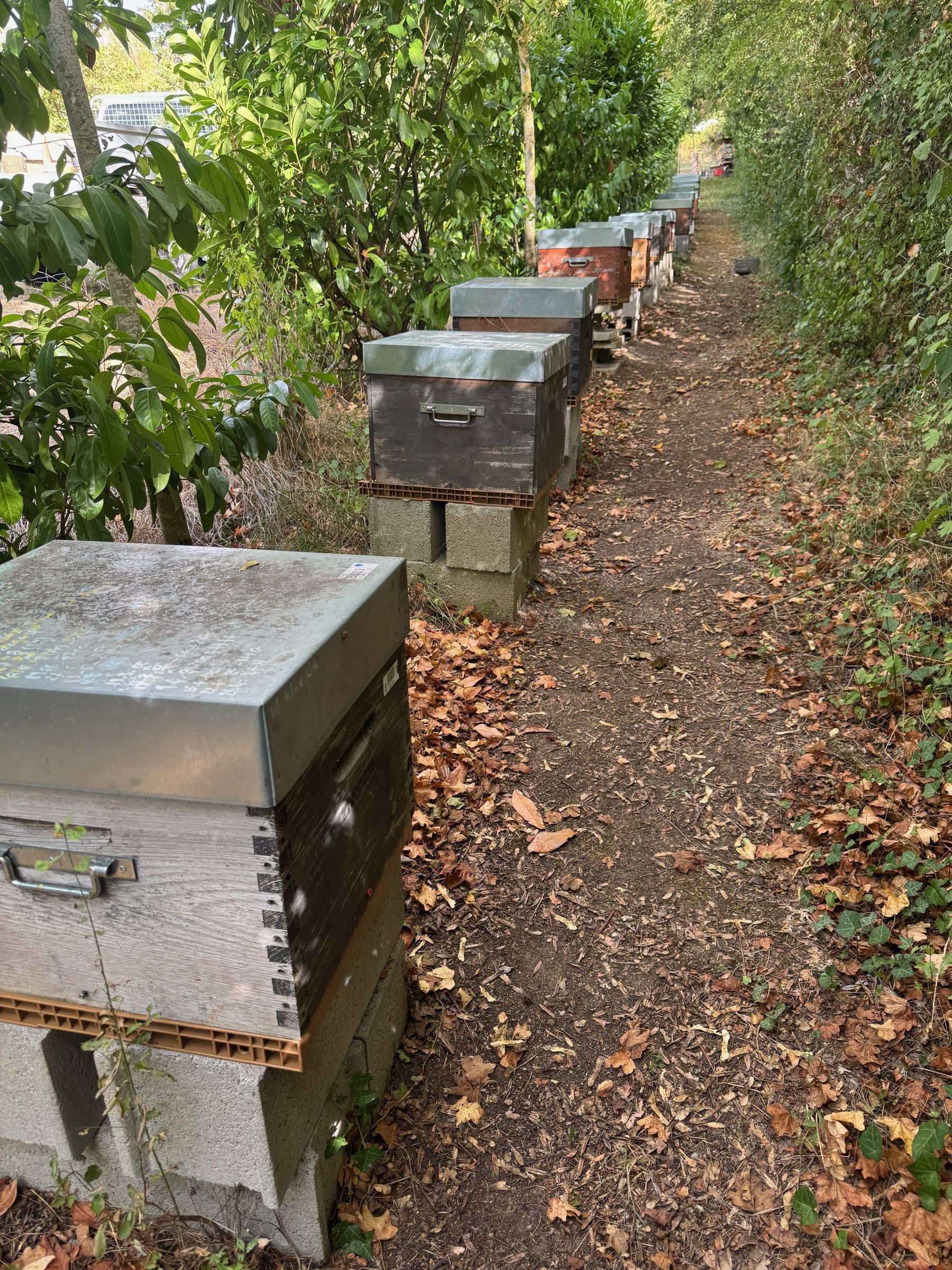
The parts of a National hive
From the ground up, a National hive is made of:
- Floor: today usually an open mesh (varroa) floor, with a slide-in tray underneath for mite counts, and an entrance block with a wide summer and narrow winter opening.
- Brood box: 225 mm (8 7/8 in) deep, about 460 mm (18 1/8 in) square outside, holding 11 brood frames plus a dummy board.
- Queen excluder: a slotted plastic sheet or a wire grid that keeps the queen in the brood box.
- Supers: 149 mm (5 7/8 in) deep, for the honey. Start with two.
- Crown board: the inner lid, with two holes that take Porter bee escapes or a feeder.
- Roof: deep enough to cover a feeder, with a metal top and ventilation.
In October 2026, one specialist supplier listed an assembled cedar National with a flat roof at £225. That price covered a varroa mesh floor with an inspection tray, one brood box, two supers, a crown board with two Porter bee escapes, a 4 in flat roof with a metal lid and an entrance block. Frames, foundation and a queen excluder were not included, and that is typical: always check what a “complete hive” contains before comparing prices.
Frames and foundation
The standard National brood frame is the DN4 (or DN5) with Hoffman self-spacing side bars. One UK maker gives its DN4 as a 431 mm (17 in) top bar, 216 mm (8 1/2 in) side bars that are 35 mm wide, and a 356 mm (14 in) bottom bar, supplied flat-packed and sold from about £1.30 a frame. The 35 mm side bars set the frames at 35 mm centres without separate spacers. Super frames (SN1, SN4 and similar) are shallower, with 5 1/2 in (140 mm) side bars, and are usually spaced with castellated spacers or plastic ends.
For one hive you need:
- 11 brood frames and a dummy board for the brood box;
- 20 super frames for two supers (9 to 10 per super on castellations);
- wired wax foundation for each frame, sold in packs of brood and super sheets; prices follow the wax market, so compare a few suppliers.
Assemble frames on a flat surface with frame nails or small panel pins and a little wood glue, check they are square, and store foundation flat and cool until you fit it: warm foundation sags and gives distorted comb.
Is a single National brood box big enough?
Often not, with a prolific queen in a good year. Beginners will hear three answers at their association: “brood and a half” (a super added under the queen excluder as extra brood space), double brood, or the 14x12 brood box, which uses the National footprint with deeper frames. All three work with the same floor, crown board, roof and supers. If you are not sure, start with a standard National brood box and decide in your first June whether your colony is short of space. Our National hive guide compares these options with their dimensions and cell counts.
Cedar, pine or polystyrene?
Western red cedar is the traditional British choice: light, resistant to rot and usable unpainted for decades. Pine is cheaper but needs a bee-safe exterior treatment on the outside only. Polystyrene hives are lighter, warmer in a cold spring; their parts are disinfected with 0.5% sodium hypochlorite for 20 to 30 minutes rather than scorched, according to the NBU’s hygiene fact sheet, so check that you are happy to clean them that way.
Why you need a spare hive
Nearly every UK swarm control method, from the Pagden artificial swarm to the nucleus method, needs a second floor, brood box, crown board and roof with a full set of frames. If you have no spare kit on the day your colony builds queen cells, the colony will usually swarm. Budget for at least one extra brood box set per two colonies, or simply buy three hives’ worth of kit for two colonies.
What protective clothing do you need?
You need a veil every time you open a hive, a smock or suit that bees cannot get inside, gloves and boots. The aim is not to make stings impossible but to make them rare enough that you keep calm, because a calm beekeeper handles frames slowly and gets fewer stings.
Full suit, jacket or veil only?
- Full suit (all-in-one): the best choice for a beginner. Bees cannot crawl under a waistband when you bend over a brood box, and your trousers stay clean of wax and propolis. In October 2026 a budget adult all-in-one with fencing veil started at about £35 at one long-established maker, and mid-range suits with a fencing veil cost around £70 to £75 elsewhere. Ventilated suits, which are noticeably cooler in July, were listed at £128 to £135.
- Jacket with veil: lighter and quicker to put on, popular for short checks on calm colonies. Budget jackets with a veil started at about £17.50 to £22; better ones cost £55 to £65.
- Veil only: for experienced beekeepers working gentle bees. Not a starting option.
Fencing-style veils hold the mesh well away from the face and fold back with the zip; round hat veils give better all-round vision and keep the sun off. Both work. What matters more is size: buy one size up so the suit does not pull tight across your back and knees when you crouch, which is where stings get through.
Choose white or a pale colour. Bees react more to dark colours and to rough or woolly surfaces, so wear smooth cotton or polycotton underneath, never a fleece.
Gloves
The National Bee Unit’s hygiene guidance is clear: leather gloves should not be used during inspections unless worn underneath nitrile or washing-up gloves, because they cannot be cleaned properly and can spread foulbrood spores from colony to colony. Its preferred option is disposable nitrile gloves, thrown away between apiaries. Washing-up gloves are acceptable if washed in a soda solution between colonies, along with the hive tool.
In practice, many beginners start in leather gloves (about £15) worn over or under nitrile, then move to nitrile alone as their handling improves. A box of 100 blue nitrile gloves cost about £11 in October 2026. Thin gloves let you feel a bee under your fingers before you squeeze it, which is how most hand stings happen.
Boots
Wellies, with the suit legs pulled over the top, stop bees climbing up your trousers. Ankles are a classic sting site for anyone working in trainers.
Washing your kit
Suits carry alarm pheromone from stings and honey from spills, both of which make bees more defensive. The NBU recommends washing suits regularly, especially after honey spills, in hot water and detergent, adding half a cup of washing soda to the wash or soaking the suit beforehand. Remove the veil first: hats and veils with metal rings cannot go in a machine.
How do you choose and use a smoker?
A smoker is a metal fire pot with a grate, a lid with a spout and a bellows. Cool smoke masks the alarm pheromone and makes bees gorge on honey, so they are calmer while you work. Choose one that stays lit for a whole inspection.
Choosing a smoker
- Size: buy a large smoker. Small ones go out mid-inspection and need refilling just when the colony is open. In October 2026 large stainless steel smokers cost about £27 to £32 at one UK supplier, with branded models at £52 to £60 and copper smokers around £77.
- Heat shield: a cage around the fire pot stops you burning your suit or your leg.
- Bellows: leather or synthetic, with a strong spring; replacement bellows for good smokers cost about £23, which is cheaper than a new smoker.
Fuel and lighting
Good fuels give cool, white, long-lasting smoke: rolled corrugated cardboard (without plastic tape), hessian sacking that has never been treated with chemicals, dried grass, rotten wood, wood shavings or commercial pellets. Avoid anything treated, printed with heavy inks or made of synthetic fibre.
To light a smoker so it stays lit:
- Light a small twist of paper or cardboard and drop it in the fire pot.
- Puff the bellows gently until it flames well.
- Add a handful of fuel, puffing between additions, until the pot is half full and burning.
- Pack more fuel on top firmly, to the rim.
- Close the lid and puff a few times: you want thick, cool, white smoke, not flame or hot grey smoke.
Use it sparingly: a few puffs at the entrance, wait a minute, then a puff under the crown board as you lift it. Over-smoking makes bees run and makes the queen harder to find. Put it out after use by plugging the spout with grass or a cork and standing it on a non-flammable surface.
The NBU notes that the smoker barrel gets hot enough to kill pathogens and needs no special cleaning, but the bellows can be scrubbed with washing soda solution between apiaries.
Hive tool and small tools for inspections
The hive tool
The hive tool is the tool you use most. Bees glue every joint with propolis, and you need a flat steel lever to crack boxes apart and to lift frames.
- Standard hive tool: a flat bar with a sharp straight end and a bent end, for prising boxes and scraping.
- J-tool: one end is a hook that slides under the lug of a frame and levers it up against its neighbour. Many National users find it the easiest way to lift Hoffman frames, which stick together along their side bars.
In October 2026 hive tools cost about £10 to £15 at a UK specialist. Buy two or three. The NBU recommends washing the hive tool between colonies, and its routine cleaning solution (1 kg of soda crystals in 4.5 litres of water with 150 ml of 4.5% sodium hypochlorite bleach, giving 0.125% bleach) needs a minimum of 20 minutes’ soaking to kill the bacteria that cause European foulbrood. With several tools you can leave one soaking in a bucket while you use the next.
Other useful tools
- Bee brush (about £11): soft, natural bristle, for gently moving bees off a frame.
- Frame rest or spare box: somewhere to stand the frames you lift out, so you have space to work.
- Queen marking cage and pen: once you can find your queen, marking her with the year’s colour saves time at every inspection.
- Queen clip catcher: a hair-clip style cage to hold the queen safely while you manipulate the colony.
- Uncapping fork: for drone brood checks for varroa, and later for uncapping honey.
- Hive strap: holds the hive together against wind, livestock and the occasional woodpecker.
- Mouse guard: a perforated metal strip fitted over the entrance from October to keep mice out of the brood box in winter.
- Notebook or record cards: write down what you see at every inspection, and keep your medicine records (see below).
Which feeder and what feed?
A new nucleus or a colony that has just been hived on foundation needs feeding to draw comb, and nearly every colony needs topping up in autumn. The NBU describes three types of feeder:
| Feeder | How it works | Best use | Price, Oct 2026 |
|---|---|---|---|
| Rapid feeder | A tray over the crown board feed hole; bees come up a central cone | Autumn feeding; one UK supplier’s models hold 4 to 6 litres | about £8.50 to £15 |
| Contact feeder | Upturned bucket with a gauze or perforated lid, set over the feed hole | Spring, nuclei and emergency feeding, because feed sits close to the bees | about £6 |
| Frame feeder | Hollow container the size of a brood frame, next to the cluster | Nuclei, small colonies, queen rearing | about £10 to £14 |
Large tray feeders that cover the whole box, such as the Ashforth or Miller type, hold many litres and suit beekeepers with several colonies; a wooden National Ashforth was about £40 and a polystyrene one about £53 in October 2026.
The NBU’s Best Practice Guideline on feeding gives two syrup strengths:
- Thick syrup for autumn stores: 1 kg of white granulated sugar to 630 ml of water (2 lb of sugar to 1 pint of water).
- Thin syrup for spring and emergency feeding: 1 kg of sugar to 1,260 ml of warm water (2 lb to 2 pints).
The same guideline says a colony usually needs 18 to 22 kg of stores to overwinter, and that bees cannot process syrup in cold weather, so fondant is the feed for winter emergencies. A 12.5 kg box of bee fondant cost about £33 to £38 in October 2026, and ready-made invert syrup about £25 to £31 for 12.5 to 14 kg. Feed in the evening after flying has stopped and reduce the entrance, because syrup triggers robbing. For quantities and timing, see our guide to feeding bees.
What do you need to monitor and treat varroa?
Every colony in Great Britain should be assumed to have Varroa destructor. A beginner’s kit is not complete without the means to count mites and an authorised treatment ready before late summer.
Monitoring equipment
The NBU’s fact sheet on estimating varroa populations recommends monitoring at least four times a season, in early spring, after the spring flow, at the honey harvest and in late autumn. It describes four methods, each with its own kit:
- Natural mite drop: an open mesh floor and a monitoring tray coated with vegetable oil or petroleum jelly so mites cannot climb back. Leave it in for at least seven days, then divide the total by the number of days. Multiply the daily drop by 30 from May to August, by 100 in March, April, September and October, and by 400 from November to February to estimate the mite population. The NBU’s threshold is to treat before the colony reaches 1,000 mites.
- Alcohol wash: a lidded jar, 70% ethanol and a mesh of about 2 mm. Shake roughly 300 to 400 worker bees (about half a cup) from a brood frame, with the queen safely elsewhere. More than 5 mites per 100 bees means urgent treatment; 3 or fewer is acceptable.
- Sugar roll: the same jar and mesh with icing sugar, which leaves the bees alive. The NBU says results are comparable to an alcohol wash.
- Drone brood uncapping: an uncapping fork and about 300 drone pupae at the purple-eye stage. More than 5 mites per 100 drone cells means urgent treatment.
Most new National hives now come with a mesh floor and tray. If yours does not, buy one: it is the cheapest monitoring tool there is.
Authorised treatments and records
In the UK you may only use veterinary medicines authorised for honey bees, and only as directed on the label. The NBU directs beekeepers to the Veterinary Medicines Directorate (VMD) Product Information Database, filtered for “Honey Bees”, for the current list. Its medicines fact sheet lists products including Apiguard and Thymovar (thymol), ApiLife Var (thymol and essential oils), Apivar and Apitraz (amitraz), Apistan (tau-fluvalinate), Formic Pro (formic acid), VarroMed (formic and oxalic acid), and oxalic acid products such as Api-Bioxal and Oxybee. The NBU warns that generic oxalic acid crystals and home-made thymol solutions sold on some websites are not authorised.
Two pieces of equipment follow from this:
- Personal protective equipment as the product label and its summary of product characteristics require. Several treatments, oxalic and formic acid products in particular, are corrosive, so read the user safety section before you buy and have the gloves and eye protection it specifies.
- A medicines record book. The NBU states that beekeepers must keep records of veterinary medicines given to their colonies for at least five years, even if the colony has died or left their possession. Bee inspectors can ask to see them.
Our full guide to varroa mites covers treatment timing, rotation and husbandry methods.
Honey harvesting equipment: buy now or later?
Later, for most people. A colony started from a nucleus in early summer often gives little or no surplus in its first year. In the meantime, your association is likely to lend or hire extraction equipment to members, which tells you what suits you before you spend several hundred pounds.
What harvest equipment does
| Stage | Equipment | Notes |
|---|---|---|
| Clearing supers of bees | Clearer board with Porter escapes or a rhombus escape | Your crown board with two Porter escapes can double as a clearer board |
| Uncapping | Uncapping fork or knife, uncapping tray | A large tray or food-grade bucket with a strainer works at first |
| Extracting | Tangential or radial extractor | Tangential extractors spin one face at a time; radial ones both at once |
| Straining | Double strainer, coarse above fine | Very fine filtering changes what you can call the honey |
| Settling and bottling | Settling tank or bucket with honey gate, 1 lb jars, lids, labels | Most British honey is sold in 1 lb (454 g) jars |
In October 2026 a manual four-frame tangential extractor in stainless steel cost £369.50 at one UK specialist; it takes four shallow frames or two deep ones. Radial models cost more and suit beekeepers with more colonies. Buy only stainless steel or food-grade plastic for anything that touches honey, and avoid galvanised or painted metal.
Honey regulations to keep in mind
If you sell or give away honey beyond your household, the Honey (England) Regulations 2015 apply, with nearly identical regulations in Scotland, Wales and Northern Ireland. Among other things they set a maximum of 20% water for most honey and 23% for heather honey, which is why a refractometer to measure water content is a useful later purchase. Heather honey is thixotropic and will not leave the comb in an ordinary extractor without a heather loosener or press. Our guide to harvesting honey explains the process step by step.
Is a beginner’s beekeeping kit worth buying, and what about second-hand kit?
Starter kits
A starter kit bundles a hive, a suit, a smoker and a hive tool, sometimes with frames and foundation. It saves time and stops you forgetting items. It is worth buying when:
- the hive is a full-size National or 14x12 in cedar or good polystyrene, taking standard frames;
- frames and foundation for brood box and supers are included;
- the smoker is large and has a heat shield;
- you can choose the suit size.
It is a poor buy when the hive is a non-standard design that only takes the seller’s own frames, the timber is thin, or the suit is one size. Price each item separately from the lists in this guide and compare.
Second-hand equipment
Second-hand boxes, roofs and floors can cut your costs in half, but used kit is also one of the main ways American and European foulbrood move between apiaries. The NBU advises:
- clean and disinfect anything second-hand before it goes near your bees;
- scrape off wax and propolis, then scorch wooden boxes with a blowtorch until the wood is a uniform dark brown;
- disinfect polystyrene and plastic in 0.5% sodium hypochlorite for 20 to 30 minutes;
- never use second-hand brood comb of unknown history: melt it down or burn it.
The NBU’s guidance on obtaining bees advises examining a colony before you buy and, if the seller refuses, considering why. Apply the same caution to equipment.
How much does beekeeping equipment cost in the UK?
The table below gives indicative October 2026 prices from UK specialist suppliers, all including VAT, for one hive with its share of tools.
| Item | Indicative price |
|---|---|
| Cedar National, assembled (mesh floor, brood box, 2 supers, crown board, roof) | about £225 |
| Queen excluder (wire, framed) | about £14 to £18 |
| 11 brood frames, 20 super frames, dummy board | about £45 to £60 |
| Wired foundation for 31 frames | roughly £40 to £60 (approximate) |
| Bee suit with veil | about £35 to £135 |
| Nitrile gloves (100) and leather gloves | about £11 to £26 |
| Large smoker and fuel | about £30 to £65 |
| Two hive tools and a bee brush | about £30 to £40 |
| Rapid or contact feeder | about £6 to £15 |
| First varroa treatment (Apiguard, 10 trays, enough for five colonies) | about £28 |
| Total for one hive, without bees | about £460 to £670 |
Add the bees, usually a five-frame National nucleus from a local beekeeper, which typically costs a few hundred pounds; buy it on National frames, or it will not fit your boxes. For two colonies, add a second hive, a spare brood box set for swarm control and a second nucleus: around £1,200 to £1,500 in total, of which a large part is the bees.
Running costs and insurance
- Association membership: varies by association. BBKA Registered membership, taken through a local association, includes public and product liability insurance with a £10 million limit. In Scotland, check what your Scottish Beekeepers Association membership includes.
- Bee Diseases Insurance (BDI): available to beekeepers in England and Wales, and separate from BBKA insurance. It compensates for equipment destroyed when an NBU bee inspector destroys or treats colonies for American or European foulbrood; it does not pay for replacement bees. Cover for one to three colonies is included in the basic subscription, £2 in BDI’s 2024 figures, paid through a member association.
- Consumables: sugar for autumn feeding, varroa treatments, nitrile gloves, smoker fuel, and about a third of brood frames and foundation replaced each year to keep comb fresh.
What else should you sort out before the bees arrive?
The equipment is only part of the preparation. Before the first nucleus arrives:
- Register your apiary. Registration is voluntary and free. In England and Wales you register on BeeBase, run by the National Bee Unit of the Animal and Plant Health Agency (APHA); the Scottish Government also encourages Scottish beekeepers to use BeeBase; in Northern Ireland, DAERA runs its own voluntary register, DataBees. Registered beekeepers are alerted to foulbrood outbreaks nearby. Our guide to how to register your bees walks through it.
- Know what you must report. Under the Bee Diseases and Pests Control Orders, American and European foulbrood, small hive beetle and Tropilaelaps mites are notifiable anywhere in the UK, and any suspicion must be reported. In England, Wales and Scotland, the presence of varroa is also reportable. In Scotland, report to the Scottish Government’s bee health team; in Northern Ireland, to DAERA.
- Set up the apiary: a stand at a comfortable working height, sheltered from the prevailing wind, with a fence or hedge so bees fly up and over people’s heads, and water nearby.
- Practise: light the smoker in the garden a few times, assemble your frames, and put the suit on and take it off in the dark. On the day you open your first colony, you want your attention on the bees, not the equipment.
Frequently asked questions
What is the minimum equipment I need to start beekeeping?
One complete National hive with frames and foundation, a spare brood box with floor, crown board and roof for swarm control, a bee suit or jacket with veil, gloves, wellies, a smoker, a hive tool, a feeder and a varroa monitoring tray. Add an authorised varroa treatment and a notebook. Honey extraction kit can wait for your second season or be borrowed from your association.
How much does it cost to start beekeeping in the UK?
For one cedar National hive with frames, a nucleus, a suit, gloves, smoker and hive tool, budget roughly £700 to £900 in 2026. Two colonies with a spare hive for swarm control come to around £1,200 to £1,500. An extractor adds up to about £370 for a manual four-frame model, a cost many beginners avoid by borrowing one.
Should I buy a full bee suit or a jacket?
A full suit is the safer first buy, because bees cannot get in at the waist when you bend over a hive and your movements are still hesitant. In October 2026 a budget all-in-one started at about £35 and a mid-range suit with a fencing veil at about £75. Many beekeepers add a lighter jacket later for quick summer checks on calm colonies.
Are leather gloves or nitrile gloves better for beekeeping?
The National Bee Unit advises against leather gloves during inspections unless they are worn under nitrile or washing-up gloves, because leather cannot be cleaned properly and can carry disease spores between colonies. Disposable nitrile gloves, at about £11 for a box of 100, can be thrown away after each apiary. They also let you feel the frames and handle the queen more gently.
Is a beginner beekeeping kit worth buying?
A kit saves time if it contains a full-size National or 14x12 hive, proper frames and a smoker of decent size. It is a poor buy if the hive is thin softwood, the suit is one size only, the smoker is tiny or the box takes non-standard frames. Price each item separately and compare before you commit, and check what your local association uses.
Can I buy second-hand beekeeping equipment?
Yes, and it can save a lot, but it is also how foulbrood spreads. The National Bee Unit says second-hand equipment must be cleaned and disinfected before use: scrape off wax and propolis, then scorch wooden boxes with a blowtorch until the wood is a uniform dark brown. Never use old brood comb of unknown history, and buy from beekeepers you know.
Do I need a honey extractor in my first year?
Rarely. A colony started from a nucleus in May or June spends the summer drawing comb and building stores, and many give little or no surplus in their first season. Most associations lend or hire an extractor to members. Buy your own once you know how many supers you take and whether you will keep National or 14x12 frames.
Which varroa treatments can I legally use in the UK?
Only veterinary medicines authorised for honey bees in the UK, used as the label says. The NBU list includes thymol products such as Apiguard, amitraz strips such as Apivar, formic acid products such as Formic Pro, and authorised oxalic acid products such as Api-Bioxal. Generic oxalic acid crystals are not authorised. You must keep medicine records for at least five years.
Sources
- Fact sheet 3: Apiary hygiene and quarantine, National Bee Unit, Animal and Plant Health Agency
- Best Practice Guideline 7a: Feeding bees, sugar, National Bee Unit, Animal and Plant Health Agency
- Fact sheet 13: Estimating Varroa mite populations, National Bee Unit, Animal and Plant Health Agency
- Varroa: medicines, National Bee Unit, Animal and Plant Health Agency
- Bee medicines available in the UK (fact sheet), National Bee Unit, Animal and Plant Health Agency
- Legal responsibility of beekeepers, National Bee Unit, Animal and Plant Health Agency
- Best Practice Guideline 5: Advice for obtaining bees, National Bee Unit, Animal and Plant Health Agency
- Honey bee health guidance, Scottish Government
- Beekeepers voluntary registration (DataBees), Department of Agriculture, Environment and Rural Affairs (DAERA)
- The Honey (England) Regulations 2015, schedules, legislation.gov.uk
- BDI premium and cover, Bee Diseases Insurance Ltd
- BBKA insurance, British Beekeepers Association
- National hive with flat roof, cedar, assembled (price and contents, October 2026), Abelo
- DN4 National frames, first quality (specification and price), Abelo
- Protective clothing (prices, October 2026), Abelo
- Bees on a budget: clothing (prices, October 2026), E.H. Thorne (Beehives) Ltd
- Hive tools and smokers (prices, October 2026), Abelo
- Bee feed and feeders (prices, October 2026), Abelo
- Apiguard, 10 trays (price, autumn 2026), Abelo
- Manual 4 frame tangential extractor, Optima line (price, October 2026), Abelo