Types of beehives in the UK: National, 14x12, Commercial, WBC, Smith, Langstroth, top-bar and Warré compared
The UK's beehive types compared: National, 14x12, Commercial, WBC, Smith, Langstroth, top-bar and Warré, with dimensions, cell counts, weights and 2026 prices.
There are eight types of beehive you will meet in the UK: the British Standard National, its deeper 14x12 version, the Commercial, the double-walled WBC, the Scottish Smith, the Langstroth, the horizontal top-bar hive and the Warré. The National is the standard, used by most associations, mentors and nucleus sellers, and it is the safest choice for a beginner. The others make sense for specific reasons: a bigger brood box for prolific bees, tradition, Scottish practice, imported equipment or low-intervention beekeeping. This guide compares them on frame size, brood space, weight, cost and how well they fit British bees and the British climate.
What types of beehive are used in the UK?
British hives fall into two families.
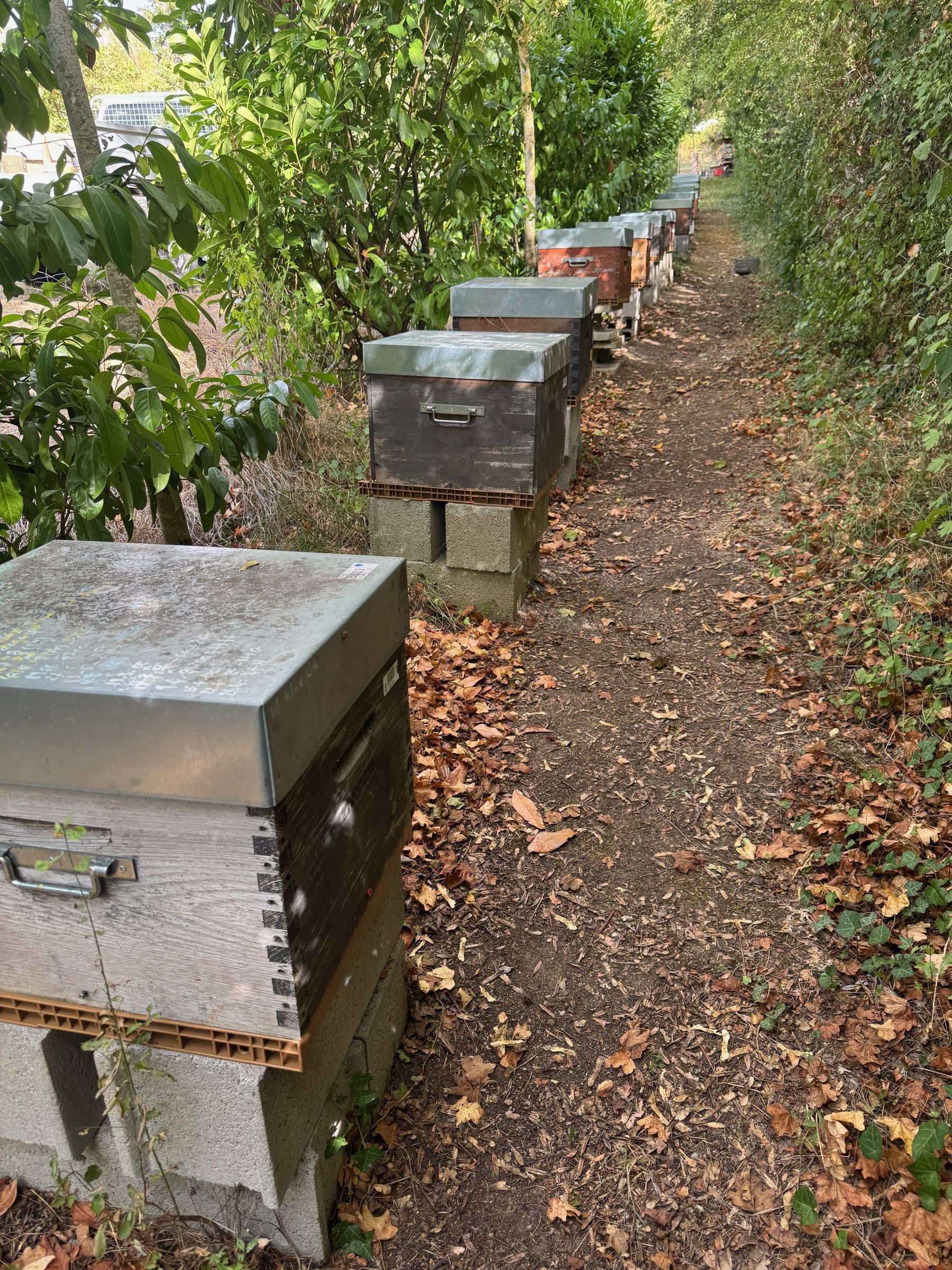
- Framed, vertical hives: removable wooden frames hang in stacked boxes. The colony lives in a brood box at the bottom and stores surplus honey in shallower boxes (supers) above a queen excluder. The National, 14x12, Commercial, WBC, Smith and Langstroth all belong here. They differ in frame size, box footprint, wall construction and where the bee space sits.
- Frameless, movable-comb hives: the bees build comb down from a wooden bar, with no side or bottom bars. The horizontal top-bar hive spreads the colony sideways along one long box; the Warré stacks small square boxes and adds new ones underneath.
How common each one is can be seen in the Scottish Beekeepers Association’s 2024 honey survey. Of 294 hive-type entries, 222 were National, 33 Smith, 14 Langstroth and 13 WBC, with the remainder spread across other designs. England and Wales have no comparable published census, but walk round any association apiary south of the border and the picture is similar, with even fewer Smiths.
All the framed designs rely on bee space, the corridor of roughly 6 to 9 mm (1/4 to 3/8 in) that bees leave open. Narrower gaps are filled with propolis, wider ones with brace comb. A hive can put that space above the frames (top bee space) or below them (bottom bee space). The National, 14x12, Commercial and WBC are bottom bee space; the Smith and Langstroth are top bee space. Mixing the two in one stack leaves either a double gap or no gap at all, which is the most common reason second-hand boxes “do not fit”.
How do the main British hives compare?
The Dorchester and Weymouth Beekeepers’ Association publishes a useful comparison. Its figures, rounded, are below. “Brood cells” is the association’s estimate of worker cells in one brood box.
| Hive | External size | Brood box depth | Super depth | Bee space | Brood cells per box | Frames that fit a National? |
|---|---|---|---|---|---|---|
| National | 460 x 460 mm | 225 mm | 149 mm | bottom | 60,000 | yes |
| 14x12 | 460 x 460 mm | 315 mm | 149 mm | bottom | 93,500 | supers yes, brood no |
| Commercial | 465 x 465 mm | 267 mm | 162 mm | bottom | 70,500 | no |
| WBC (inner boxes) | 505 x 505 mm over lifts | 225 mm | 149 mm | bottom | 45,000 | yes |
| Smith | 416 x 463 mm | 225 mm | 149 mm | top | 50,000 | frame body yes, lugs no |
| Langstroth | 508 x 413 mm | 240 mm | 146 mm | top | 61,400 | no |
| Dadant | 508 x 470 mm | 299 mm | 168 mm | n/a | 85,000 | no |
Two horizontal designs sit outside this table, because they have no standard frame:
| Hive | Typical layout | Comb | Honey harvest |
|---|---|---|---|
| Top-bar hive | one long box, usually 90 to 120 cm, with sloped or vertical sides and 25 to 30 bars | free comb hanging from bars, no wire | cut comb, or crush and strain |
| Warré | stacked boxes 300 x 300 x 210 mm inside, eight top bars each, new boxes added underneath | free comb, often attached to the box walls | whole top box removed, crush and strain or cut comb |
The same association estimates that a colony at its spring peak, with a queen laying around 2,000 eggs a day, needs about 72,000 cells in all: at least 42,000 for worker brood, the rest for drone brood and stores. That one number explains most of the arguments in British beekeeping: a single National brood box is a little small for a strong colony in May, the Commercial and Dadant are a little large for a gentle one in winter, and the 14x12 sits on the generous side.
How heavy is each box when full?
Weight is the factor beginners underestimate. A full National super holds about 11.4 kg of honey on the Dorchester and Weymouth figures, and at least 12 kg according to the National Bee Unit; add the wood and wax and you lift 14 to 15 kg. A National brood frame full of honey holds about 2.3 kg. The Commercial super, deeper by 13 mm and slightly wider, is noticeably heavier, and full Dadant and 14x12 brood boxes are lifts most people avoid. Top-bar hives remove the problem: you lift one comb at a time, never a box.
National hive: why is it the UK standard?
The National is a single-walled square box with British Standard frames: a 17 in (432 mm) top bar with long 1 1/2 in lugs, a 14 in (356 mm) bottom bar and 8 1/2 in (216 mm) side bars in the brood box, 5 1/2 in (140 mm) in the super. The dimensions were set in British Standard BS 1300, “Beehives, frames and wax foundation”, whose 1960 edition BSI now lists as withdrawn. The standard lapsed; the hive did not.
Its strengths are practical rather than technical:
- Availability. Every UK supplier sells National boxes, frames, foundation, crown boards, excluders and feeders, and second-hand kit is easy to buy and resell.
- Compatibility with other people. Nuclei are sold on National frames and association apiaries use them, so your training, your mentor’s spare frames and your bees all fit.
- Handling. A full super is a manageable lift, and the long lugs let you hold a frame without fingers among the bees.
- Choice of brood box. You can run single brood, brood and a half (a super under the excluder), double brood or move later to 14x12 without changing floors, roofs or supers.
Its weaknesses are the small single brood box, discussed below, the rebated box construction that makes handholds awkward, and frames that fit no foreign hive. For the full dimensions, frame types and seasonal management, see our guide to the National hive.
Is one National brood box enough?
For native and near-native dark bees (Apis mellifera mellifera), which tend to build up slowly and keep compact brood nests, often yes, especially in the north and west. For prolific strains, such as Buckfast and imported Carniolan or Italian lines, a single National brood box is usually full by late April or May, and a congested brood nest is a classic swarm trigger. The standard National answers are brood and a half or double brood, both using equipment you already own.
14x12 and Commercial: when do you need a bigger brood box?
The 14x12
The 14x12 is a National with a deeper brood box (315 mm against 225 mm) holding frames with the same 17 in top bar and 14 in bottom bar but 12 in side bars. It shares the National footprint, floors, crown boards, roofs and supers, so it is the easiest upgrade in British beekeeping. At about 93,500 cells it gives a prolific colony all the laying space it needs in one box, which means one frame size in the brood nest and no queen hunting across two boxes.
The costs are heavier brood frames, two frame sizes in the apiary (14x12 for brood, National shallow for supers) and frames that do not swap with a neighbour’s standard National. You can convert gradually by putting a 14x12 box below the old brood box, or by standing a National brood box on an eke of about 90 mm so that the deep frames hang into it, and removing the old combs as the queen moves down.
The Commercial
The Commercial uses a 16 x 10 in frame with short lugs in a box of almost the same footprint as the National (465 against 460 mm). Its brood box holds about 70,500 cells, between the National and the 14x12. Some larger operations favour it because the plain-sided boxes are simple to build and handle, and its footprint is close enough to the National’s that boxes can usually be stacked together. For a hobbyist its drawback is the super: at 162 mm deep it is heavier than a National super, and Commercial frames do not swap with anyone else’s.
Which bigger box should you choose?
| If you… | Consider |
|---|---|
| keep a prolific strain and want to stay compatible with your association’s supers | 14x12 |
| run many colonies and value simple box construction | Commercial |
| keep gentle native bees, or lift with difficulty | National, with brood and a half when needed |
| want to test before committing | a spare National super under the excluder for one season |
WBC and Smith: the traditional and the Scottish options
The WBC
Designed by William Broughton Carr in 1890, the WBC is the white, pagoda-roofed hive of cottage gardens and garden centres. Inside it uses the same British Standard frames as the National, in smaller inner boxes, surrounded by tapered outer lifts. The gap between inner box and lift gives a double wall, which keeps rain off the boxes and adds a little insulation.
In practice the WBC is slower and dearer. Every inspection starts by removing the roof and lifts, the inner boxes hold fewer frames (the Dorchester and Weymouth figure is about 45,000 brood cells), and a cedar WBC costs roughly twice a cedar National: in October 2026 one large UK supplier lists its red cedar WBC at £445 flat-packed or £595 assembled, without frames, against about £225 for an assembled cedar National with two supers. Choose it for its looks or for a garden where appearance matters, and keep it compatible by using National frames throughout.
The Smith
The Smith is a Scottish design that takes National-sized frames with short lugs in a box about 416 x 463 mm, with top bee space. It is light, cheap to build and easy to stack in a car for the heather. It remains the second most common hive in the Scottish survey, with 33 of 294 entries. Outside Scotland it is rare. Because of the short lugs and top bee space, Smith boxes and frames do not mix with Nationals, so a Smith beekeeper needs a Smith mentor or a Smith-using association.
Langstroth and Dadant in the UK: are they worth it?
The Langstroth is the world’s most common hive: standard in North America, Australia, New Zealand and much of the rest of the world, and patented in the United States by Lorenzo Langstroth in 1852. It uses top bee space, a frame with a 19 in (about 48 cm) top bar and boxes about 508 x 413 mm. Its brood box, at about 61,400 cells, is only marginally larger than a National’s.
In the UK, its appeal is mostly that it is the global standard: much imported equipment and many polystyrene hives are designed for Langstroth first. Its drawback is that it is a minority system here, with 14 of 294 entries in the Scottish survey. British nuclei are almost all sold on National frames, so a Langstroth beginner will struggle to buy bees, borrow frames or get hands-on help from the association.
The Dadant, the standard hive in France and much of continental Europe, is larger again: a brood box of about 85,000 cells, 299 mm deep, with 168 mm supers. Few British beekeepers use it. Those who want that much space keep the National footprint and move to 14x12 or Commercial instead.
Top-bar and Warré hives: what natural beekeepers use
Both designs have a following in the UK among beekeepers who want fewer interventions, natural comb and lower costs, and both have British champions: the Warré plans most widely used in English were drawn by David Heaf, a beekeeper in Llanystumdwy, Gwynedd.
The horizontal top-bar hive
A top-bar hive is a single long box, often with sloped sides that discourage the bees from attaching comb to the walls, covered by 25 to 30 wooden bars. The colony builds a natural comb down from each bar. There are no supers and no queen excluder: the brood nest sits towards the entrance and honey is stored at the far end, behind a movable follower board that sets the size of the nest.
| Strengths | Limits |
|---|---|
| no boxes to lift, one comb at a time, at waist height | free comb is fragile, especially new comb on a warm day; never tilt it flat |
| cheap and simple to build from timber | combs cannot go in a centrifugal extractor, so honey is cut or crushed and strained |
| natural comb, no foundation to buy | each harvest removes wax the bees must rebuild, so yields are lower |
| easy to see the colony’s progress bar by bar | no standard: bars from one top-bar hive rarely fit another, and National frames do not fit at all |
| good for teaching and observation | swarm control, uniting and nuc-making need more improvisation |
Top-bar hives suit people who cannot lift supers, who want cut-comb honey for themselves rather than a large crop, or who like to watch their bees closely. They are less forgiving for a beginner, because a dropped comb or a crooked start is hard to correct and few mentors use them.
The Warré
Abbé Émile Warré designed his “people’s hive” in France in the first half of the 20th century. Heaf’s metric plans, based on the 12th edition of Warré’s Beekeeping for All (1948), give a box of 300 x 300 x 210 mm inside, crossed by top bars 315 mm long, with gaps of 12 mm between all bars and between the end bars and the walls. A quilt filled with straw or wood shavings sits on a cloth over the top box, and a ventilated gabled roof sits over the quilt.
The key difference is the direction of expansion. Bees naturally build down, so the Warré beekeeper adds empty boxes underneath (nadiring) rather than on top. The colony moves down over time, and the top box, full of honey, is taken off at harvest. Each box is small: about 19 litres inside, which is close to half of a typical tree cavity of about 40 litres, the volume swarms preferred in Thomas Seeley and Roger Morse’s classic nest-site studies.
| Strengths | Limits |
|---|---|
| small boxes are close to a natural nest shape and volume | adding boxes underneath means lifting the whole stack at once, which gets heavy in a good year |
| quilt and thick walls give good insulation | combs are often attached to box walls and must be cut free to inspect them |
| very low running cost, no foundation | small honey crop, harvested by crushing and straining |
| suits a hands-off approach | inspections are harder, so varroa monitoring and foulbrood checks need extra discipline |
A variant with framed bars, sometimes called a modified Warré, makes inspection easier. For a full guide to building and managing one, see our page on the Warré hive.
Do natural hives need varroa control?
Yes. Varroa reaches every hive in the UK, whatever its shape, and the NBU’s November 2025 varroa guideline asks every beekeeper to monitor at least four times a year and keep the mite population below about 1,000, because around 2,500 mites cause irreversible damage. Most authorised medicines, such as Apivar strips, Apiguard gel trays and oxalic acid trickling or sublimation, were designed for framed hives. They can be used in top-bar and Warré hives, but you have to follow the label for the dose per colony and adapt the placement to bars and free comb. Read our guide to varroa mites before you buy bees for any hive.
Wood, polystyrene or something else?
The material matters almost as much as the model in a cool, damp maritime climate.
- Western red cedar is the British tradition: light, naturally rot-resistant and long-lasting without paint. Most UK suppliers offer first and second quality; second-quality boxes have knots and blemishes but work equally well.
- Pine and other softwoods are cheaper but need an exterior, bee-safe treatment or paint on the outside only.
- Polystyrene (expanded or extruded) hives, made to National, 14x12 and Langstroth sizes, insulate far better than wood. About a third of the hives recorded in the 2024 Scottish honey survey were polystyrene, against two thirds wooden.
The insulation question is not cosmetic. The University of Leeds reported that Derek Mitchell’s work, published in the Journal of the Royal Society Interface, found that a typical hive with 19 mm wooden walls loses about seven times more heat than a natural nest in a tree hollow with 150 mm walls. A single-walled cedar National is about that thickness. In practice, British beekeepers compensate with a block of insulation over the crown board in winter, a WBC’s double wall, a Warré quilt or a polystyrene hive.
Polystyrene has drawbacks: it dents under a hive tool, woodpeckers and mice can damage it, and some brands have slightly different internal dimensions, so check that your frames fit before mixing with wooden boxes. Plastic and composite hives also exist; check that they keep correct bee space.
Damp, wind and the June gap
Whatever you choose, the British climate shapes the details. Damp kills more colonies than cold, so an open mesh floor (standard on most National floors now) and a dry roof matter more than extra wall thickness. Strong wind on exposed sites argues for a heavy roof, straps or a brick. The June gap, the drop in forage after the spring flow from oilseed rape, fruit blossom and hawthorn, can leave a large colony in a big hive short of food at the very time you have supers on, so heft the hive and check stores even in summer.
The National Bee Unit advises that a colony needs approximately 20 kg of honey for winter. In a National that is roughly a full super plus three or four full brood frames. In a top-bar hive it means leaving a generous run of honey combs behind the brood nest; in a Warré, a full box above the cluster.
What do the law and bee health rules mean for your hive choice?
No law in England, Wales, Scotland or Northern Ireland tells you which hive to use. What the law does is set duties that some hives make easier to meet than others.
Notifiable diseases and inspections
Under the Bee Diseases and Pests Control Orders (in England, the 2006 Order as amended, with separate Orders in Wales, Scotland and Northern Ireland), you must report any suspicion of American foulbrood, European foulbrood, small hive beetle or Tropilaelaps mites, and failing to do so is an offence. Bee inspectors from the National Bee Unit (APHA) in England and Wales, the Scottish Government’s Bee Inspectors in Scotland and DAERA in Northern Ireland examine the brood comb by comb when they visit.
- Framed hives make this quick: every brood frame can be lifted and turned.
- Top-bar and Warré hives can be inspected comb by comb, but more slowly and carefully. If combs are fixed to the walls of a Warré, they must be cut free first.
- Skeps and log hives cannot be inspected without cutting comb, which makes disease checks and treatment very difficult.
Since 21 April 2021, varroa has also been a reportable pest in England, Wales and Scotland: you report it once, through BeeBase, or in Scotland by email to the bee health team if you prefer. The duty applies to every hive type.
Registration
Registration is voluntary everywhere in the UK. In England, Wales and Scotland you register free on BeeBase; the NBU states that it is not a legal requirement, and the Welsh Government strongly recommends it. In Northern Ireland, voluntary registration is on DAERA’s DataBees. Registering means an inspector will warn you if foulbrood is found within 3 km, whatever hive you keep. Our guide on how to register your bees has the steps for each nation.
Medicines
The NBU’s bee medicines fact sheet (June 2025) states that only products authorised by the Veterinary Medicines Directorate can legally be used on honey bees without a veterinary prescription, and that records of medicines bought, used and disposed of must be kept for at least five years. Authorised products include amitraz strips (Apivar, Apitraz), thymol (Apiguard, Thymovar, Apilife-VAR), oxalic acid (Api-Bioxal, Oxybee, Oxuvar, Dany’s BienenWohl and, in Great Britain only, Varroxal), formic acid (Formic Pro), formic plus oxalic acid (VarroMed) and tau-fluvalinate (Apistan). The authorisation does not depend on the hive model, but doses are given per colony or per brood box, so a beekeeper with a top-bar hive or a Warré has to work out the equivalent.
Which beehive is best for a beginner in the UK?
For most beginners: a cedar or polystyrene National with Hoffman self-spacing brood frames, a varroa floor, two supers and a queen excluder. Buy two hives rather than one, so that you can share frames between colonies, and buy a spare super so you can move to brood and a half if your bees outgrow a single brood box.
Match the hive to your situation
| Your situation | Recommended hive | Why |
|---|---|---|
| first hive, association mentor uses National | National | compatible frames, nuclei and help |
| prolific bees (Buckfast, Carniolan) or mild southern site | National with brood and a half, or 14x12 | more laying space, fewer swarms |
| native dark bees, north or west, short season | single-brood National | compact colonies, light boxes |
| Scotland, association uses Smith, heather trips | Smith | local standard, light to carry |
| lifting is difficult | top-bar hive, or National with half-filled supers | no box lifting, or lighter boxes |
| garden where looks matter | WBC on National frames | traditional appearance, same frames |
| low intervention, small crop, keen observer | Warré or top-bar, after a season on a National | natural comb, small boxes |
| larger operation, many colonies | Commercial or 14x12 | bigger brood box, simple construction |
A buying checklist
- Ask your association what they use, and buy the same. Most run beginners’ courses over the winter and an apiary where you will handle their hives. The BBKA Basic Assessment, which the BBKA asks you to take after at least 12 months of managing a colony, assumes you are comfortable with framed hives.
- Buy bees on the same frames. A nucleus on National frames will not go into a Commercial, a Smith or a Langstroth. Nuclei of five or six National frames are the usual way to start, and local association members often sell bees adapted to your area.
- Choose one bee space and one frame size, and do not mix top and bottom bee space in one stack.
- Budget for the whole hive. In October 2026, one large UK supplier lists an assembled cedar National (varroa floor, brood box, two supers, crown board, roof, entrance block, no frames) at about £225 and a flat-pack cedar 14x12 at about £194. Frames, foundation, an excluder, a dummy board, a feeder and a mouse guard are extra. Our list of beekeeping equipment for beginners gives a full budget.
- Plan winter insulation for the crown board if you buy single-walled wooden boxes.
- Register on BeeBase or DataBees as soon as the bees arrive, and plan your first varroa monitoring before spring.
Once you know your bees and your site, nothing stops you trying a top-bar hive or a Warré alongside your Nationals. Starting with the local standard simply means that, in your first two seasons, when something goes wrong, someone nearby has a frame that fits. For the wider steps, see our guide on how to start beekeeping.
Frequently asked questions
What is the best beehive for a beginner in the UK?
For most beginners it is the British Standard National with Hoffman frames. Your association apiary, your mentor and most nucleus sellers use it, every UK supplier stocks parts for it, and a full super, holding at least 12 kg of honey, is a manageable lift of about 14 to 15 kg. Buy a spare super so that you can run brood and a half if your bees outgrow a single brood box.
What is the difference between a National and a WBC hive?
Both take the same British Standard frames, so frames swap between them. The WBC adds outer lifts around inner boxes, which gives a double wall and its cottage-garden look. That makes it slower to inspect, because the lifts come off first, and dearer: a cedar WBC costs roughly twice a cedar National. The inner WBC boxes also hold fewer frames, about 45,000 brood cells against 60,000.
Is a 14x12 better than a National?
A 14x12 is a National with a deeper brood box: same footprint, roof, floor and supers, but brood frames 12 in deep instead of 8 1/2 in. It gives about 93,500 cells in one box, which suits prolific strains such as Buckfast that overflow a single National. The trade-off is heavier brood frames and a second frame size in the apiary. Many keep standard Nationals for gentle native bees.
Can I use Langstroth equipment in the UK?
Yes, there is no rule against it, and Langstroth gear is easy to import. The problem is practical: the frames, boxes and bee space do not match the National, so you cannot swap frames with your association or buy a standard British nucleus straight into it. In the 2024 Scottish survey, only 14 of 294 hive entries were Langstroth. Choose it only if you will source bees on Langstroth frames.
Are top-bar hives and Warré hives legal in the UK?
Yes. No UK law sets the hive model. What the law requires is that you report suspected foulbrood and other notifiable pests and let bee inspectors examine your colonies. Top-bar and Warré combs can be lifted and inspected, but they are fragile and not wired, so handle them carefully. Skeps and fixed-comb log hives are hard to inspect and treat, and few UK associations recommend them for beginners.
Do polystyrene hives work in the British climate?
They work well: about a third of the hives in the 2024 Scottish honey survey were polystyrene. Research publicised by the University of Leeds found that a hive with 19 mm wooden walls loses about seven times more heat than a tree nest with 150 mm walls, and polystyrene insulates far better than wood. Downsides are damage from hive tools, woodpeckers and mice, and brand-to-brand size differences, so check frame fit.
How much does a beehive cost in the UK in 2026?
At one large UK supplier in October 2026, an assembled cedar National with floor, brood box, two supers, crown board and roof, but no frames, is about £225; a flat-pack cedar 14x12 is about £194; a cedar WBC is about £445 flat-packed or £595 assembled. Frames, foundation, a queen excluder, a feeder and the bees come on top; ask your association what local nuclei on National frames cost.
Should I mix different hive types in one apiary?
Not in your first years. The great advantage of one standard is that a frame of eggs, brood or stores can move to any colony to rescue a queenless hive, boost a weak one or make a nucleus. Nationals, WBCs and 14x12 boxes on National supers mix partially; Smith, Langstroth, Commercial, top-bar and Warré frames do not fit Nationals. Pick one system and stay with it.
Sources
- Hive sizes (National, 14x12, Commercial, WBC, Langstroth, Smith and Dadant compared), Dorchester and Weymouth Beekeepers' Association
- Beehives, frames and wax foundation (BS 1300:1960, withdrawn), BSI Knowledge
- 2024 Scottish Honey Survey results, Scottish Beekeepers Association
- National hive with flat roof, cedar, assembled (price and contents), Abelo
- National 14x12 hive with flat roof, cedar, flat pack (price and contents), Abelo
- WBC National hive, red cedar (price and contents), Abelo
- Warré hive plans, metric (version 1.2, 2011, after the 12th edition of Beekeeping for All), D. Heaf, biobees.com
- Research challenges beliefs on honeybee insulation (work of D. Mitchell), University of Leeds
- Nest site selection by the honey bee, Apis mellifera (Insectes Sociaux 25, 323-337, 1978), T. D. Seeley and R. A. Morse, Springer
- Preparing your hives for winter (Fact sheet 19), National Bee Unit, APHA
- Varroa (Best Practice Guideline No. 11, November 2025), National Bee Unit, APHA
- Bee medicines: products authorised in the UK (June 2025), National Bee Unit, APHA
- Legal responsibility of beekeepers, National Bee Unit, APHA
- Honey bees: protecting them from pests and diseases, Defra and APHA, GOV.UK
- The Bee Diseases and Pests Control (England) Order 2006 (as amended), legislation.gov.uk
- Healthy honey bees, Welsh Government
- Honey bee health: guidance, Inspections, Scottish Government
- Beekeepers voluntary registration on DataBees, Department of Agriculture, Environment and Rural Affairs (DAERA)
- Basic Assessment, British Beekeepers Association