Queen bee: what she does, how she is made and mated, how long she lives and how to find her
The queen bee explained for UK beekeepers: her role, queen cells, mating flights, laying, pheromones, lifespan, the 2026 marking colour and queenless hives.
The queen bee is the only mated female in a honey bee colony. She lays all its eggs, up to about 2,000 a day at the spring peak, and produces the pheromones that tell tens of thousands of workers she is present and fertile. She gives no orders, yet without her the colony cannot replace itself and soon falls apart. She usually lives two to three years, and she mates only once in her life, on a few flights in her first week or two.
Being able to find her, judge her and tell when she has gone is the core skill of a weekly inspection: it is how you read laying, swarm preparations, a failing queen or a queenless hive. For how she fits alongside the workers and drones, see our guide to the honey bee colony.
What does a queen bee actually do?
She has two jobs, and only two.
- Laying. Every worker, every drone and every future queen in the hive is her daughter or son. She decides egg by egg whether to release sperm: a fertilised egg becomes a female, an unfertilised one a drone, laid in the wider drone cells.
- Holding the colony together chemically. The pheromones she produces are licked off her by the workers around her and passed through the hive. They suppress queen rearing and worker ovary development and keep a swarm cluster together.
She does not forage, build comb or tend brood, and she does not even feed herself: young nurse bees feed her a secretion from their head glands. The word “queen” is misleading. The workers decide when to rear a new queen, when to supersede her, when to swarm with her and, sometimes, when to kill her. Her influence is chemical, not political.
How do you recognise the queen bee?
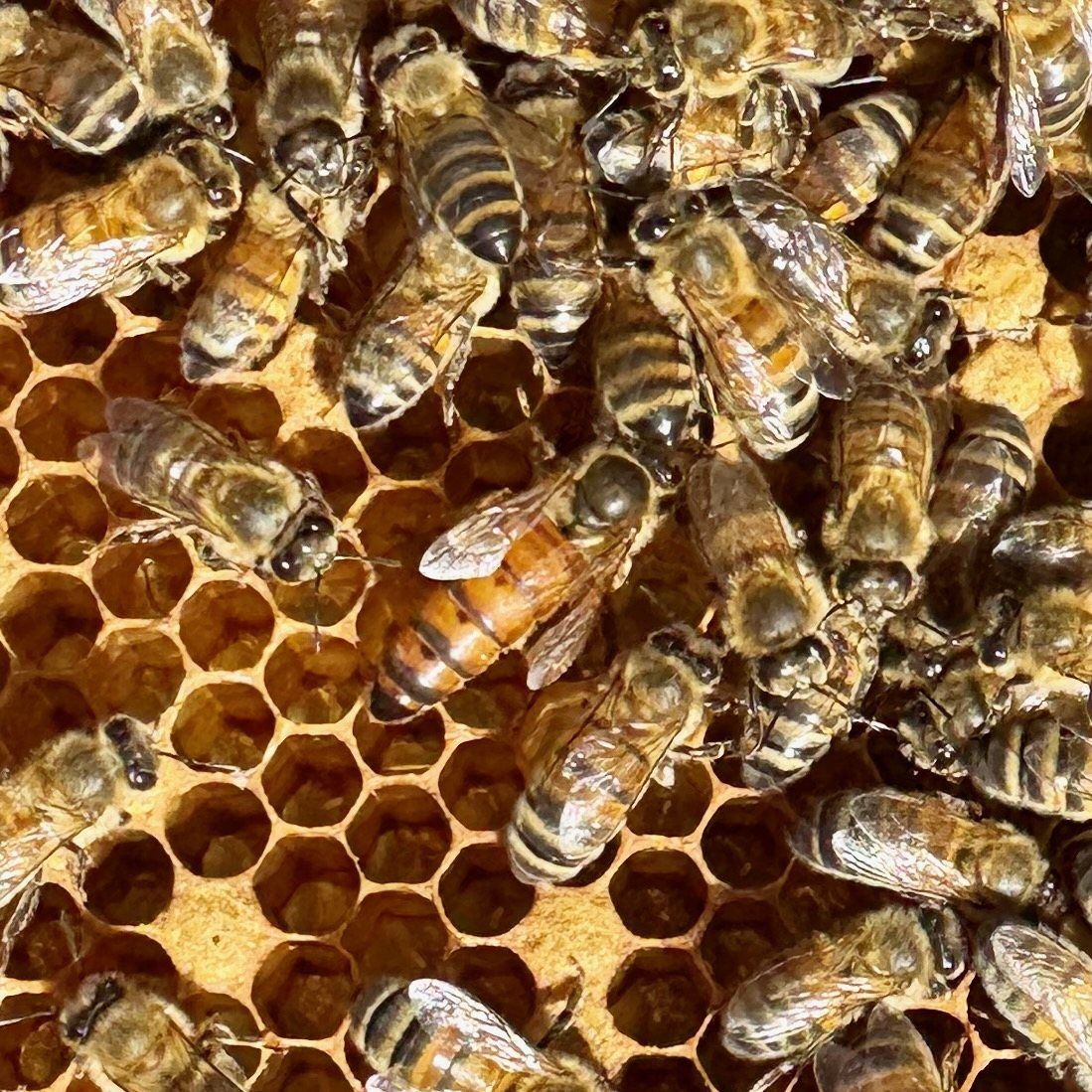
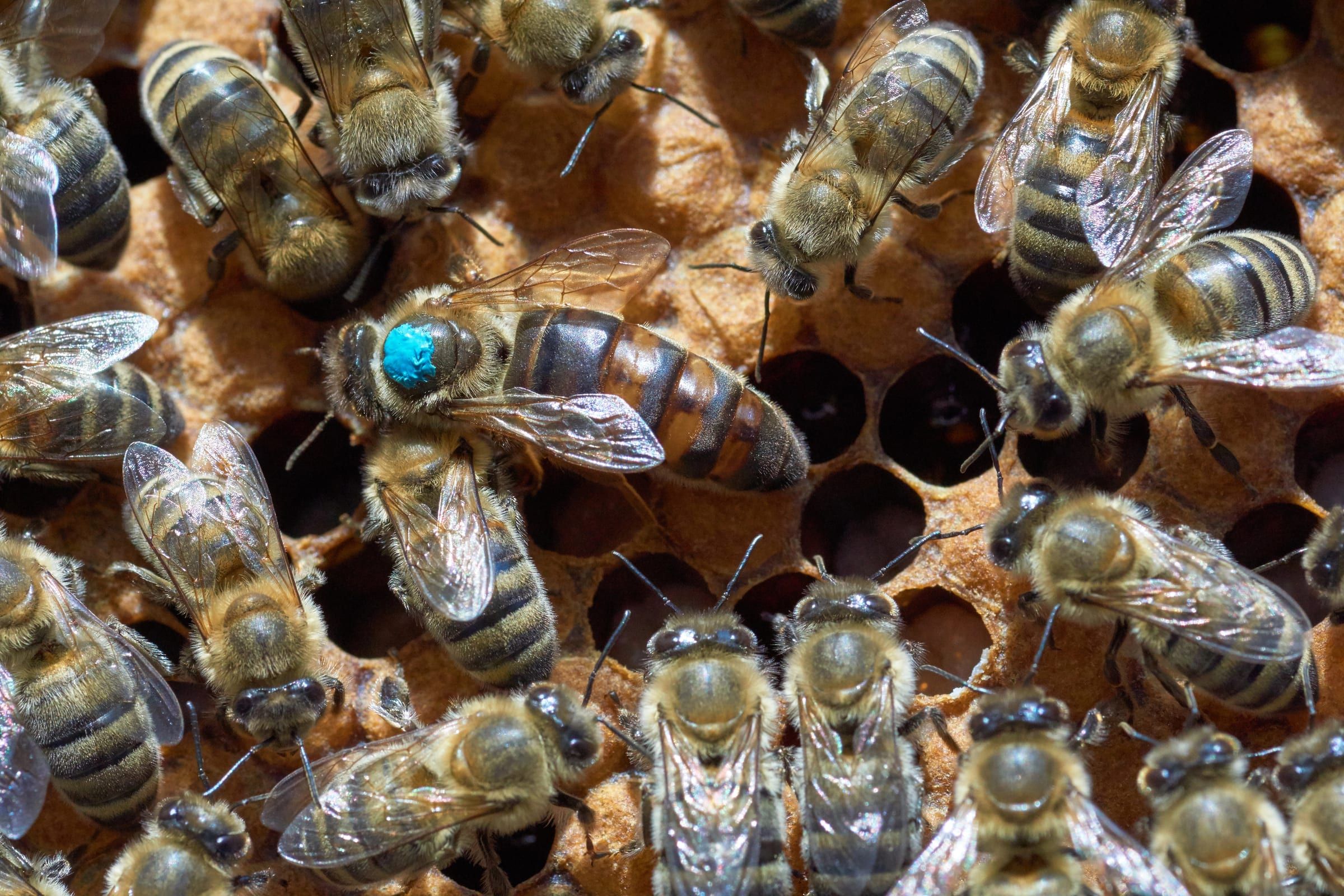
What she looks like
| Feature | Queen | Worker | Drone |
|---|---|---|---|
| Body | long, about twice a worker’s length in the abdomen | short and slim | broad, square-ended |
| Abdomen | tapered, extends well beyond the folded wings | covered by the wings at rest | blunt and rounded |
| Eyes | separate, at the sides of the head | separate | very large, meeting on top of the head |
| Legs | long and conspicuous, often splayed | shorter, with pollen baskets | no pollen baskets |
| Sting | curved, barely barbed, used against rival queens | strongly barbed | none |
| Behaviour | moves deliberately, often with a ring of attendants | busy | slow, wandering |
The colour varies with the strain. Queens of dark native type look almost black, while Buckfast and Italian-derived queens are often orange or banded. University of Florida extension notes that a queen is often a slightly different colour from her workers, larger and shinier. Inside, the difference is greater still. Jackson, Tarpy and Fahrbach counted the egg-producing tubes, the ovarioles, in 75 queens (Journal of Insect Science, 2011): a median of 320 across both ovaries, against fewer than 10 per ovary in a worker. She also has a spermatheca, the small sac in which she keeps sperm alive for the rest of her life.
How to find her in a National brood box
With 11 frames in the brood box and up to 60,000 bees in midsummer, finding an unmarked queen is a matter of method rather than eyesight.
- Use little smoke and work quietly. A heavily smoked colony runs, and the queen heads for the corners and the floor.
- Start from the edge. Lift out an outer frame, look at it and lean it against the hive or put it in a spare box, then work towards the centre so you are never pushing a frame past the queen.
- Look at the side facing you first, as soon as it comes out of the box. She moves away from light.
- Concentrate on frames with eggs. She is almost always on or near the comb where she has laid most recently, close to the pollen arc. Micheál Mac Giolla Coda, writing for BIBBA, suggests scanning in concentric circles from the top bar inwards and choosing a warm, sunny morning, when many foragers are out.
- Look for the retinue, a small ring of workers facing one point, rather than for the queen herself.
- Hold every frame over the open box, so a queen who falls lands in the hive and not in the grass.
If she does not turn up, it rarely matters. Fresh eggs, standing one per cell at the bottom, prove that a laying queen was there within the last three days. Many experienced beekeepers close up rather than prolong the search, unless they need her for swarm control.
How is a queen bee made?
Same egg, different diet
A queen develops from a fertilised egg identical to a worker egg. The difference lies in her cell and her food. She is reared in a large vertical queen cell hanging from the comb and fed royal jelly in abundance throughout her larval life, whereas worker larvae are switched to a diet that includes honey and pollen. Our guide to the honey bee life cycle explains caste determination in detail.
Development times
| Stage | Queen | Worker | Drone |
|---|---|---|---|
| Egg | 3 days | 3 days | 3 days |
| Unsealed larva | about 5 days | about 6 days | about 6.5 days |
| Sealed (prepupa and pupa) | about 8 days | about 12 days | about 14.5 days |
| Egg to emergence | about 16 days | about 21 days | about 24 days |
A queen cell is sealed around day 8 or 9 after the egg was laid, and the virgin queen emerges around day 16, a day earlier or later depending on brood nest temperature. The NBU’s Queen Rearing Workbook recommends moving cells into mating nucs on day 14, because moving them earlier can damage the developing queen and waiting longer risks virgins emerging and fighting. In the queenright system tested at the Central Science Laboratory by David Wilkinson and Mike Brown, grafted cells were removed 11 days after grafting, about a day before the queens would emerge.
Swarm cells, supersedure cells and emergency cells
Workers raise queens in three situations, which the Mid-Atlantic Apiculture Research and Extension Consortium (MAAREC) describes. Reading the cells is one of the most useful diagnostics you have, though the positions below are tendencies rather than rules.
| Situation | Why | Where the cells are | How many |
|---|---|---|---|
| Swarming | the colony is reproducing; the old queen leaves with a swarm | along the bottom bars and edges of the comb | often many |
| Supersedure | the queen is ageing, injured or failing, and her pheromone output falls | on the face of the comb, often near the edge of the brood | usually few |
| Emergency | the queen has died or been removed suddenly | on the face of the comb, built from worker cells | several, scattered, often smaller |
For emergency cells, MAAREC explains that the workers turn a horizontal worker cell into a vertical one, usually destroying the walls and larvae of three or four neighbouring cells, and that they always start several queens rather than one. The University of Georgia notes that they begin within a few hours of losing their queen, using worker larvae less than four days old. The younger the larva chosen, the better the queen, which is why queen rearers graft larvae well under a day old; the CSL method grafted larvae 12 to 18 hours from hatching.
Do not confuse queen cells with play cups, the empty acorn-shaped cups most colonies build every spring. A cup becomes a queen cell only when it holds an egg or a larva in royal jelly. Charged swarm cells in May or June mean you have days, not weeks, to act; our guide to swarming sets out the Pagden artificial swarm and the other methods.
Piping, tooting and quacking
When several queens emerge in one colony, only one stays. The first virgin out usually tears open rival cells, or the queens fight. They also communicate by vibration. A team led by Dr Martin Bencsik at Nottingham Trent University, with INRAE in France and CARI in Belgium, recorded these signals with accelerometers through a swarming season (Scientific Reports, 2020). The free queen “toots”, signalling that she is fertile and mobile and should be protected from rivals; virgins still held in their cells answer by “quacking”. When the quacking stops, no virgins remain and the colony will not cast again. British beekeepers who hear piping through the hive wall in June are hearing exactly this exchange.
How does a queen bee mate?
Mating flights and drone congregation areas
A virgin queen first makes short orientation flights to learn the position of her hive, then one or a few mating flights. The NBU workbook places them around 21 to 31 days after her egg was laid, that is roughly 5 to 15 days after emergence. She flies to a drone congregation area, a patch of air that drones use year after year. Rangel and Fisher’s review (Apidologie, 2019) gives the figures: 30 to 200 m across, 10 to 40 m above the ground, with up to 11,000 drones from as many as 240 colonies up to 5 km away. Virgin queens commonly fly several kilometres. Mating takes place in the air, and each drone dies immediately afterwards.
What a field study found
Michael Simone-Finstrom and David Tarpy followed 80 queens at North Carolina State University (Journal of Insect Behavior, 2018):
- 2.4 flights per queen on average, orientation flights included;
- mating flights of 12 to 47 minutes, 22.8 on average, against under 5 minutes for an orientation flight;
- 8 to 25 drones per queen, 13.5 on average (Rangel and Fisher give a typical mean of 12 to 14, with extreme cases above 50);
- 65% of the queens began laying after a single successful mating flight.
A fully mated queen, the authors note, stores around 5 to 7 million sperm. Mating with many drones, polyandry, gives the colony a mix of worker lines that improves its resilience.
Why the British weather matters
The mating window is short and final. A queen who cannot fly for a week or two of wind and rain may stay unmated and become a drone layer, which the NBU workbook flags as the main risk of poor weather. This is the reason, it says, that the most common months for queen rearing in the UK are May, June and July, when the weather is most reliable and drones are plentiful. Cells raised in a cold April or a wet September often fail, and many beekeepers simply avoid them. Allow about a week from emergence to the first flights and a few days more before laying. The NBU leaves its mating nucs alone for two to three weeks before checking whether the queens have mated properly.
You cannot choose the drones in an open apiary: your young queens will mate with drones from every colony within several kilometres. That is why selection in Britain is often a group effort through local association queen rearing groups, isolated mating sites and, for breeders, instrumental insemination. Our page on queen rearing covers the methods.
How many eggs does a queen bee lay?
The rate
At the peak of the season a good queen can lay up to about 2,000 eggs a day, according to University of Florida extension. In the UK the peak is short: it builds through April and May, often falters in the June gap if forage dries up, and declines from August. In midwinter laying is low or nil, and it resumes inside the cluster from around the turn of the year.
Reading the brood pattern
Laying is the best measure of a queen. A good queen lays outwards from the centre of the comb, leaving solid slabs of brood of the same age.
| What you see | What it suggests |
|---|---|
| Compact brood, all stages present, few gaps | well mated, vigorous queen |
| One egg per cell, upright, at the bottom | a laying queen present within 3 days |
| Pepper-pot brood with many empty cells | failing or poorly mated queen, but also disease, varroa or inbreeding |
| Domed drone cappings scattered in worker brood | queen running out of sperm |
| Only drone brood in worker cells, one egg per cell | drone laying queen |
| Several eggs per cell, stuck to the walls | laying workers (or a newly laying young queen in her first days) |
| No eggs or young larvae in May or June | queenless, or a pause in laying (virgin queen, dearth, just before swarming) |
The University of Georgia warns that a spotty pattern does not always mean a poor queen: disease, varroa and inbreeding can all produce it. In the UK, American and European foulbrood are notifiable, so if the brood looks wrong, rule disease out first and contact your Seasonal Bee Inspector through BeeBase if you suspect it.
Queen pheromones: how the queen holds the colony together
A blend, not a single substance
“Queen substance” is a mixture from several glands. The best known part is queen mandibular pheromone (QMP), produced by glands in her head. Bortolotti and Costa’s review (2014) traces it from the identification of 9-ODA in 1960 to Slessor’s 1988 finding that four other compounds, 9-HDA, HOB and HVA among them, act together with it and are more active as a blend. Keeling and colleagues added further compounds in 2003 that strengthen the attraction of the retinue only in combination with QMP. Other glands contribute: Dufour’s gland secretion appears to work as a fertility signal, and the tarsal glands on her feet leave “footprints” on the comb that discourage workers from building queen cups.
What the pheromones do
- Attract the retinue, which licks and touches the queen and spreads the pheromone through the hive.
- Suppress queen rearing. Synthetic QMP stops queenless colonies starting queen cups only if applied within about 24 hours of queen loss; after four days it has no effect on cells already begun.
- Suppress worker ovaries, together with brood pheromone.
- Attract drones to the virgin queen on her mating flight, 9-ODA being the long-range sex attractant.
- Keep a swarm together. The queen is the strongest attractant in a swarm cluster; if she is lost or cannot fly, the swarm returns home.
Why the signal fades
The Koschevnikov gland, part of the sting apparatus and another source of the queen signal, begins to degenerate when the queen is about a year old, which helps explain the weaker signal of older queens. The signal is also diluted in a crowded hive, one reason a congested colony starts swarm preparations. Young queens, with a stronger signal, are less inclined to swarm, one reason many beekeepers prefer not to keep a queen beyond her second or third season.
How long does a queen bee live, and when should you replace her?
Lifespan
Simone-Finstrom and Tarpy describe queens lasting “upwards of 2-3 years” once they begin laying. University of Florida extension says the life span can exceed seven years but that productivity drops sharply after one or two. Compare that with five or six weeks for a summer worker and several months for a winter bee, covered in our guide to the honey bee life cycle.
Why laying declines
Several things combine. The sperm store runs down and is never replenished; the pheromone signal weakens; and an old queen lays a growing share of unfertilised eggs in worker cells. Mating quality matters too: Rangel and Fisher note that supersedure can follow inadequate or poor quality sperm, and cite work by Burley showing that drones from coumaphos-treated colonies had markedly lower sperm viability. Finally, Jackson and colleagues found no correlation between ovariole number and a queen’s weight, size or sperm store, so judge a queen by her brood, not her looks.
When to requeen
Colonies often replace their own queen by supersedure, sometimes so quietly that the beekeeper only notices an unmarked queen at the next inspection. Replace her yourself when:
- she is in her third season and the brood is shrinking;
- the brood stays pepper-potted once disease has been ruled out;
- drone cells appear in the worker brood;
- the colony is persistently bad tempered, runny on the comb or swarmy, traits you do not want to pass on through her drones.
The NBU workbook notes that many queen rearers like to raise queens in July so they have young queens to requeen colonies before winter. Requeening in the main flow is also possible, but finding and removing a queen in a two or three super National colony in June is hard work.
When you introduce a mated queen in a cage, remove the old queen first, wait a few hours, and leave the new one in her cage with a candy plug for the bees to eat through. Then leave the colony alone for about a week. Most rejections happen when a colony is opened too soon and the new queen is balled. Uniting a queenright nucleus over a newspaper is the most reliable way of all.
What colour should a queen be marked in 2026?
The international colour code
A dot of paint on the thorax lets you find the queen in seconds and tells you her age. The international code follows the last digit of the year she was reared:
| Last digit of the year | Colour | Coming years |
|---|---|---|
| 1 or 6 | white | 2026, 2031 |
| 2 or 7 | yellow | 2027, 2032 |
| 3 or 8 | red | 2028, 2033 |
| 4 or 9 | green | 2029, 2034 |
| 5 or 0 | blue | 2030, 2035 |
Queens reared in 2026 are marked white. The Dorchester and Weymouth Beekeepers’ Association, like many British associations, gives the mnemonic Will You Rear Good Bees? for the order. BIBBA points out that the code is a convenience: what matters is recording the year the queen was reared and the date she was marked, in your hive records.
Marking and clipping
- Catch her by the wings or thorax, never the abdomen. BIBBA’s advice is blunt: the abdomen is the most easily damaged part of her anatomy. A crown-of-thorns cage pressed over her on the comb, or a plunger marking tube, avoids handling altogether.
- Put a small dot on top of the thorax with a queen marking pen, keeping clear of the head, wings and abdomen.
- Let the paint dry for a minute or two before releasing her onto the frame she came from.
- Practise on drones first: they cannot sting.
Many British beekeepers also clip a queen, removing part of one forewing so she cannot fly away with a swarm. Clip only a mated, laying queen. BIBBA warns to check that no leg is in the way of the scissors: a queen who loses a leg may be superseded. Clipping does not stop swarming. The swarm emerges, the queen falls in front of the hive and the swarm returns, but the colony will leave with the first virgin to emerge unless you carry out swarm control in time.
Queenless hive: how to spot it and what to do
A colony is queenless when it has lost its queen: natural death, a queen crushed or rolled during an inspection, a queen lost to a bird on her mating flight, or a swarm that left with the old queen before the new one was mated.
The signs
- No eggs or young larvae in the active season.
- A restless, noisy colony. The University of Georgia describes agitated bees, fanning at the top bars and a loud roar when the crownboard comes off.
- Emergency queen cells on the face of the comb.
- Later, scattered drone brood with several eggs per cell, laid by workers.
What happens next, day by day
If young worker larvae are still present, the colony rears an emergency queen. The timetable is long:
| Time since queen loss | What happens |
|---|---|
| a few hours | emergency cells started on young worker larvae |
| about 12 days | emergency queen emerges |
| about 3 weeks | mating and first eggs, if all goes well |
| about 6 weeks | first workers of the new queen emerge |
During those six weeks no new workers emerge, and the colony dwindles. A colony that goes queenless in May can miss the whole spring flow, and in Britain the oil seed rape and early summer flows will not wait.
Without usable larvae, the colony is, in the University of Georgia’s phrase, hopelessly queenless. After some weeks without queen pheromone, some workers develop their ovaries and lay unfertilised eggs, which give only drones. Left alone, the colony dies out.
What to do
- Check before you act. A colony without eggs is not necessarily queenless. After a swarm or an artificial swarm, a virgin queen may still be mating, and introducing a mated queen would get her killed.
- Use a test frame. Put a frame of eggs and young larvae from a healthy colony in the middle of the brood nest. If the bees start queen cells on it within a few days, they are queenless and will rear their own queen. If not, a queen, often an unmated virgin, is probably present.
- Save time with a mated queen, introduced in a cage, or a sealed queen cell from another colony. Either saves weeks.
- Unite if the colony is weak. A small queenless colony is better united with a queenright one by the newspaper method than nursed for six weeks.
- Do not expect laying workers to accept a queen. The University of Georgia notes that such colonies rarely accept a new queen. Uniting them with a strong queenright colony, or shaking the bees out well away from the hive so they drift into other colonies, works better.
Buying or rearing a queen in the UK
Imports: what the law allows
Many British beekeepers never buy a queen; they raise them from swarm cells, splits or a few grafts. The BBKA has pointed out that the UK has few commercial breeders and relies heavily on imported queens, which are health checked but not adapted to the British climate. Prices give an idea of the market: one UK bee farm lists imported 2026 Buckfast and Carniolan mated queens, marked for the year, at £39 ex VAT, plus about £10 for guaranteed next-day post, supplied April to September. The import rules changed after Brexit. The NBU’s June 2026 guidance for England sets them out:
| Source | Great Britain | Northern Ireland |
|---|---|---|
| Mated queens from the EU | allowed, each queen in her own cage with up to 20 attendants | allowed, along with packages and colonies |
| Packages and colonies from the EU | not allowed | allowed |
| Queens from other countries | only from listed countries where AFB, small hive beetle and Tropilaelaps are notifiable | only queens from GB and other third countries |
| Packages | only from New Zealand | not from GB |
For Great Britain, each consignment needs an original health certificate issued within 24 hours of dispatch and valid for 10 days, and prior notification on the IPAFFS system; as of April 2026, small hive beetle safeguard measures block bees from Calabria, Lazio and Sicily in Italy. On arrival, the importer must move the queens into new cages before introducing them, and send the original cages, attendants and packing to Fera Science in York within five days for small hive beetle and Tropilaelaps checks. Scottish importers send them to SASA in Edinburgh instead, and the NBU notes that similar legislation applies in Scotland and Wales. In Northern Ireland, DAERA requires registration, pre-notification in TRACES NT and an EU animal health certificate for consignments from member states.
The NBU workbook makes its own position clear: imported queens can spread exotic pests and diseases into the UK and may be poorly adapted to local conditions. It suggests buying in queens only to add a trait your bees lack, such as gentleness or reduced swarming, and otherwise breeding from your best colony and sharing spare queens with neighbours.
Native and local bees
The native dark bee, Apis mellifera mellifera, still survives in parts of Britain and Ireland, and groups such as BIBBA work to conserve and improve it. Scotland has gone further: the Bee Keeping (Colonsay and Oronsay) Order 2013 has prohibited keeping any honey bee other than Apis mellifera mellifera on the two islands since 1 January 2014, under the Wildlife and Countryside Act 1981. Elsewhere, most British colonies are mongrels of native, Buckfast, Carniolan and Italian ancestry. Whatever the line, a queen reared from your own best colony and mated locally is adapted to your climate and forage. Our guide to honey bee breeds compares them.
Rearing your own
You need no grafting tool to start. Swarm cells from a good colony, a split with eggs, or the Miller method described in the NBU workbook all produce queens; the workbook expects about five usable cells per Miller frame, and up to 15 have been recorded. Small mating nucs such as Apideas economise on bees. The NBU’s own queen rearing gives an idea of realistic losses: over 20 years, about 80% of its grafts were accepted and about 80% of those produced queens, 5,240 mated queens in all. Queen rearing also has a varroa role: the NBU’s queen trapping method confines the queen to one comb at a time, in a cage of about 4.3 mm mesh moved every nine days, to concentrate mites in brood that is then destroyed. See our guide to varroa mites.
For the other members of the hive and how the colony lives as a whole, browse the colony section.
Frequently asked questions
How long does a queen bee live?
A queen can live for several years. Researchers at North Carolina State University and USDA describe queens lasting upwards of two to three years once they start laying, and University of Florida extension says the life span can exceed seven years. Her laying usually falls off after one or two seasons, which is why many British beekeepers replace queens every two years or let the bees supersede them.
What colour should I mark my queen in 2026?
White. The international code follows the last digit of the year the queen was reared: white for 1 and 6, yellow for 2 and 7, red for 3 and 8, green for 4 and 9, and blue for 5 and 0. Queens reared in 2027 will be yellow and those reared in 2028 red. British associations teach the order with the phrase Will You Rear Good Bees.
How do I know if my hive is queenless?
In the active season, a queenless colony has no eggs and no young larvae. The bees are often restless and noisy when you open the hive, and emergency queen cells may appear on the face of the comb. To be sure, put in a frame of eggs and young larvae from another colony: if the bees start queen cells on it within a few days, they had no queen.
How many eggs does a queen bee lay a day?
At the spring and early summer peak, a good queen can lay up to about 2,000 eggs a day, one per cell, working outwards from the centre of the brood nest. In the UK that rate lasts only a few weeks. Laying slows from late summer, is low or nil in midwinter, and picks up again from around the turn of the year inside the cluster.
Can a queen bee mate more than once?
She mates only during a short period early in her life, on one or a few flights, usually with a dozen or so drones. In a North Carolina field study the queens mated with 13.5 drones on average. She stores the sperm in her spermatheca and never mates again, so all her future fertilised eggs depend on that one store.
What is a drone laying queen?
A drone layer is a queen who lays only unfertilised eggs, so every egg becomes a drone. It happens when a virgin queen fails to mate, often after a spell of bad weather in her mating window, or when an old queen runs out of sperm. You see one egg per cell but domed drone cappings on worker comb. The cure is to replace her quickly.
Can I import a queen bee into the UK?
Into Great Britain you can import mated queens, each in her own cage with up to 20 attendants, from the EU and certain other countries, with an original health certificate and prior notification on IPAFFS. Packages and colonies are not allowed, except packages from New Zealand. Northern Ireland follows EU rules and can receive queens, packages and colonies from EU member states.
Why is my colony killing its queen?
Workers sometimes ball a queen, clustering tightly around her until she dies of heat or stings. It happens most often to a newly introduced queen released too early, to a queen who has been handled roughly or carries foreign odour, and occasionally during a disturbed inspection. Leave a caged queen undisturbed for about a week and avoid opening the hive again until you expect her to be laying.
Sources
- Honey Bee Queens Do Not Count Mates to Assess their Mating Success (Journal of Insect Behavior, 2018), Michael Simone-Finstrom and David R. Tarpy, USDA-ARS
- Factors affecting the reproductive health of honey bee (Apis mellifera) drones: a review (Apidologie, 2019), Juliana Rangel and Adrian Fisher II, Springer
- Histological Estimates of Ovariole Number in Honey Bee Queens, Apis mellifera, Reveal Lack of Correlation with other Queen Quality Measures (Journal of Insect Science, 2011), Joseph T. Jackson, David R. Tarpy and Susan E. Fahrbach, via PubMed Central
- Chemical Communication in the Honey Bee Society (Neurobiology of Chemical Communication, 2014), Laura Bortolotti and Cecilia Costa, CRC Press, via NCBI Bookshelf
- Queen bees 'toot' to instruct colony to keep them safe (2020), Nottingham Trent University
- Queen Replacement (Basic Bee Biology for Beekeepers, MAAREC), Mid-Atlantic Apiculture Research and Extension Consortium, Bee Health Extension
- Honey bee disorders: non-infectious diseases and pests, University of Georgia, Honey Bee Program
- Queen Rearing Workbook: Miller Method, National Bee Unit, APHA
- Rearing Queen Honeybees in a Queenright Colony (American Bee Journal, 2002), David Wilkinson and Mike A. Brown, Central Science Laboratory, via National Bee Unit
- Mating nucs and artificial insemination, National Bee Unit, BeeBase
- Queen Trapping (fact sheet, September 2026), National Bee Unit, APHA
- Guidance on Importing Bees into England (June 2026), National Bee Unit, APHA
- Importing bees into Scotland, SASA, Scottish Government
- Honeybee and bumblebee imports and exports, Department of Agriculture, Environment and Rural Affairs (DAERA)
- The Bee Keeping (Colonsay and Oronsay) Order 2013 (SSI 2013/279), legislation.gov.uk
- Find, Mark and Clip the Queen, Micheál Mac Giolla Coda, BIBBA
- The Basics of Queen Management in Beekeeping Operations (ENY2128, 2025), Francesca L. Michelini, Devan Rawn and Cameron Jack, University of Florida IFAS Extension
- Queen marking, Dorchester and Weymouth Beekeepers' Association
- BBKA plan for nationwide queen rearing training (2018), British Beekeepers Association
- Queen bees (2026 price listing), Honeyfields Bee Farm