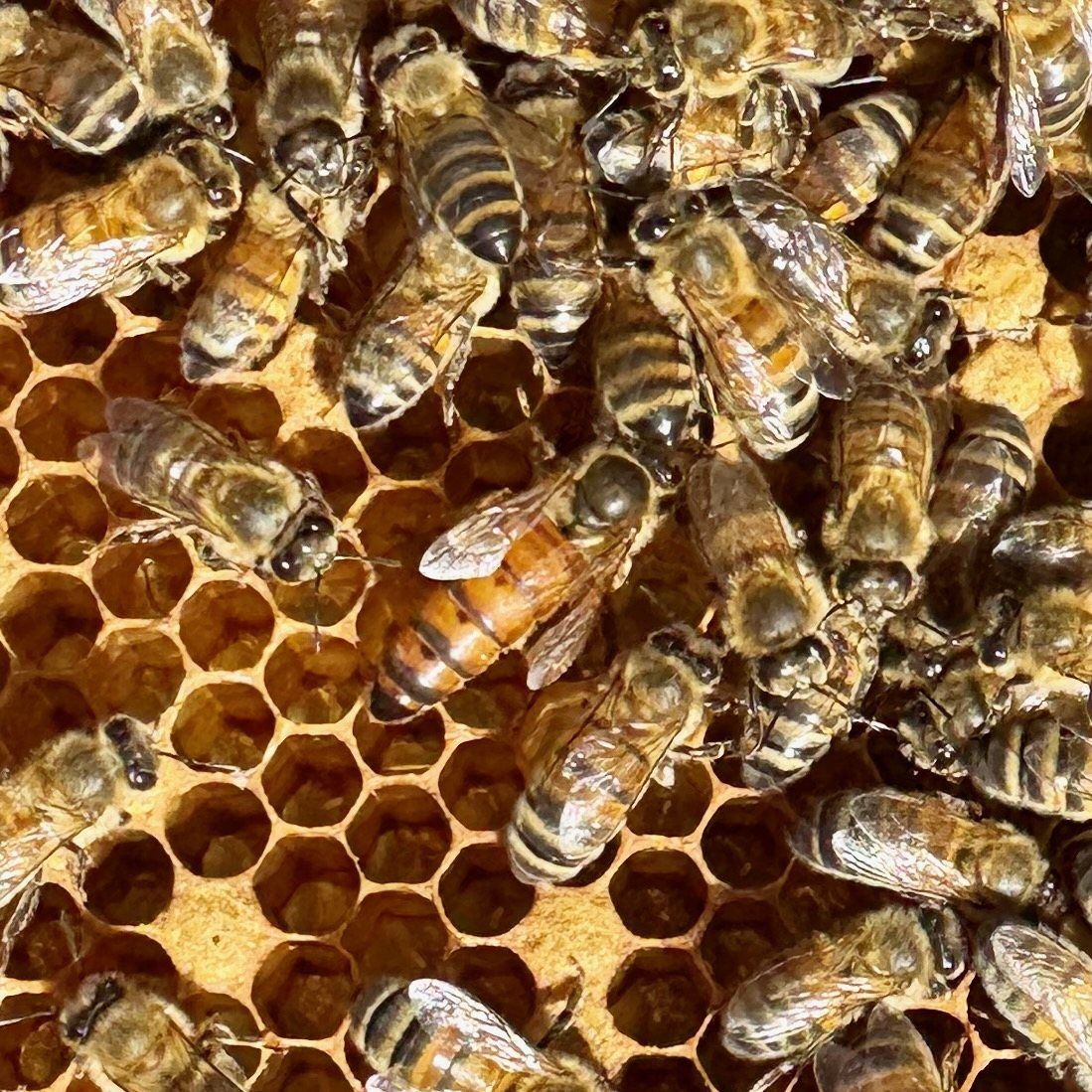
Queen marking colors
A spot of color on the thorax helps you find the queen in seconds and tells you her age. Enter a year to see its color, or pick a color to find out when a marked queen emerged.
How it is calculated
The international color code
The color follows the last figure of the year the queen emerged, on a five-year cycle. Beekeepers remember the order with “Will You Raise Good Bees?”: White, Yellow, Red, Green, Blue.
| Year ends in | Color | Years |
|---|---|---|
| 1 or 6 | white | 2026, 2031 |
| 2 or 7 | yellow | 2022, 2027 |
| 3 or 8 | red | 2023, 2028 |
| 4 or 9 | green | 2024, 2029 |
| 5 or 0 | blue | 2025, 2030 |
How to mark a queen
A single small spot on top of the thorax, with a queen marking pen or a numbered disc, never on the abdomen, head or wings. Hold her in a one-handed queen catcher, a clip or a cage, use a non-toxic queen marking pen tested first on another surface, and let the paint dry for a few minutes before releasing her on a frame. Practice on drones first: they cannot sting. Read more in our article on the queen bee, and plan a rearing season with the queen rearing calendar.
Frequently asked questions
What color is a queen bee marked this year?
A queen that emerged in 2026 is marked white. The color follows the last figure of the year on a five-year cycle: white for 1 and 6, yellow for 2 and 7, red for 3 and 8, green for 4 and 9, blue for 5 and 0.
How do I remember the queen marking colors?
The initials of White, Yellow, Red, Green and Blue give the question “Will You Raise Good Bees?”, which beekeepers use to remember the order.
Where do you put the mark on a queen?
A single small spot on top of the thorax, the part between the head and the abdomen, and nowhere else. Hold her in a one-handed queen catcher, clip or cage, and let the paint dry before releasing her.
Do I need to remark an old queen?
No. Her color tells you the year she emerged. If she is still the color of several years ago, it is a sign she may be due for replacement.
Sources
- The Basics of Queen Management in Beekeeping Operations (ENY2128, November 2025), UF/IFAS Extension, University of Florida
Calculators
Sugar water for bees calculator
How much sugar and water for 1:1 or 2:1 syrup, by weight or by volume: pounds, gallons and cups for your colonies, with fall doses from extension guides.
Open the toolFondant and sugar brick calculator for bees
Fondant for bees or no-cook sugar bricks: pounds of sugar, cups of water and candy temperatures for the batch you need, from extension service recipes.
Open the toolQueen rearing calendar
Enter your grafting or cupkit date: capping, ripe cells into mating nucs, emergence, mating and first eggs, dated day by day and ready for your calendar.
Open the toolHoney yield and price calculator
Pounds of honey per hive, 12 oz bears, 1 lb or 2 lb jars and quarts to fill, revenue at surveyed US prices or yours, and what is left after jars and sugar.
Open the toolHoney moisture content calculator
Is your honey dry enough? Check a refractometer reading against USDA Grade A (18.6%), Grade C and state standards, and work out the moisture of a blend.
Open the toolVarroa mite count calculator
Alcohol wash or sugar roll: turn your mite count into mites per 100 bees and compare it with the Honey Bee Health Coalition threshold for the colony phase.
Open the tool