Royal jelly: what it is, what the evidence shows, allergy risks and UK rules
Royal jelly explained: why bees make it, what science and UK law say about its benefits, who should avoid it due to asthma or allergy, and how to store it.
Royal jelly is a creamy white secretion that young worker bees produce from glands in their heads to feed every larva for its first days and the future queen throughout her development. For people, it is a food rich in water, proteins, sugars and an unusual fatty acid called 10-HDA, but no health benefit is recognised in UK law: every claim assessed by European food safety experts was rejected, so none was carried into the Great Britain register of authorised health claims. It can, on the other hand, trigger severe allergic reactions, especially in people with asthma or allergies.
If you are thinking of buying some, three things matter more than any promise on the box: whether you have asthma or allergies, how the product has been stored, and what the label is actually allowed to say.
What is royal jelly and why do bees make it?
A secretion from nurse bees, not something gathered outside
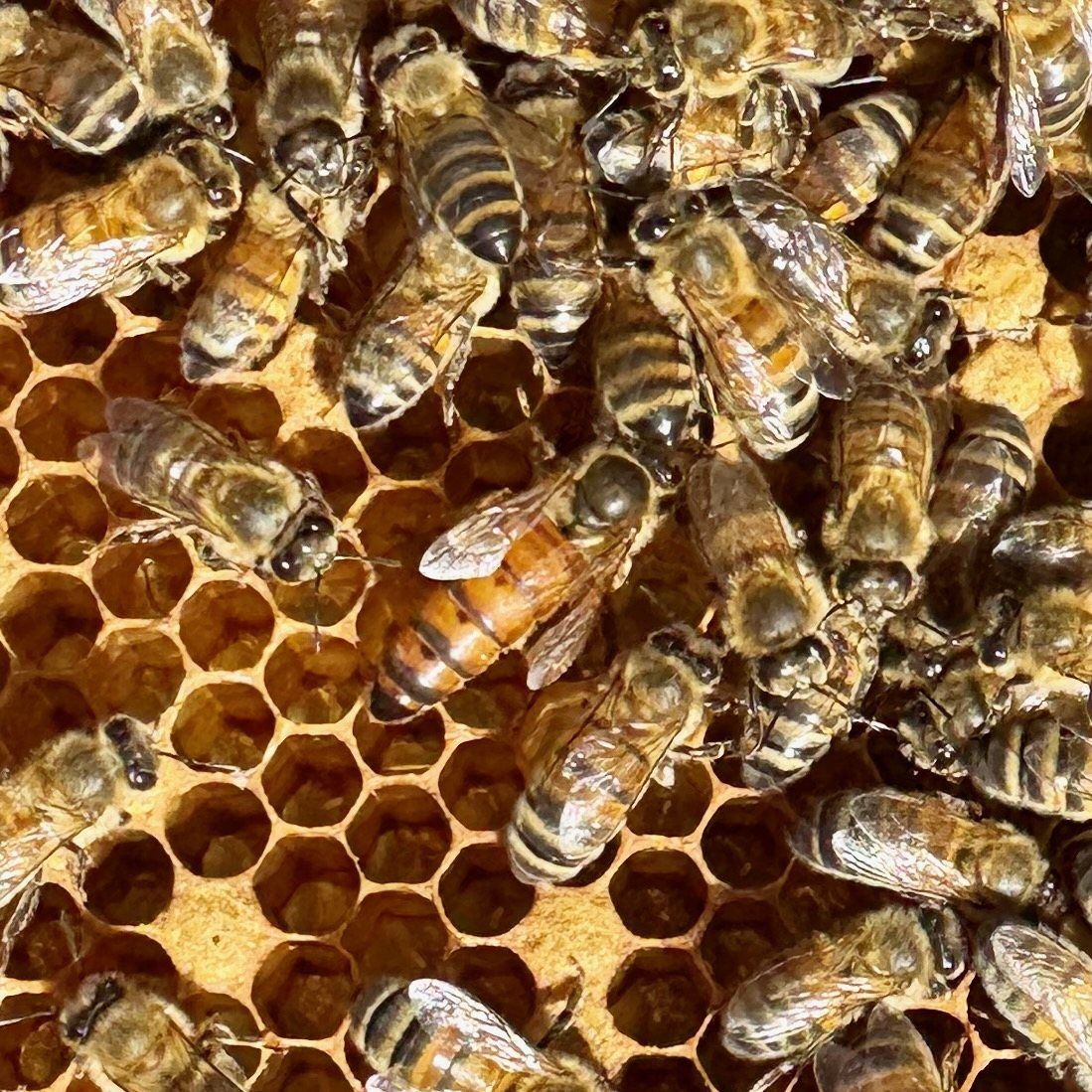
Unlike honey, pollen or propolis, royal jelly is not collected from plants. It is made inside the hive by nurse bees, young workers roughly one to two weeks old, using their hypopharyngeal and mandibular glands. You can read more about who does what in our guide to the honey bee colony.
Fresh royal jelly looks like a thick, pale cream. It tastes sharp and slightly peppery because it is acidic: the FAO gives a pH of 3.6 to 4.2 and a density of about 1.1 g/cm³, so it is a little heavier than water.
Nurse bees place it at the bottom of the cells. Every larva, whether it will become a worker, a drone or a queen, gets royal jelly for its first days. After that, the diet changes. Worker larvae move on to a food that includes honey and pollen, while a larva in a queen cell keeps receiving large amounts of jelly. That difference in feeding, not a difference in genes, is what turns a female larva into a queen bee rather than a worker.
Why it is called “royal”
The name comes from that special diet. An adult queen also goes on being fed by workers throughout her egg laying life. A queen can live for several years, while a summer worker lives a few weeks, and that contrast gave rise to the idea that royal jelly must be a kind of elixir. It is a tempting leap, but what steers the development of a bee larva tells us nothing about what a spoonful does in an adult human.
What is royal jelly made of?
The main components
Its make-up varies with the season, the strain of bee, what the colony is eating and the age of the larvae when the jelly is taken. The FAO bulletin on hive products gives these ranges:
| Component | Content | Measured on |
|---|---|---|
| Water | 57 to 70%, about two thirds | fresh jelly |
| Protein | 17 to 45% | dry matter |
| Sugars, mostly fructose and glucose | 18 to 52% | dry matter |
| Lipids | 3.5 to 19%, of which 80 to 90% are free fatty acids | dry matter |
| Minerals (ash) | 2 to 3%, about 1% of fresh weight | dry matter |
As a rule of thumb, fresh royal jelly is about two thirds water, and the remaining third is shared roughly between protein, sugars and fats.
10-HDA, the fingerprint of real royal jelly
The fatty part of royal jelly is unusual. It is made mainly of short fatty acids with 8 or 10 carbon atoms, and the main one is 10-hydroxy-2-decenoic acid, or 10-HDA. No other natural food contains it at comparable levels, which is why laboratories use it as a marker of authenticity and quality. Jelly that has been diluted, adulterated or badly stored contains less.
The international standard ISO 12824:2016 sets specifications for royal jelly. For fresh jelly it requires, among other things, at least 1.4% 10-HDA, a water content between 62 and 68.5% and a protein content between 11 and 18%. The standard is voluntary in the UK: it is a quality benchmark that serious suppliers may test against, not a legal requirement printed on every jar.
Hormones and vitamins: less than the marketing suggests
You may read that royal jelly is “packed with hormones”. The FAO reports testosterone at about 0.012 micrograms per gram of fresh jelly and points out that an adult man produces 250,000 to a million times that amount every day. At a dose of a few hundred milligrams, that is biologically irrelevant. Royal jelly does contain B vitamins, but at the amounts people take, their contribution is tiny compared with an ordinary diet.
Royal jelly benefits: what does the evidence actually show?
What European experts assessed and rejected
When the UK was part of the EU, health claims on foods were assessed by the European Food Safety Authority (EFSA). Royal jelly went through that process. In a 2011 opinion (EFSA Journal 2011;9(4):2083), EFSA’s panel on dietetic products, nutrition and allergies looked at twelve claims, which said royal jelly could, among other things:
- support the immune system and natural defences;
- improve vitality, physical and mental tone, and fight fatigue;
- support metabolism, blood vessel function or gland function;
- benefit the skin;
- ease the menopause through a hormone-like effect;
- lower cholesterol and blood fats and benefit the heart.
The conclusion was the same each time: the royal jelly in question was “not sufficiently characterised”, and no cause and effect relationship could be established with the claimed effect. In plain terms, products sold under the name royal jelly vary too much for a study on one jelly to support a general promise about all of them.
What clinical studies say
The FAO’s review of hive products concluded that “none of the claimed therapeutic or other effects of royal jelly have been proven with certainty”. Solid observations mostly concern:
- bees themselves, where its role in queen development is well established;
- laboratory tests, where 10-HDA shows antibacterial activity, about a quarter of that of penicillin against a staphylococcus according to the FAO, which adds that this activity of the fatty acids disappears once the pH rises above 5.6, as it does inside the body;
- animal studies, which cannot be transferred directly to humans.
Human trials have since looked at blood fats, menopause symptoms, weight and blood sugar. Recent reviews show how thin the evidence is:
- A 2023 meta-analysis of 10 randomised trials with 512 participants found no significant effect on body weight, body mass index or fat mass, and stressed the short duration of the trials, their differences and the poor description of the jelly used.
- A 2026 meta-analysis on menopause included 6 studies and 471 women and found better symptom scores than placebo, but that pooled result rested on only 2 studies and 312 women, with the certainty of evidence judged moderate by the authors.
- Memorial Sloan Kettering Cancer Center’s integrative medicine service, which reviews supplements for patients, describes the evidence on cholesterol as very limited and notes that a meta-analysis found no improvement in blood glucose in people with diabetes.
These trials are generally small and short, and they use jellies of different composition, which makes them hard to compare or add together. That is exactly the problem EFSA identified. None of them is enough to recommend royal jelly to prevent or treat anything.
What you can honestly say
Royal jelly is a rare food that genuinely interests researchers. If you enjoy taking it, know the risks and have none of the conditions listed below, nothing stops you. But it is not a substitute for a varied diet, for treatment, or for seeing your GP about persistent tiredness. The same reasoning applies to other hive products, as we explain in our guide to the health benefits of honey.
Royal jelly side effects: who should avoid it?
The allergy risk is real and documented
This is the most important part of this page. Royal jelly contains bee proteins, and one of them, major royal jelly protein 3, has been identified as a main allergen. The medical literature reviewed by Memorial Sloan Kettering includes:
- reports of acute asthma in Australian and New Zealand medical journals in the 1990s: Thien and colleagues in the Medical Journal of Australia in 1993, a 1994 report in the same journal by Bullock and colleagues titled “Fatal royal jelly-induced asthma”, and Harwood and colleagues in the New Zealand Medical Journal in 1996;
- several case reports of anaphylaxis after taking royal jelly, published between 2006 and 2021;
- a case of haemorrhagic colitis, bleeding inflammation of the bowel, reported in 1997.
The most recent of those anaphylaxis reports, published in 2021, describes a 56-year-old woman in China who twice developed hives, swelling of the larynx, chest tightness and a collapse in blood pressure within an hour of taking royal jelly. Laboratory tests pointed to major royal jelly protein 3 as the culprit.
The FAO also cites a 1983 Japanese study in which 2 of 10 patients patch-tested showed allergic contact dermatitis. Reviewing these data in 2018 after reports to its own vigilance scheme, France’s food safety agency ANSES cited a 1997 survey of 1,472 hospital workers in Hong Kong: 9 of them, about 0.6%, reported reactions after consuming royal jelly, ranging from hives and eczema to runny nose and breathing problems. It also noted that royal jelly may contain pollen without the label saying so.
In Australia and New Zealand, the risk is taken seriously enough that foods containing royal jelly must carry a mandatory warning: “This product contains royal jelly which has been reported to cause severe allergic reactions and, in rare cases, fatalities, especially in asthma and allergy sufferers.” There is no equivalent compulsory wording in UK law, so do not take the absence of a warning on a British label as a sign of safety.
Who should not take it
| Your situation | What to do |
|---|---|
| Asthma | Avoid royal jelly |
| Hay fever or pollen allergy | Avoid: pollen allergy is a known risk factor for reactions to hive products |
| Eczema or other atopic conditions, several allergies | Avoid |
| Allergy to bee stings, honey, pollen or propolis | Avoid |
| Taking warfarin or another blood thinner | Ask your GP or pharmacist first: a case of raised INR and bleeding has been linked to royal jelly |
| Past or current hormone sensitive (oestrogen receptor positive) breast cancer | Avoid unless your oncology team agrees: laboratory studies show oestrogen-like activity |
| Pregnant or breastfeeding, or for a child | No safety data: ask your GP, midwife or pharmacist first |
Sensible precautions
- If you have never taken it, start with a tiny amount for a few days before taking a full dose, as the FAO recommends for any potentially allergenic substance.
- Stop at once if you notice itching, a rash, swollen lips, a tight chest or wheezing.
- If someone has difficulty breathing, swelling of the throat or tongue, or feels faint, call 999 and say you think it is anaphylaxis. If they carry an adrenaline auto-injector, use it, and use a second one after 5 minutes if there is no improvement, as the NHS advises. They should lie down with their legs raised, or sit up slowly if breathing is hard, and not stand or walk.
- Never exceed the dose on the label, and avoid long or repeated courses without medical advice.
- Read the full ingredient list of “energy” or “vitality” blends: royal jelly is often combined with pollen or propolis, which adds to the allergy risk.
If you think a supplement has made you ill, tell your GP or pharmacist, who can record and report the reaction.
What can a royal jelly label legally claim in the UK?
Health claims: the Great Britain register
In Great Britain, nutrition and health claims on food, including food supplements, are governed by Regulation (EC) No 1924/2006 as it stands in UK law after Brexit (assimilated law). Under Article 10, health claims are prohibited unless they are authorised. The Department of Health and Social Care keeps the Great Britain nutrition and health claims register, which covers England, Scotland and Wales and states plainly: “Only authorised claims in the Great Britain NHC register may be used in Great Britain.” The register lists rejected claims as well as authorised ones.
No royal jelly health claim was authorised before the UK left the EU, because EFSA’s assessment was negative, so none entered the Great Britain register as an authorised claim. A new claim would need its own application and scientific assessment in Great Britain, and could be used only once listed as authorised. In Northern Ireland, EU food law on supplements continues to apply under the Windsor Framework, and the EU position on royal jelly is the same: no authorised claim.
Article 10(3) adds a subtle but important rule: a reference to a general, non-specific benefit for overall health or wellbeing is only allowed if it is accompanied by a specific authorised health claim. That is why you will often see a “vitality” royal jelly supplement that also contains added vitamins. The legal claim, for example about tiredness and fatigue, belongs to the vitamin, not to the royal jelly.
So a royal jelly product sold in the UK should not say that it:
- “boosts immunity” or “strengthens your defences”;
- “fights fatigue” thanks to the royal jelly itself;
- “balances hormones” or “relieves menopause symptoms”;
- “lowers cholesterol”;
- “rejuvenates the skin from within”.
Food supplement or medicine?
Most royal jelly capsules, vials and jars are sold as food supplements. The Food Standards Agency explains that supplements fall under the Food Supplements (England) Regulations 2003 and their equivalents: the Food Supplements (Scotland) Regulations 2003, the Food Supplements (Wales) Regulations 2003 and the Food Supplements Regulations (Northern Ireland) 2003. A supplement does not need a licence or pre-market approval. The business must register with its local authority and is responsible for the product’s safety. The label must include, among other things:
- the words “food supplement”;
- the recommended daily dose and a warning not to exceed it;
- a statement that supplements should not replace a varied diet;
- a warning to keep the product out of reach of young children;
- the amount of each substance with a nutritional or physiological effect;
- a full ingredient list, with allergens emphasised.
The FSA is clear that supplements are not medicines and are not intended to treat or prevent disease. If a product is presented as preventing or treating a disease, it can fall under medicines law instead. The Medicines and Healthcare products Regulatory Agency (MHRA) decides whether a product is a medicinal product, looking at its claims, labelling, marketing and ingredients, and it acts on complaints. A royal jelly product sold as a cure for arthritis, infertility or asthma would therefore be breaking the rules twice over. Misleading food labels can be reported to your local Trading Standards service.
Origin on the label
Under Article 26 of the food information regulation (Regulation (EU) No 1169/2011 as kept in UK law), the country of origin is compulsory only where leaving it out could mislead the buyer about the product’s true origin. Many jars and capsules therefore give only the name and UK address of the company, not where the jelly was harvested. If a label does state an origin, for example “Product of the UK”, and the jelly came from somewhere else, Article 26(3) requires the label to give the jelly’s origin too, or to say that it comes from a different country.
Most of the world’s royal jelly comes from China. In the 1990s the FAO put Chinese output at 400 to 500 tonnes a year, around 60% of the world total; a 2023 review in the journal Molecules gives about 3,500 tonnes a year, more than 90% of world production. If origin matters to you, ask the seller directly where the jelly was produced.
How is royal jelly produced?
Commercial production uses the same skills as queen rearing, with one twist: the beekeeper empties the queen cells before the queens can develop.
The principle: raise queens, then harvest early
A colony that feels queenless, or a part of the hive separated from the queen, starts rearing new queens and fills their cells with jelly. The producer uses that reflex. Dozens of artificial queen cups are each given a very young larva, the nurse bees provision them for three days, and the jelly is removed before the larva has eaten it.
The steps of one cycle
- Build very strong colonies. Only populous colonies, rich in young nurse bees and well stocked with pollen and honey, produce well. Making jelly costs the colony a lot of food.
- Get larvae of the right age. Grafted larvae should be less than about 24 hours old.
- Graft. In a warm, humid room, each larva is lifted with a grafting tool into a plastic or wax cup fixed to a bar on a frame. A drop of diluted royal jelly in the cup can improve acceptance.
- Insert the frame. It goes into a queenless colony, or into a part of the hive kept away from the queen by a queen excluder, next to open brood that attracts nurse bees.
- Wait three days. The FAO places harvest three days after grafting, when the larvae are about four days old.
- Harvest. The bees are brushed off, the tops of the cells cut away, each larva removed with tweezers, and the jelly sucked out with a small vacuum pump or scooped with a spatula.
- Chill at once. The jelly goes into dark glass containers and into the fridge straight away, out of sunlight.
- Graft again. The producer usually grafts a new batch the same day for the next cycle.
The French researcher Maurice Vuillaume described this rhythm as early as 1958: harvest three days after grafting, with a second series of cells grafted at the same time.
Yields: why royal jelly is scarce
| Benchmark | Figure | Source |
|---|---|---|
| Jelly per well accepted cell | at least 200 mg, 250 mg for retail cell packs | FAO |
| Cycle | about every 3 days | FAO, Vuillaume |
| Output of one well managed hive | about 500 g over a season of 5 to 6 months | FAO |
A 20 g jar therefore represents the contents of around 80 to 100 queen cells, each grafted by hand, larva by larva. A whole season from one hive gives about half a kilo.
In the UK, the main limit is the climate. Production needs strong colonies, plenty of brood and a steady supply of nectar and pollen, which a British beekeeper can only count on for a few months in late spring and summer, and the June gap or a wet spell quickly reduces acceptance. That is one reason why commercial royal jelly is mostly produced in warmer countries. A hobby beekeeper who learns grafting for queen rearing has the core skill, but turning it into a saleable product also means registering as a food business with the local authority and keeping a strict cold chain.
How do you store royal jelly?
The basic rules
Fresh royal jelly is fragile. It oxidises in air and deteriorates with light and heat. The FAO describes refrigeration at 0 to 5°C as a minimum precaution.
| How it is kept | Temperature | Indicative duration | Source |
|---|---|---|---|
| Fresh, in the fridge | 0 to 5°C | about 18 months from production | FAO |
| Frozen, bulk jelly before packing | minus 17°C or colder | up to 24 months | FAO |
| After thawing and packing | fridge | no more than 12 months | FAO |
| Freeze-dried powder | room temperature, dry | longer, but cool storage still recommended | FAO |
Retail advice is usually more cautious. One UK seller of fresh jelly, for example, advises keeping its jar refrigerated and using it within six months, or freezing it, and finishing it within 21 days of opening.
At home
- Put the jar in the fridge as soon as you get home, on a shelf rather than in the door, where the temperature swings.
- Keep it closed in its original dark glass jar.
- Take each dose with a clean, dry spoon, usually the small one supplied, and close the lid straight away.
- Respect the date on the jar and the seller’s advice after opening.
Jelly that has turned distinctly yellow or grainy, smells rancid or tastes very bitter has gone off. Do not eat it.
A jar labelled “fresh” should be sold from a chiller cabinet or shipped chilled. If a shop keeps fresh royal jelly on an ordinary shelf, choose another product.
Royal jelly dosage: how much and for how long?
No dose has been validated
Since no effect has been proven, there is no “effective” dose. The figures in circulation come from tradition and from manufacturers:
- the FAO notes that commercial preparations are usually designed to provide the equivalent of 200 to 300 mg of fresh jelly per dose;
- it also describes traditional use of 200 to 500 mg a day for one to two months, while stressing that the claimed effects are not proven;
- some supplements go much higher, and many are labelled in “fresh weight equivalent” rather than in grams of powder, which makes the dose look larger.
Fresh, freeze-dried, vials and honey blends
| Form | What it is | Equivalence | Storage |
|---|---|---|---|
| Fresh, in a jar | raw jelly as harvested | reference | fridge, 0 to 5°C |
| Freeze-dried (powder, capsules, tablets) | jelly dried at low temperature | about 1 g for 3 g fresh | dry, room temperature |
| Drinkable vials | diluted jelly, often freeze-dried, with honey, vitamins or plants | varies: read the label | as directed |
| Honey with royal jelly | a blend, usually a small proportion of jelly | 100 to 300 mg per teaspoon in FAO examples | room temperature |
The FAO gives 166 mg of freeze-dried jelly as the equivalent of 500 mg fresh, which is where the one to three ratio comes from. When you compare two products, always convert to fresh weight. A capsule containing 333 mg of powder is roughly 1,000 mg fresh equivalent; one containing 1,000 mg “fresh equivalent” may hold only about a third of a gram of powder.
If you decide to take it
- Check first that none of the warnings above applies to you.
- Start with the tip of a spoon for three or four days.
- Tradition says to let it melt under the tongue in the morning before eating. Nothing shows this matters, but it does no harm. The sharp, peppery taste surprises people, so you can mix it with a spoonful of honey as you take it.
- Keep courses short, a few weeks, rather than taking it all year round.
- Stop at the first sign of a reaction and speak to a pharmacist or GP.
At 500 mg a day, a 20 g jar lasts about 40 days.
Royal jelly prices in the UK: why do they vary so much?
Prices vary enormously, and the differences come almost entirely from the form, the concentration and the origin. In October 2026, one London pharmacy listed a 21 g jar of fresh royal jelly at £115, more than £5 a gram. At the other end, a UK online health retailer listed 30 capsules, each “equivalent to 500mg of Royal Jelly”, at £12.29, or about 82p per gram of equivalent jelly. That page did not say whether the 500 mg meant fresh weight or powder, nor where the jelly came from, and it carried no asthma or allergy warning. Honey blends contain only a few per cent of jelly.
To compare honestly, always work out:
- the price per gram of fresh jelly or fresh weight equivalent, not per jar or per box;
- the form: a vial is mostly water or honey, a capsule is dried powder;
- the storage: fresh jelly sold outside the cold chain has lost part of what you are paying for;
- the origin: whether the label says where the jelly was harvested, not just where it was packed.
For historical context, the FAO reported an international wholesale price of 50 to 80 US dollars per kilogram in the early 1990s, mainly for Chinese jelly. Those large Asian volumes are why mass market capsules can be cheap, while small batch fresh jelly is very expensive.
Royal jelly, honey, pollen and propolis: how do they compare?
Royal jelly is often sold alongside honey, bee pollen and propolis in “wellness” ranges. These products have different origins and compositions, but they share two things in the UK: none has an authorised health claim of its own, and all can trigger allergies, particularly in people allergic to pollen. Honey also carries a specific risk for babies, infant botulism, so no honey for children under 12 months.
| Product | Made from | Main point to know |
|---|---|---|
| Honey | nectar or honeydew, processed by bees | mostly sugars; never for babies under 1 |
| Bee pollen | pollen pellets collected by foragers | strong allergy risk for hay fever sufferers |
| Propolis | plant resins mixed with wax | contact allergy is well documented |
| Royal jelly | gland secretion of nurse bees | asthma and anaphylaxis risk; keep chilled |
To understand how this jelly turns an ordinary larva into an egg layer, see our pages on the queen bee and, for beekeepers, queen rearing. You will find our other guides to propolis, pollen and wax in the hive products section.
Frequently asked questions
What are the proven benefits of royal jelly?
None that the law recognises. In 2011 the European Food Safety Authority assessed claims about immunity, vitality, cholesterol, skin and menopause and could not establish a cause and effect for any of them, so none was carried into the Great Britain register of authorised claims. Small trials on menopause symptoms look promising, but the evidence is still limited and the products tested vary widely.
Is royal jelly safe?
For most people a small amount is unlikely to cause harm, but it is not risk free. Royal jelly has caused severe asthma attacks, anaphylaxis and at least one reported death, mainly in people with asthma or allergies. Avoid it if you have asthma, hay fever, eczema or a bee product allergy, and talk to your GP or pharmacist first if you are pregnant, breastfeeding or take warfarin.
Who should not take royal jelly?
People with asthma, pollen allergy or hay fever, eczema or other atopic conditions, and anyone allergic to bee stings, honey, pollen or propolis. Ask your GP or pharmacist first if you take warfarin or other blood thinners, have had hormone sensitive breast cancer, are pregnant or breastfeeding, or want to give it to a child. Stop at once if you notice itching, rash or wheezing.
How should I store fresh royal jelly?
In the fridge, at 0 to 5°C, in its closed dark glass jar, away from light and air. FAO guidance gives around 18 months refrigerated from production, and up to 24 months frozen at minus 17°C or below for bulk jelly. Once opened, follow the seller's instructions: one UK seller advises using its jar within 21 days. Always use a clean, dry spoon.
How much royal jelly should I take a day?
There is no scientifically validated dose because no benefit has been proven. Traditional use described by the FAO is 200 to 500 mg of fresh jelly a day for one to two months, and many supplements provide the equivalent of 200 to 300 mg of fresh jelly per dose. Never exceed the dose on the label, and start with a tiny amount for a few days.
Is freeze-dried royal jelly as good as fresh?
It is the same substance with the water removed. About 166 mg of freeze-dried jelly corresponds to 500 mg of fresh jelly, so roughly one part powder for three parts fresh. Freeze-dried capsules are easier to store and carry, but check whether the label gives the amount of powder or the fresh weight equivalent before comparing products.
Does royal jelly help with menopause?
Possibly a little, but it is not proven. A 2026 meta-analysis found better menopause symptom scores than placebo, but that result rested on only two trials with 312 women. Royal jelly cannot be sold in the UK with a menopause claim. If symptoms affect your life, the NHS offers effective treatments, so speak to your GP before spending money on supplements.
Why is fresh royal jelly so expensive?
Because it is made in tiny quantities and by hand. Each queen cell holds only about 200 to 250 mg, every larva has to be grafted individually, and a well managed hive gives roughly 500 g over a whole season. Fresh jelly also has to stay chilled from the hive to your fridge. Prices for small jars in UK shops can exceed £5 a gram.
Sources
- Value-added products from beekeeping, chapter 6: Royal jelly (sections 6.1 to 6.7), FAO, R. Krell, Agricultural Services Bulletin 124
- Value-added products from beekeeping, chapter 6: Royal jelly (sections 6.8 to 6.11), FAO, R. Krell, Agricultural Services Bulletin 124
- Scientific Opinion on the substantiation of health claims related to various food(s)/food constituent(s) not sufficiently characterised, including royal jelly (ID 1225 to 1228, 1230, 1231, 1326, 1328, 1329, 1982, 4696, 4697), pursuant to Article 13(1) of Regulation (EC) No 1924/2006, EFSA Journal 2011;9(4):2083, European Food Safety Authority, NDA Panel
- Great Britain nutrition and health claims (NHC) register, Department of Health and Social Care
- Regulation (EC) No 1924/2006 on nutrition and health claims made on foods, Article 10 (UK revised text), legislation.gov.uk, The National Archives
- Food supplements: guidance for businesses, Food Standards Agency
- Borderline products: how to tell if your product is a medicine, Medicines and Healthcare products Regulatory Agency (MHRA)
- Royal Jelly: integrative medicine monograph (adverse reactions, interactions, clinical evidence), Memorial Sloan Kettering Cancer Center
- Opinion on the risk of allergy related to the consumption of food supplements containing pollen or hive products (request 2017-SA-0215), ANSES, French Agency for Food, Environmental and Occupational Health and Safety
- Warning and advisory statements (mandatory royal jelly warning under the Australia New Zealand Food Standards Code), NSW Food Authority
- The effects of royal jelly supplementation on anthropometric indices: a GRADE-assessed systematic review and dose-response meta-analysis of randomized controlled trials (Frontiers in Nutrition, 2023), M. Vajdi et al., Frontiers in Nutrition
- Royal jelly for management of postmenopausal symptoms: a systematic review and meta-analysis (Menopause, 2026;33(4):501-509), S. Dagostin Ferraz et al., PubMed
- ISO 12824:2016 Royal jelly, Specifications (official preview, table of physical and chemical requirements), ISO, preview distributed by SIST
- Techniques d'élevage des reines. I. Le premier stade : élevage des cellules royales (Annales de l'Abeille, 1958), M. Vuillaume, Apidologie archive
- Truherb Fresh Royal Jelly 21g (product page, price and storage advice), John Bell & Croyden
- Bumbles Royal Gelee 500mg, 30 capsules (product page, price and label wording), Victoria Health
- A case of anaphylaxis caused by major royal jelly protein 3 of royal jelly and its cross-reactivity with honeycomb (Journal of Asthma and Allergy, 2021;14:1555-1557), J.D. Li et al., Dove Medical Press
- Anaphylaxis: what to do, NHS
- Regulation (EU) No 1169/2011 on the provision of food information to consumers, Article 26: country of origin (UK revised text), legislation.gov.uk, The National Archives
- Current status of the bioactive properties of royal jelly: a comprehensive review (Molecules, 2023;28(3):1510), S. Botezan et al., MDPI