Overwintering bees: how to prepare a UK colony for winter, step by step
Overwintering bees in the UK: varroa in August, 20 kg of stores, fondant, mouse guards, woodpecker netting, ventilation, insulation, hefting and winter checks.
Overwintering bees in the UK comes down to four things done in order: control varroa as soon as the honey comes off in August so that healthy winter bees are reared, make sure each colony has about 20 kg of stores by the end of September, then close the hive against mice, woodpeckers and wind in October and keep it dry rather than warm. From November to February the beekeeper mostly stays out of the hive, hefts it every other week, and adds fondant only if it feels light. A strong, queenright, low-mite colony on enough honey rarely dies of cold in a British winter; it dies of varroa, starvation, damp or queen failure.
This guide follows that sequence for a single-brood National hive in lowland England, using National Bee Unit (NBU) fact sheets, Veterinary Medicines Directorate (VMD) product information and association advice as they stand in November 2026, and explains how to shift the dates for Wales, northern England and Scotland. For the rest of the year, see the beekeeping calendar.
How do honey bees survive the winter?
A honey bee colony does not hibernate. It survives on two adaptations: a different kind of worker, and the winter cluster.
Winter bees
Workers reared in summer live about five to six weeks. Workers reared from late August onwards, often called winter bees or diutinus bees, do little brood rearing or foraging, store more protein and fat in their fat bodies, carry high levels of the storage protein vitellogenin, and can live for up to six months. They carry the colony from autumn to the first spring brood. The review by Döke, Frazier and Grozinger (2015) sets out this winter-bee physiology and the thermoregulating cluster, and the management factors, among them nutrition and parasites, that bear on whether a colony survives. Bees damaged while they are being reared, by varroa and the viruses it spreads or by a shortage of pollen, do not live long enough to see the colony through.
That is why winter preparation starts in August, not in November. A colony that rears its winter bees under a heavy mite load goes into November looking strong and collapses in January or February.
The winter cluster
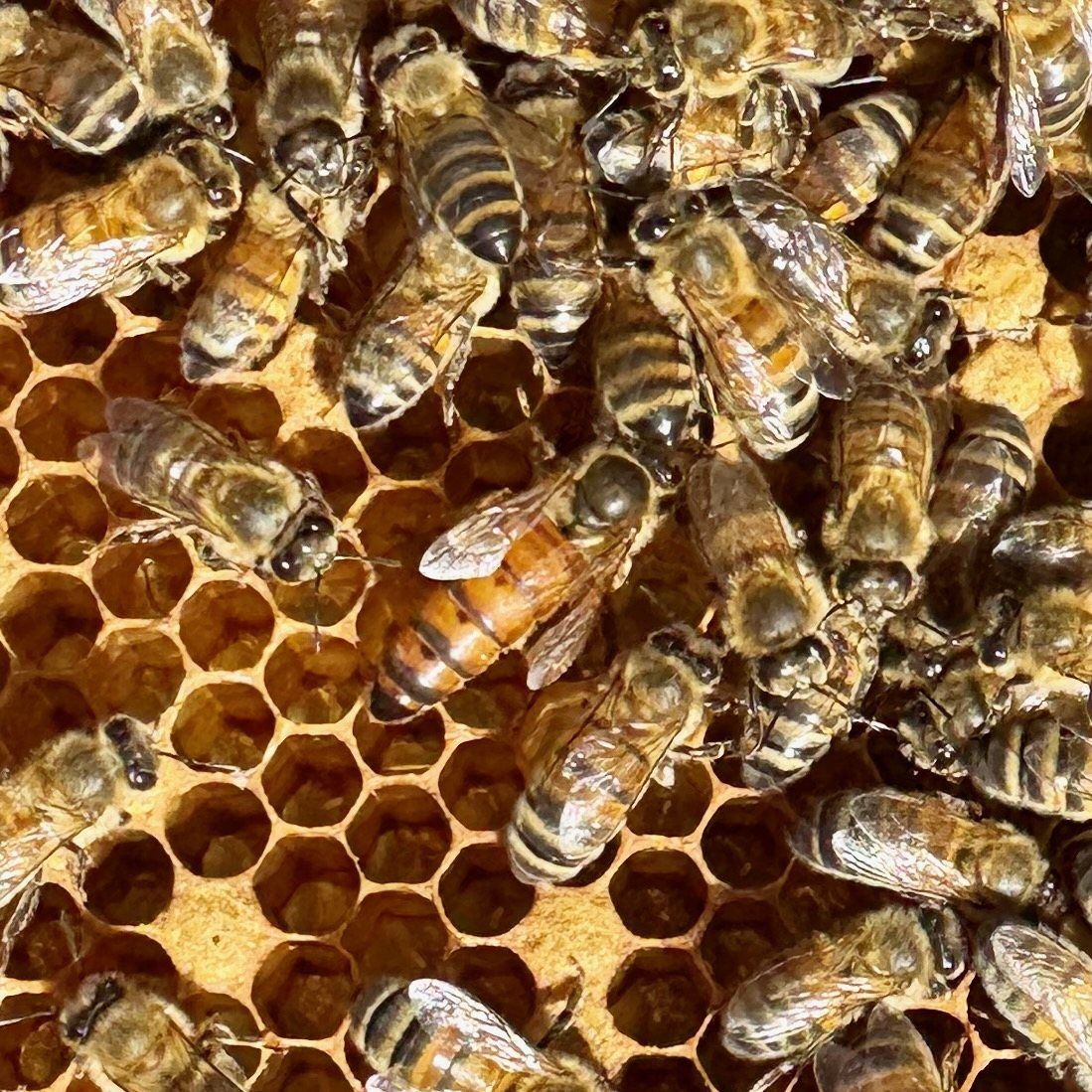
When the air around the hive cools to about 14°C, bees begin to draw together on the combs; in colder weather they form a tight cluster over and around empty cells and the stores at its edge. The outer layer of bees, the mantle, packs close to reduce heat loss and stays above about 8 to 10°C, below which bees become too chilled to move. Bees inside generate heat by shivering their flight muscles without moving their wings. When the colony is rearing brood, the brood nest at the centre is held at about 34 to 35°C; when it is broodless, the core can drop to around 20°C, which saves honey.
The cluster moves slowly upwards and sideways through the stores over the winter. It cannot cross a gap of empty comb in a cold spell, so a colony can starve with honey a few frames away. This is why the NBU advises checking in autumn that stores are next to the cluster, and if not, moving combs of honey beside it or placing fondant over it.
Clustering is not a comfortable resting state. Derek Mitchell, at the University of Leeds, argues in a 2023 paper in the Journal of the Royal Society Interface that the cluster is a survival response to cold stress, and that poorly insulated hives force colonies into it more often than a natural nest would.
When should you prepare bees for winter in the UK?
The UK’s maritime climate gives mild, damp winters with short cold spells and frequent mild days, rather than a long hard freeze. The season’s length, though, varies widely between the Channel coast and the Highlands. Use the colony and the local flowers as your clock: the end of the main flow, the first ivy, the first frosts.
| Job | Southern and central England | Wales, northern England, uplands | Scotland, and colonies back from the heather |
|---|---|---|---|
| Honey off, main varroa treatment on | Early to mid-August | Mid to late August | Late August to mid-September, after the heather |
| Post-treatment varroa count | September | September | September to October |
| Feeding to target weight | September | September | Late August to September, before it turns cold |
| Unite weak colonies, requeen | September | September | Late August to September |
| Entrance reduced, mouse guard on | Late September to October | September to October | September |
| Woodpecker netting, roofs strapped | October | October | September to October |
| Broodless oxalic acid window | December to early January | December to early January | December, sooner after an early hard frost |
| Fondant if light | January to March | January to March | February to April |
These are typical ranges. A frost hollow can run two weeks behind a south-facing slope nearby, colonies in sheltered coastal or urban apiaries may keep a small patch of brood all winter, and colonies that worked Himalayan balsam or heather go into winter later. Your local association’s apiary meetings are a good guide to your own district’s timing.
Is the colony strong enough to overwinter?
Colony size and queen
The NBU’s winter fact sheet says colonies with fewer than about 9,000 bees have a poor chance of surviving the winter, notes that some sources recommend 18,000 to 20,000, and advises at least five brood frames covered with bees. At the last full inspection in September, check:
- Bees: at least five National brood frames well covered on a cool morning;
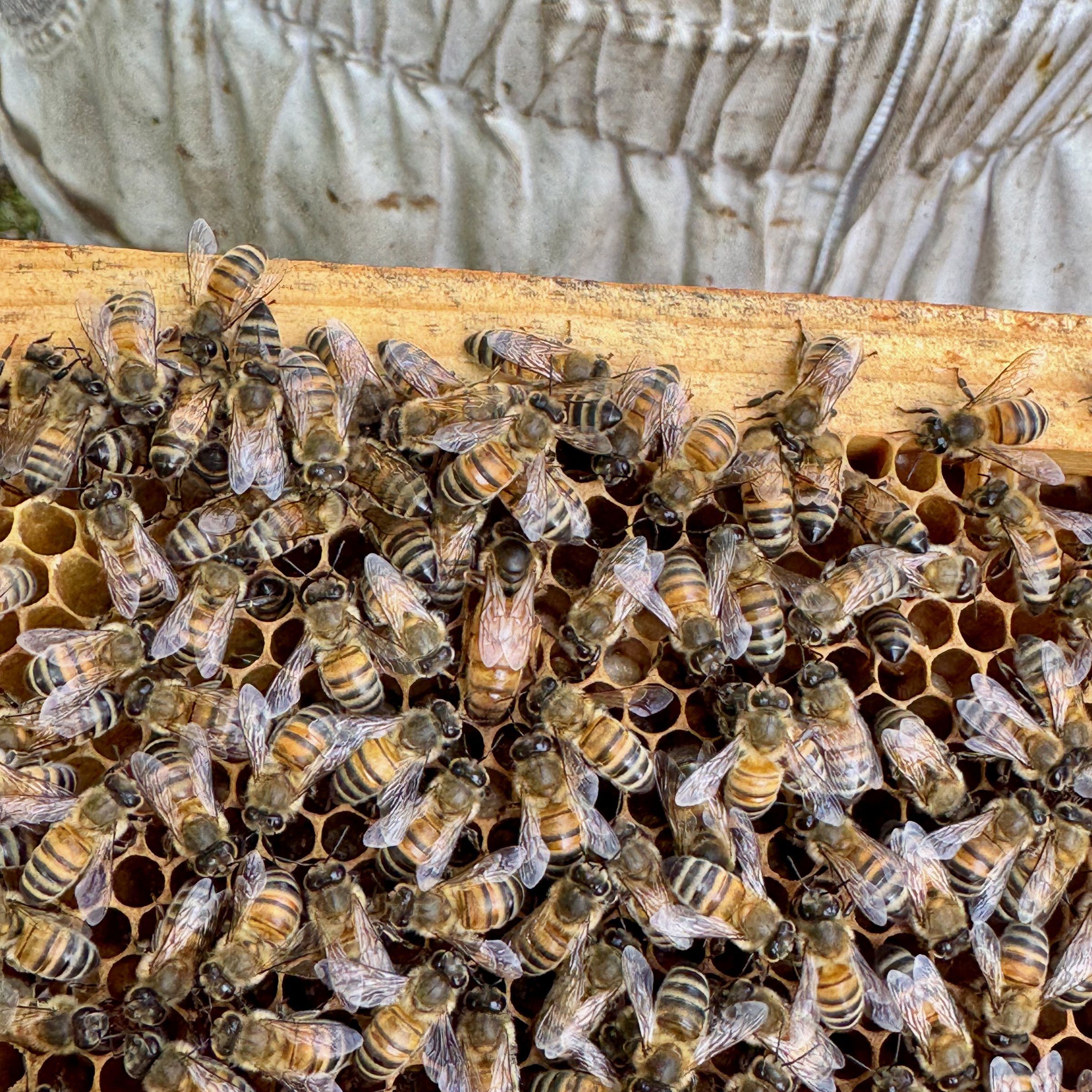
- Queen: present, laying a compact pattern, ideally not over two or three years old;
- Brood: healthy, with no signs of foulbrood, deformed wings or other disease;
- Stores: the frames on either side of and above the brood nest full and capped.
Unite rather than nurse
A small or queenless colony in September is better united to a strong one than coaxed through the winter, since it is unlikely to survive and can be robbed out, spreading mites and disease. The NBU advises combining a colony below the minimum size with another one, provided both are free of disease. The usual method is the newspaper unite: remove the poorer queen, place a sheet of newspaper with a few slits over the strong colony’s brood box, and set the weak box on top. The bees chew through within a day or two. Ideally, unite colonies that have both been treated for varroa.
Volume and hive configuration
A National brood box holds 11 British Standard frames plus a dummy board. Most colonies winter well in a single brood box with a super of stores, either above the queen excluder (with the excluder removed, so the queen is not stranded below as the cluster moves up) or below the brood box. A colony run on brood and a half or on 14 x 12 frames usually winters with its stores in the upper box. Remove empty supers in autumn: a hive with too much empty space is harder for the bees to defend against damp, robbers and wax moth. Stored drawn comb should be kept where wax moth cannot reach it; see our page on wax moth. For box and frame dimensions, see our guide to the National hive.
Why is varroa control the first winter job?
Varroa is the commonest single reason for colonies to die over winter in the UK. Mites feed on developing bees and spread deformed wing virus, and the bees most damaged are the winter bees reared in late August and September. The NBU’s Managing Varroa booklet notes that mite numbers double about every four weeks, that late summer is a particularly important time to treat, and that winter bees develop in the crucial period of early September, so mites must be under control before then. A colony that goes into the autumn with several thousand mites can still look busy in October and be gone by February.
Treat in August
The NBU’s winter fact sheet places the main varroa treatment normally in early to mid-August, as soon as the supers come off, or after late forage such as heather and Himalayan balsam. Treat every colony in the apiary at the same time, with a product authorised by the VMD, following its label. Most UK varroa medicines must not be used with honey supers on the hive.
Check the treatment worked
Count the natural mite drop on a clean tray after treatment. The NBU’s estimation method multiplies the average daily natural drop by a seasonal factor to give the colony’s mite population. Above about 1,000 mites, it advises that colonies are at risk of damage and further control is needed. From November to February, when there is little brood, the NBU factor is 400, so an average drop of only 2 or 3 mites a day already indicates a colony near that threshold. For the other months and methods, see our varroa guide.
Winter oxalic acid
Most colonies in lowland Britain have little or no sealed brood for a few weeks around December; the University of Sussex Laboratory of Apiculture and Social Insects (LASI), which ran its oxalic acid trials in Sussex, names December as the month with least brood. That is the best time to use oxalic acid, which reaches mites on adult bees but not mites under cappings. The NBU’s Managing Varroa booklet lists oxalic acid for winter and broodless periods at outside temperatures above 3°C. For Api-Bioxal powder, the VMD summary of product characteristics (SPC) gives:
| Method | Dose | Limits in the SPC |
|---|---|---|
| Trickling | 4.4% solution in sugar syrup (31 g sachet in 500 ml of 1:1 syrup, enough for about 10 hives); 5 ml per seam of bees, up to 50 ml per colony | No more than two trickle treatments a year |
| Sublimation (vaporising) | 2.0 g per colony | Once a year |
Treat without supers and outside a honey flow. Other authorised oxalic products, such as Oxybee, Dany’s BienenWohl, Oxuvar and Varroxal, have their own concentrations and doses. Our page on oxalic acid treatment compares them and explains how to check that a colony is broodless.
Whatever you use, record it. VMD guidance requires keepers of food-producing animals, which includes honey bees, to keep records of every medicine bought and given, and to keep them for at least five years.
How much honey do bees need for winter, and when should you feed?
The 20 kg target
The NBU recommends that each colony has about 20 kg of stores in autumn; its sugar-feeding guideline gives a range of 18 to 22 kg, and more for large colonies headed by prolific queens. As a guide for National equipment:
| Frame or box | Approximate weight of honey when full |
|---|---|
| British Standard brood frame (14 x 8½ in) | 2.3 kg |
| British Standard shallow (super) frame | 1.2 kg |
| National super, full | at least 12 kg |
A full super plus three full brood frames of honey therefore reaches the target.
Judging weight by hefting
You cannot look at every frame in October, so learn to judge stores by weight. Hefting means lifting the hive a few centimetres by the floor, from each side in turn as the NBU suggests, and feeling how heavy it is. It takes practice: heft a hive whose stores you have just checked so you know what “heavy enough” feels like for your equipment. Some beekeepers hang a luggage scale from the floor at the back and the front and add the two readings to get an estimate of the total.
Feed thick syrup in September
If a colony is short, feed thick syrup: the NBU’s recipe is 1 kg of white granulated sugar dissolved in 630 ml of water. September is a good month in most of the UK. Feed earlier and the bees use it to rear more brood; feed later and they cannot evaporate and cap it before the cold. A rapid feeder over the crown board holds up to 10 litres and suits autumn feeding, and feeding in the evening limits robbing. The NBU warns against brown or raw sugars, which cause dysentery, and against honey of unknown origin, which can carry American or European foulbrood spores. Ready-made invert syrups are an alternative and need no mixing.
Ivy flowers from September to November and is a major late source of pollen and nectar. In the Sussex study by Garbuzov and Ratnieks, about 89% of the pollen loads honey bees collected in autumn came from ivy. It can add weight in a mild autumn, but ivy honey crystallises hard in the comb and colonies cannot always use it in a cold spell, so do not count on it to reach the target.
Fondant for winter emergencies
The NBU says to feed fondant if there is not enough honey by the end of October, and not to feed syrup in cold weather, because the bees cannot process it. If a hive feels light, place a block of bee fondant over the feed hole in the crown board or directly on the top bars above the cluster, with a cut in the wrapping so the bees can reach it, and add an eke or empty super to make room under the roof. In very cold weather the NBU suggests putting fondant directly on the top bars, because the bees may not move up through the crown board to reach it. Check it every few weeks and replace it as it is used. Late February and March are the danger months: brood rearing restarts and the colony’s consumption rises sharply while forage is still scarce. Our guide to feeding bees covers syrup strengths, fondant and pollen supplements in detail.
How do you protect hives from mice, woodpeckers and robbers?
Entrance reducers and mouse guards
Once the main flow ends, reduce the entrance to a few centimetres with the entrance block. It helps a smaller colony guard against robbing bees and wasps in late summer. Then, before the first cold nights, typically from late September in Scotland to October in southern England, fit a mouse guard: a strip of metal with a row of holes about 9.5 mm (⅜ in) across, pinned across the entrance. Bees pass, but wood mice and shrews, which look for a dry winter nest, cannot. A mouse that gets in will chew combs, foul the brood box and can drive the cluster off its stores.
Two points to watch:
- dead bees can pile up behind the guard in a long cold spell and block the entrance, so clear it with a bent wire after cold weather;
- pollen loads can be scraped off by the holes in late winter and spring, so take the guard off once the colony is foraging strongly again, usually in March or April.
Woodpeckers
Green woodpeckers learn to drill through the walls of wooden hives in hard weather, usually when the ground is frozen and ants are out of reach, and can destroy a colony. The NBU suggests surrounding hives with chicken wire held at least 300 mm away from the walls, so the bird cannot cling to the hive. A sheet of plastic or an old fertiliser bag wrapped around the hive does the same job by denying the bird a grip. Woodpeckers are local: if your association has no reports of them, netting is optional.
Wasps and the yellow-legged hornet
Wasps rob weak colonies in late summer, and the yellow-legged hornet (Vespa velutina), often called the Asian hornet, hunts bees at hive entrances from late summer into autumn. Reduced entrances help the bees defend themselves. If you see a suspect hornet, report it with the Asian Hornet Watch app or the online form. Our Asian hornet page explains how to tell it apart from the native hornet.
Ventilation and damp: why the hive must stay dry
Where the water comes from
A wintering colony burns honey, and burning honey produces water vapour as well as heat. In a cold hive this vapour condenses on the coldest surfaces, usually the underside of the crown board and the walls, and can drip onto the cluster or soak the outer combs, which then grow mould. Wet bees lose heat much faster than dry ones. In the UK’s long wet winters, damp is a bigger threat than cold.
What to do
The NBU’s winter fact sheet makes several practical points:
- ventilation from the entrance, the open mesh floor and the roof is usually enough;
- tilt the hive slightly forward, so any condensation runs out of the entrance rather than pooling on the floor;
- open mesh floor inserts can be left out in winter unless the site is windy;
- insulation can help in harsh areas, provided ventilation is kept;
- hives should be strapped to their stands against gales, without overtightening polystyrene hives.
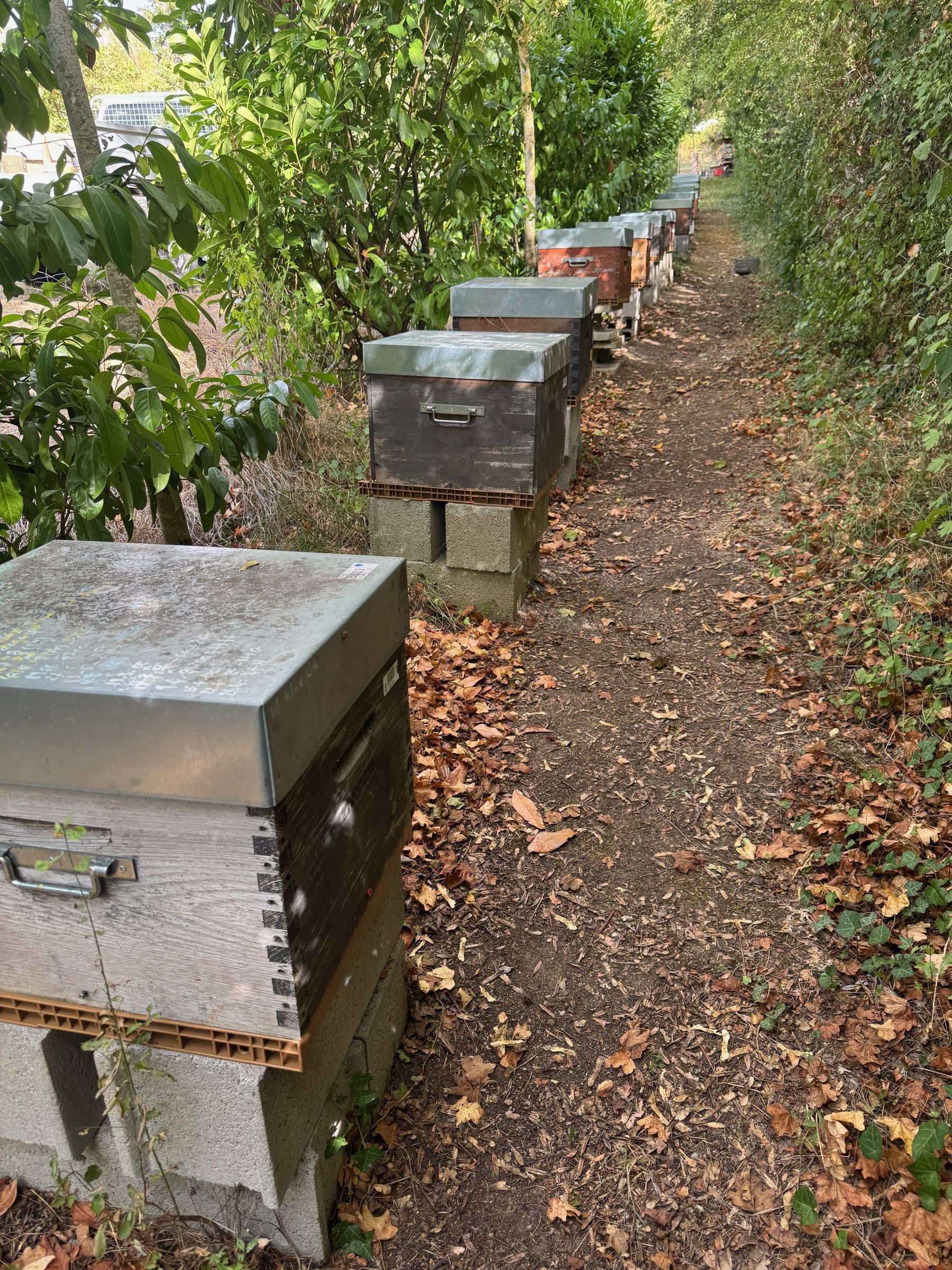
Site matters too. The NBU advises a sunny spot, protected from strong winds and never in a frost pocket. Avoid spots under dripping trees, keep hives off the ground on a stand, out of rising damp and splash, and shelter them from the prevailing wind with a hedge or windbreak.
Signs of a problem
Mould on the outer frames, water on the floor tray, a wet or rotten crown board or many dead bees in the entrance after a mild spell can all point to poor ventilation or a leaking roof. Fix the roof first, then look at the floor and entrance.
Should you insulate a hive in winter?
What the research says
Hive walls are thin. The University of Leeds reports that Derek Mitchell’s earlier research suggested most manufactured hives, with 19 mm wooden walls, have about seven times more heat loss than a natural nest in a tree hollow with 150 mm walls, and describes such hives as inadequately insulated. Less heat lost means less honey burned, and warmer inner surfaces also mean less condensation where it can drip onto the bees.
Insulate the top first
Heat rises, so the cheapest and most useful step is a sheet of rigid insulation board laid on the crown board under the roof, with the feed hole covered or used for fondant. Many beekeepers leave it in place all year. A polystyrene hive or a polystyrene roof gives a similar effect, though polystyrene is more easily damaged by hive tools, woodpeckers and rodents, and some brands differ slightly in internal dimensions.
What to avoid
- Do not seal the hive. Insulation reduces heat loss; it should not stop air reaching the entrance and floor.
- Do not wrap hives in materials that trap rain against the wood.
- Do not try to keep a colony warm with heaters or by moving it indoors: bees cluster tighter and use less food when left alone in a well-made hive.
What should you do in the apiary from November to February?
Winter beekeeping is mostly about leaving the colony alone. Each time the crown board comes off on a cold day the cluster loses heat it must replace from its stores.
Checks that need no opening
- Heft every other week. The NBU suggests hefting through the winter; a hive that feels much lighter than at the last check, or than its neighbours, needs fondant.
- Watch the entrance. On a mild day, bees making cleansing flights and, from February, bringing in pale yellow or orange pollen are good signs. No flight on a day when other colonies are flying is a warning.
- Clear the entrance of dead bees after cold spells. A few dead bees each day is normal: old summer bees are dying off.
- Read the floor tray. Debris in strips shows where the cluster is and how many seams of bees it covers; fresh wax cappings show where it is eating; mites tell you whether a winter treatment is justified.
- Check after storms and snow. Look at roofs, straps and stands, and clear snow from the entrance. A hive blown over in January rarely survives.
If you must open the hive
The NBU’s advice is to choose a warm, sunny day and keep any look to about 20 seconds; a glass quilt or clear polycarbonate crown board lets you see the cluster without taking it off. Lift the roof, look through the feed hole or under one corner of the crown board, add fondant if needed, and close up. Do not take frames out until the first spring inspection.
Dead colonies
If a colony has died, close the entrance at once so other bees cannot rob out the remaining honey, which could spread disease. Look for the cause: a cluster of dead bees head-first in the cells with honey a few frames away suggests isolation starvation; a small cluster with deformed bees and mite droppings in the cells points to varroa; no queen and no brood pattern suggests queen failure. If you suspect foulbrood or any notifiable disease, do not reuse the equipment, and contact your bee inspector through BeeBase.
What paperwork goes with the winter?
Hive Count on BeeBase
Each year the NBU and the Scottish Honey Bee Health Team ask beekeepers registered on BeeBase to record the number of colonies they hold on 1 November. The Hive Count runs from 1 November to 31 December, through a link on BeeBase that is only live during the count, and beekeepers who had no colonies on 1 November are still asked to update their record to confirm it. The NBU gives 257,976 hives for the 2025 count. Registration on BeeBase is voluntary, but it brings disease alerts for your area and visits from the bee inspectors. In Northern Ireland, beekeepers register on DAERA’s DataBees system instead. Our page on how to register your bees explains the details nation by nation.
Varroa reporting and medicine records
Since April 2021, beekeepers in England, Wales and Scotland have a legal duty to report varroa, which most do by marking their apiary as varroa-positive on BeeBase. Any winter oxalic acid treatment must go in your veterinary medicine record, with the product, batch, date, dose and colonies treated.
Use the quiet months
Winter is the time to clean and scorch spare boxes, render old comb, make up frames, update each colony’s record card and order nuclei for spring, since breeders take most orders in autumn and winter.
Frequently asked questions
When should I start preparing my bees for winter?
In lowland England the work starts in early to mid-August, when the honey comes off and the main varroa treatment goes on, because the long-lived winter bees are reared from late August. Feeding follows in September, mouse guards and woodpecker netting in October. After the heather or in Scotland, each step usually moves two to four weeks later.
How much honey do bees need to get through a UK winter?
The National Bee Unit recommends about 20 kg of stores per colony in autumn, within a range of 18 to 22 kg, and more for large colonies with prolific queens. On a National hive that is a full super of honey plus about three brood frames: a full super holds at least 12 kg, a brood frame about 2.3 kg.
Can I feed sugar syrup to bees in winter?
No. The NBU advises against feeding syrup in cold weather, because the bees cannot process it, and syrup left on the hive can go mouldy. Feed thick syrup in September so it is stored and capped by October. If a hive is light from late October, give fondant over the crown board feed hole.
When should I put mouse guards on my hives?
Fit them in early autumn, before the first cold nights, which in most of the UK means late September or October. Mice look for a dry nest site as temperatures fall and can move into the hive while the bees are clustered. Check the guard after cold spells, because dead bees can pile up behind it and block the entrance.
Should I close the open mesh floor in winter?
Not as a rule. The NBU says open mesh floor inserts can be left out in winter, which lets condensation drain, unless the site is windy. Many beekeepers slide the tray in for a week or two to count varroa drop, then take it out again. Insulation over the crown board matters more than the floor.
Do I need to insulate my hive in winter in the UK?
UK winters are more damp than cold, so the priority is a dry, ventilated hive with a sound roof. Research at the University of Leeds found that thin wooden hive walls lose far more heat than a tree hollow, so insulation board over the crown board is a cheap, low-risk improvement, provided ventilation is kept.
How do I protect my hives from woodpeckers?
Green woodpeckers can drill through the walls of wooden hives in hard weather to reach bees and brood. The NBU suggests chicken wire held at least 300 mm away from the hive walls, so the bird cannot cling to the hive and hammer at it. Some beekeepers wrap hives in plastic sheeting instead, which denies the bird a grip.
Can I open my hive in winter?
Only briefly, and only with a reason. The NBU's advice is to open only on a warm, sunny day and keep any look to about 20 seconds, so the cluster loses little heat. Most winter checks need no opening: heft the hive, watch the entrance, read the varroa tray and check roofs and straps after storms.
Sources
- Preparing your hives for winter (Fact sheet 19), Animal and Plant Health Agency, National Bee Unit
- Feeding bees: sugar (Best Practice Guideline 7a), Animal and Plant Health Agency, National Bee Unit
- Estimating Varroa mite populations (Fact sheet 13), Animal and Plant Health Agency, National Bee Unit
- Managing Varroa (advisory booklet), Animal and Plant Health Agency, National Bee Unit
- Bee medicines (fact sheet, June 2025), Animal and Plant Health Agency, National Bee Unit
- API-Bioxal 0.71 g/g bee-hive powder: summary of product characteristics, Veterinary Medicines Directorate
- Record keeping requirements for veterinary medicines, Veterinary Medicines Directorate, GOV.UK
- Hive Count, Animal and Plant Health Agency, National Bee Unit
- Report Varroa, Animal and Plant Health Agency, National Bee Unit
- Beekeepers: voluntary registration (DataBees), Department of Agriculture, Environment and Rural Affairs (DAERA), Northern Ireland
- Research challenges beliefs on honeybee insulation, University of Leeds
- Honeybee cluster: not insulation but stressful heat sink (Mitchell, Journal of the Royal Society Interface, 2023), University of Leeds, White Rose Research Online
- Overwintering honey bees: biology and management (Döke, Frazier and Grozinger, Current Opinion in Insect Science 10, 2015), PubMed
- Ivy: an underappreciated key resource to flower-visiting insects in autumn (Garbuzov and Ratnieks, Insect Conservation and Diversity 7, 2014), University of Sussex
- Sublimation treatment with oxalic acid (LASI pamphlet, 2016), Laboratory of Apiculture and Social Insects, University of Sussex